Cross-Chain RWA Architecture (Explained)
Get to know how cross-chain RWA architecture works, enabling secure asset bridging, improved liquidity and seamless on-chain interoperability.

As decentralized finance continues to mature, real-world assets (RWAs) have become the connective layer between traditional finance and blockchain’s programmable, global infrastructure. RWAs are no longer a niche experiment, they’re rapidly becoming a foundational building block for on-chain capital markets. Tokenized U.S. Treasuries now offer institutional-grade yields on-chain, and fractionalized real estate is making global liquidity possible in ways that weren’t feasible before. Industry estimates, including those from BCG and ADDX, suggest that the total value of tokenized assets could climb to nearly $16 trillion by 2030.
But as promising as this growth is, the multi-chain world introduces its own set of challenges, liquidity becomes siloed across ecosystems, compliance processes are duplicated chain by chain, and settlement flows are fragmented. Building RWAs that work seamlessly across chains requires a thoughtful approach to architecture.
Designing for cross-chain interoperability is complex but so is knowing whether your architecture is actually secure once it's built. The RWA Security Score is a free tool that evaluates your protocol across 8 critical risk categories, the exact layers that cross-chain architectures stress the most. Get a weighted security rating across 30+ factors before you ship.
We’ll break down what a robust cross-chain RWA stack looks like, covering the legal pillars, technical primitives, security assumptions, and the architectural patterns needed to design production-ready systems. We’ll walk through why cross-chain functionality is becoming essential, highlight the standards shaping the space, and share reference designs you can adapt to your own applications.
Why RWAs Are Becoming DeFi’s Core Primitive?
RWAs bring traditional financial instruments, such as bonds and real estate, as well as invoices, on-chain, giving them programmability and global liquidity. Their rise is driven by institutional demand for better yields and operational efficiency.
By mid-2025, BlackRock’s BUIDL fund had tokenized nearly $3B in U.S. Treasuries with 5–6% yields. Ondo Finance, Franklin Templeton, and others manage billions in tokenized assets, offering automated payouts and seamless on-chain collateralization.
Institutions are rapidly joining, J.P. Morgan’s Onyx settles tokenized bonds on-chain. Governments are running MiCA-compliant digital security pilots, and private credit yields (8–12% APY) continue to outperform traditional finance (TradFi). This is attracting hundreds of billions in yield-seeking capital.
RWAs also make high-value assets accessible through fractionalization, turning multi-million-dollar properties into $50 shares and unlocking parts of a $16T+ tokenized market by 2030.
But fragmentation remains the biggest barrier. RWAs issued on Ethereum can’t natively interact with Solana, Base, or Cosmos. Moving assets across chains often requires off-ramping, re-tokenization, and re-KYC, leading to 2–5% fees and multi-day delays.
To scale RWAs across ecosystems, cross-chain architecture must deliver:
- Universal Liquidity: RWAs usable across chains without wrappers.
- Portable Compliance: KYC/AML rules enforced wherever the asset moves.
- Secure Settlement: Atomic, bridge-safe transfers with strong finality.
- Reusable Identity: One DID/VC for all chains, avoiding repeated onboarding.RWAs are poised to transform on-chain finance, but only if they become interoperable by design.
RWAs are poised to transform on-chain finance, but only if they become interoperable by design.

If fragmentation is the core problem, a newer class of RWA-native chains is trying to solve it at the protocol layer instead of bolting compliance onto a generic L1. Our handbook's Chains Built for RWAs chapter breaks down Plume, Canton Network, Provenance, MANTRA, Intain, and Hedera, their consensus models, validator architecture, and where each one's security assumptions actually break down, useful context before deciding whether cross-chain bridging or an RWA-native chain fits your protocol better.
Legal, Data and On-Chain Models
RWAs rely on hybrid legal structures that connect on-chain tokens to enforceable off-chain rights. Most issuers use Special Purpose Vehicles (SPVs), for example, a Delaware SPV holding a property and issuing tokens as beneficial interests under UCC Article 8. Irrevocable trusts add bankruptcy protection, while custodians like BNY Mellon safeguard assets and attest ownership via secure APIs.
Token holders don’t own the asset directly, they own contractual rights tied to the SPV’s cap table. Custodians ensure insured segregation (often up to $250M), while registrars maintain authoritative off-chain records that sync with on-chain state through oracle feeds. This hybrid model delivers immediate MiCA/SEC-aligned compliance.
Data integrity is critical. Chainlink oracles supply NAV, collateral ratios, and corporate actions with medianized aggregation to reduce manipulation. Proof-of-Reserves is validated using Merkle proofs or zk-SNARK-backed trees, enabling on-chain verification of custodian balances.
Off-chain attestations, auditor reports, financial statements, custody receipts, flow into smart contracts via Chainlink Functions, generating events like AssetAttested(...) and creating immutable audit trails pinned to IPFS.
On-chain representations vary by asset type:
- Fully-backed tokens (ERC-20): 1:1 redeemable models like USDC-RWA.
- Synthetic RWAs: Oracle-driven exposure (e.g., synthetic real estate) for hedging and derivatives.
- Yield-bearing vaults (ERC-4626): Deposit USDC, mint shares that auto-accrue yield from T-Bills.
- NFT-based models: ERC-721/1155 for unique or indivisible assets, with fractional splits tied to legal documents via metadata.
Together, these models ensure RWAs aren’t simply digitized, they become programmable, verifiable, and composable primitives for global markets.

Token Standards for RWAs (Ethereum-Centric, Cross-Chain Ready)
ERC-3643 (T-REX) is the leading permissioned RWA standard, embedding KYC/AML through ONCHAINID so only verified wallets can hold or transfer tokens.
The ERC-1400 suite adds partitions, documentation links, and regulatory actions (e.g., clawbacks), making it ideal for security tokens. Generic ERC-20s lack these controls and are mostly used for simple wrappers.
ERC-7518 (DyCIST) is the emerging multi-asset standard. Built on ERC-1155, it supports dynamic compliance rules, jurisdiction locks, and cross-chain metadata portability, while reducing deployment costs significantly.
For yield-bearing assets, ERC-4626 provides a unified vault interface, and ERC-7540 extends it for asynchronous flows suited to private credit or T+3 settlements.
Quick view:
| Standard | Purpose |
|---|---|
| ERC-20 | Basic fungible RWA or wrappers |
| ERC-1400 | Regulated security tokens |
| ERC-3643 | Permissioned, identity-gated tokens |
| ERC-4626 | Yield-bearing vaults |
| ERC-7540 | Async vault mechanics |
| ERC-7518 | Multi-asset, compliance-heavy RWAs |
These standards form the core toolkit for building compliant, scalable, cross-chain RWA systems.
Matching a standard to your specific asset class and target chain is exactly what Tokenization 101 is built for, an interactive tool that recommends a standard based on live adoption data rather than the general guidance above.

Identity, Compliance and Access Control Layer
RWA systems rely on Decentralized Identifiers (DIDs) as the base identity layer, following W3C standards to produce verifiable, tamper-resistant identity documents.
Verifiable Credentials (VCs) sit on top, signed claims such as KYC/AML checks, accreditation status, or jurisdiction tags. These credentials are portable, selectively revealable, and revocable. Providers like Sumsub issue VCs tied to a user’s DID.
Secure Your Cross-Chain RWA Infrastructure with QuillAudits
Secure Your Cross-Chain RWA Infrastructure with QuillAudits
Building RWAs across chains demands airtight security. Ensure your asset tokenization, identity flows, and cross-chain messaging are protected from exploits.
Standards integrate these checks directly:
- ERC-3643 uses an
IdentityRegistryto verify VC-based permissions before anytransfer().
- ERC-1400 applies partition rules (e.g., “US-qualified only”) to enforce jurisdiction-specific access at the token level.
For cross-chain flows, xRWA enables identity reuse. A VC is anchored in the source chain, then proven on the destination chain using a Merkle/SPV proof, no repeated KYC, dramatically lower cost, and smoother onboarding. This layer ensures RWAs stay compliant, portable, and enforceable across all chains.

Interoperability Primitives and Cross-Chain Messaging
Messaging Models Cross-chain communication starts with simple relayer-based messaging (sendMessage(payload, dstChain)) and scales up to light-client systems like IBC that verify headers on-chain using SPV proofs. Shared-security hubs further reduce trust assumptions by distributing validator sets across multiple chains.
Ecosystem Implementations 2025’s leading frameworks each offer distinct trade-offs: Chainlink CCIP provides oracle-secured messaging with RMN redundancy, LayerZero uses modular DVNs with configurable trust, IBC offers pure light-client security, Axelar runs a quorum-based DPoS network, deBridge and Across use intent-based and optimistic models optimized for speed and low TVL risk.
Omnichain Asset Models. Newer standards like LayerZero’s OFT and Wormhole’s NTT enable native mint–burn with global supply tracking, avoiding the fragmentation of wrapped tokens. Traditional wrapped bridges still exist but carry desync and custody risks, making them less suitable for high-value RWAs.

Cross-Chain RWA Architecture (Reference Stack)
Foundational Layers A cross-chain RWA system starts with the Asset & Legal Layer, where SPVs, custodians, and PoR oracles anchor the real-world asset. Above this sits the Identity & Compliance Layer, DIDs and VCs enforcing ERC-3643 rules to control who can hold or transfer the asset.
Tokenization & Interoperability RWAs are represented as ERC-3643 tokens and often wrapped in ERC-4626 vaults to automate yield and redemption flows. The Interoperability Layer, via CCIP, OFT, or similar, handles messaging and state updates across chains, keeping mirrors in sync without manual reconciliation.
Application Logic & Deployment Models. At the top, application modules such as lending markets, AMMs, and portfolio DAOs compose these primitives. Oracles update NAV through events like pushNAV(asset, value), which propagate cross-chain through CCIP. Deployments vary: some anchor on a single chain with OFT-based mirrors, while others use native omnichain models like NTT for unified supply across all networks.

xRWA and Recent Academic Frameworks
Identity Reuse & Verification: xRWA models pair DIDs and VCs with SPV-style proofs to enable frictionless authentication across chains. A single verification can be reused everywhere through Merkle-path proofs, removing redundant KYC/compliance checks and improving throughput.
Channel-Based State Updates: Advanced cross-chain channels use lightweight primitives: open a channel, exchange signedState updates off-chain, and finalize with atomic Lock(h(ρ), T) operations. This avoids HTLC-style overhead and enables fast, low-cost settlement. Batched netting and off-chain RFQs further reduce gas and latency.
Academic Foundations: Recent arXiv research formalizes these channels as persistent state streams, designed specifically to handle real-world delays and RWA lifecycle events. These findings confirm that xRWA patterns offer scalable, low-friction execution suitable for production-grade systems.

Cross-Chain Settlement and Liquidity Models
Liquidity Coordination: Fragmented liquidity creates slippage and wide spreads, especially for institutions. New models like UAT20 use CRDTs to unify balances across chains, while CRATE enables atomic cross-rollup execution to reduce exposure and settlement risk.
Settlement Architectures: Systems vary by trust and asset type, lock-and-mint relies on HTLC-style refundable locks, burn-and-mint uses oracle-confirmed supply sync for fungibles, and state-sync approaches mirror balances via light-client proofs such as IBC. Trading flows layer on top, cross-chain AMMs adapt Uniswap V3 with intent routing, while RFQ models dominate RWAs for privacy and precise execution.
Finality & Safety Guarantees: Chains differ widely in settlement times, Ethereum at ~12s, rollups at ~1s, which bridges absorb through finality windows and economic penalties to guard against reorgs. Together, these models transform fragmented chains into a coordinated, borderless liquidity environment.

Oracles, Proof-of-Reserves and Attestation Networks
RWA Data Feeds: Oracles must deliver precise, timely data. Chainlink’s latestRoundData() provides timestamped NAV values, while medianized aggregation filters outliers for stability. Corporate actions are automated through Functions that parse documents or event data on demand.
Proof-of-Reserves: PoR systems rely on Merkle proofs to verify custodian balances without revealing full account details. Inclusion checks like proveInclusion(leaf, path) confirm holdings, and automated assertions ensure reserves exceed liabilities, crucial for regulated RWAs.
Regulatory Attestations: Auditors issue signed Verifiable Credentials, allowing smart contracts to enforce checks via verifyAttestation. This creates an immutable trail of compliance and custody, forming a robust, regulation-aligned data backbone for RWAs.

Compliance-Aware Cross-Chain Flows
End-to-End Compliance Hooks: Cross-chain RWA transfers embed compliance at every step. ERC-3643 ties into CCIP through preTransferCheck and postTransferCheck, while systems like LayerZero and Axelar append jurisdiction payloads to each message to ensure destination-chain rules are validated before tokens settle.
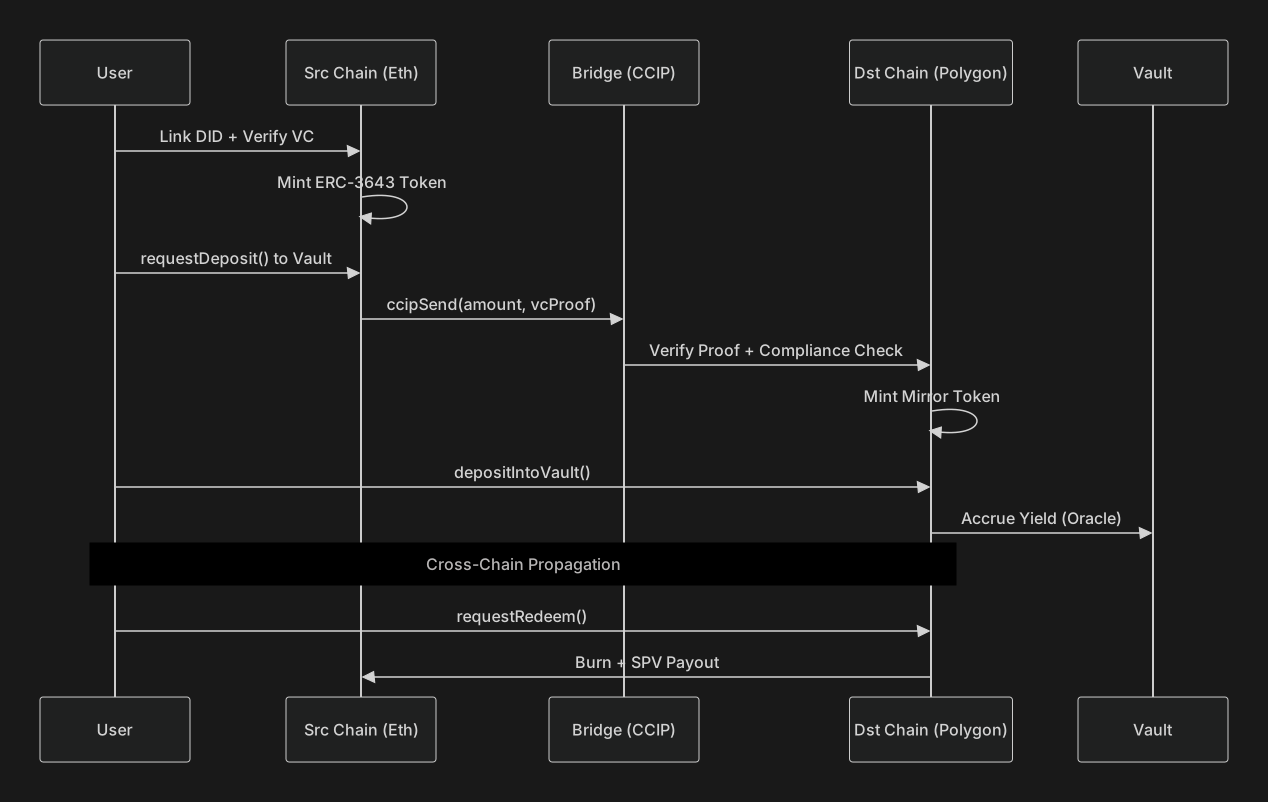
Lifecycle, Onboarding → Tokenization → Transfer → Redemption: A regulated RWA flow begins with KYC: the user links a DID, receives a VC (e.g., IssueKYCVC), and passes isVerified. Subscription follows through ERC-7540 requestDeposit, minting shares based on oracle-updated NAV. Cross-chain movement uses ccipSend(amount, vcProof) with destination-side checks and a burn-and-mint model. Vault interactions then allow deposits and yield harvesting, with redemptions handled asynchronously (T+3) through requestRedeem and fulfillRedeem.
State Enforcement: A simple on-chain state machine, Unverified → Verified → Subscribed → Transferred → Redeemed prevents invalid transitions through modifier checks. This ensures every cross-chain move remains compliant, auditable, and aligned with regulator expectations.
Conclusion
RWAs are quickly becoming the foundation of on-chain finance, but their real impact depends on making them interoperable, compliant, and seamless across chains. By combining strong legal structures, identity standards, oracle-backed proofs, and modern cross-chain messaging, we can turn fragmented liquidity into unified, global markets.
The roadmap is clear, RWAs will scale only when they move as easily as any native crypto asset. Building with a cross-chain, compliance-aware architecture supported by a thorough RWA security audit that ensures every component is built to withstand real-world risk. To know more about RWA in depth, explore QuillAudits comprehensive handbook on RWA that dives into fundamentals, development frameworks, and practical implementation strategies.

Contents