2026 RWA Tokenization Security: Everything Leaders Bringing Real Assets On-Chain Need to Know
Tokenized Treasuries, deposits and repo are going live in 2026. Here's what CXOs should know about security audits before launch, in plain terms.

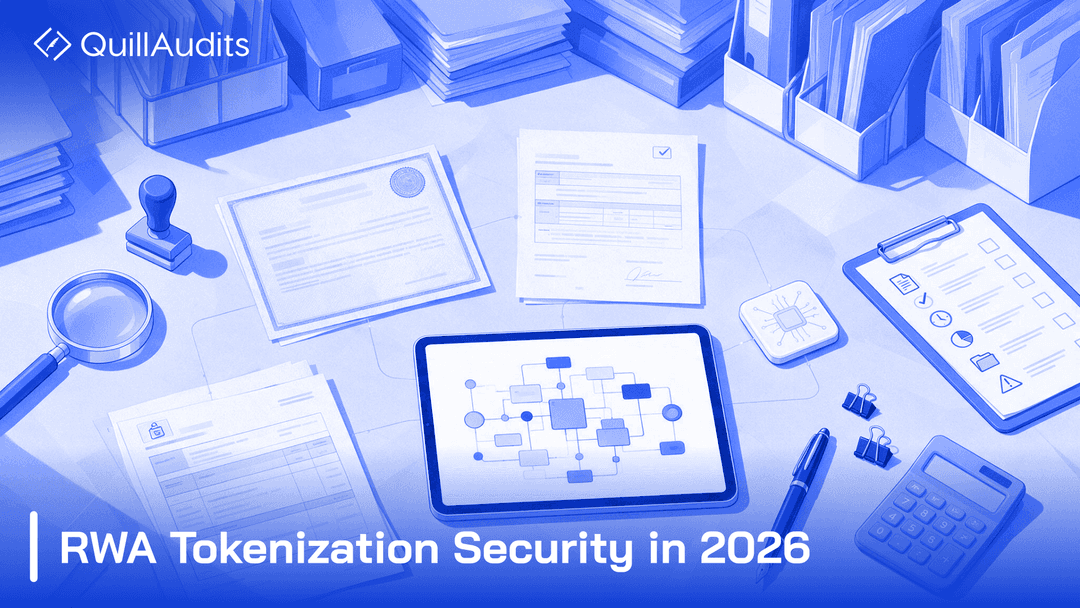
Tokenization is not a research project anymore. DTCC is putting US Treasuries on the blockchain under an SEC no-action letter, JPMorgan is bringing its deposit token, JPM Coin, to the Canton Network, and HSBC successfully concluded a pilot program in April for tokenized deposits. More than half of the world's leading investment banks are now engaged in active tokenization initiatives.
As a leader in the sector, the focus is no longer on whether to tokenize.
The core question now is whether your infrastructure is secure enough to handle real funds. As Treasuries and bank deposits move on-chain, any single flaw transforms from a minor technical issue into a regulatory problem, a client trust problem, and possibly a headline bearing your name.
RWA Tokenization Security Is a Board-Level Concern
The statistics make the case better than any sales pitch could. In the first half of 2025 alone, Web3 suffered losses of roughly $3.1 billion to hacks, and the average incident costs around $1.9 million. A DeFi startup might weather that. A regulated institution handling client funds cannot.
Tokenized assets also carry a risk many teams underestimate: the digital token on the blockchain is a claim on an actual asset held by a custodian. Two records, one asset.
If those two records diverge even briefly, the entire settlement promise collapses. A thorough security audit exists precisely to prevent this scenario. It's why the institutions winning 2026 mandates treat an independent audit as part of launch itself, not an optional add-on after it.
The Five Key Questions for Any Smart Contract Audit Firm
So, what should a smart contract audit firm be examining?
Five crucial things, in simple terms. First, that tokens cannot be issued without a real asset behind them. Ever.
Second, that assets and cash swap simultaneously, so no party is left holding air mid-settlement.
Third, that your privacy walls and access controls actually hold. Institutional networks like Canton are built on need-to-know access, and checking that is a different job from reviewing a public ledger where everything is visible anyway. Fourth, that the auditors genuinely know the languages your system runs on. Much of this infrastructure is built on Daml and Rust, not the Solidity most audit firms are familiar with. Reading unfamiliar code is one thing; securing it is another.
Finally, that your admin keys, upgrade procedures, and emergency controls would withstand a regulator's questions, because a careless upgrade process is itself an entry point for attackers.
Put these five to every firm you shortlist and watch how specifically they answer. Vague answers are your signal to move on.
Before you shortlist audit firms, two free tools can sharpen the questions you're asking. Tokenization 101 confirms whether your asset class and chain combination matches what institutions are actually deploying, and the RWA Security Score gives your team an objective baseline across the same risk categories an auditor will scrutinize, before you're paying for the answer.
Cost and Planning for Tokenized Asset Audits
Plan early and budget honestly. A serious audit for this kind of infrastructure typically costs between $50,000 and $150,000, takes 3 to 6 weeks to complete (plus time to fix and re-test findings), and should be repeated each time you upgrade contracts or introduce a new asset class. That figure may look substantial until you put it next to the $1.9 million average loss per exploit and the reputational damage no insurer covers.
The leading institutions build the audit into their project plan from day one and choose firms with demonstrable experience in tokenized assets and non-EVM systems. That named, independent report is increasingly what counterparties, exchanges, and regulators ask to see before they'll transact with you.
Audit-Ready Is Market-Ready
In tokenized finance, being audit-ready and being market-ready have become the same thing. Our team audits tokenization infrastructure across the full range, from Ethereum-style chains to institutional networks, including Daml smart contracts on Canton, an area where very few firms possess credible, proven expertise. If you are building with tokenized Treasuries, deposits, or repo agreements, book a complimentary scoping call.
We will map your risk surface and give you a detailed audit plan and quote, no obligation. Take both to any competitor for comparison if you like.
The conversation itself takes 30 minutes. The cost of skipping it could be considerably higher.

Contents