VARA's Compliance and Security Requirements for Tokenization
A breakdown of VARA's four rulebooks, security, compliance, capital, and token issuance rules, plus the checklist projects need before going live in Dubai.

Most teams building a digital asset project in Dubai spend months developing the product and weeks preparing their license application. Then they launch.
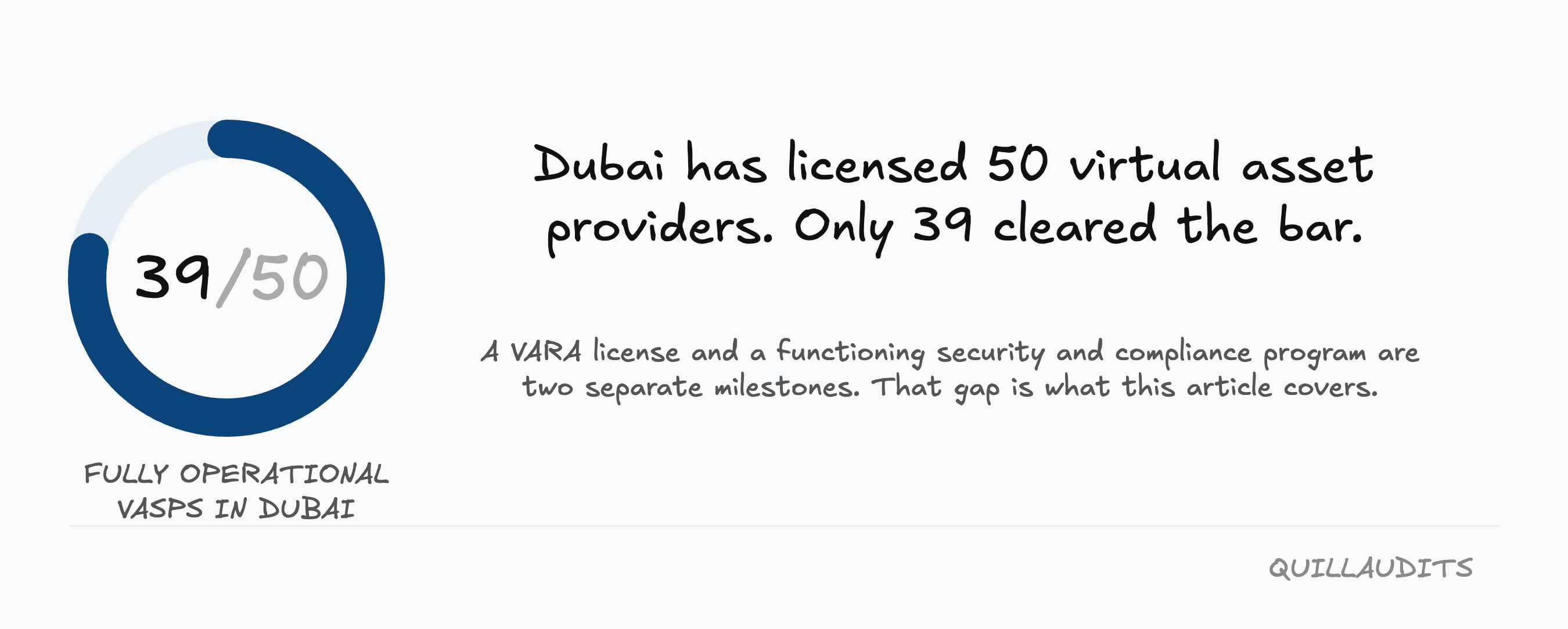
A few months later, VARA conducts a routine review. The project has no designated security officer, no documented incident response plan, and no independent smart contract audit. The team now has to explain why these controls were missing before launch, while dealing with the consequences of getting them wrong.
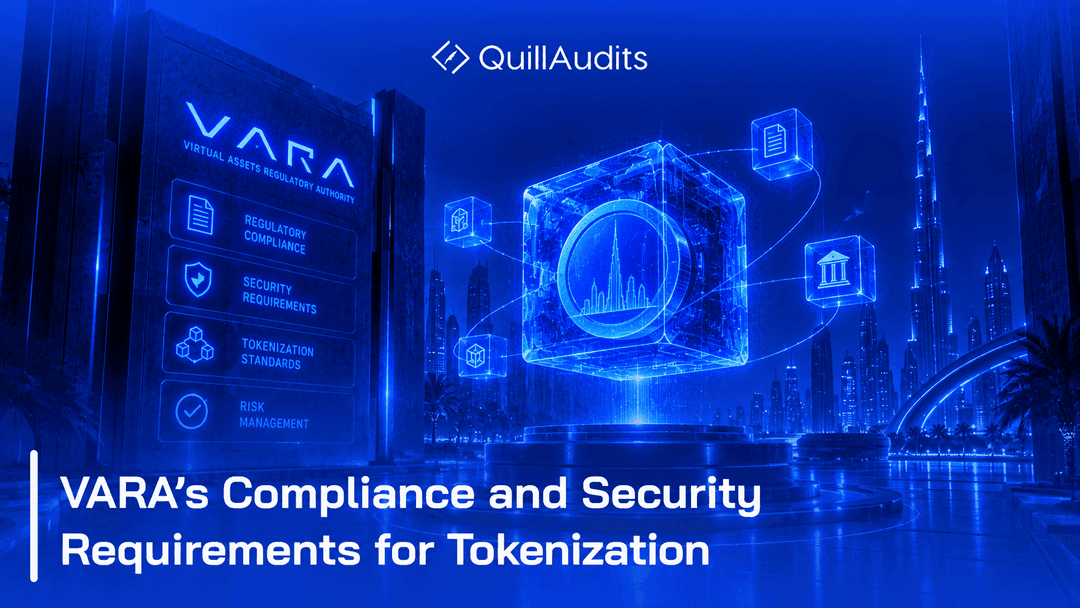
This is what happens when VARA compliance is treated as a licensing exercise rather than an ongoing operational responsibility. The Virtual Assets Regulatory Authority (VARA) regulates virtual assets across Dubai's mainland and free zones, excluding the DIFC. Its rulebooks cover the controls a Virtual Asset Service Provider (VASP) must have in place, and those controls need to work in practice not just exist in a policy document.
This article breaks down what needs to be documented, what needs to be operational, and what a project should have in place before going live under VARA.
Compliance and security aren't separate conversations
Many teams treat licensing and security audits as separate workstreams, handled by different people with little overlap. Under VARA, that approach creates gaps.
The Technology and Information Rulebook sets requirements for technical security, while the Compliance and Risk Management Rulebook covers financial and operational controls. Both form part of the broader licensing framework. A project that satisfies its licensing requirements on paper but fails to maintain the necessary controls can still face regulatory action.
Every VASP must comply with four compulsory rulebooks, along with any activity-specific rulebook that applies to its business. These activities include exchange services, custody, broker-dealing, lending, asset management, and token issuance.
| Rulebook | What it covers |
|---|---|
| Company Rulebook | Entity structure, governance, capital, and wind-down planning |
| Compliance and Risk Management Rulebook | AML/CFT, sanctions, client money, and asset protection |
| Technology and Information Rulebook | Security controls, data protection, and smart contract audits |
| Market Conduct Rulebook | Marketing, client agreements, and disclosures |
Security lives in the Technology and Information Rulebook
This is the rulebook most closely connected to a project's engineering and security operations. It covers technology governance, security controls, personal data protection, and confidential information. For a project preparing to launch, several areas deserve particular attention.
A named CISO. A VASP needs a designated Chief Information Security Officer an actual person who can be identified and held accountable for information security. The role can be filled internally or outsourced. However, the Company Rulebook allows VARA to require the CISO to be a full-time employee at its discretion, including after the license has been granted.
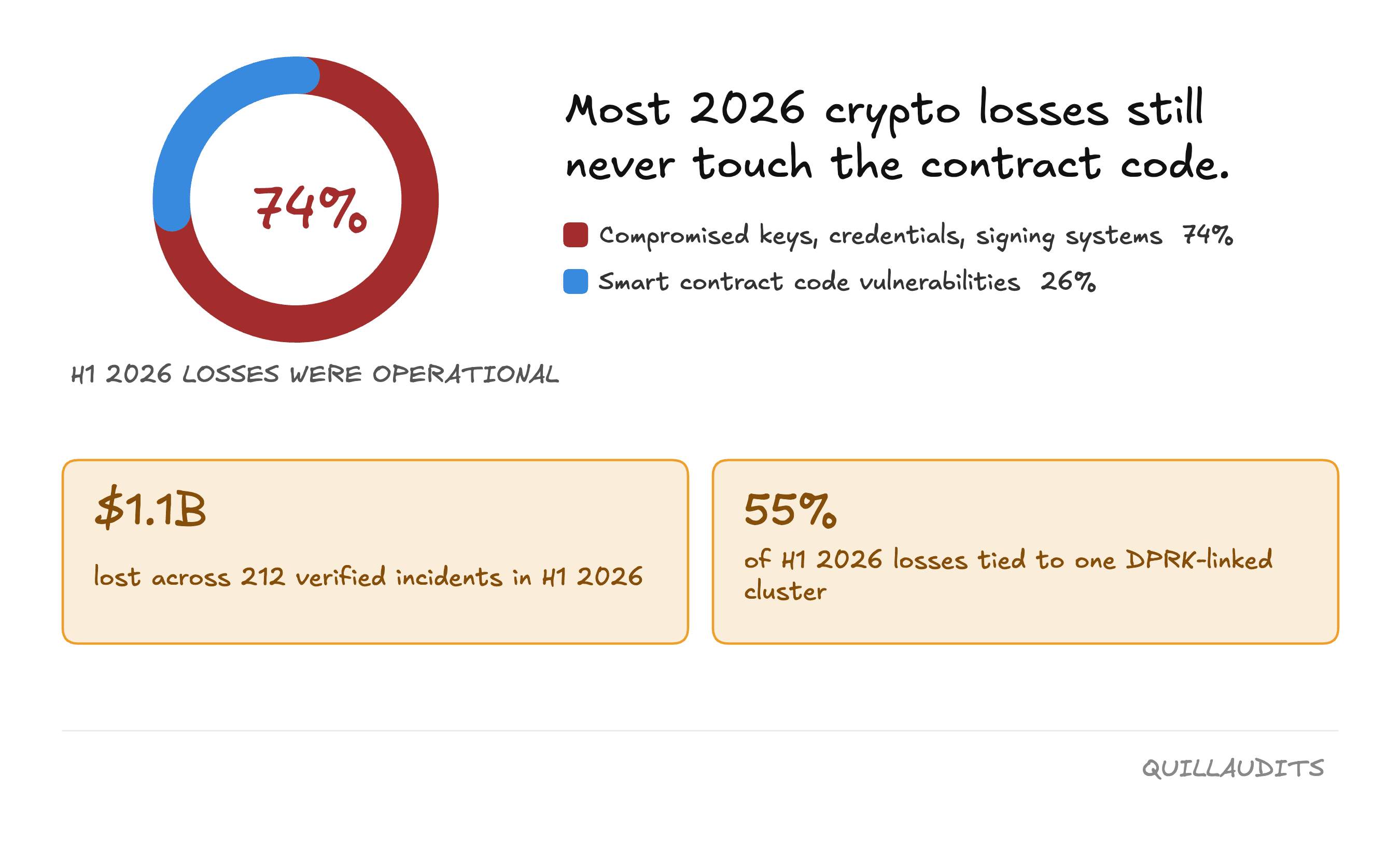
Documented key management. A VASP needs a cybersecurity policy that covers how it manages cryptographic keys and virtual asset wallets. This is where a strong smart contract audit can still leave a major gap: the contracts may be secure, but the keys controlling the funds may not be.
If multisig keys are being tracked in a spreadsheet or handled without proper access controls, an audit report will not solve the underlying problem. Key generation, storage, access, signing authority, and recovery procedures need to be documented and aligned with how the system actually operates.
Continuous testing, not a one-time audit. A smart contract audit before mainnet is an important starting point, but it should not be the end of the security process. VARA's requirements include ongoing testing and audit activities. As the codebase changes and new threats emerge, the project needs a process for reassessing its security posture.
A single audit report filed during licensing is not a substitute for that process.
A tested response plan. Incident response and business continuity plans also need to be part of the operating model. Writing a plan is one step; testing it is another. A tabletop exercise can reveal unclear responsibilities, missing escalation paths, and gaps in communication before a real incident puts those weaknesses under pressure.
Money controls sit in the Compliance and Risk Management Rulebook
This rulebook covers much of the financial crime, client asset protection, and operational risk framework. It is also an area where technically capable teams can underestimate the amount of work required.
AML, CFT, and Travel Rule compliance. Every VASP needs an appointed Money Laundering Reporting Officer (MLRO), defined responsibilities, and documented anti-money laundering and counter-terrorist financing policies and procedures. Client due diligence must work in practice, not simply exist as a written process.
The framework also includes FATF Travel Rule obligations, which require the transmission of relevant originator and beneficiary information alongside virtual asset transfers. Sanctions screening and record-keeping requirements form part of the same compliance process.
Segregated client money and assets. Client money and client virtual assets are subject to separate requirements. Client money must be handled through appropriate third-party banking arrangements and supported by disclosure, reporting, auditing, and reconciliation processes.
Client virtual assets have their own treatment requirements, including proof-of-reserves obligations. A VASP needs to be able to demonstrate what it holds against what it owes, rather than relying solely on an internal ledger or a public statement.
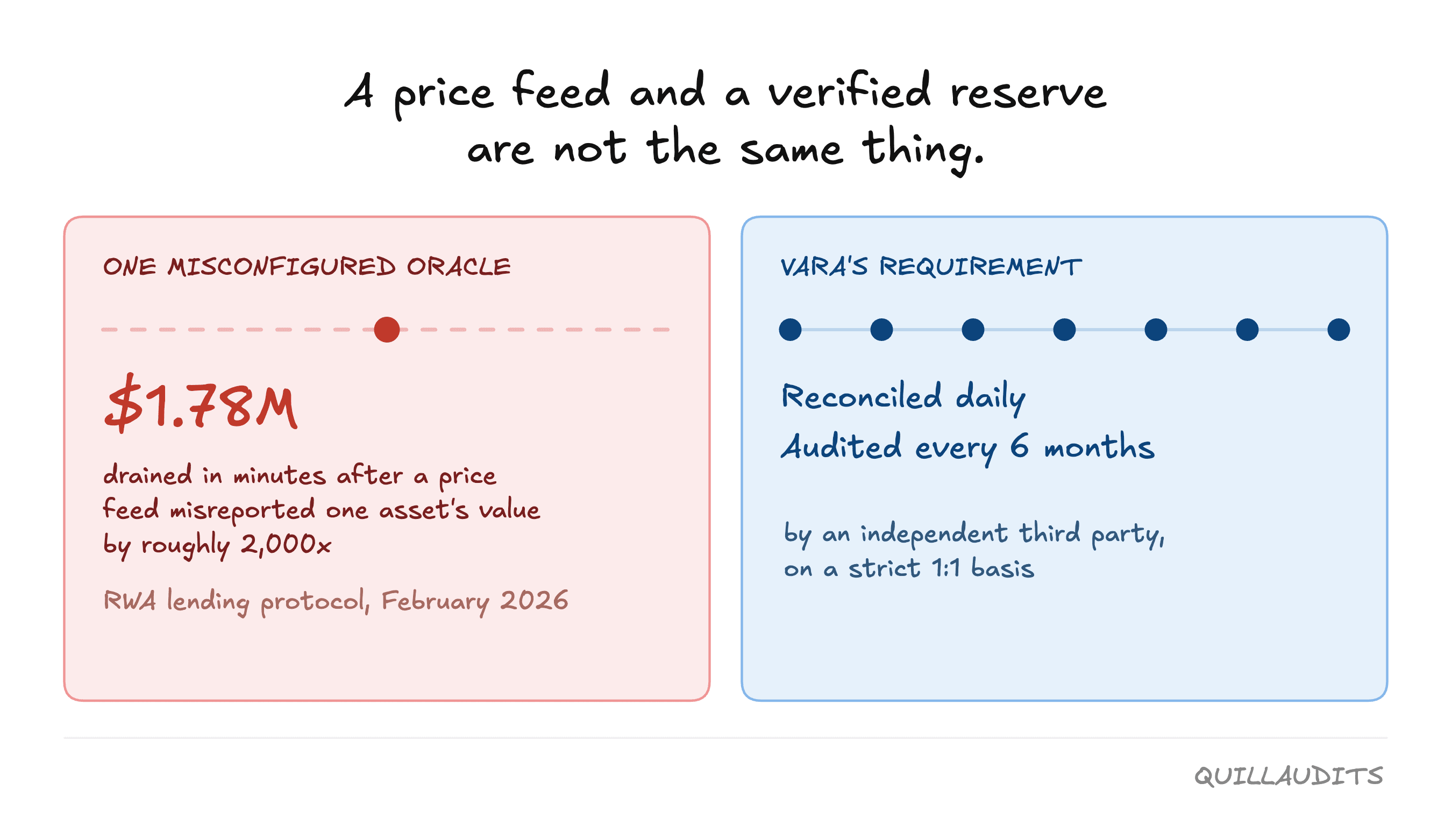
Proof of reserves. The Company Rulebook's capital and financial requirements connect directly to this area. Under the requirements described here, VASPs must maintain reserve assets equal to 100% of their client liabilities, on a strict 1:1 basis in the same virtual asset owed.
These reserves must be reconciled daily and audited by an independent third-party auditor at least every six months. If the internal ledger does not match the underlying on-chain position, the VASP must treat the discrepancy seriously and comply with its notification obligations to VARA.
Anti-bribery and corruption policies, as well as requirements concerning sponsored VASP relationships where applicable, are also covered by this rulebook.
The Company Rulebook sets the financial and governance floor
Security and compliance controls do not operate in isolation. VARA also expects the VASP itself to have an appropriate legal, financial, and governance structure.
Entity structure and governance. The entity must be registered in the Emirate, with a transparent ownership structure. Its Board and Senior Management are assessed against Fit and Proper criteria, including qualifications, experience, solvency, and integrity.
The framework also requires exactly two Responsible Individuals who are UAE residents or passport holders and full-time employees approved by VARA.
Capital requirements. Capital requirements depend on the licensed activity.
| VA Activity | Capital Requirement |
|---|---|
| Advisory Services | AED 100,000 in paid-up capital |
| Custody Services | The higher of AED 600,000 or 25% of fixed annual overheads |
| Exchange Services | The higher of AED 1,500,000 or 25% of overheads. Where a separately VARA-licensed custodian is used, the alternative thresholds described are AED 800,000 or 15% of overheads. |
In addition to paid-up capital, VASPs must maintain Net Liquid Assets equal to at least 1.2 times their monthly operating expenses. These assets must be reconciled daily and reported monthly.
Insurance requirements also apply, including professional indemnity, directors' and officers' liability, and commercial crime coverage for assets held in hot wallets, where applicable.
Wind-down planning. Every VASP needs a current wind-down plan, even if the business is growing and has no immediate plans to close. The plan should address how client assets will be returned, how clients and other stakeholders will be informed, and how records will be retained.
It should be maintained as the business changes, rather than written during the licensing process and left untouched.
The Market Conduct Rulebook governs how you talk to the market
The fourth compulsory rulebook deals with how a VASP communicates with clients and the wider market. It covers marketing, advertising, promotions, client agreements, complaints handling, investor classification, public disclosures, and market transparency.
These requirements are easy to overlook when most of the team's attention is on the product. But promotional material that misrepresents risk or exaggerates the scope of an audit can create a compliance problem of its own. A technically sound protocol does not excuse inaccurate or misleading marketing.
Issuing a token adds another layer
Projects issuing virtual assets including tokenized real-world assets must also consider the Virtual Asset Issuance Rulebook. This sits alongside the four compulsory rulebooks and any other activity-specific requirements that apply to the project.
VARA has a specific Asset-Referenced Virtual Asset (ARVA) category for tokens that represent or reference real-world assets or income. Under the framework described in this article, issuing an ARVA is classified as a Category 1 VA Issuance and requires prior VARA approval before the token is issued.
That approval comes with additional governance and capital requirements, on top of the obligations already discussed.
The pre-launch checklist
Before a digital asset project goes live on mainnet in Dubai, the following should already be in place:
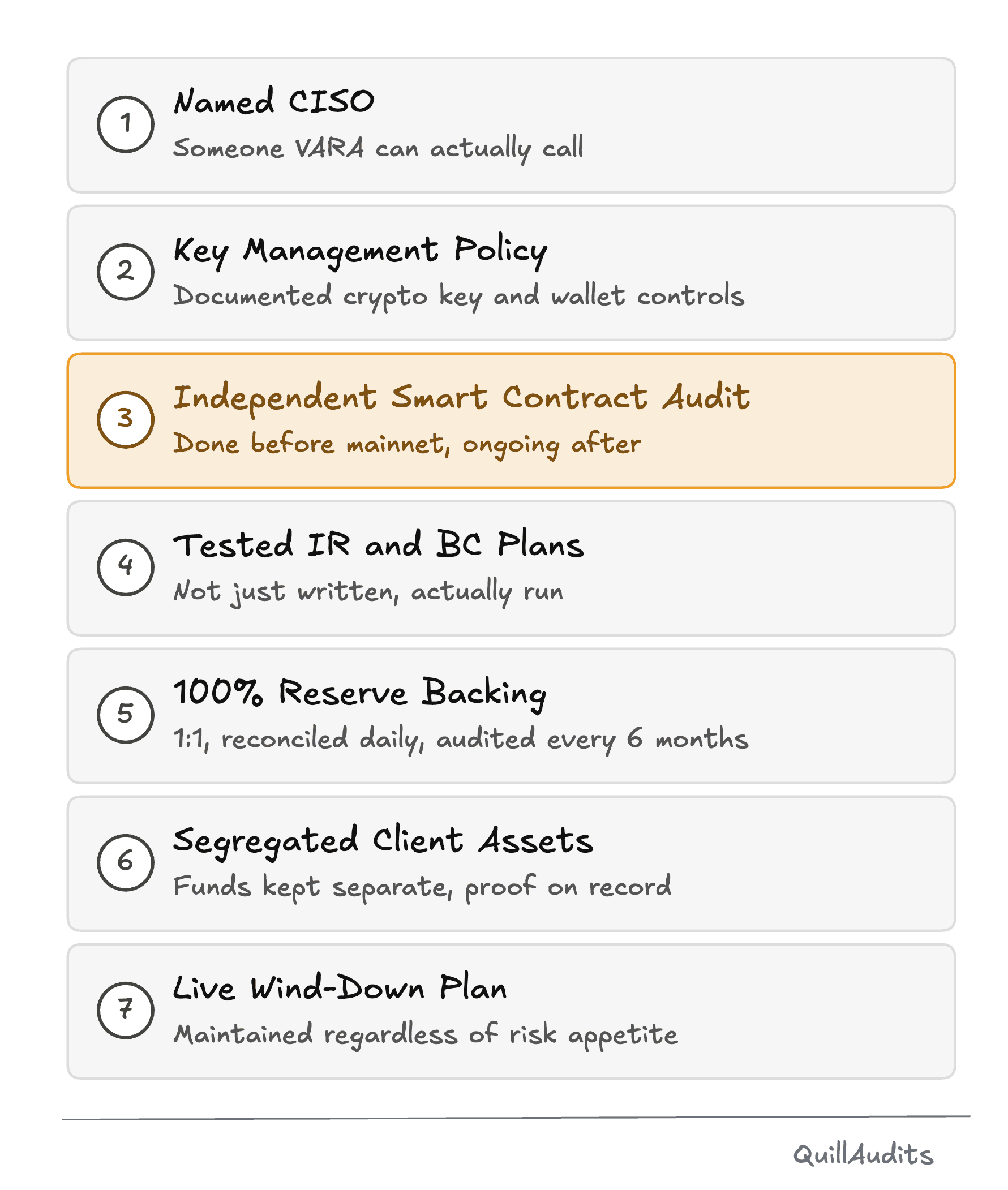
- A named CISO whom VARA can contact directly.
- A documented cybersecurity policy covering key management and wallet controls, aligned with the way the team actually operates.
- An independent smart contract audit, with identified issues addressed before launch and a process for continued testing.
- A tested incident response and business continuity plan, including at least one internal exercise.
- An appointed MLRO, functioning AML and CFT procedures, and Travel Rule compliance integrated into the transaction flow.
- Daily reserve reconciliation, with records ready for independent review and client money and virtual assets properly segregated.
- Paid-up capital, Net Liquid Assets, and the required insurance coverage in place, based on the specific VA Activity being licensed.
- A current wind-down plan that reflects the project's actual operations.
The real risk isn't just getting hacked
A security incident is not the only way a project can run into trouble with VARA. A project may also face serious problems when it cannot demonstrate that its security, financial, and compliance controls are working as required.
That is why compliance cannot end when the license is granted. The controls need to be maintained, tested, and supported by evidence.
VARA compliance is not a one-time licensing exercise. It is an ongoing operating responsibility, and the project needs evidence that its controls work.
An independent audit before go-live is a useful foundation. But it needs to be backed by a security and compliance operating model that can withstand scrutiny after launch.
How QuillAudits can help
Obtaining a VARA license involves legal, financial, governance, and compliance work. From a security perspective, the important question is whether the controls behind that license hold up in practice.
That is where QuillAudits can help.
We audit smart contracts before mainnet and help teams establish a process for ongoing security testing. We also work with projects on the operational controls that support a stronger security and compliance program, including:
- Key management and wallet security processes that reflect how multisig infrastructure is actually operated.
- Incident response and business continuity plans, including testing and exercises.
- Security reviews and remediation tracking.
- Reserve and proof-of-reserves processes designed to produce reliable evidence.
If you're preparing a VARA license application, or you're already licensed and want to assess whether your security and compliance setup is ready for a regulatory review, get in touch. We can help map your project against the relevant requirements and identify areas that need attention.
Conclusion
Getting a VARA license is only the beginning. Keeping it requires the security, financial, and operational controls to work after launch not just appear in a policy document during the application process.
Build the operating model, test it, address the gaps, and maintain the evidence. That's how a project prepares for the responsibilities that come with operating under VARA.
Contents