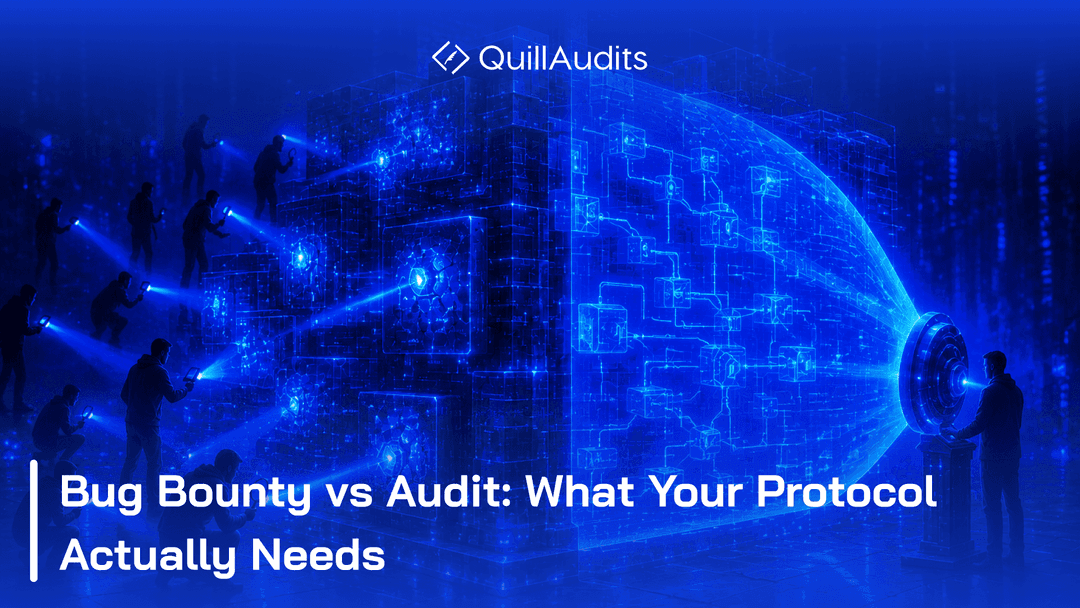
Bug Bounty vs Audit: What Your Protocol Actually Needs
Compare smart contract audits and bug bounties, including costs, coverage, and timing, and learn how both protect your protocol before and after launch.

This isn't really an audit vs. bug bounty debate.
The two solve different problems, and any protocol managing real value will likely need both, used at different stages.
A smart contract audit is a structured security review conducted before launch. A bug bounty is an ongoing program that rewards researchers for finding vulnerabilities after your protocol is live.
Treating one as a replacement for the other often leads to the worst possible outcome. You either spend money without getting the coverage you need, or you discover critical vulnerabilities after real funds are at risk.
Here's how to decide where each one fits.
What an audit does
A smart contract audit is a scheduled, time-bound security review.
A dedicated team of security engineers studies your code, analyzes it with specialized tools, tests different attack scenarios, and delivers a detailed report of their findings.
You pay for the review itself, regardless of whether vulnerabilities are discovered.
Its biggest strength is depth.
Auditors spend days or even weeks understanding your protocol's business logic, which allows them to identify subtle issues that automated tools or quick reviews often miss.
The limitation is that an audit reflects a specific point in time.
It evaluates the code exactly as it exists during the engagement. Once meaningful changes are made afterward, parts of that review are no longer current and may need to be revisited.
What a bug bounty does
A bug bounty works very differently.
Instead of hiring a dedicated audit team, you publish the scope of your program, usually through platforms such as Immunefi, and invite independent security researchers to look for vulnerabilities.
Researchers receive rewards only when they submit valid findings, with payouts increasing based on the severity of the issue. For major protocols, critical vulnerabilities can earn six or even seven-figure rewards.
The biggest advantage of a bug bounty is continuous coverage.
Unlike an audit, it doesn't end after a few weeks. It also gives your protocol access to a much larger pool of researchers, each bringing different areas of expertise.
The trade-off is that participation is voluntary.
No one is required to review your code. If your rewards aren't competitive or your program isn't attractive, experienced researchers may simply spend their time elsewhere.
A bug bounty only creates value when skilled researchers decide your protocol is worth investigating.
The honest comparison
| Audit | Bug bounty | |
|---|---|---|
| When | Before launch or before a major upgrade | Ongoing after launch |
| Who looks | A dedicated, named security team | Any researcher who chooses to participate |
| You pay | A fixed fee upfront | Only for valid vulnerability reports |
| Coverage | A defined codebase within the agreed scope | Live code with an open-ended scope |
| Depth | Deep, focused review | Depends on who participates |
| Guarantee | The review is guaranteed to happen | No guarantee that anyone will review your code |
| Best for | Finding vulnerabilities before deployment | Discovering issues that remain after launch or appear over time |
The order that actually makes sense
Start with an audit. Launch a bug bounty afterward.
That sequence gives you the strongest security coverage.
Launching an unaudited protocol with a public bug bounty is risky. Instead of asking researchers to uncover subtle edge cases, you're asking the internet to find your most obvious vulnerabilities. The first person to discover them may not be someone interested in reporting them responsibly.
A better approach is straightforward.
Complete the audit, address every finding, deploy the reviewed code, and then launch a bug bounty to catch anything that was missed or introduced through future updates.
Think of the audit as your foundation.
The bug bounty adds another layer of protection once your protocol is live.
Both reduce risk, but they do it at different stages of the development lifecycle.
Common mistakes
Some patterns come up repeatedly across new protocols.
- Treating a bug bounty as a cheaper alternative to an audit. These programs serve different purposes. A bug bounty complements an audit. It doesn't replace one.
- Offering rewards that are too small. If the payout isn't competitive, experienced researchers are unlikely to spend time reviewing your protocol.
- Publishing a vague scope. Researchers shouldn't have to guess which contracts or components are in scope. Clear rules encourage better participation.
- Launching a bounty without properly managing it. Slow responses, unfunded rewards, or poor triage discourage researchers from reporting future findings.
- Skipping the audit altogether. Hoping a public bug bounty will uncover obvious vulnerabilities before attackers do is a risky strategy that has gone wrong for more than one protocol.
A third option worth knowing
There's another approach that combines elements of both audits and bug bounties.
Competitive audit contests, hosted on platforms like Code4rena, Sherlock, and Cantina, bring together multiple security researchers to review the same codebase during a fixed time window.
Researchers compete for a shared prize pool, creating strong incentives to uncover as many issues as possible before the contest ends.
For teams, this offers broader coverage than a traditional audit alone because many experienced researchers examine the code from different perspectives.
Some protocols combine a private audit with a competitive contest before launch, using the dedicated review for depth and the contest for additional coverage.
It's a practical option for teams that want more eyes on their code before moving to production.
What each costs
A smart contract audit is typically priced as a fixed engagement.
The final cost depends on factors such as code size, protocol complexity, and the scope of the review, but you'll generally know the price before the work begins.
Bug bounties work differently.
You only pay when a valid vulnerability is reported. Reward amounts are usually based on severity, with higher payouts for critical findings.
When planning your budget, it's worth assuming that a critical issue may eventually be reported. If your protocol attracts meaningful value, experienced researchers will continue looking for vulnerabilities.
Competitive audit contests fall somewhere in between.
Instead of paying individual researchers directly, you commit to a prize pool upfront, which is then distributed based on the findings submitted during the contest.
Conclusion
Choosing between an audit and a bug bounty is usually the wrong question. The better question is when to use each. A thorough audit helps eliminate critical vulnerabilities before launch, while a bug bounty extends that protection once your protocol is live and exposed to real users. Together, they create a stronger security process than either could provide on its own, giving teams a better chance of identifying issues before attackers do.

Contents