What I would build if I were launching a stablecoin in the next 60 days.
Building a stablecoin in 60 days? Here's the security-first blueprint from collateral architecture and threat modeling to RWA settlement and audit structure.

The stablecoin market crossed $322 billion in total supply in 2026. More significant than the size is what that supply is actually doing. Stablecoins are settling cross-border B2B payments at Visa-scale volumes, acting as liquidity rails for on-chain tokenized equities, and serving as the settlement currency for institutional asset management products. Franklin Templeton's FOBXX fund crossed $1 billion in on-chain AUM. BlackRock's BUIDL followed. Platforms like Ondo and Backed Finance are running tokenized versions of equities and ETFs that trade around the clock with stablecoin settlement.
This shift in usage changes what a stablecoin failure costs. When stablecoins were primarily DeFi collateral, a depeg was a DeFi problem. When they are the settlement layer for tokenized stock trading, a depeg propagates into the balance sheets of asset managers, custodians, and institutional counterparties. The security requirements for a stablecoin built in this environment are fundamentally different from those of a protocol built three years ago.
This post outlines what a well-structured stablecoin build looks like, sequenced in the order that security decisions must actually be made: regulation, collateral architecture, smart contract design, infrastructure, tokenized equity requirements, audit structure, and institutional adoption. Each decision constrains the next. Getting the order wrong means revisiting foundational choices under time pressure, which is when mistakes compound.
Why Stablecoins Still Matter And Why the Stakes Are Higher Now
Before the architecture, understand what is actually being built.
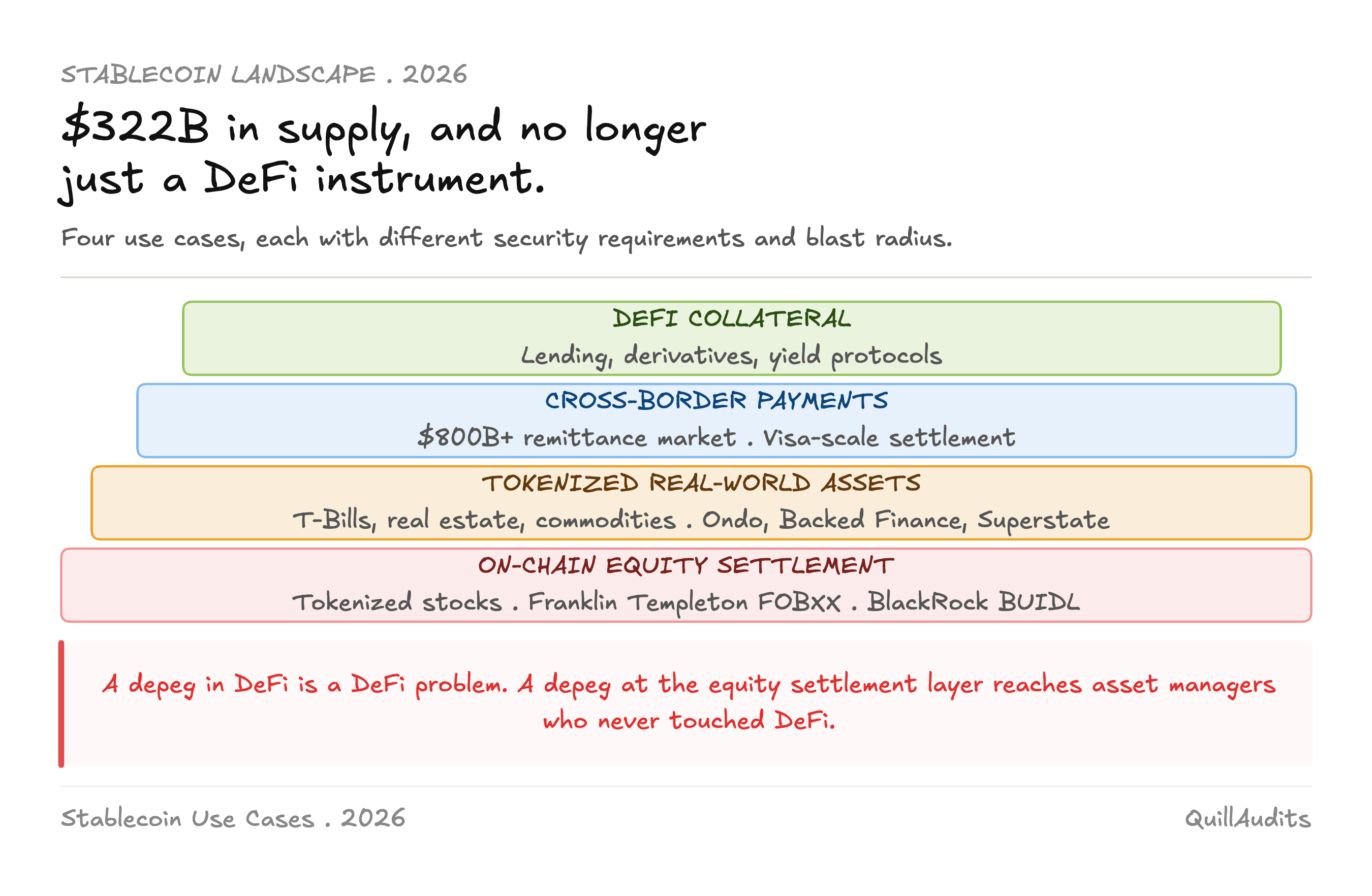
Yield-bearing stablecoins are already competing with money market funds for institutional deposits. Regulatory-compliant stablecoins are becoming the standard for cross-border institutional settlement. And stablecoins as a DeFi primitive used as collateral, as yield-generating assets, as the base currency in on-chain derivatives are expanding into every layer of decentralized finance.
But the most consequential expansion is into tokenized real-world assets.
Tokenized RWA and equities need a settlement currency. When a trader buys tokenized Apple stock on a platform like Backed Finance, the settlement leg runs through a stablecoin. When an institution allocates to a tokenized Treasury fund, the entry and exit transactions settle in stablecoin. When a DeFi protocol issues a loan against tokenized real estate, the collateral pricing and liquidation logic depend on a stablecoin-denominated oracle.
The blast radius of a stablecoin failure in this context is categorically different from a DeFi-native depeg. A 5% depeg during equity settlement means a 5% discrepancy between trade price and received value. A total depeg strands positions. Counterparties outside DeFi asset managers, custodians, institutional brokers are exposed to losses they did not model as a DeFi risk.
This changes the security requirement fundamentally. A stablecoin serving RWA settlement must be designed for the highest-stakes use case it will serve, not the average one. The architecture decisions made in the first week of the build determine whether the protocol can serve that use case safely.
Regulation Is a Technical Constraint, Not a Legal Formality
Most stablecoin teams historically treated regulation as a post-launch problem. That sequencing is no longer available.
The EU's MiCA framework came into full effect in 2024. Above defined supply thresholds, issuers must hold segregated reserves, publish monthly attestations, and maintain redemption mechanisms within specified response time limits.
The US GENIUS Act, passed in 2025, established a federal licensing pathway for payment stablecoin issuers with reserve and audit requirements that mirror money transmission law.
What compliance actually requires at the technical level:
A verifiable 1:1 reserve with on-chain proof auditable in real time, not just a monthly attestation, but continuous provability. Transaction monitoring and address screening, implemented as an on-chain KYC module or a permissioned access layer wrapping the core protocol. Programmable compliance controls: address freezing under legal order, transaction reversibility in defined circumstances, and complete audit logs of every reserve movement correlated against on-chain mint and burn events.
Each compliance feature is also an attack surface.
A freeze function is an exploit vector if its access control is misconfigured or the key managing it is compromised. An upgradeable compliance module is a governance risk if its timelock is insufficient. A centralized reserve attestation pipeline is an infrastructure dependency that can be manipulated or go stale under market stress.
Compliance architecture and security architecture are the same problem approached from different directions. Teams that design them separately produce compliance features that are architecturally isolated from the security model present on paper, unsafe in production.
Collateral Architecture Is the First Security Decision
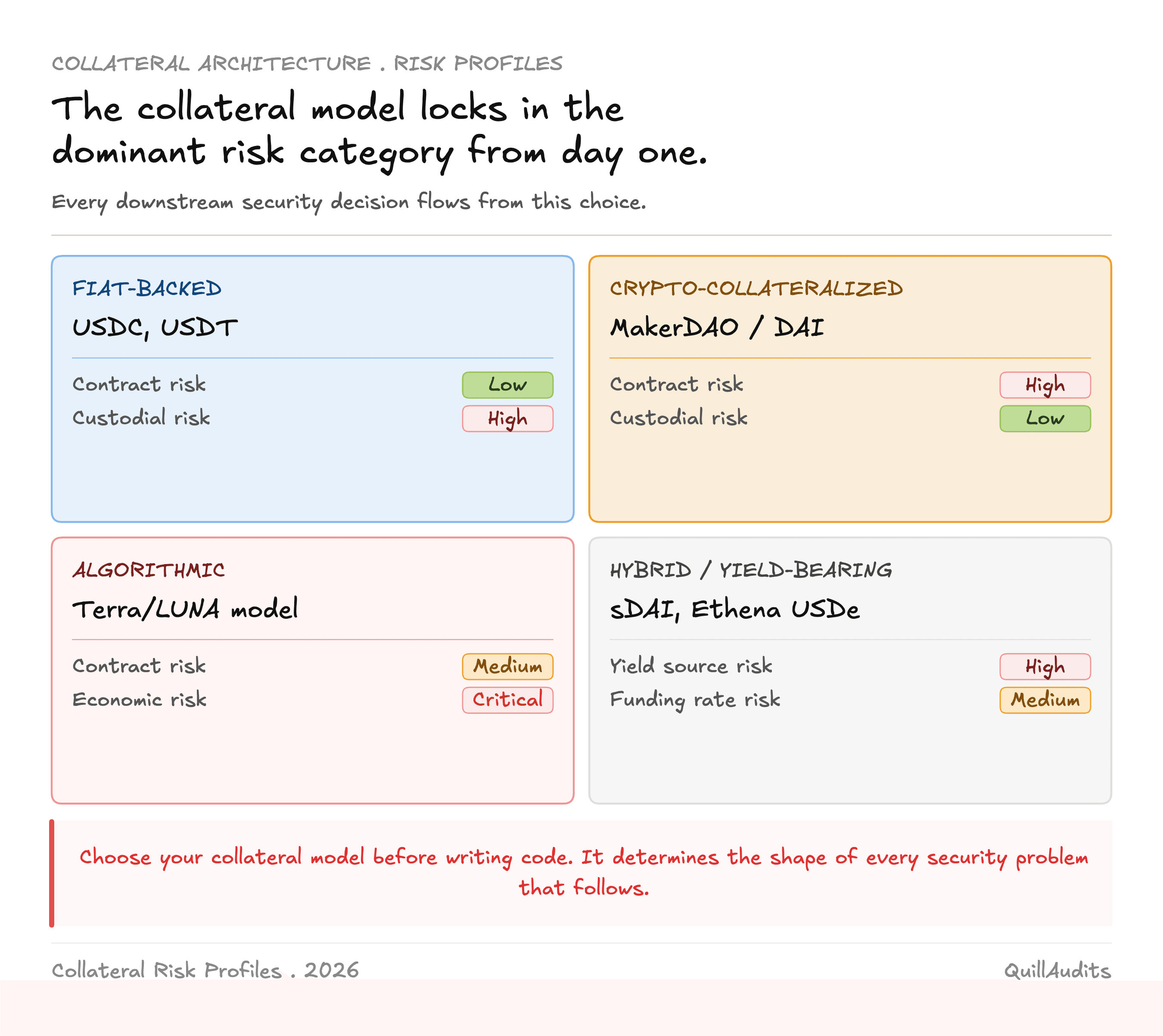
Before a single line of code, the collateral model determines the shape of every downstream security problem. Each model carries a distinct risk profile that is not interchangeable.
Fiat-backed (USDC, USDT model)
Reserves held off-chain with regulated custodians. On-chain contract risk is relatively narrow: mint and burn authorization, reserve attestation feed integrity, access control on treasury functions.
The dominant risk is off-chain. Circle's USDC depegged to $0.87 in March 2023 because $3.3 billion of its reserves were held at Silicon Valley Bank at the time of its failure. The contracts functioned correctly throughout. The vulnerability was entirely in the custody arrangement.
For protocols targeting RWA settlement, fiat-backed models carry additional custodial complexity, reserves must be segregated and provably adequate at every settlement event, not just at attestation intervals.
Crypto-collateralized (MakerDAO/DAI model)
The risk profile inverts. Custodial risk is lower because collateral is on-chain and transparent. Contract risk is dramatically higher.
The system must price collateral accurately under adversarial oracle conditions, trigger liquidations under simultaneous network stress and MEV pressure, and remain solvent through coordinated attacks on both the price feed and the collateral market.
MakerDAO's March 2020 Black Thursday event is the reference case: network congestion during a market crash prevented liquidations from executing, generating $4 million in bad debt and nearly causing insolvency. No contract had a bug. The threat emerged from a systemic condition the contract-level threat model had not modeled.
Algorithmic (no direct collateral backing)
Risk is primarily economic rather than technical. Terra/LUNA did not fail through a contract exploit. An attacker drained a large USDT position on Curve to generate UST selling pressure at a scale the Luna burn mechanism could not absorb.
The attack surface was the economic model's solvency boundary. The design question every algorithmic stablecoin must answer before launch: at what TVL and what level of coordinated sell pressure does the peg break irreversibly? If that threshold is reachable with available capital, the model has a fundamental viability problem that no contract-level security can address.
Hybrid and yield-bearing (sDAI, Ethena's USDe model)
These introduce yield source risk on top of collateral risk. Protocols sourcing yield from lending markets face liquidation cascade risk when borrowing demand contracts. Protocols sourcing yield from delta-neutral perpetual positions face funding rate risk: extended negative funding rates make positions expensive to hold and can exhaust reserve buffers.
The threat model for this category requires stress testing yield source failure over multi-month time horizons, not short-term volatility scenarios.
The collateral decision locks in the dominant risk category. Everything downstream contract design, infrastructure requirements, audit scope, and monitoring architecture flows from this choice.
The 60-Day Security Timeline
This is not a feature roadmap. It is a security sequencing framework. The order matters because each phase's decisions depend on the integrity of the ones before it.
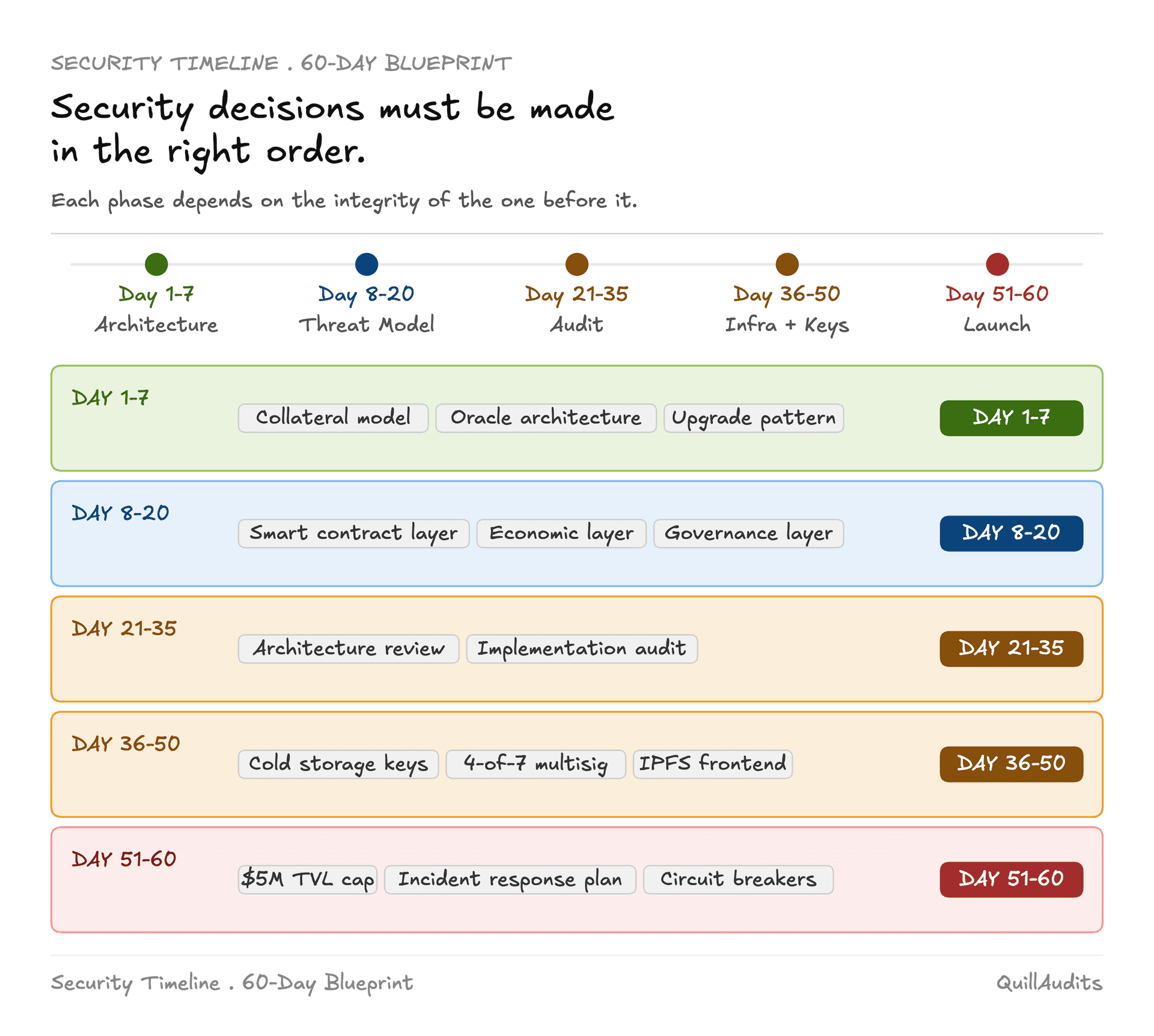
Days 1-7: Architecture Decisions That Cannot Be Undone
The most expensive security mistakes happen before a single line of code is written.
Collateral model and peg-break condition.
Document the answer to one question explicitly on day one: what is the minimum condition under which the peg breaks irreversibly? If that question does not have a clear, quantified answer, the architecture is not ready. Terra/LUNA did not fail at the contract layer first. It failed at the economic design layer.
Upgrade patterns matter immediately.
Will the contracts be upgradeable? If yes, who controls that, and with what time delay? A multisig with a 48-hour timelock is a meaningfully different trust model than a 2-of-3 with no delay. Most protocol governance exploits do not wait for the protocol to reach scale.
Oracle dependency is a load-bearing wall.
The oracle architecture must be decided before writing any logic that consumes price data. Chainlink, Pyth, Redstone, custom TWAP each has tradeoffs. Chainlink has documented staleness issues under market stress. Custom TWAPs are manipulable without sufficient liquidity depth. The correct choice depends on the collateral model. Having no documented choice is always wrong.
For RWA-targeting protocols: compliance architecture belongs on day one as well.
The KYC/AML module structure, the freeze function access control model, and the reserve attestation pipeline must be designed as part of the core architecture not bolted onto completed contracts. Compliance features added post-implementation produce architectural seams that become exploit surfaces.
Days 8-20: Building the Threat Model
Most founders write code first and build a threat model second. The correct order is reversed.
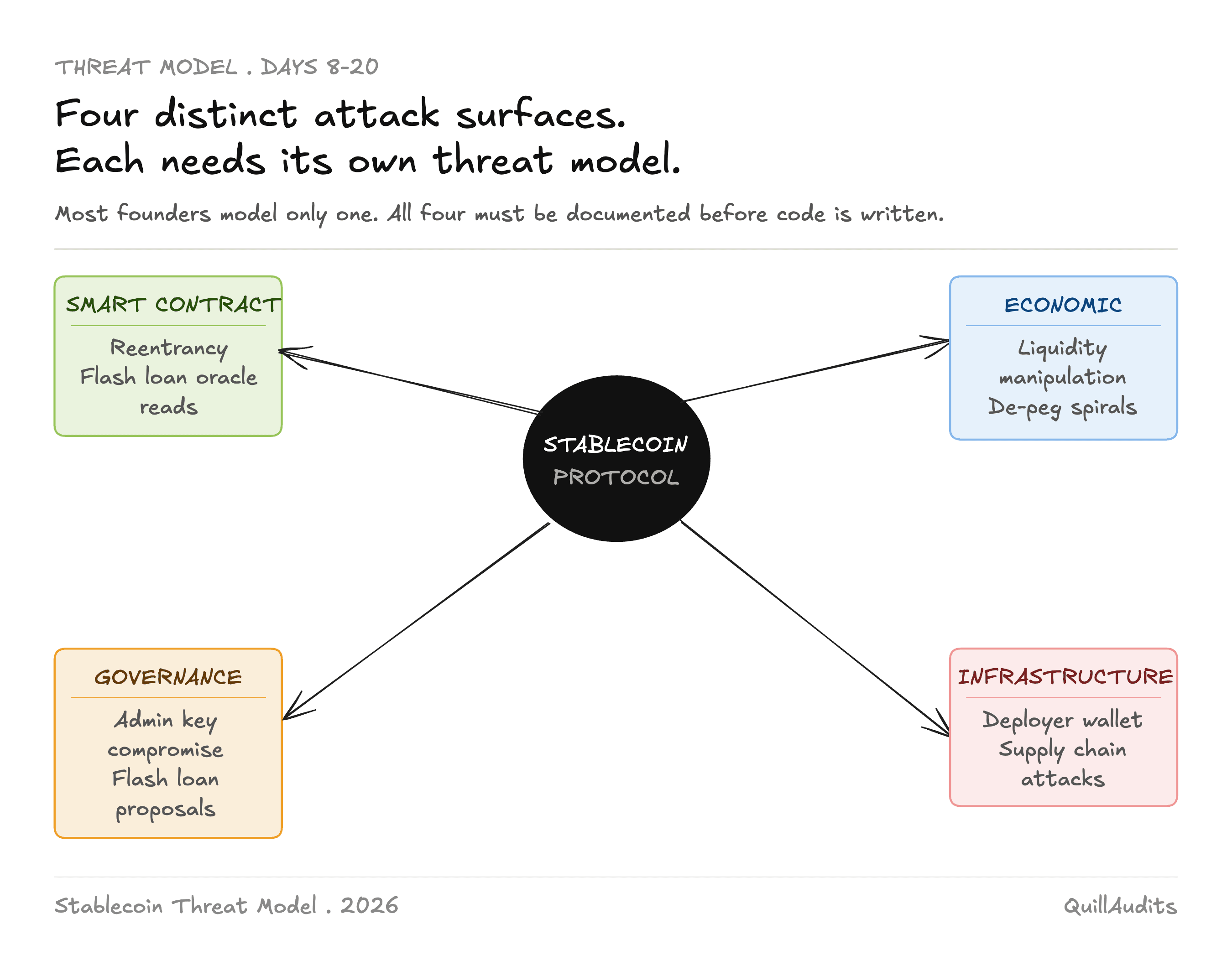
A stablecoin has four distinct attack surfaces that each require their own threat model:
Smart Contract Layer
The most documented attack surface in Web3. Common vectors include reentrancy, integer precision errors in collateral ratio calculations, and flash loan amplification of price oracle reads.
Cumulative rounding errors across thousands of positions can compound into exploitable discrepancies. Any function that reads a price and takes an action in the same transaction deserves extreme scrutiny.
Economic Layer
Price manipulation, liquidity attacks, and de-peg spirals belong here. The well-documented attack pattern: an attacker builds a short position on the token, then simultaneously drains the liquidity pool the oracle references to force a false undercollateralization signal. The contract executes correctly against price input that has been deliberately falsified.
For RWA settlement use cases, this layer also includes reserve attestation feed manipulation where a falsified off-chain reserve report triggers incorrect on-chain mint or burn events.
Governance Layer
Admin key compromise was the leading cause of protocol losses in 2025 and still in 2026. Bybit, Kelp DAO, Drift, and others fell not because of contract bugs but because the humans and infrastructure around the contracts were compromised.
The multisig key ceremony must happen before testnet, not after mainnet. Flash loan governance manipulation where an attacker borrows massive token supply to pass a malicious proposal in a single transaction requires time-weighted governance snapshots and mandatory execution delays as baseline defenses.
Infrastructure Layer
RPC providers, deployer wallets, CI/CD pipelines, and npm dependencies are all part of the attack surface. The Wintermute $160M loss originated from a vanity address generated with a compromised tool. Supply chain attacks on Web3 tooling are underreported and increasing in sophistication.
The Ronin Network hack cost $625 million through spear-phishing against team members on LinkedIn. No contract vulnerability existed. The attack surface was entirely operational.
Days 21-35: Audits as a Process, Not a Milestone
The worst way to use an audit is to schedule it for week eight and treat the report as the finish line.
Phase 1 Architecture review, before implementation.
Bring in a security partner during the architecture phase, aka CISO, not to audit finished code, but to pressure-test the threat model. The goal is identifying design-level vulnerabilities that code changes cannot fix: economic model solvency boundaries, governance attack surface analysis, oracle manipulation scenario modeling, and compliance feature security analysis.
Phase 2 Full implementation audit at feature-complete status.
Explicit focus areas: price oracle manipulation and stale feed handling, collateral accounting precision and rounding error accumulation, liquidation logic under extreme conditions (does the system remain solvent if 30% of collateral drops 40% in one hour?), reentrancy guards across all external call patterns, governance delay and execution logic, and access control inheritance in proxy implementations.
Phase 3 Re-audit plus formal invariant verification.
A third pass through a community invariant competition or bug bounty on testnet gives external researchers the incentive to find what internal teams missed. Formal verification must confirm that total outstanding supply cannot exceed total collateral value through any sequence of individually valid transactions, and that the liquidation engine maintains solvency under its stated collateralization assumptions.
One audit is better than none. But no single audit has ever been sufficient for a protocol that reached meaningful TVL.
Days 36-50: Infrastructure and Key Security
By this point the code is close to done. The next risk is not in the contracts. It is in the people and systems around them.
Deployer wallet hygiene is non-negotiable.
Cold storage for all admin keys. Hardware wallet ceremony documented with multiple participants and a written record. No key material on an internet-connected machine at any point. The deployer wallet used to send the genesis transaction should be used exactly once for that purpose.
Multisig configuration.
Minimum 4-of-7 threshold for any function that can pause, upgrade, or adjust core parameters. All signers on hardware wallets. Geographic distribution across signers reduces physical coercion risk. A Wrench Attack is not theoretical for high-TVL protocol founders.
Frontend security.
BGP hijacking and DNS spoofing have been used to redirect users of legitimate protocols to malicious frontends that harvest approvals. IPFS-pinned frontends with ENS resolution give users a verification path beyond DNS trust. This is not optional for a stablecoin.
On-chain monitoring before launch, not after.
Watch for unusual collateral deposit and withdrawal patterns, oracle deviation from reference prices, large governance proposal submissions, and abnormal mint and burn event sequences. Bybit had warning signals. Most protocols that suffer infrastructure-layer losses had detectable signals. The difference was whether anyone was watching.
Days 51-60: Controlled Launch and Response Readiness
Launch with a hard TVL cap.
Not a soft guideline a parameter-enforced maximum. $5M is a reasonable starting ceiling. Raise it through transparent, time-delayed governance proposals as the protocol demonstrates stability under real conditions. The cost of moving slowly is measured in weeks. The cost of moving too fast is measured in total protocol value.
Publish the incident response plan before the first user deposits.
A documented playbook covering who holds pause authority, under what conditions pausing is triggered, how users will be notified, and how post-mortem communication will be handled. Protocols that respond to incidents with transparency recover. Protocols that go silent do not.
Circuit breakers across all critical functions.
Rate-limit large single-transaction collateral withdrawals. Price deviation thresholds that trigger automated pauses. Emergency shutdown mechanisms that prioritize user fund recovery over protocol continuity.
For protocols serving RWA settlement use cases, these parameters should be coordinated with institutional counterparties before launch. Circuit breaker behavior during active settlement windows has direct consequences for counterparties holding open positions.
The Attack Vectors That Will Target You at Scale
Beyond the architecture phase, these are the vectors most likely to appear as TVL grows.
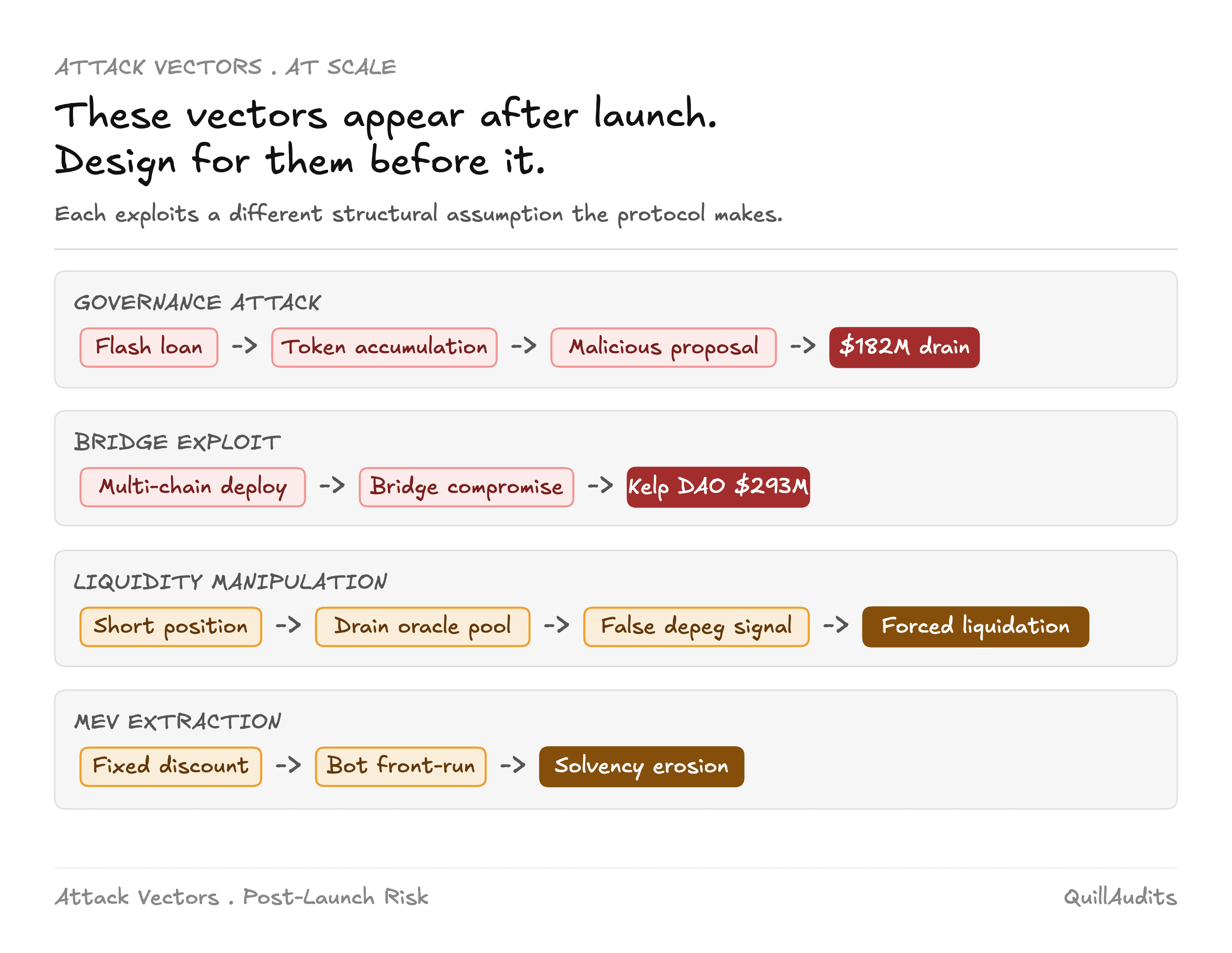
Governance attacks.
Flash loan governance manipulation, borrowing massive token supply to pass a malicious proposal in a single transaction, has drained multiple protocols. The Beanstalk exploit drained $182 million this way. Time-weighted governance snapshots and minimum execution delays are baseline defenses that must be implemented from the start.
Cross-chain bridge exploits.
If the stablecoin is multi-chain, each bridge is an attack multiplier. Every bridge added is an additional trust assumption. Kelp DAO's $293M loss in early 2025 was a bridge exploitation. Every bridge implementation should be audited independently. A reputable bridge provider does not mean a secure integration of that bridge.
Liquidity depth manipulation.
An attacker who can move the market for the collateral asset even temporarily can trigger undercollateralization signals that force liquidations or halt operations. Deep, well-distributed liquidity across multiple venues makes this significantly harder and more expensive to execute. For RWA-backed protocols, thin liquidity in the tokenized asset itself creates the same risk.
Sandwich and MEV extraction.
Liquidation functions that can be sandwiched allow MEV bots to extract value in ways that stress the solvency model under volatility. Dutch auction liquidation mechanisms eliminate the fixed discount that makes sandwiching profitable. MEV-aware design from the beginning is substantially easier than retrofitting.
What the Future of Stablecoins Actually Looks Like
The stablecoin category is not going to consolidate around one winner. The future is specialized across three distinct tracks.
Yield-bearing stablecoins (USDY, sUSDe) are already competing with money market funds for institutional deposits. That category will grow as regulatory clarity increases. The security requirement here is yield source integrity the threat model must cover what happens when the yield source fails, not just when the peg comes under pressure.
Regulatory-compliant stablecoins with on-chain KYC and programmable compliance will become the standard for institutional settlement and cross-border payments. USDC's trajectory points here. These protocols are also the natural settlement currency for tokenized RWA platforms, where regulatory auditability is a product requirement, not just a compliance checkbox.
Stablecoins as DeFi primitives, used as collateral, as yield-generating assets, and as the base currency in on-chain derivatives, will continue expanding. The protocols that win this layer will be the ones with the most credible security track records because sophisticated DeFi protocols integrating a stablecoin as collateral will conduct their own due diligence on its security architecture.
The peg mechanism that survives long-term market cycles will not be the most capital-efficient one. It will be the most boring one. Boring architecture with robust collateralization, conservative parameters, and verified code survives. Complex algorithmic models with insufficient liquidity backing do not.
Where QuillAudits Fits in This Process
Every phase of this timeline has a security decision point. Most founders get the technical decisions right eventually. The ones who suffer significant losses made those decisions too late after the architecture was locked, after the contracts were deployed, after users had funds in the protocol.
QuillAudits covers every layer of this process. Smart contract audits, economic threat modeling, architecture reviews, infrastructure security assessments, on-chain monitoring, and incident response readiness. For protocols targeting RWA and tokenized asset settlement, we additionally provide compliance feature security review and dual-mode architecture analysis.
You do not need five different vendors for a stablecoin launch. You need one team that understands how all the layers connect.
If you are building in the next 60 days, reach out before launch, not after.
Conclusion
Stablecoins are no longer experimental payment tokens or isolated DeFi collateral. They are becoming a financial infrastructure that settles value across tokenized assets, institutions, and global markets. At that scale, security is not a final checklist item but the architecture itself. The protocols that survive the next decade will not be the fastest to launch or the most aggressive in design. They will be the ones that treat regulation, collateral, infrastructure, and security as interconnected systems built to withstand stress before it arrives.

Contents