QuillAudits Now Supports Canton Network
Canton Network security audits covering Daml smart contract review, workflow authorization analysis, and institutional-grade blockchain security.

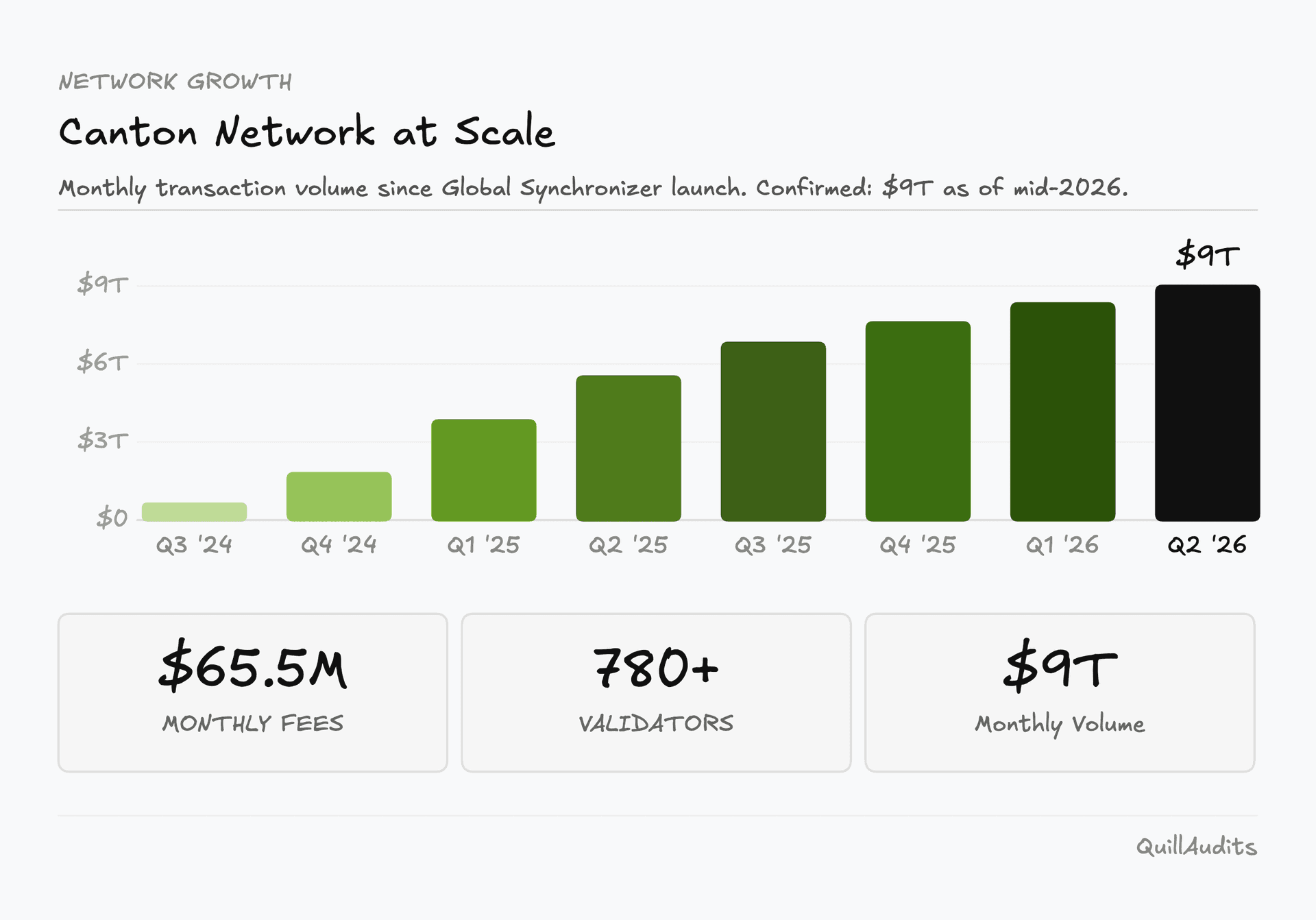
There is a blockchain processing $9 trillion in monthly volume, backed by Goldman Sachs, JPMorgan, DTCC, and 780+ institution validators running live workloads on it. It is not Ethereum. Most of the crypto community has barely heard of it.
The Canton Network moved from pilot to production in 2024. DTCC is tokenizing U.S. Treasury securities on it. Broadridge settles $350 billion in daily repo transactions through it. JPMorgan is bringing JPM Coin natively onto it. Visa joined as a Super Validator in March 2026.
QuillAudits now formally supports Canton Network security audits, covering Daml smart contract review, workflow authorization analysis, and Canton-specific application security. Here is why this matters.
Canton Is Not Ethereum
Ethereum was designed for open, permissionless, globally transparent computation. Every transaction is visible to every node. Every contract state is public. This is powerful for retail DeFi but creates a fundamental problem for regulated finance. Institutions cannot operate on a network that broadcasts their trading positions and client data to every market participant.
Canton was built to solve exactly that. The architecture differs from Ethereum at every level.
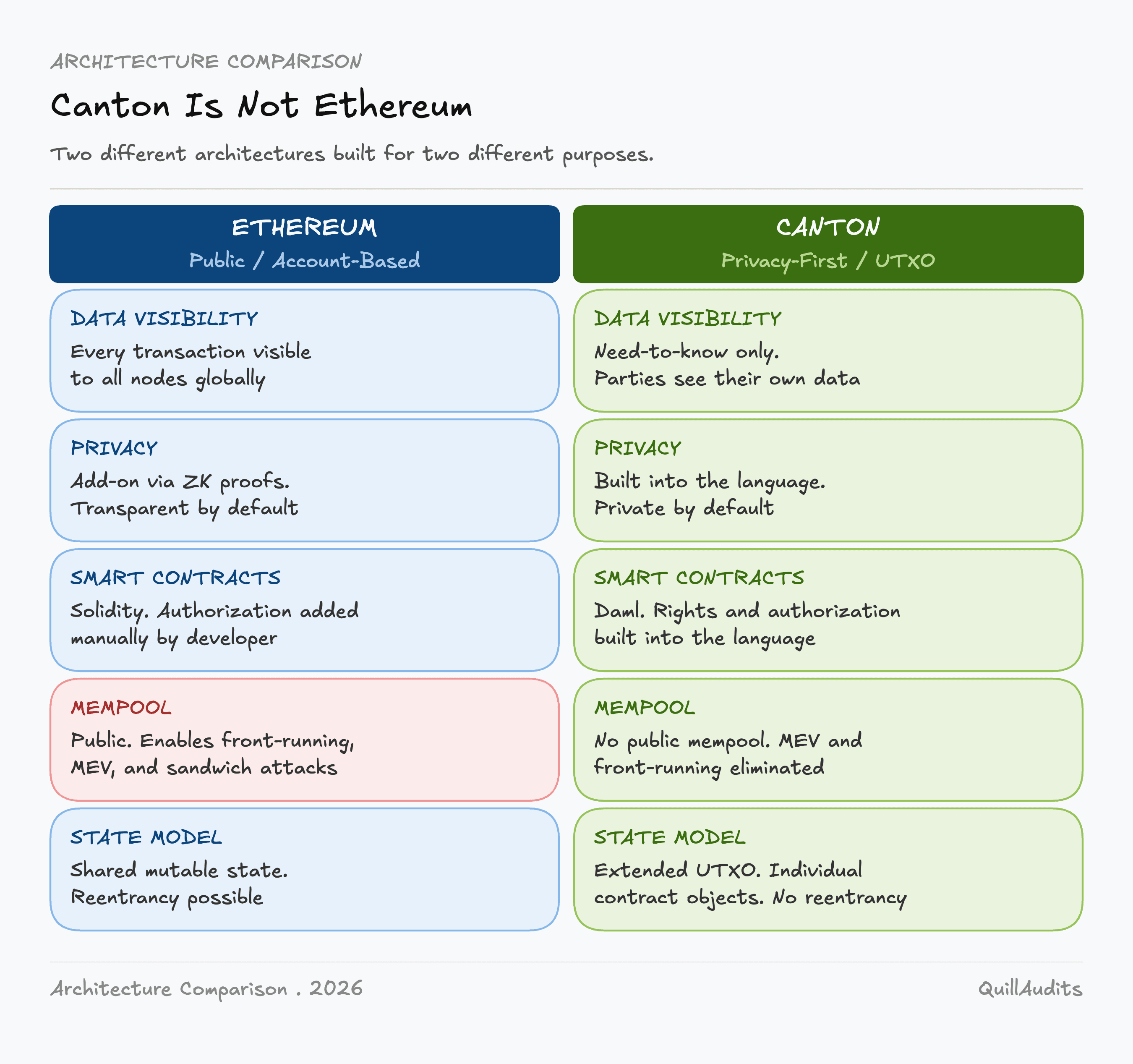
Ethereum uses an account-based model with shared mutable state. Canton uses an extended UTXO model where contracts are individual objects with unique identifiers. There is no shared global state to exploit.
Privacy on Ethereum requires zero-knowledge proofs layered on top of a transparent base. On Canton, privacy is the default. Every Daml contract specifies exactly who can see it and who can act on it. A lender does not see the borrower's other positions. A trade validator confirms a trade without knowing the negotiated price. Participants see only the parts of a transaction that are relevant to them, by design and by cryptographic enforcement.
Ethereum uses Solidity, where authorization checks must be added manually by the developer. Canton uses Daml, where rights, obligations, and visibility are built directly into the language. You cannot write a Daml contract without specifying who is authorized.
Canton also has no public mempool. Front-running, sandwich attacks, MEV extraction, and reentrancy are structurally eliminated from the threat model.
Why Institutions Are Choosing Canton
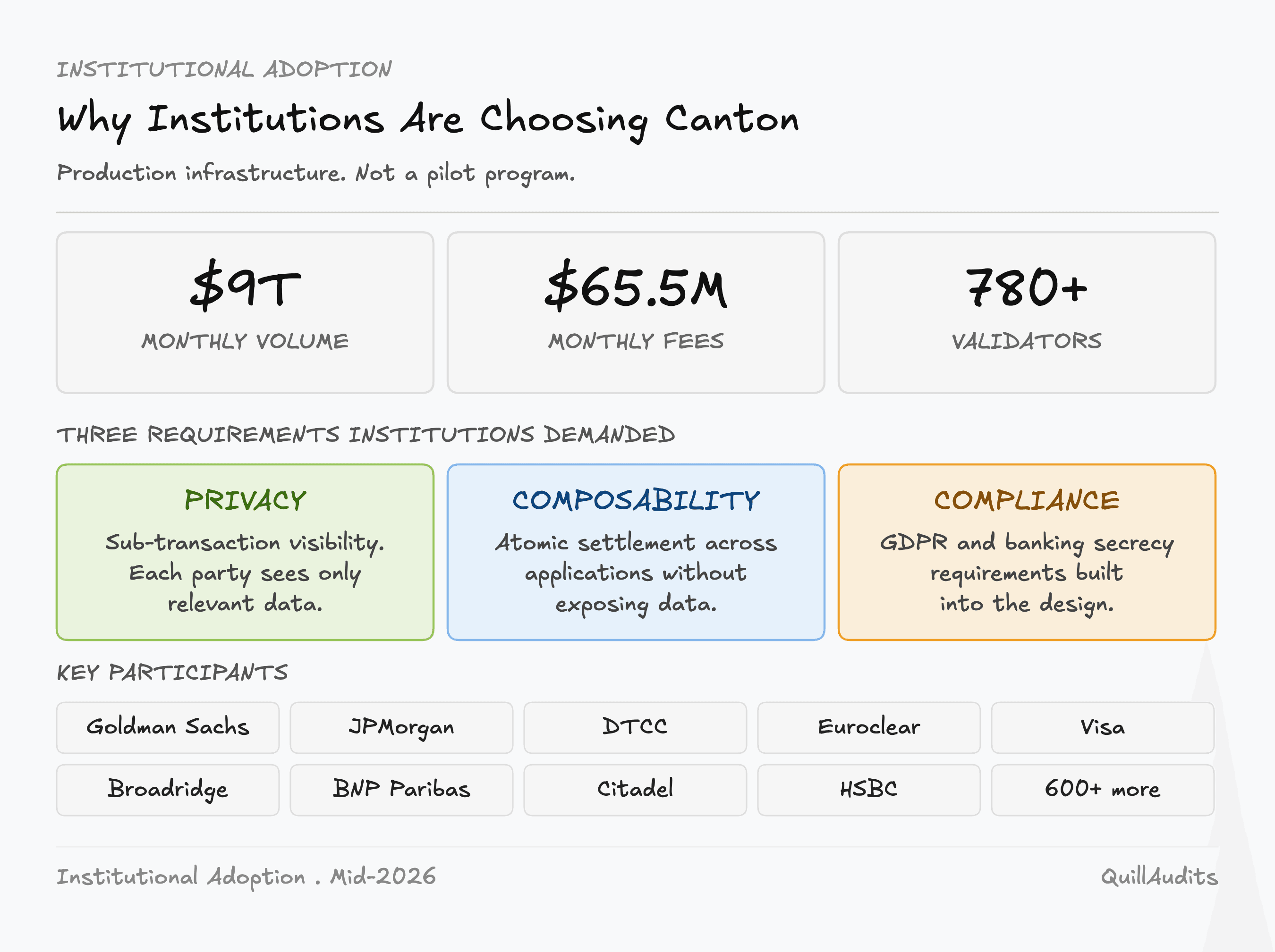
As of mid-2026, Canton processes over $9 trillion in monthly transaction volume, generates $65.5 million in monthly fees, and operates across 780+ validators. DTCC and Euroclear co-chair the Canton Foundation, the governance body overseeing the network. Together, they custody and settle the majority of the world's securities. That governance involvement is a structural bet on Canton as the future settlement layer, not a pilot program.
Three requirements drove institutions here, privacy, composability, and regulatory compliance. Ethereum delivers composability but sacrifices privacy. Traditional enterprise blockchains like Hyperledger Fabric deliver privacy but force institutions into siloed deployments that cannot transact atomically with each other. Canton delivers all three through its Global Synchronizer, a consensus layer that coordinates atomic cross-application settlement without any participant exposing their transaction data.
Chris Zuehlke, Partner at DRW and Global Head of Cumberland, said at Canton's launch that “Canton Network is a powerful answer to industry calls for a solution that harnesses the potential of blockchain while preserving fundamental privacy requirements for institutional finance.”
In August 2025, Bank of America, Citadel Securities, DTCC, Societe Generale, and Tradeweb completed the first real-time on-chain U.S. Treasury financing against USDC on a Saturday. Traditional markets treat weekends as dead time. Canton's 24/7 atomic settlement eliminated that constraint in a single transaction.
The Audit Gap Nobody Talks About
Canton Network's Daml language, protocol, and built-in privacy model mitigate many of the primary concerns that plague other chains, but business workflow and authorization logic issues can still exist. QuillAudit’s direct knowledge and experience with Canton Network ensures your applications receive high-quality security audits.
Why QuillAudits
QuillAudits has secured $3B+ in Total Value Locked, identified 2,000+ critical and high-severity vulnerabilities, and protected 1,500+ protocols across EVM, Solana, Cosmos, and institutional Layer 1 infrastructure. Our expansion into Canton is a direct response to where institutional capital is moving.
Canton applications are not simple token contracts. They model multi-party financial agreements, collateral systems, settlement workflows, and regulated asset issuance pipelines. Auditing them correctly requires understanding both the execution environment and the financial logic the contracts encode. That combination is what we bring.
Secure What You Are Building
The institutions on Canton are not running experiments. They are building the settlement infrastructure for the next generation of global finance. That work deserves security review from auditors who actually understand the environment.
Reach out to start your Canton audit.

Contents