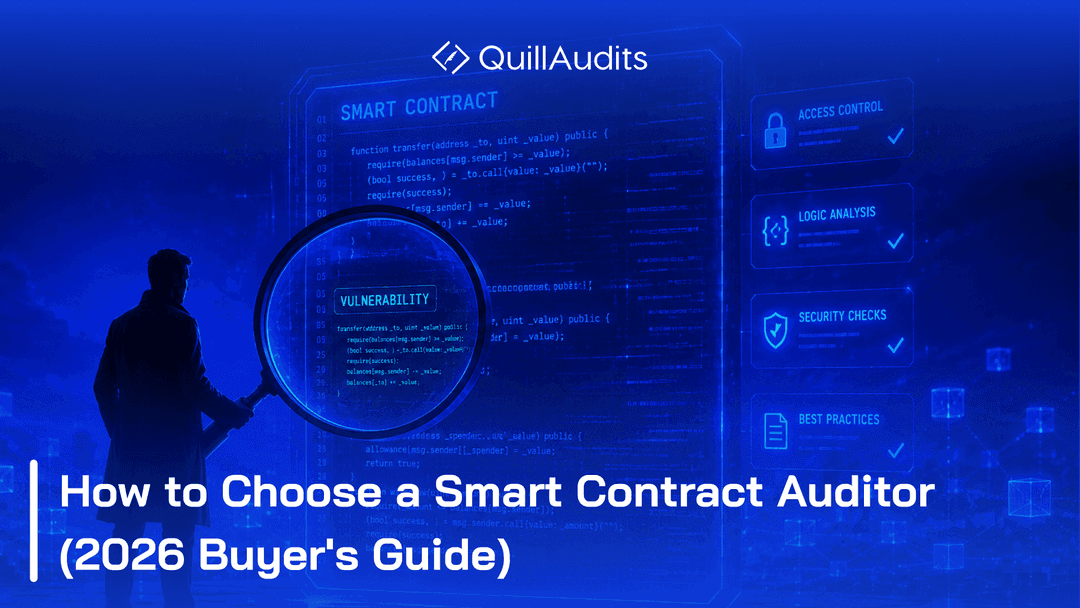
How to Choose a Smart Contract Auditor: A 2026 Buyer's Guide
Learn how to choose a smart contract auditor in 2026, from reviewer experience and methodology to audit reports, fix verification, pricing, and red flags.

Quick answer:
Choosing a smart contract auditor comes down to five key factors: who is actually reviewing your code, whether they've audited protocols similar to yours, how they approach the audit beyond automated tools, what their report includes, and whether they verify your fixes afterward. Get those five things right, and you're far less likely to end up paying for a superficial audit or dealing with an exploit after launch.
Here's how to evaluate an audit firm before making that decision.
First, know what you are actually buying
A smart contract audit isn't a certificate that guarantees your code is safe.
It's a security review where experienced engineers examine your contracts, use specialized tools, and actively look for ways an attacker could exploit the system before it goes live.
That distinction matters.
Many protocols that were exploited in 2025 had audit reports displayed prominently on their websites. Even so, the industry still lost more than $3 billion to smart contract exploits that year.
A good audit significantly reduces risk. It doesn't eliminate it.
Any firm that promises your contracts will be completely secure is selling confidence, not security.
The goal isn't simply to hire an auditor.
It's to find an audit partner whose experience, process, and expertise match your protocol, your timeline, and your budget.
What to look for
Relevant track record
Don't be distracted by the total number of audits listed on a firm's homepage.
What's far more important is whether they've worked on protocols similar to yours.
A team that has audited multiple lending protocols will usually recognize lending-specific vulnerabilities much faster than a team whose experience is mostly NFT collections.
Ask for examples that match your category.
Who does the review
Not every audit firm assigns senior engineers to every engagement.
Some have experienced auditors leading the review. Others rely on junior engineers, with a senior only performing a final review.
Ask who will be working on your audit and what kinds of protocols they've reviewed before.
Named auditors with a public track record inspire much more confidence than an anonymous "security team."
How they work
A thorough audit combines manual code review with automated tooling and extensive testing.
That typically includes static analysis using tools like Slither, fuzz testing with Foundry, and detailed manual inspection of the business logic.
If the entire process consists of running an automated scanner and packaging the results into a report, you're not getting a real audit.
Ask the firm to explain exactly what their methodology includes.
The report and the re-check
A high-quality audit report should clearly explain every finding, its severity, why it matters, and how to fix it.
Just as importantly, the auditor should review your code again after you've implemented the fixes.
Without that final verification, a rushed patch could introduce an entirely new vulnerability.
Before signing anything, confirm whether fix verification is included in the quoted price or billed separately.
Reputation you can verify
Look for published reports, documented findings, and previous work you can review yourself.
A strong reputation should be backed by evidence, not marketing.
Firms such as QuillAudits, Trail of Bits, and OpenZeppelin publicly publish many of their audit reports, making it easier for prospective clients to evaluate the quality of their work.
Red flags worth walking away from
Some warning signs should make you think twice before hiring an audit firm.
- They guarantee your code will be "100% secure" or "bug-free." No credible auditor makes that promise. Security audits reduce risk, but they can't eliminate it entirely.
- They quote a fixed price before reviewing your codebase. A proper audit is scoped based on factors like code size, complexity, architecture, and protocol design. Pricing without seeing the code is a red flag.
- They have no public reports or client references. If you can't verify their previous work, you're relying entirely on their marketing.
- They won't tell you who is conducting the audit. You should know who's reviewing your contracts and what experience they bring to the engagement.
- They pressure you to skip the scoping process and begin immediately. A thorough audit starts with understanding the protocol. Rushing into the review without proper scoping usually means corners are being cut.
Questions to ask before you sign
A few straightforward questions can tell you a lot about an audit firm.
- Who will be reviewing my code, and what similar protocols have they audited?
- What does your audit process include beyond automated scanning?
- Is fix verification included in the quoted price?
- Can you share a previous audit report for a protocol similar to mine?
- What falls outside the scope of this audit?
The answers often reveal more than a polished sales presentation.
A firm that answers these questions clearly, without vague promises or marketing jargon, is usually a much safer choice for your protocol.
What it costs and how long it takes
There's no universal price for a smart contract audit.
The final cost depends on factors such as the size of your codebase, the complexity of the protocol, and how quickly you need the review completed.
One thing should immediately raise concerns: receiving a fixed quote before anyone has looked at your repository.
Most focused smart contract audits take one to three weeks.
If someone promises to fully audit a complex protocol in two days, the scope is almost certainly limited, or the review isn't as comprehensive as it should be.
Conclusion
A smart contract audit is one of the most important investments you'll make before launch, but not all audits offer the same level of assurance. The right audit partner brings relevant experience, a transparent review process, clear reporting, and thorough verification of every fix. Taking the time to evaluate those factors upfront can make the difference between a protocol that launches with confidence and one that discovers its weaknesses after real funds are at risk.

Contents