Security First: A Founder’s Guide to Building Secure Crypto Protocols 2026
$635M stolen in April 2026. Most protocols had audits. Here's the 8-layer security stack, vCISO, testing, formal verification, auditing, OPSEC, monitoring, and training that actually keeps protocols safe.

Nobody remembers exactly who sent the first message. Someone on Telegram, one line, no punctuation: something is wrong with the treasury.
By the time the engineering lead got on a call, $8M was already moving. By the time the multisig holders were awake and assembling, the transaction had finalized. The attacker hadn't touched a single line of Solidity. They had compromised a DevOps engineer's AWS credentials. Credentials that lived, for seven months, in a shared Notion doc nobody had thought to clean up.
This is not a case study. This is a pattern. April 2026 saw $635 million stolen across 28 incidents on 7 chains. Most of those protocols had been audited. Some had been audited multiple times. Their code was clean. The infrastructure around it was not.
The question worth asking is: what does a security model that actually works look like?
Before the First Commit
Most security conversations begin too late.
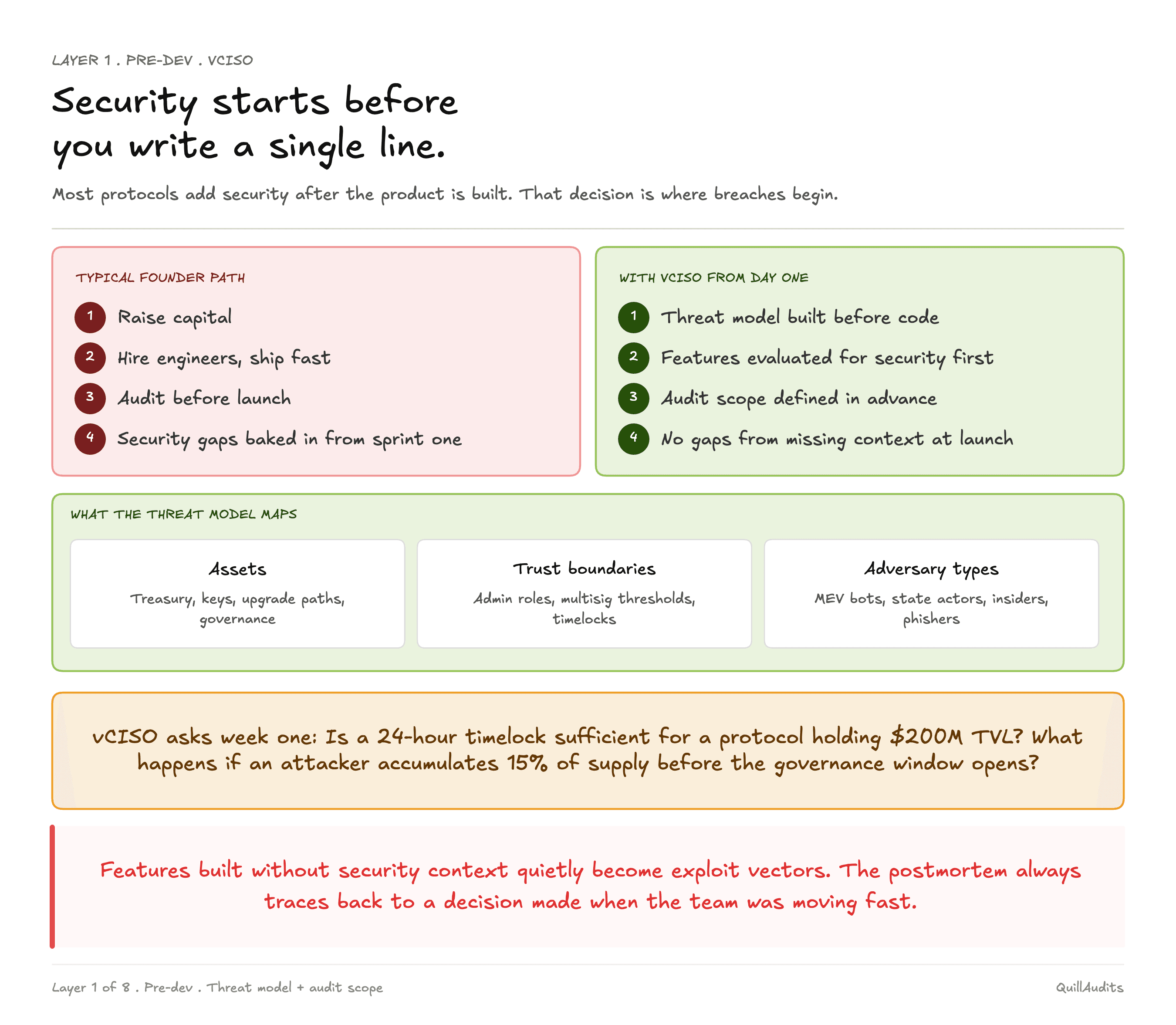
A typical founder trajectory: raise capital, hire engineers, ship product, get audited before launch. Security enters the picture somewhere between we're almost done and we need this report before the VC unlocks the next tranche.
This is backwards. And it is expensive.
The correct starting point is a threat model. A structured document that maps every asset your protocol holds, every trust boundary in your system, and every category of adversary who has incentive to cross those boundaries. It is not a checklist. It is a living architecture decision that shapes what gets built and how.
QuillAudits embeds a virtual CISO (vCISO) into a protocol's team from day one to own this process. The vCISO is not an auditor who shows up at the end. They are the person who looks at your tokenomics design and asks: what happens if an attacker accumulates 15% of supply before the governance window opens? They are the person who reviews your upgrade mechanism and flags that a 24-hour timelock is insufficient for a protocol holding $200M TVL. They write the scope document that governs what the audit covers and what it does not.
A threat model built in week one saves far more than it costs. Features designed without security context get built, shipped, and then quietly become the exploit vector that the postmortem traces back to a decision made when the team was moving fast and not thinking about adversaries.
The Testing Layer: Trying to Break Your Own Code
Assume the threat model is done. The architecture is decided. Sprints are running. Now the question is: how do you know the code does what you think it does?
The answer is adversarial testing. Not happy-path QA, but systematic attempts to destroy your own protocol before anyone else gets the chance.
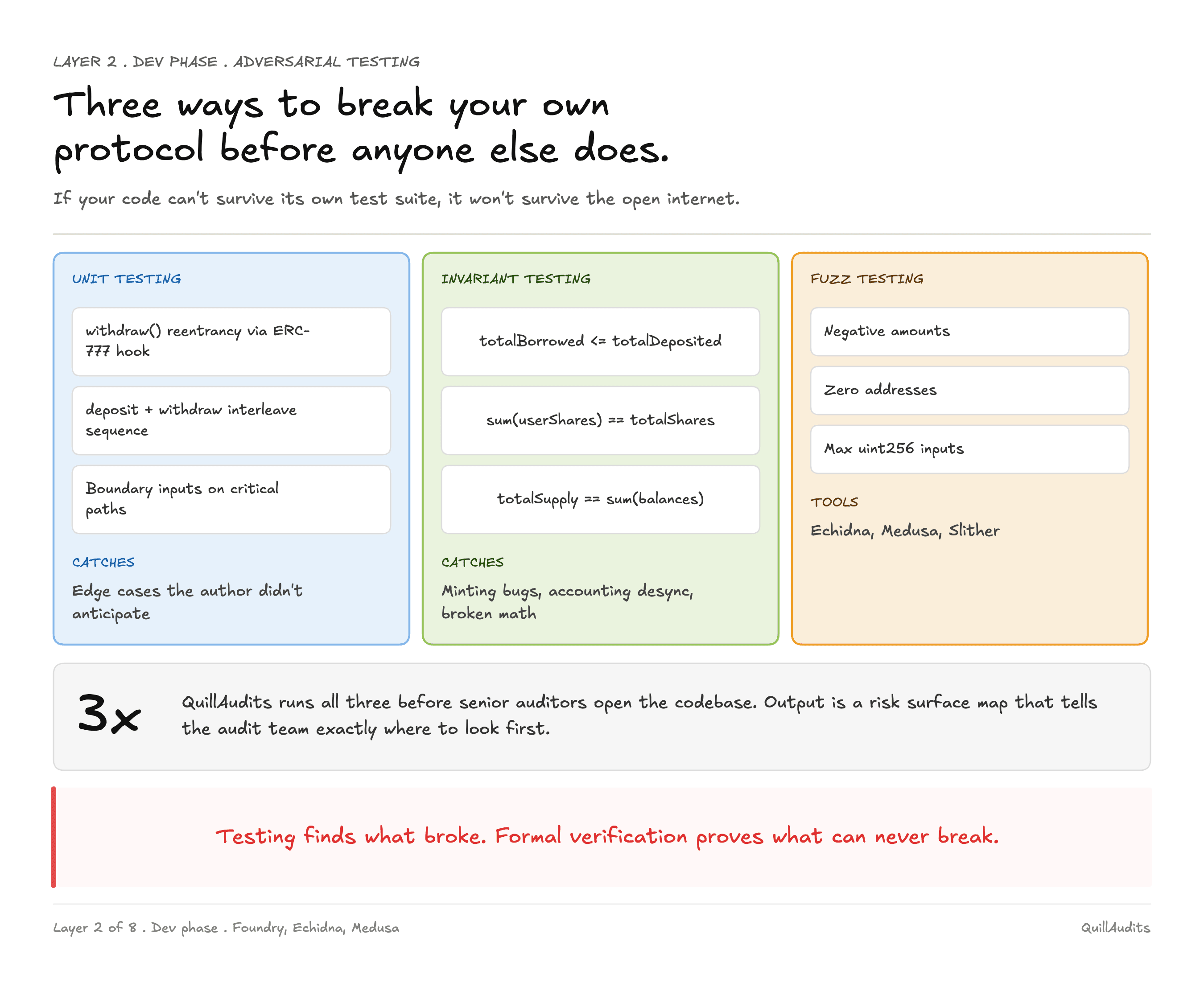
Unit testing with adversarial cases means writing test scenarios that probe edge conditions your engineers probably didn't consider during implementation. Not just: does withdraw() return the correct amount? But: can withdraw() be called reentrantly through an ERC-777 hook? Can deposit() and withdraw() be interleaved in a sequence that desynchronizes the vault's internal accounting from its actual token balance?
Invariant testing goes one layer deeper. An invariant is a mathematical relationship that must always hold true inside your protocol, no matter what sequence of transactions occurs. For a lending protocol: totalBorrowed ≤ totalDeposited. For a yield vault: sum(userShares) == totalShares. Invariant testing frameworks like Foundry's invariant suite spin up a stateful fuzzer that calls your contract functions in random sequences, thousands of times, looking for any execution path that breaks the relationship. If totalSupply ever diverges from sum(balances), you've found a minting bug that might have lived undetected in production.
Fuzz testing completes the picture. Tools like Echidna and Medusa generate randomized, malformed, and boundary-case inputs against your contract surface. Negative amounts, zero addresses, maximum uint256 values passed where a reasonable caller would never go. Watch what breaks. Static analysis tools like Slither catch known vulnerability patterns syntactically. Fuzz testing finds the edge cases that exist in the space between patterns, too subtle for rules, too numerous for manual enumeration.
QuillAudits runs all three as a prerequisite layer before senior auditors open the codebase. The output is not just bugs found. It is a risk surface map that tells the audit team where to look first.
Formal Verification: From Probably Safe to Proven
Testing tells you what broke under the conditions you tested. Formal verification tells you what cannot break under any condition.
This matters because the exploit space is not finite. An attacker has unlimited time and a financial incentive proportional to your TVL. They will find the input sequence you didn't test. Formal verification removes the category of inputs we didn't consider.
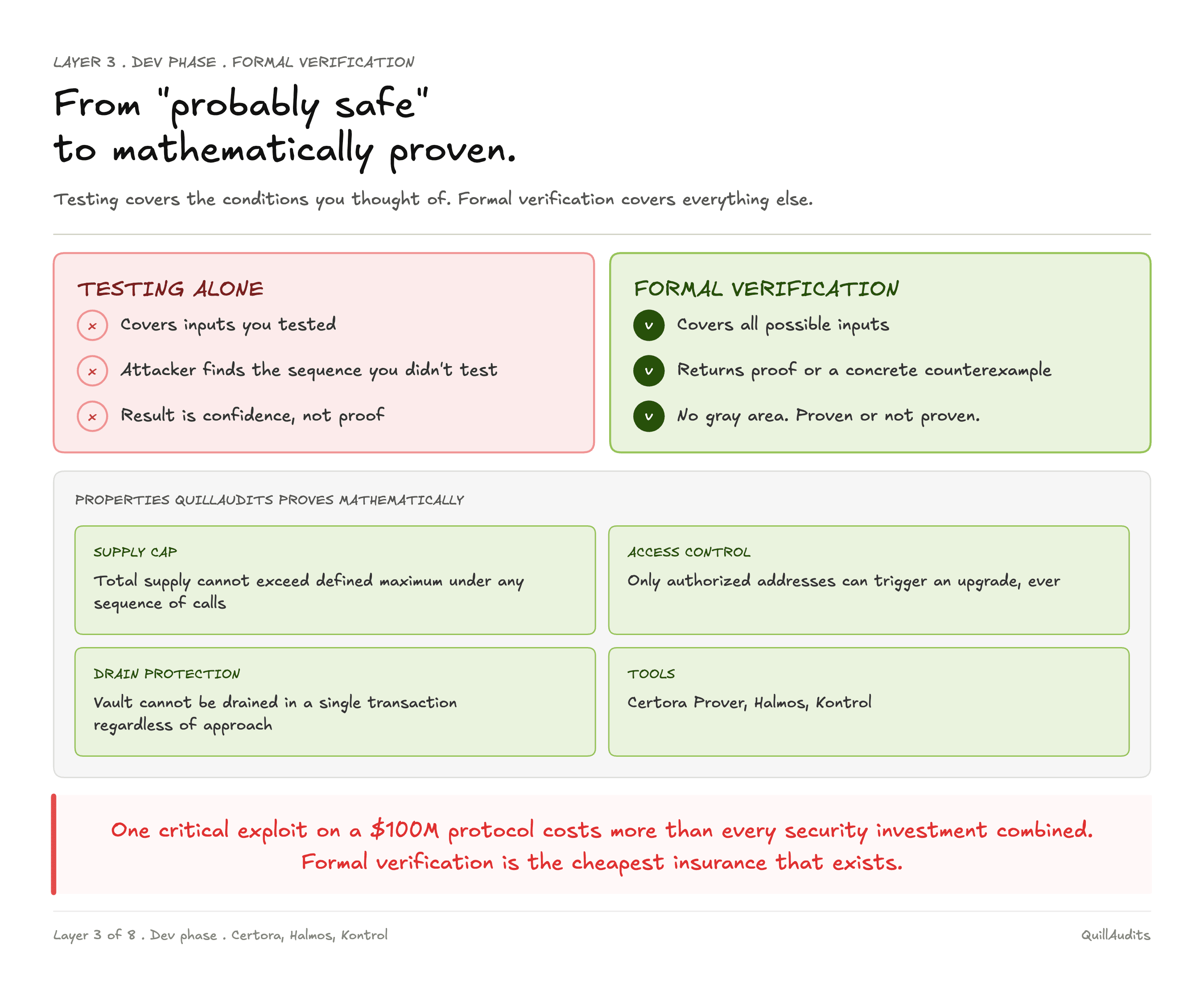
The approach uses mathematical proof systems. Tools like Certora Prover, Halmos, or Kontrol to assert specific, absolute properties about your contract's behavior. You write a specification:
1rule no_unauthorized_mint {
2    address caller = msg.sender;
3    uint256 supplyBefore = totalSupply();
4    mint(caller, amount);
5    assert(totalSupply() == supplyBefore + amount);
6    assert(hasRole(MINTER_ROLE, caller));
7}
8
The prover either produces a formal proof that the assertion holds for all possible inputs, or it produces a counterexample: a specific set of inputs under which it breaks. Not a probability. Not a confidence level. A proof or a counterexample.
QuillAudits runs formal verification on critical protocol properties, supply caps, access control invariants, upgrade authority constraints for any protocol above a threshold TVL. The economics are straightforward. A single critical exploit on a $100M protocol costs more than every security investment combined, often by an order of magnitude. The Formal Verification engagement is the cheapest insurance that exists against that category of loss.
AI Audit: QuillShield Goes In First
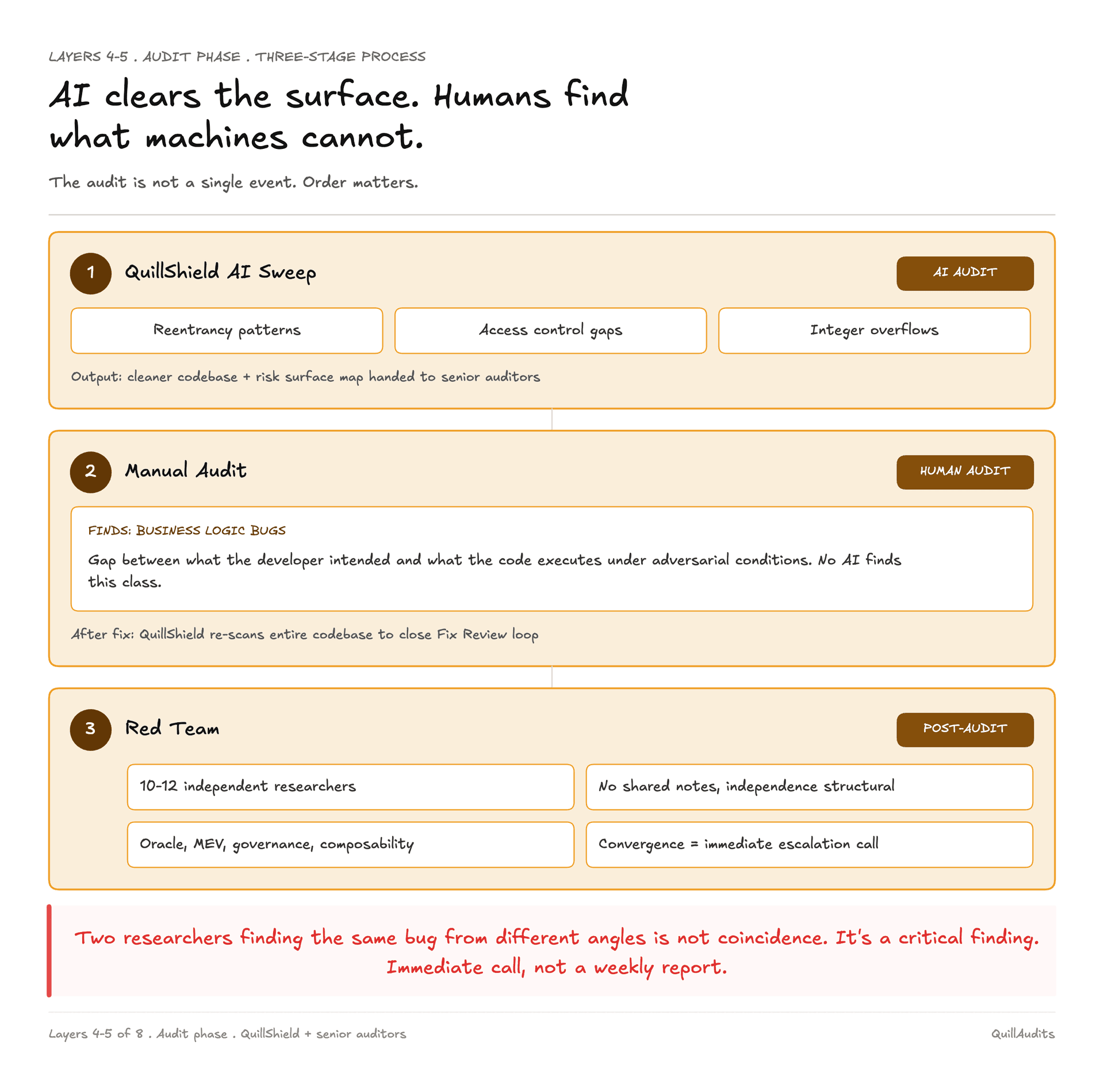
Before any human opens the codebase, QuillShield runs. It builds a semantic map of the entire codebase. Every function signature, every state variable, every dependency graph, every inherited contract from OpenZeppelin or custom libraries. Then it sweeps for surface-level issues at scale: reentrancy patterns, unchecked return values, integer overflow candidates, access control inconsistencies, known vulnerability signatures across hundreds of attack classes.
This pass typically surfaces a significant share of high and medium severity findings quickly. The obvious attack surface gets cleared fast. Human time is not spent on what a machine can already see.
The result is a cleaner, prioritized codebase handed to senior auditors with a risk map already drawn. After remediation, QuillShield runs again across the entire updated codebase, not just the changed functions. The Fix Review loop closes the common failure mode where patching one vulnerability quietly opens another in a function that shares state with the original.
Manual Audit and Red Team: What Machines Cannot Find
Manual review operates on a different class of problem entirely: business logic bugs. These are not syntactic errors. They are gaps between what the developer intended and what the code actually executes under adversarial conditions. No AI finds these, because finding them requires understanding the protocol's purpose, not just its syntax.
A canonical example: a lending protocol implements a liquidation function that calculates the bonus as a percentage of collateral value. The developer tests it at reasonable ratios. The auditor asks: what happens when collateral value drops faster than the liquidation threshold updates? Can an attacker force a state where liquidating a position is unprofitable, leaving bad debt to accumulate silently? That's not a reentrancy bug. That's not an integer overflow. That's a design vulnerability that lives entirely in the gap between spec and implementation.
Once the manual audit closes and fixes are verified, the red team begins.
QuillAudits deploys 10 to 12 independent security researchers against the protocol under controlled conditions. Each specializes in a different attack class. One focused on oracle manipulation, one on MEV and sandwich attacks, one on cross-protocol composability exploits, one on governance attack vectors. They do not share notes. The independence is structural, because a researcher who knows another person already checked the oracle integration will unconsciously weight their attention elsewhere. Independence means every surface gets fresh, unanchored eyes.
Convergence is the signal. If two researchers arrive at the same vulnerability from different attack angles, that's not a coincidence. It's a critical finding. Any issue flagged triggers an immediate call, not a weekly report. The window between attacker knows about this and protocol is safe is measured in hours on-chain.
OPSEC: The Layer the Audit Cannot See
Here is the uncomfortable truth about April 2026.
Of the $635 million stolen, $578 million came from two incidents. Neither involved a smart contract exploit. Both were operational security failures. Admin key compromises executed with precision. The Solidity was clean. The infrastructure around it was not.
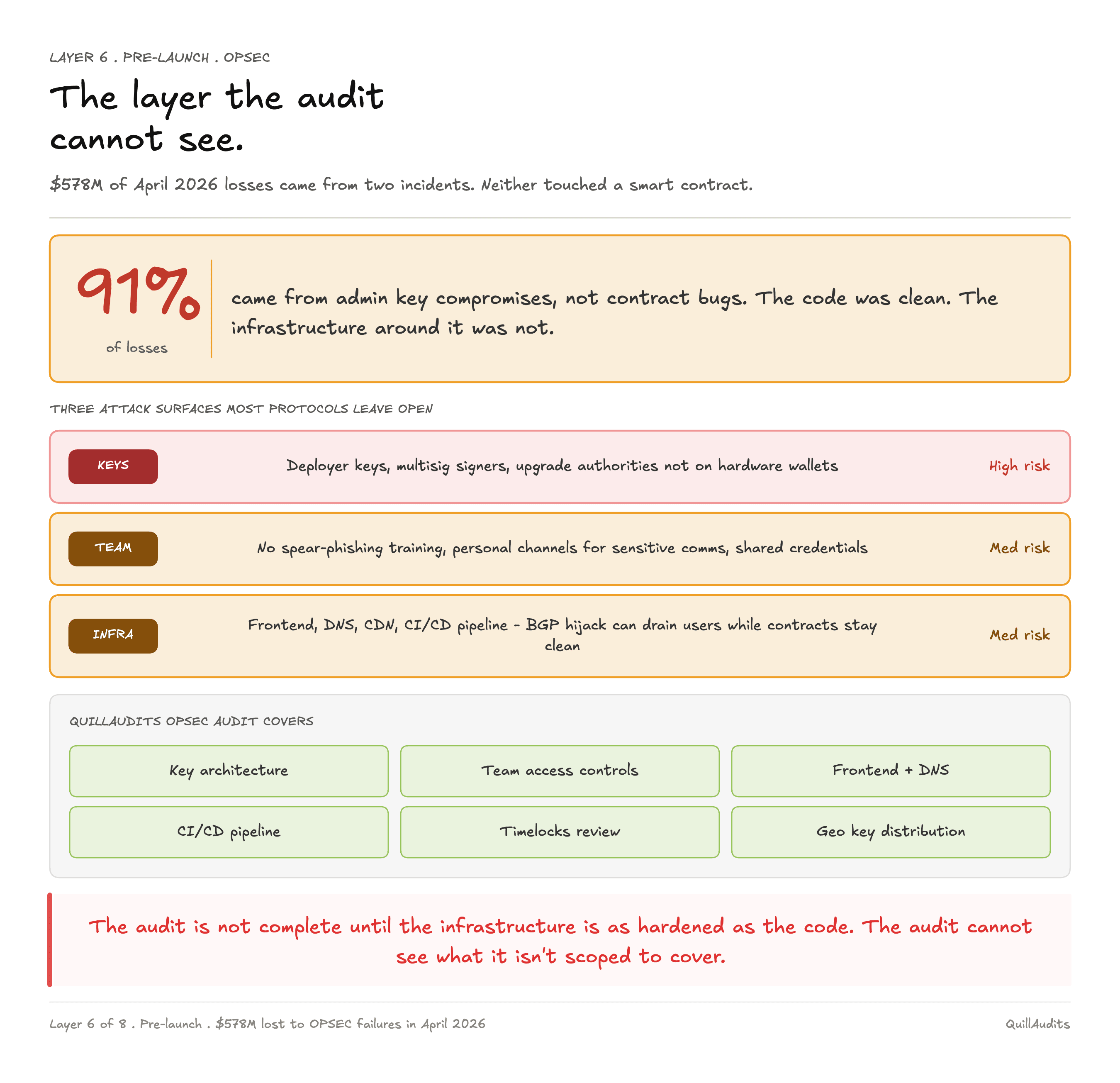
Operational security is the practice of hardening the human and infrastructure layer that your protocol depends on. This is where most protocols are completely exposed, and it is invisible to a code audit.
The baseline requirements: every privileged key deployer keys, multisig signers, upgrade authorities lives in a hardware wallet. Access is distributed across geographies. No single person holds unilateral control over protocol funds. Time-locks of at least 48 hours sit in front of every critical administrative function for any protocol above $10M TVL.
The team layer is equally important. Separate devices for crypto operations. Hardware 2FA on every privileged account. No sensitive operational communications on personal channels. Every team member with privileged access needs training to recognize spear-phishing attempts built specifically for them. Attacks that use information scraped from their LinkedIn, their GitHub commit history, their Twitter to construct messages that look like they came from a co-founder.
The infrastructure layer goes further. Your frontend is attack surface. Your DNS records are attack surface. A BGP hijack or a compromised CDN can serve a malicious frontend to your users while your on-chain contracts remain completely untouched. Users sign transactions they never intended to authorize. Funds move. Your contracts are not involved.
QuillAudits OPSEC audit covers the entire operational stack. Key management architecture, team access control, frontend infrastructure, DNS configuration, CI/CD pipeline security. The audit is not complete until the infrastructure is as hardened as the code.
Monitoring: The Attack You Don't Stop, You Detect
Deployment is not the finish line. It is when the adversary starts paying attention.
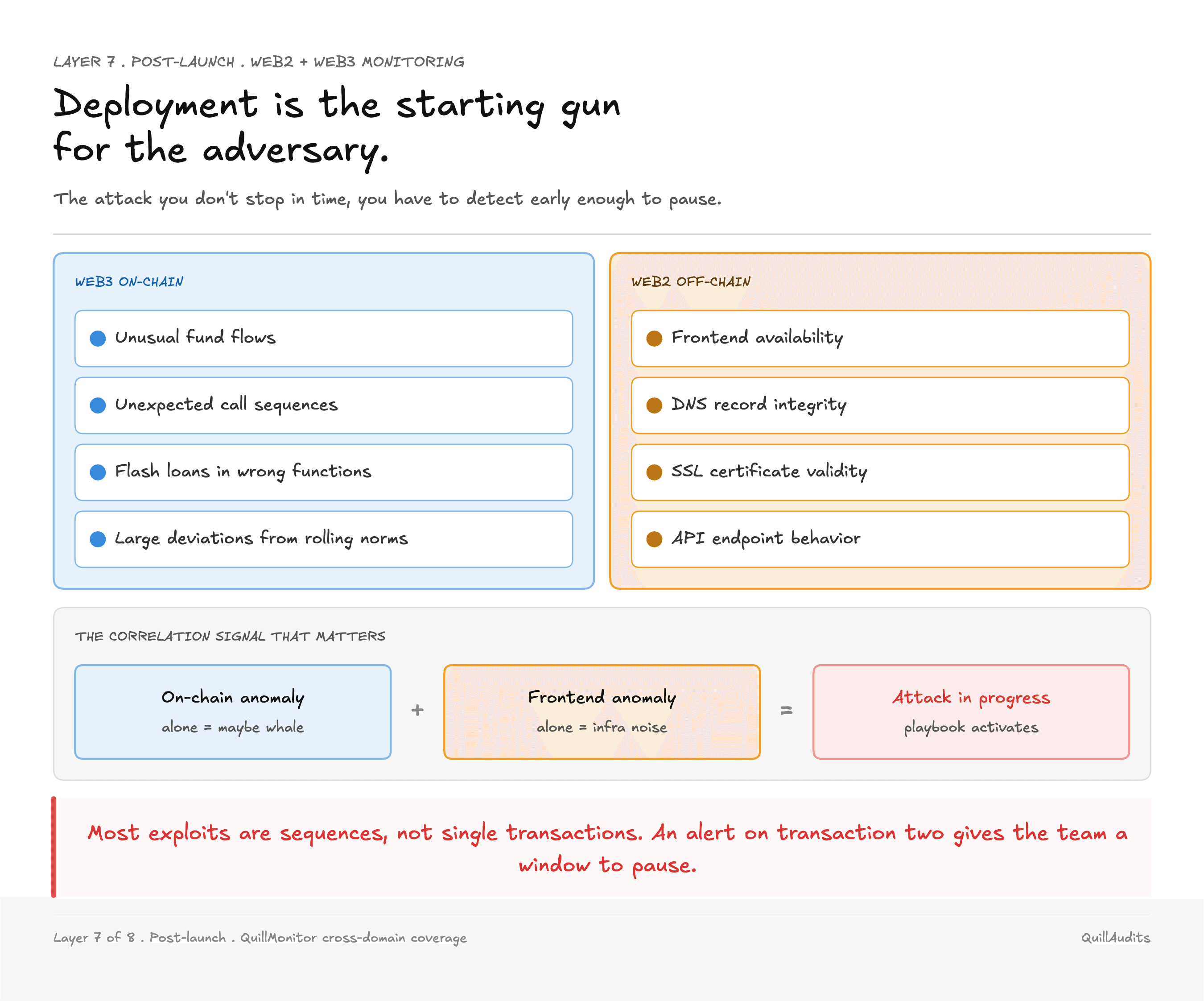
On-chain monitoring means every transaction against your protocol is analyzed against behavioral baselines in real time. Unusual fund flows. Unexpected function call sequences that don't match historical patterns. Large withdrawals that deviate from rolling norms. Flash loan interactions in functions where flash loans have no legitimate use case.
The goal is not to catch the attacker after the transaction confirms. The goal is to catch the attack while the transaction is in the mempool, or at the first anomalous transaction before the full exploit sequence completes. Most protocol exploits are not single-transaction events. They are sequences. Setup transactions followed by the exploit followed by fund movement. An alert on transaction two gives the team a window to pause.
Off-chain monitoring runs in parallel. Frontend availability, DNS record integrity, SSL certificate validity, API endpoint behavior. The correlation layer is where the signal lives. An on-chain anomaly alone might be a large whale. A frontend anomaly alone might be infrastructure noise. An on-chain anomaly plus a frontend anomaly at the same timestamp is an attack in progress. The response playbook activates.
QuillMonitor, QuillAudits continuous monitoring product, provides this coverage across Web3 systems. It is the layer that closes the gap between the audit said we're secure and we're still secure at latest block.
The Incident Response Plan No One Wants to Write
Some attacks will succeed. The question is whether you lose everything or lose the first ten minutes.
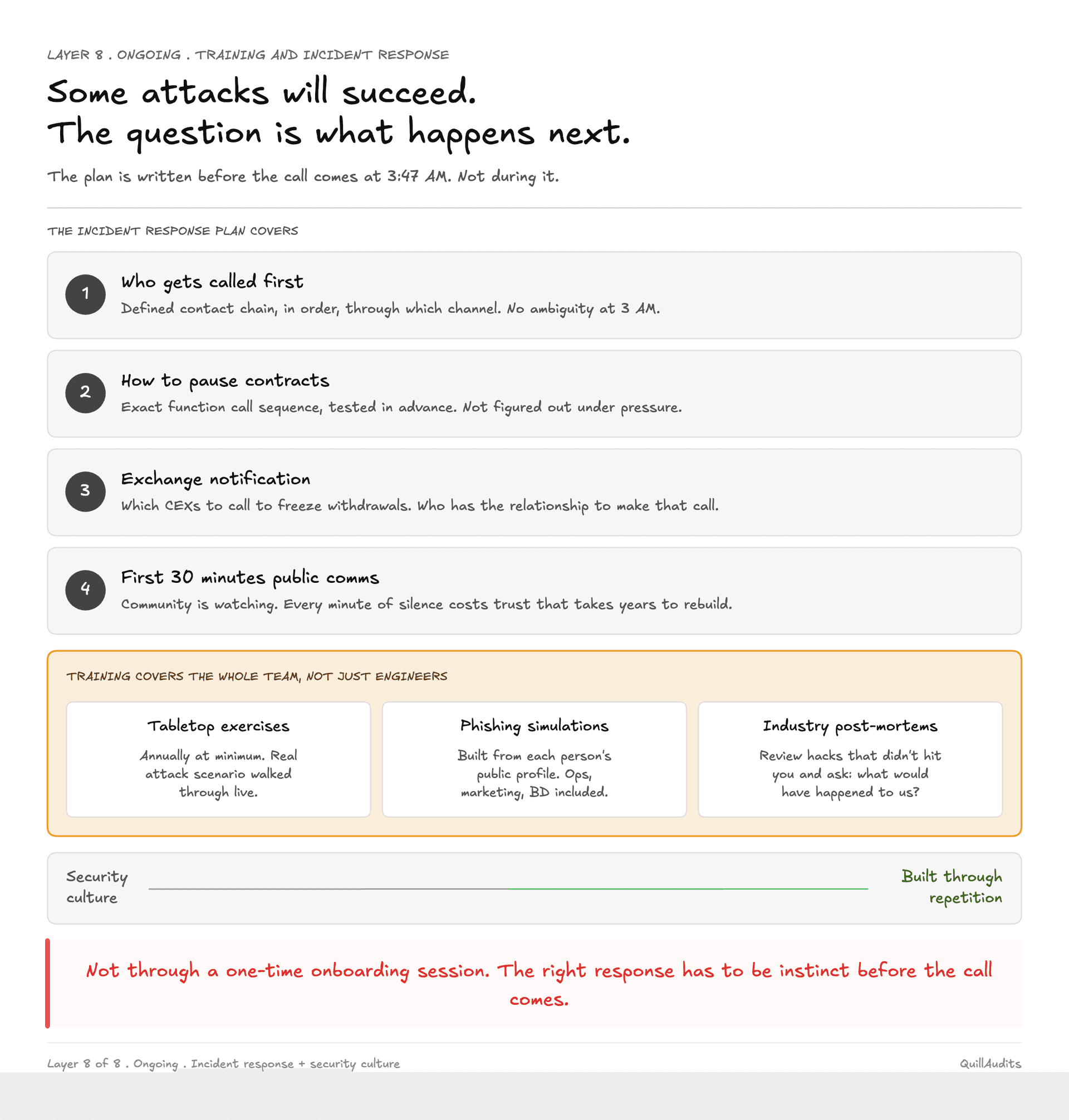
Before anything happens, the protocol needs a written incident response plan: who gets called first, in what order, through which channel. How to pause contracts. The exact function call sequence, tested in advance. Which centralized exchanges need to be notified to freeze withdrawals, and who has the relationship to make that call at 3 AM. What gets communicated publicly in the first thirty minutes, because the community is watching and every minute of silence costs trust that takes years to rebuild.
The plan gets drilled. Tabletop exercises, annually at minimum, where the scenario is a specific attack type and the team walks through every decision point in real time. Post-mortems on industry incidents that didn't target your protocol but could have, with a specific answer to: what would have happened to us if this attack hit our architecture instead?
Security culture is built through repetition until the response is instinct. Not through a one-time onboarding session that nobody remembers six months later.
The Stack, Complete
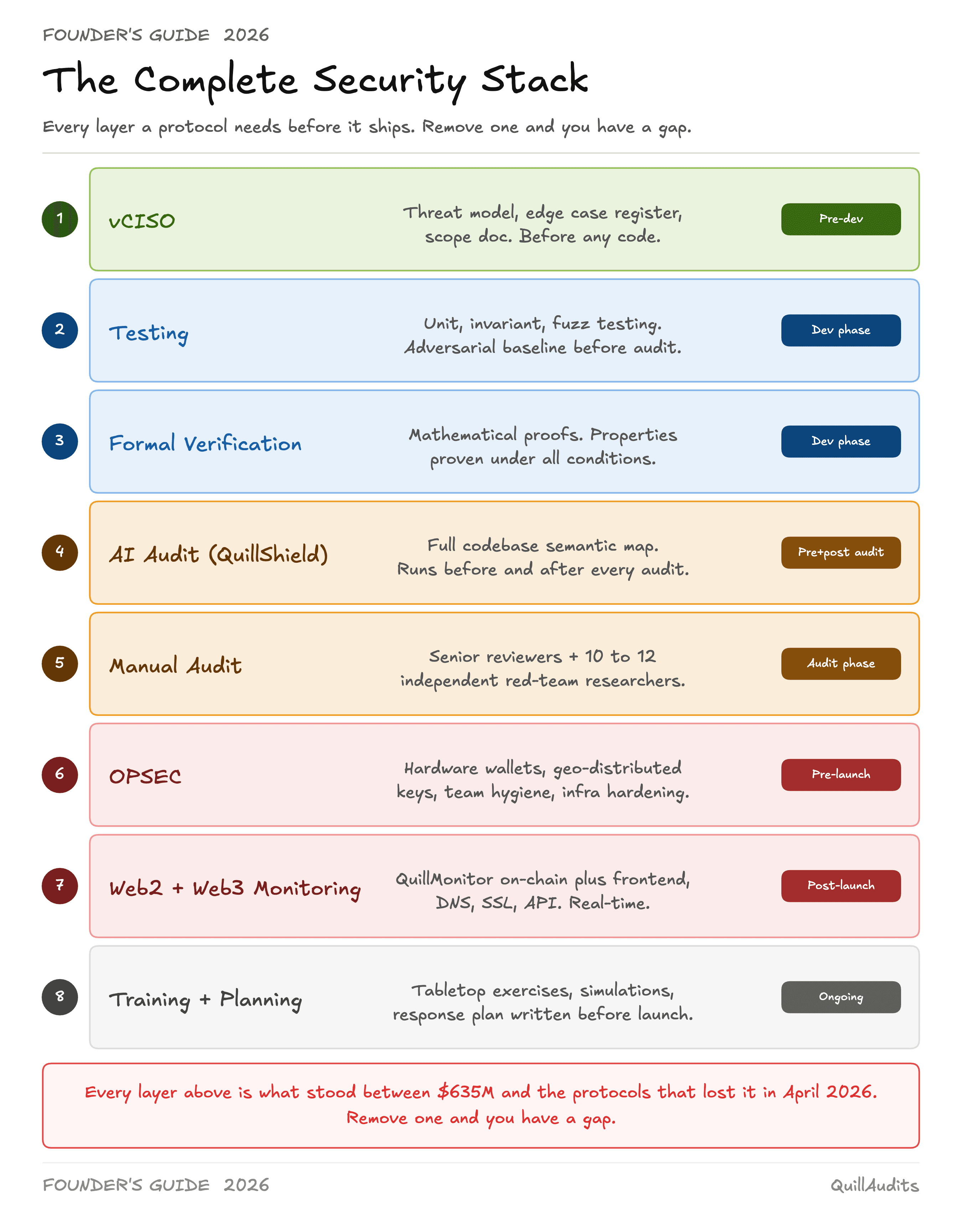
Each layer above is not a standalone option. It is one layer in a stack where every gap is a potential failure mode.
The vCISO defines the threat model before a line of code is written. Adversarial testing and formal verification prove the code holds under conditions the team didn't anticipate. AI augmentation and manual auditing find what automated tools and human intuition each miss alone. OPSEC hardens the infrastructure the code depends on. Monitoring watches every layer in real time after deployment. Incident response ensures the team knows what to do when the call comes at 3:47 AM.
$635 million disappeared in April 2026 across protocols that had most of these layers but not all of them. The layer they were missing is usually where the attacker went.
QuillAudits offers the complete stack. 1,500+ protocols secured across every major chain. Every threat class, from reentrancy to state-level infrastructure attacks.
If you're building something worth protecting, the conversation starts here.
Conclusion
Security is not a milestone reached before launch. It is an ongoing system of decisions, processes, and habits that begin long before the first line of code and continue long after deployment. Protocols fail where assumptions go unchallenged and where a single missing layer becomes the attacker's entry point. The strongest protocols are not the ones with the most audits, but the ones that build security into their culture from day one and continuously evolve alongside the threat landscape.

Contents