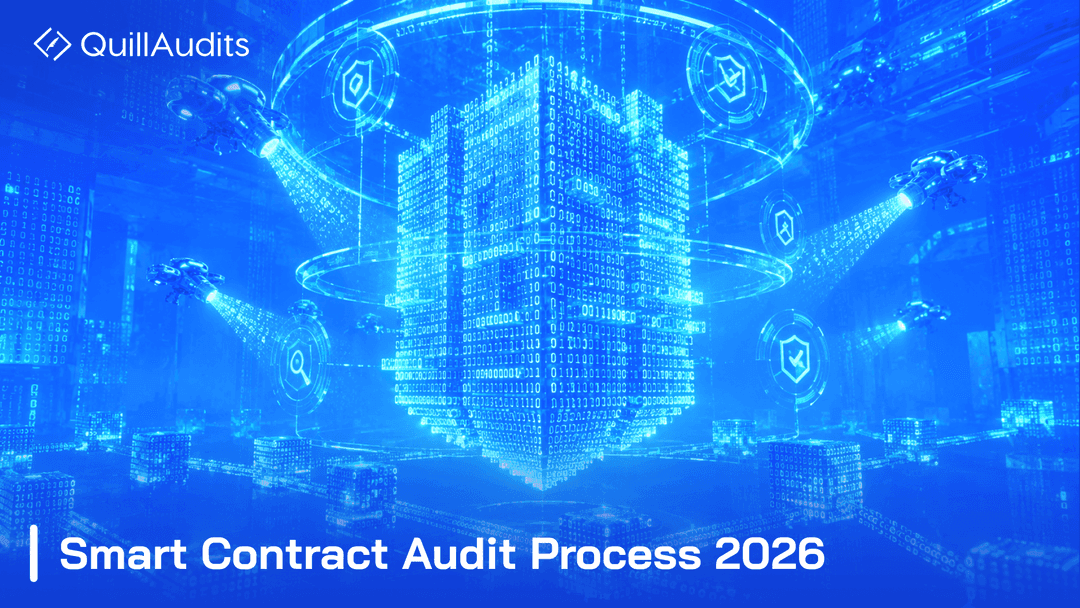
Smart Contract Audit Process 2026
A complete breakdown of the smart contract audit process in 2026, covering fuzzing, formal verification, AI audit, manual audit, independent researcher review, mitigation review, deployment checks, and opsec.

Smart contract exploits in 2026 are no longer limited to reentrancy bugs and simple overflow errors. Attackers now target cross-chain bridges, RWA settlement layers, oracle configurations, and the operational security surrounding multisig wallets. A single missed edge case in a lending protocol, or a poorly distributed signer set, can cost a protocol tens of millions of dollars in minutes.
This is why the smart contract audit process in 2026 looks very different from a single pass of manual code review. A modern smart contract security audit combines automated tooling, formal guarantees, independent human judgment, and post-deployment operational discipline into one methodology. This guide breaks down that full smart contract audit process stage by stage, the same methodology QuillAudits runs on every engagement: fuzzing, formal verification, AI-assisted audit, manual audit, independent researcher review, mitigation review, deployment checks, and opsec checks.
Smart Contract Audit Process 2026 at a Glance
Before going stage by stage, here is the full smart contract audit process in summary. Each stage catches a different class of vulnerability that the others tend to miss.
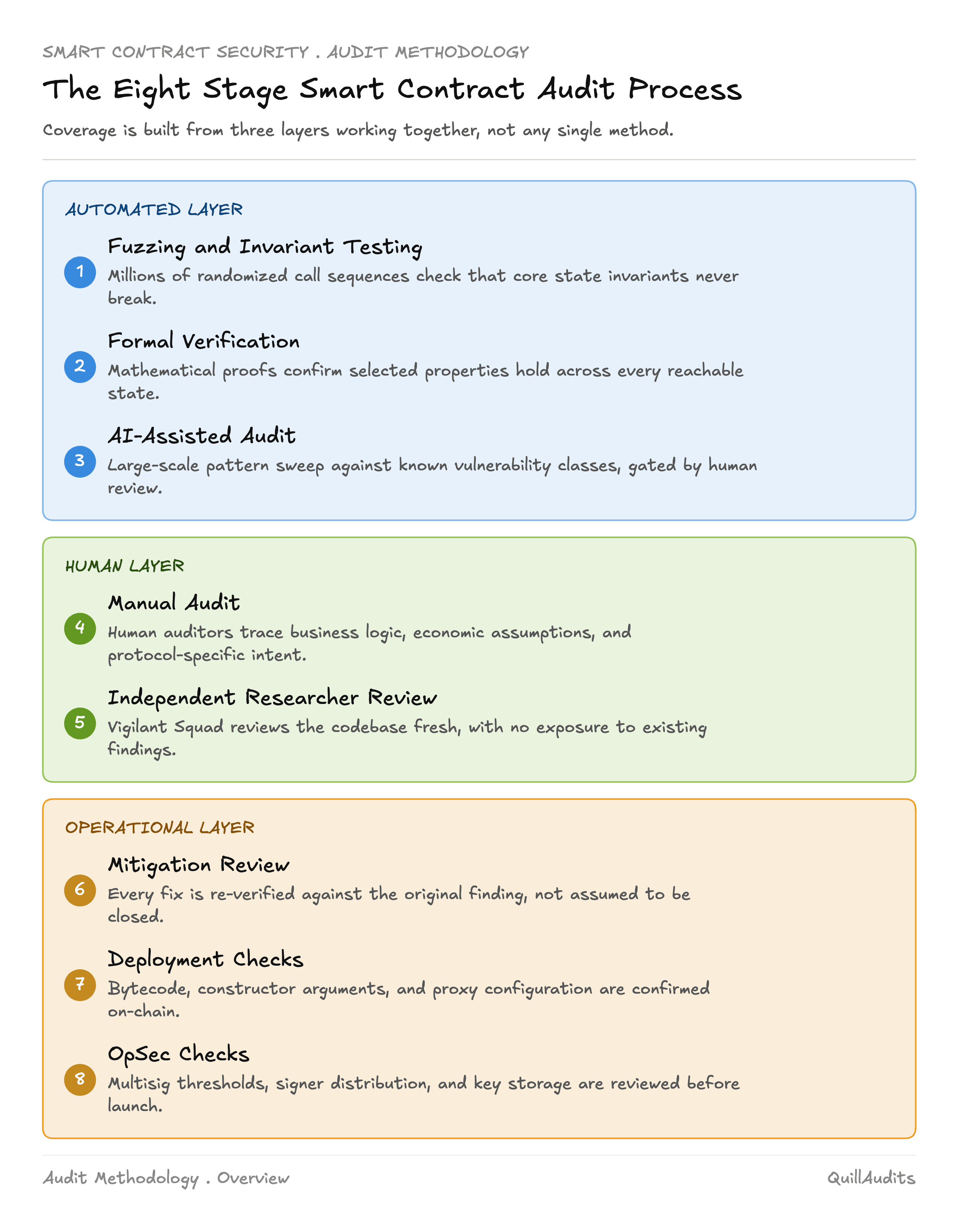
- Fuzzing and invariant testing - automated random and stateful testing to break protocol invariants
- Formal verification - mathematical proof that critical properties hold across every possible state
- AI-assisted audit - large-scale pattern matching against known smart contract vulnerability classes
- Manual audit - human-led review of business logic, economic assumptions, and intent
- Independent researcher review - a second, unanchored pass from external researchers (Vigilant Squad)
- Mitigation review - re-verification that every fix actually closes the reported issue
- Deployment checks - confirming deployed bytecode and configuration match what was audited
- Opsec checks - multisig configuration, signer distribution, and hardware wallet enforcement
What Is a Smart Contract Audit Process
A smart contract audit process is the structured methodology a security firm applies to identify, verify, and help remediate vulnerabilities in a blockchain codebase before and after it goes live. A modern smart contract audit process is not a single code review. It is a pipeline of complementary techniques, each designed to catch a different category of bug: automated tools for scale, formal methods for mathematical certainty, and human auditors for judgment and intent.
Why a Single-Pass Manual Review Is Not Enough
Manual review is excellent at catching business logic errors, incorrect assumptions about external protocol behavior, and access control mistakes. It is comparatively weak at exploring the full state space of a contract. A human reviewer might trace through five or six execution paths for a function. A fuzzer can generate millions of inputs and state transitions in the same time. Formal verification goes further, proving that certain properties hold for every possible input rather than a sampled subset.
Each method in a smart contract audit methodology has blind spots the others cover. Fuzzers find edge cases but do not understand intent. Formal verification proves properties but only the properties you specify. AI-assisted review is fast at pattern matching against known vulnerability classes but can miss protocol-specific logic errors. Manual audit understands intent but is bounded by reviewer time and attention. Layering all of these, then following through with independent review, mitigation review, deployment checks, and opsec checks, closes most of the gaps any single method leaves open.
Smart Contract Fuzzing and Invariant Testing
Fuzzing is the first automated layer applied to any codebase in a smart contract security audit. The goal is to generate a large volume of pseudo-random inputs and call sequences against the contract and check whether any of them break the properties that should always hold.
Two forms of fuzzing are used side by side in a thorough smart contract audit process.
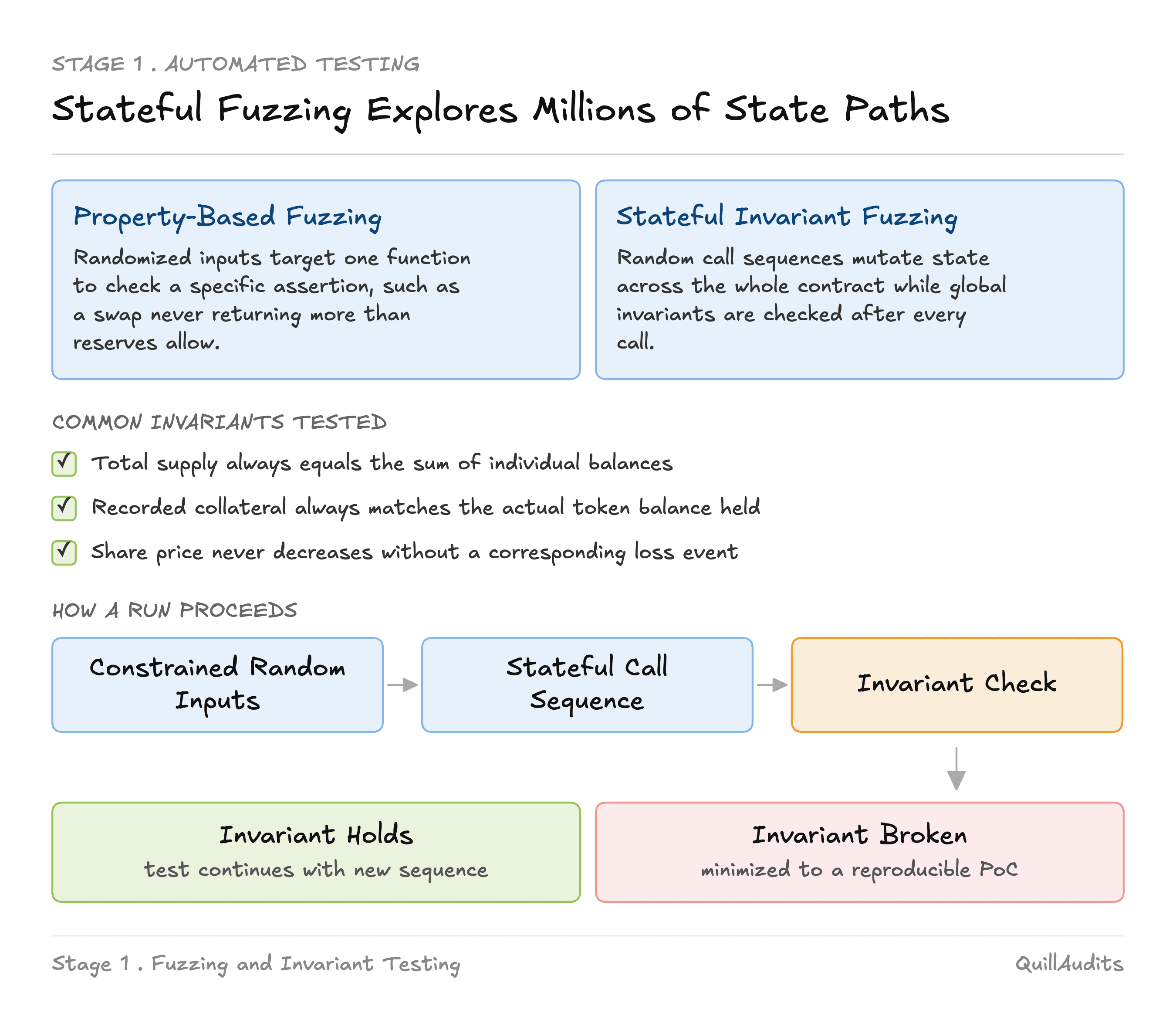
Property-based fuzzing targets individual functions with randomized inputs to check specific assertions, such as a swap function never returning more output tokens than the pool's reserves allow, or a withdrawal function never allowing a user to remove more than their recorded balance.
Stateful invariant fuzzing is more powerful and more relevant for complex DeFi protocols. Rather than testing one function in isolation, the fuzzer calls a random sequence of functions across the entire contract, mutating state along the way, and checks that global invariants hold after every call. Typical invariants include total supply always equaling the sum of individual balances, recorded collateral always matching actual token balance, and share price never decreasing without a corresponding loss event.
Foundry's invariant testing framework is the primary tool here, supplemented with handler contracts that constrain the fuzzer to realistic call sequences so that the fuzzer spends its budget exploring meaningful states rather than reverting on trivial input errors. Call sequences that break an invariant are minimized down to the shortest reproducible failure case and handed to the audit team as a proof of concept.
For codebases with complex mathematical components such as AMM curves, interest rate models, or liquidation formulas, differential fuzzing is used as well, comparing the Solidity implementation's output against a reference implementation to catch precision loss or rounding errors that would otherwise pass unnoticed.
Formal Verification for Smart Contracts
Where fuzzing samples the state space, formal verification proves properties across it exhaustively using symbolic execution and theorem proving. This stage of the smart contract audit process is reserved for the highest-value, highest-risk components of a codebase: core accounting logic, access control state machines, and any function where a single violated invariant could drain the protocol.
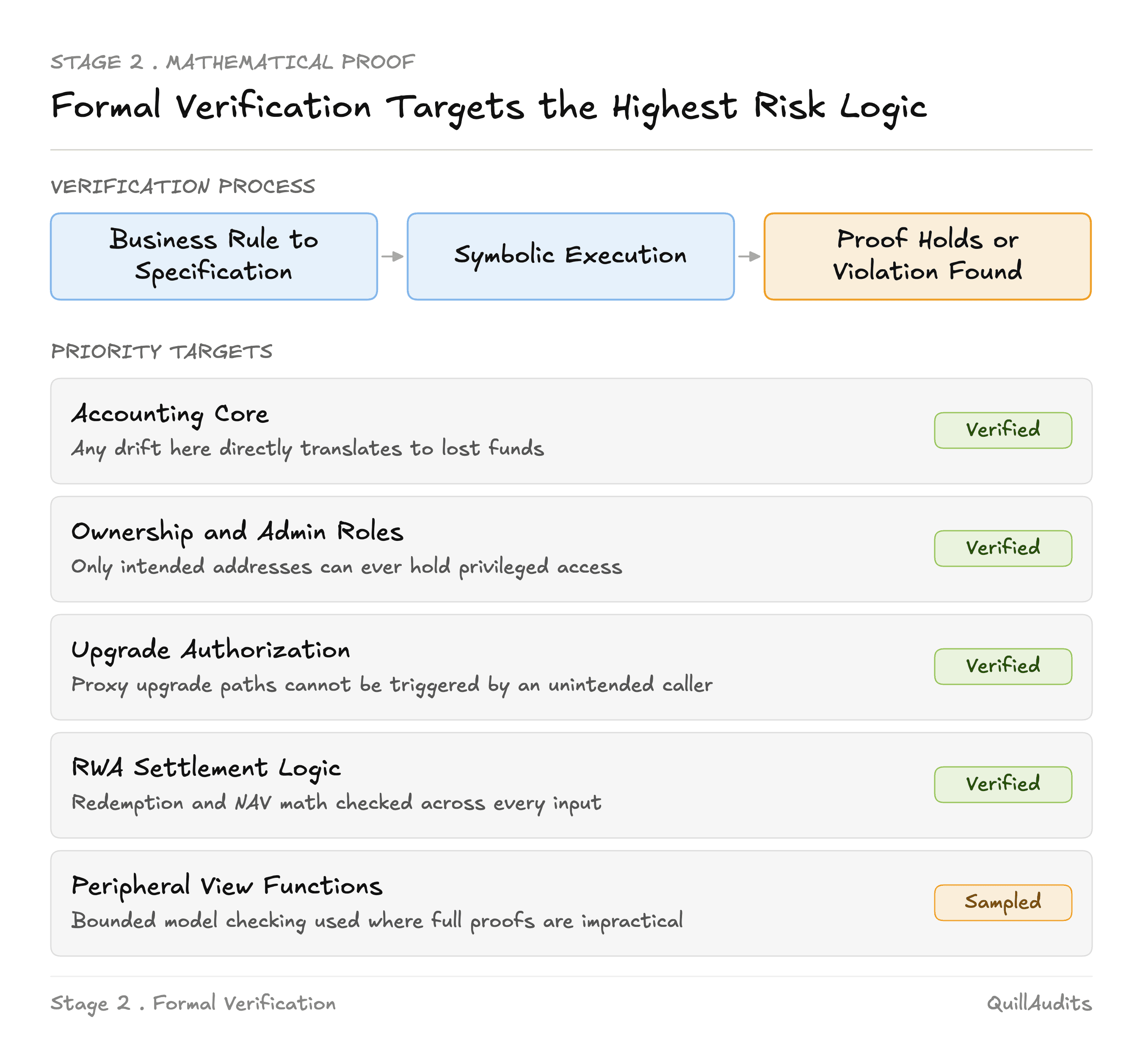
The process starts by translating business requirements into formal specifications, statements like "the sum of all user shares must equal total supply at every reachable state" or "only the current owner or a pending owner accepted through a two-step transfer can hold admin rights." These specifications are checked against every possible input and state transition using symbolic execution engines that represent variables as symbolic values rather than concrete numbers, exploring all paths through the code simultaneously.
Formal verification is expensive in engineer time and computation, so it is applied selectively rather than across an entire codebase. Priority targets are usually the accounting core, any function that changes ownership or admin roles, upgrade authorization logic in proxy contracts, and the settlement or redemption logic in RWA and tokenized fund contracts, where an off-by-one error in share calculation directly translates to lost investor funds. Where full formal proofs are impractical due to complexity, bounded model checking is used instead, verifying properties hold up to a fixed number of transaction steps, which still catches the overwhelming majority of real-world exploit patterns.
AI-Assisted Smart Contract Audit
AI-assisted review sits between automated tooling and manual review in the smart contract audit process, acting as a force multiplier for the human auditors rather than a replacement for them. In 2026, LLM-based static analysis is mature enough to reliably flag known vulnerability patterns across a large codebase in minutes: unchecked external call return values, missing access control modifiers, reentrancy-prone state ordering, unsafe delegatecall usage, and signature replay risks from missing nonce or domain separator checks.
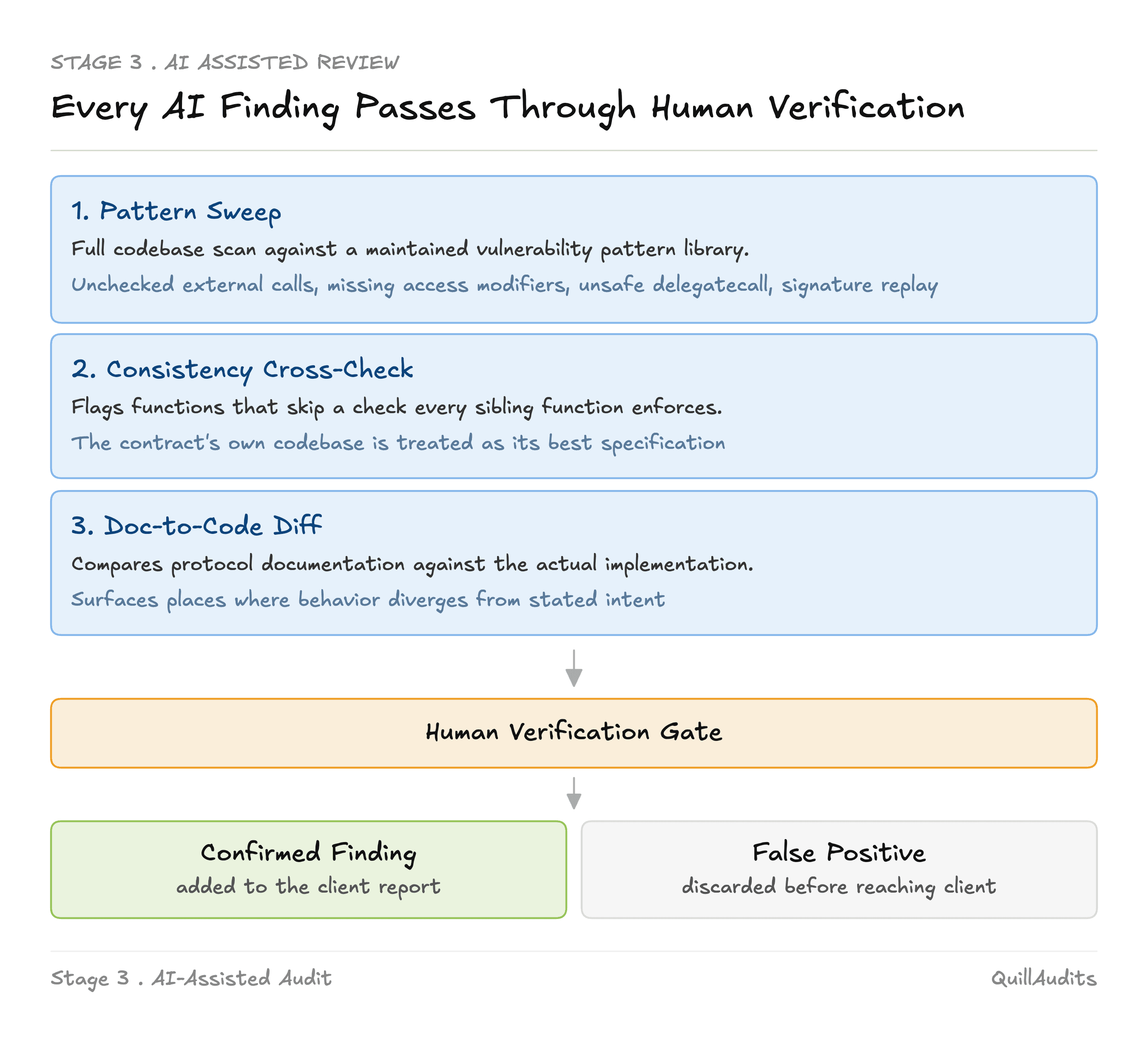
The AI-assisted audit runs in three stages. First, a full-codebase sweep against a maintained vulnerability pattern library, covering categories like DoS through unbounded loops, fee-on-transfer and rebasing token incompatibilities, oracle manipulation surfaces, and storage layout collisions in upgradeable proxies. Second, a cross-reference pass that checks whether the contract's actual behavior is internally consistent, flagging functions that skip a check that every similar function in the same contract enforces, since a contract's own codebase is often the best specification of what it is supposed to do. Third, a natural language diff between the protocol's documentation or whitepaper and the actual implementation, surfacing places where the code diverges from stated intent.
Every finding from an AI-assisted audit pass is a candidate, not a conclusion. False positive rates on pattern-matched findings are still meaningful, so nothing from this stage is reported to a client until a human auditor has independently confirmed it is exploitable in the context of that specific protocol.
Manual Smart Contract Audit
Manual audit remains the stage where the majority of critical and high severity findings in complex protocols originate, because it is the only stage that reasons about intent rather than pattern. Auditors read the codebase function by function, building a mental model of the protocol's state machine, then actively try to find inputs or sequences that violate the assumptions the code depends on.
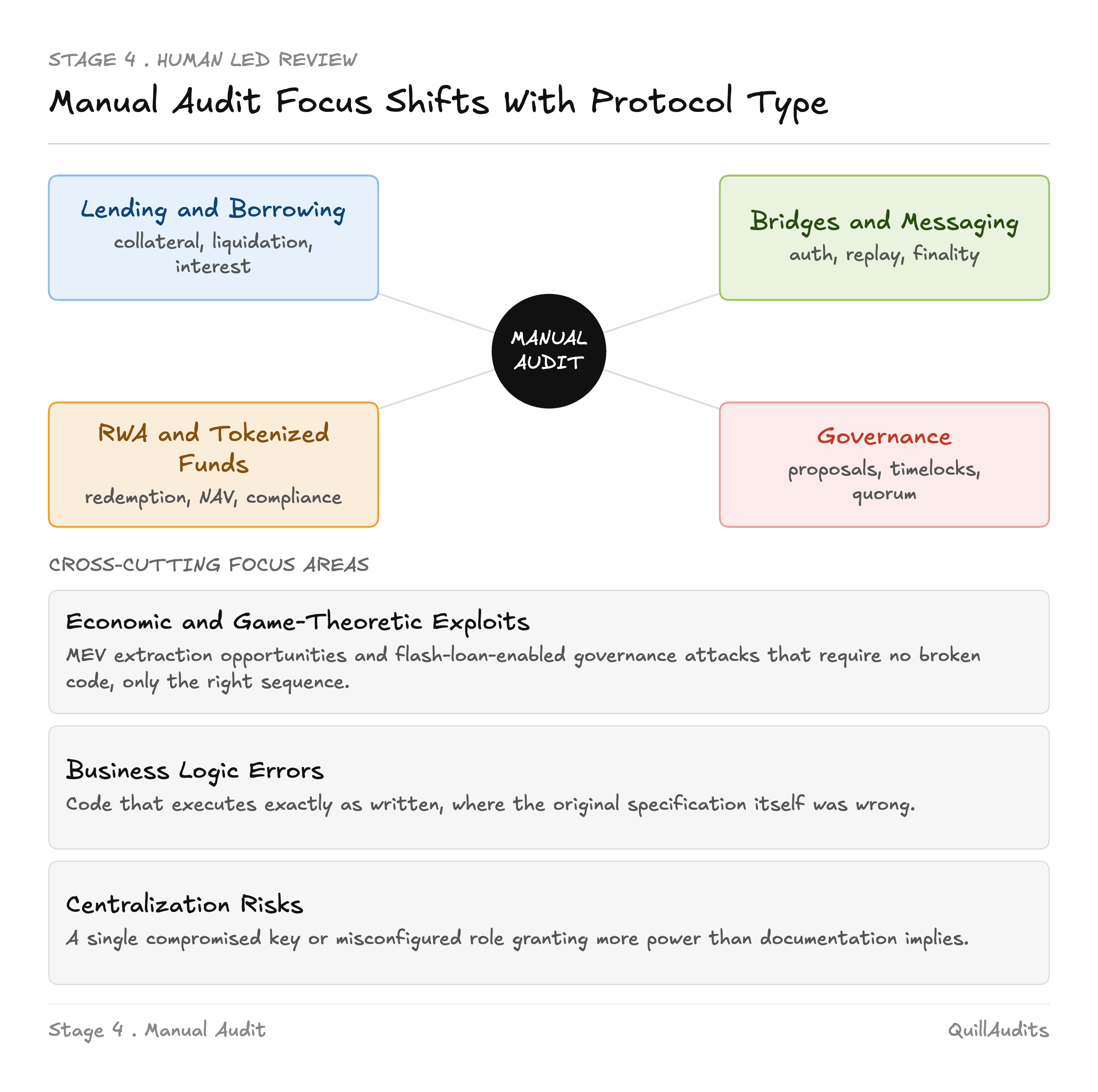
The manual audit process is structured around a checklist adapted to the protocol type. For lending and borrowing protocols, this means tracing collateral valuation paths, liquidation thresholds, and interest accrual timing. For bridges and cross-chain messaging, it means verifying that message authentication, replay protection, and finality assumptions hold on both source and destination chains. For RWA and tokenized fund protocols, it means confirming that redemption logic, NAV calculation, and compliance gating (KYC allowlists, transfer restrictions) cannot be bypassed through unexpected call orderings.
Auditors also specifically hunt for the categories that automated tooling tends to miss during a manual smart contract audit: economic and game-theoretic exploits such as MEV extraction opportunities and flash-loan-enabled governance attacks, business logic errors where the code executes exactly as written but the specification itself was wrong, and centralization risks where a single compromised key or misconfigured role grants more power than the protocol's documentation implies.
Findings are documented with severity ratings, a reproducible proof of concept where applicable, and a recommended fix, then walked through directly with the protocol's engineering team so there is no ambiguity about root cause.
Independent Security Researcher Review
A single audit team, however experienced, develops blind spots simply from spending days inside the same codebase. To counter this, the reviewed contract is passed to Vigilant Squad, a pool of independent security researchers outside the core audit team, for a fresh look after the manual audit is complete but before mitigation review begins.
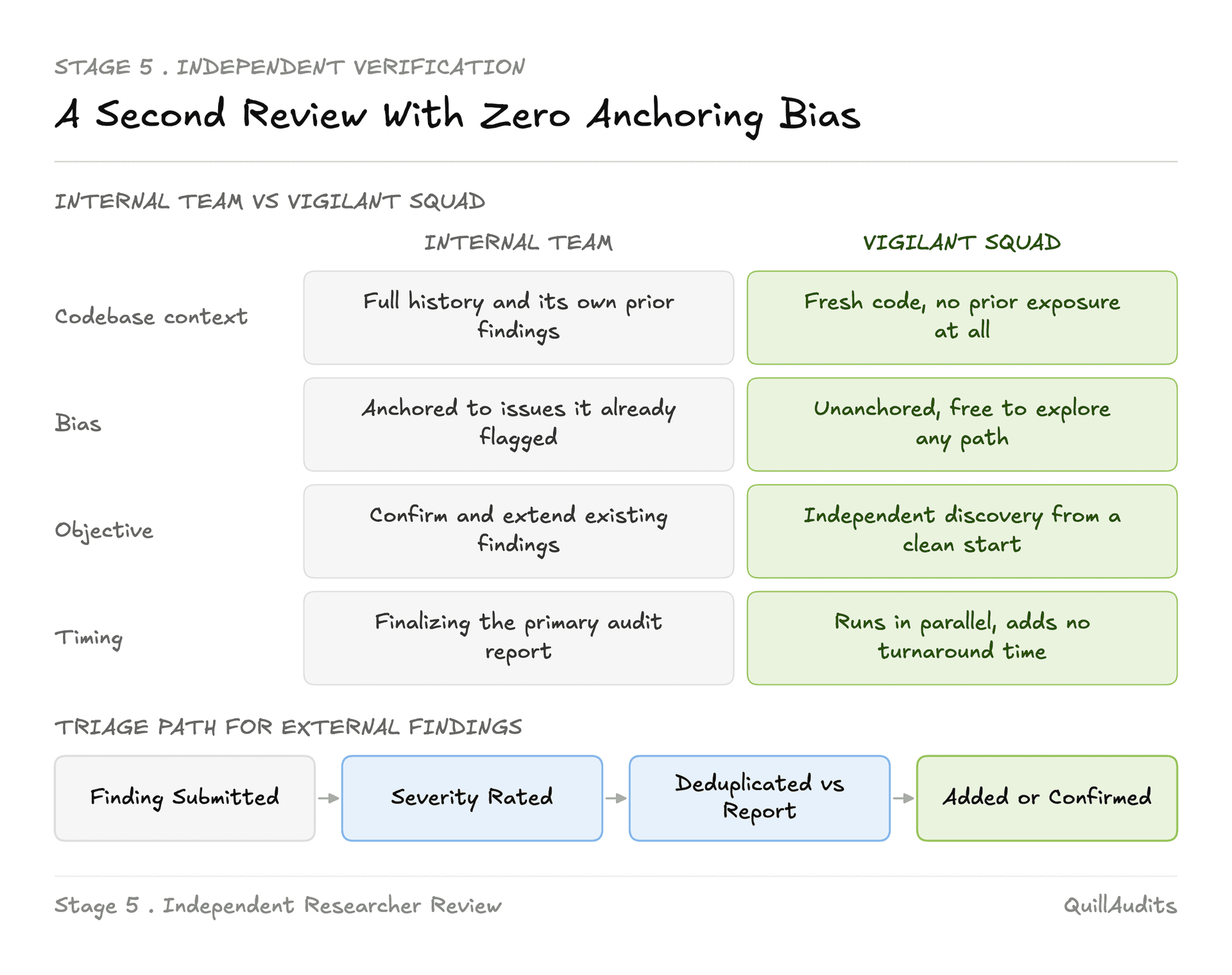
These researchers work from the codebase without the accumulated context or assumptions the primary auditors have built up. They are not told which areas the internal team already flagged, so their review is not anchored to the existing findings list. This structure is deliberate: an auditor who already knows where the internal team is worried tends to spend more time confirming those worries and less time exploring paths nobody has looked at yet.
Vigilant Squad researchers are drawn from active participants in the competitive audit contest scene, people who spend their time hunting for the kind of subtle, protocol-specific logic errors that contest judging rewards and that a single internal review can miss under deadline pressure. Their findings are triaged the same way internal findings are: severity rated, deduplicated against the existing report, and where a genuinely new issue surfaces, added to the report before it goes back to the protocol team. Where a researcher's finding overlaps with something the internal team already caught, it serves as independent confirmation that the issue is real and worth prioritizing.
This stage of the smart contract audit process adds a second, differently biased set of eyes on the codebase at close to zero additional turnaround time, since it runs in parallel with the internal team finalizing its own report rather than as a sequential step afterward.
Smart Contract Mitigation Review
A vulnerability report is only half the smart contract audit process. Once the protocol team ships fixes, every single finding, from the internal audit team and from Vigilant Squad alike, is reviewed again against the patched code, not just spot-checked. This stage exists because fixes introduce their own risk: a patch for a reentrancy issue might introduce a new access control gap, or a fix that adds a check in one function might miss an identical code path in a sibling function.
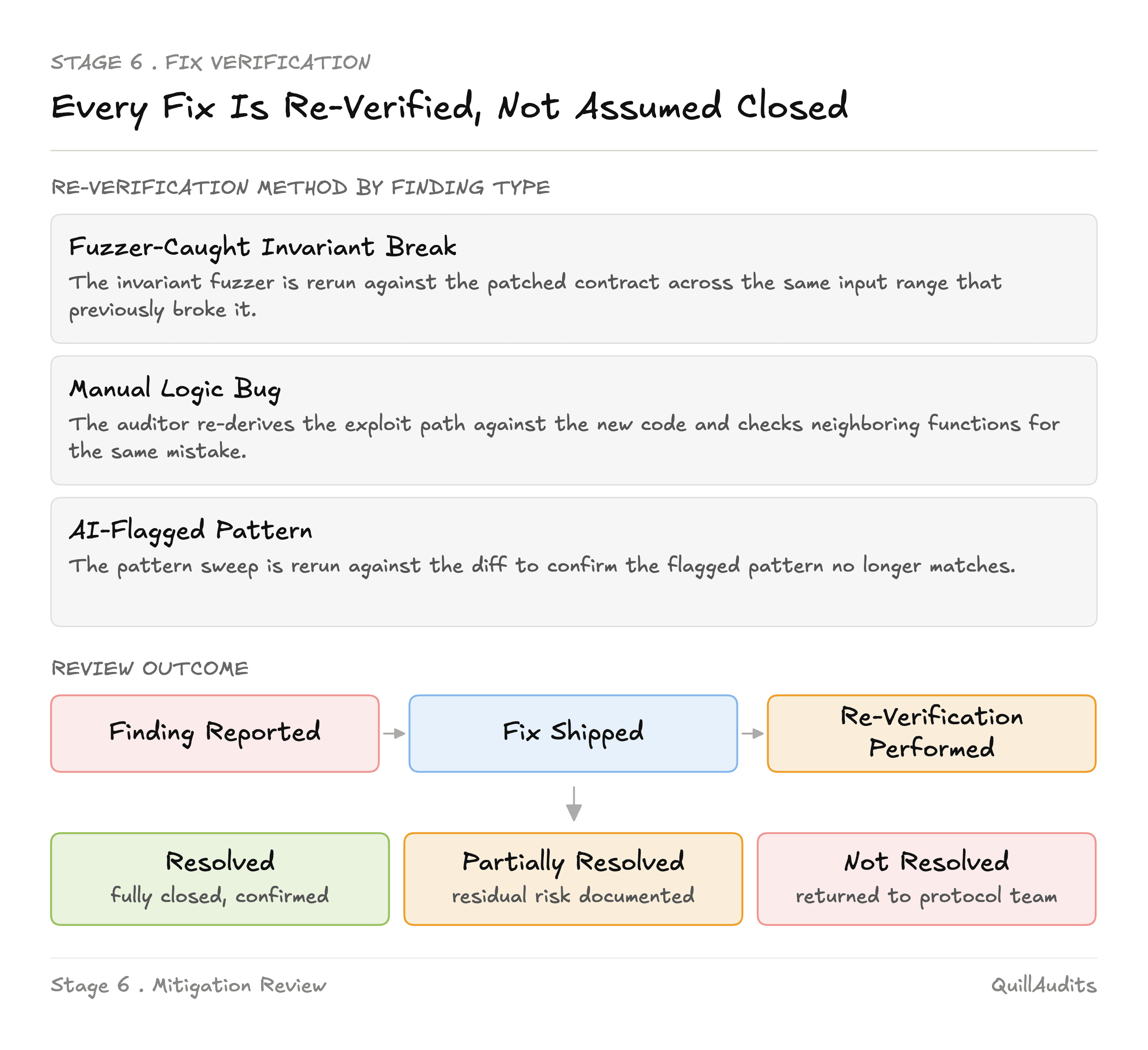
The mitigation review repeats the relevant slice of the original methodology against the diff. If the original finding was caught by an invariant fuzzer, the fuzzer is rerun against the patched contract to confirm the invariant now holds across the same range of inputs that previously broke it. If the finding was a manual logic bug, the auditor re-derives the exploit path against the new code to confirm it is closed, and checks neighboring functions for the same class of mistake. Each finding is closed out with one of three statuses: resolved, partially resolved with residual risk documented, or not resolved, and a final report reflects the state of the code as actually deployed rather than the state at the time of the original findings.
Smart Contract Deployment Security Checks
The gap between an audited codebase and a correctly deployed protocol is a common source of real-world losses that have nothing to do with the Solidity itself. Deployment checks are the stage of the smart contract audit process that verifies what goes on-chain matches what was audited, and that the deployment configuration itself is safe.
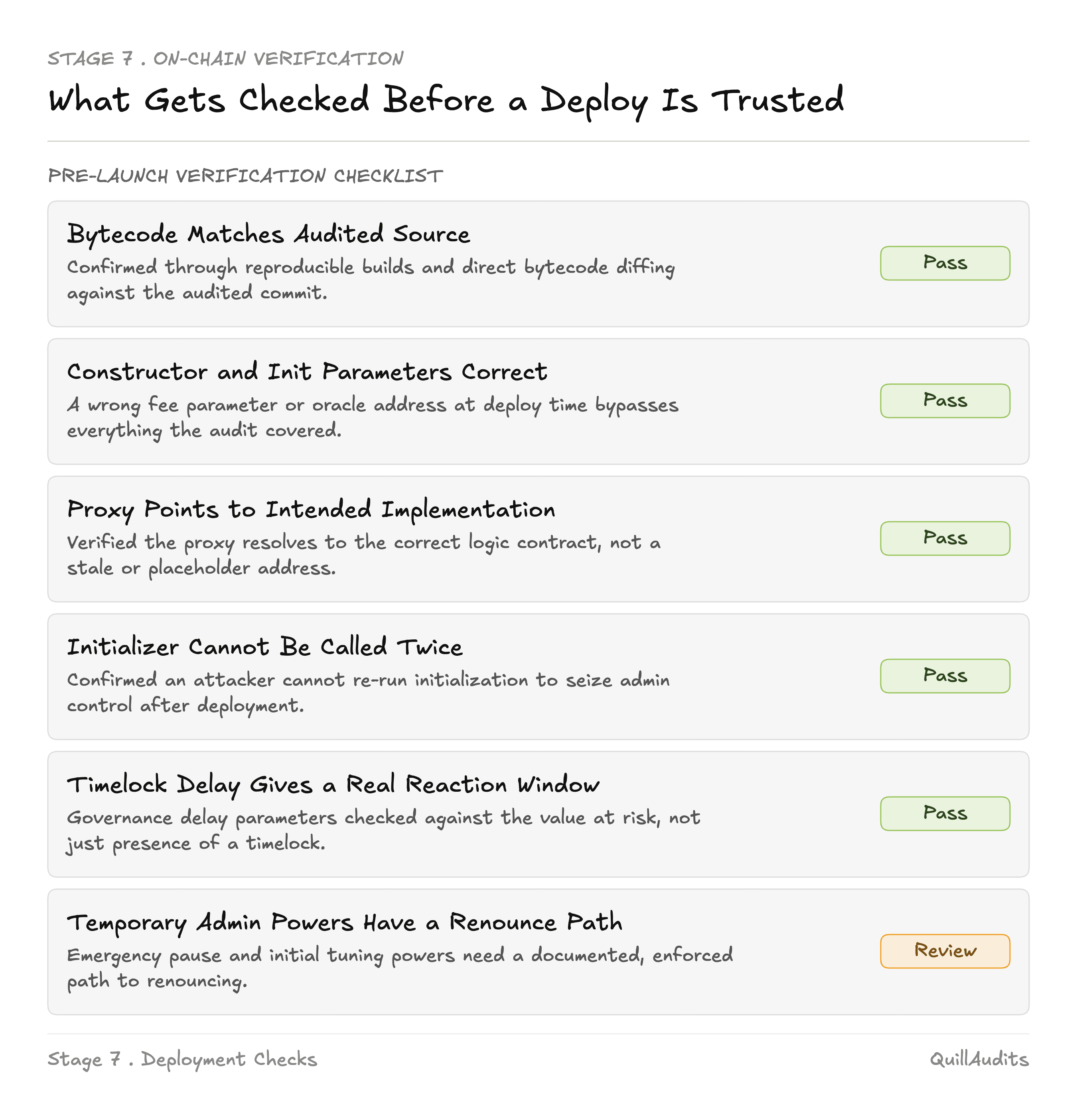
This includes confirming deployed bytecode matches the audited source through reproducible builds and bytecode diffing, verifying constructor arguments and initialization parameters match the intended configuration (a wrong fee parameter or an incorrectly set oracle address at deploy time bypasses the entire audit), checking that proxy contracts point to the correct implementation and that initializer functions cannot be called a second time by an attacker, confirming timelock and governance delay parameters are set to values that give the community a real window to react to malicious proposals, and validating that any admin functions intended to be temporary (emergency pause, initial parameter tuning) have a documented and enforced path to renouncing or transferring that power.
Multisig and OpSec Security Checks for Web3 Protocols
Even a perfectly audited and correctly deployed contract can be drained if the keys controlling it are poorly managed. Opsec review looks past the code entirely and evaluates how the protocol's privileged operations are actually secured in practice. This is one of the most overlooked stages of the smart contract audit process, and one of the most common root causes of large losses in 2026.
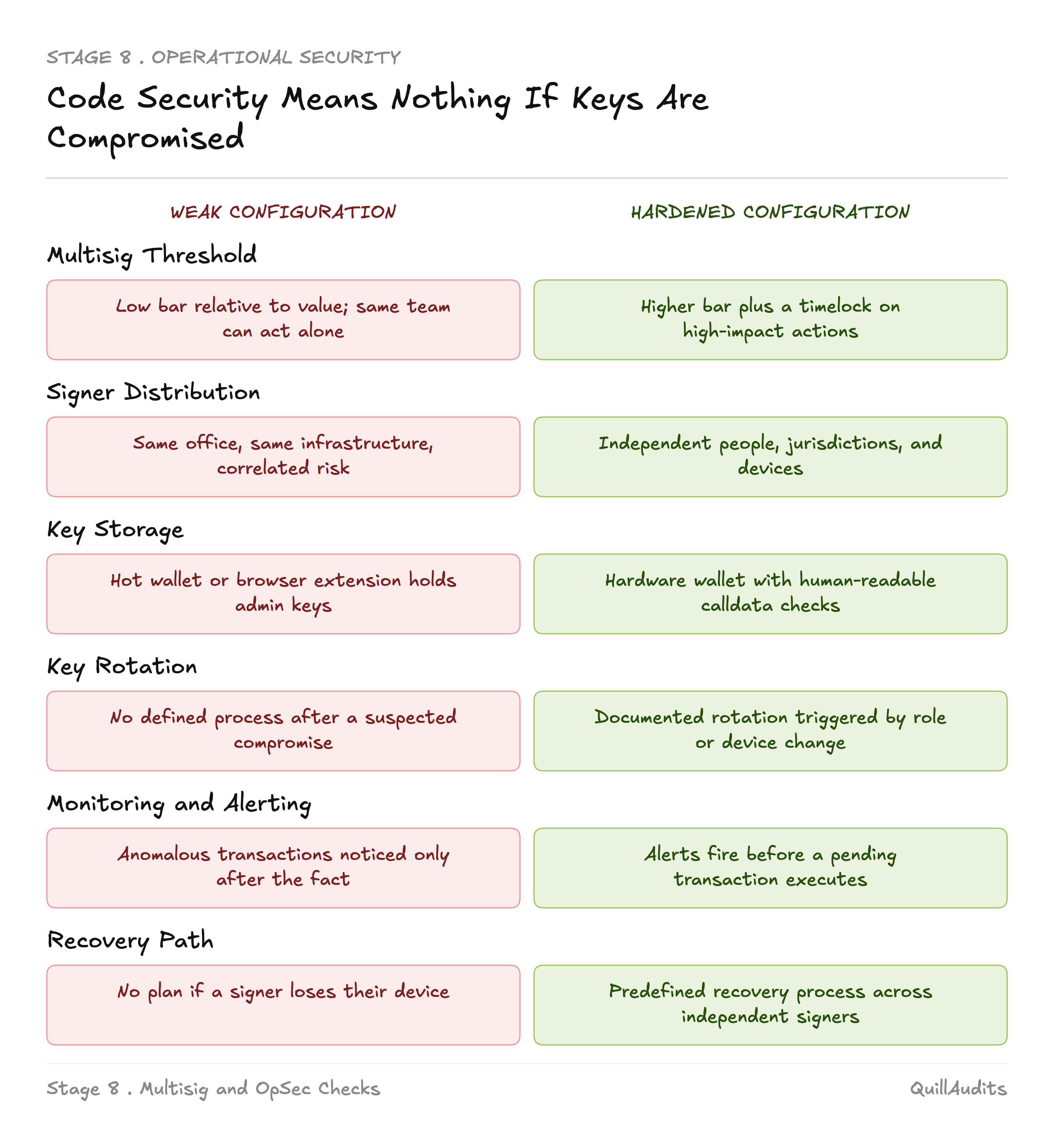
Multisig configuration is reviewed for threshold appropriateness relative to the value controlled and the number of signers, whether the threshold and signer set can be changed unilaterally by a subset of signers, and whether critical actions (upgrades, large withdrawals, parameter changes with financial impact) require a higher threshold or a timelock delay on top of the multisig approval itself.
Signer geographic and organizational distribution is checked to reduce correlated compromise risk. A multisig where all signers work for the same team, sit in the same office, or use the same infrastructure provider has a much smaller real-world attack surface for an adversary to compromise than one distributed across independent individuals, jurisdictions, and operational environments. Protocols with all signers reachable through a single social engineering vector or a single compromised device effectively have single points of failure disguised as multisigs.
Hardware wallet usage is verified for every signer with meaningful privileges. Hot wallets or browser extension wallets holding admin keys are flagged regardless of how strong the multisig threshold is, since a compromised individual signer's device is often the actual attack vector in real incidents, not the smart contract logic. Signing procedures are reviewed to confirm signers verify transaction calldata against a human-readable source before signing rather than blind-signing raw hex, since blind signing has been the root cause of several large multisig compromises.
Beyond these three checks, the opsec review also covers key rotation procedures after any suspected compromise or personnel change, whether recovery paths exist if signers lose access to their devices, and whether monitoring and alerting is in place to detect anomalous transactions from the multisig before they are executed rather than after funds are already gone.
Bringing the Smart Contract Audit Process Together
None of these eight stages is sufficient on its own, and running them out of order reduces their value. Fuzzing and formal verification establish that the code holds up under exhaustive automated pressure before a human spends time on it. AI-assisted audit compresses the time needed to sweep for known patterns so manual auditors can focus their attention on protocol-specific logic and economic reasoning. Manual audit produces the findings that actually matter. Independent researcher review through Vigilant Squad catches what a single team, however careful, can miss simply from having spent too long inside the same code. Mitigation review confirms those findings are genuinely closed rather than assumed closed. Deployment checks confirm the audited code is what actually went live. Opsec checks confirm that even a flawless deployment cannot be undone by a single compromised key or an undertrained signer.
A protocol that treats its smart contract audit process as a one-time code review before launch, rather than a process that extends through deployment configuration and ongoing key management, is leaving exactly the kind of gap attackers in 2026 are actively looking for.
Conclusion
Smart contract security in 2026 requires more than a code review. Fuzzing and formal verification stress-test logic exhaustively, AI-assisted review accelerates pattern detection, and manual audit catches what only human judgment can. Independent researcher review adds a second, unanchored perspective before findings are finalized. Mitigation review, deployment checks, and opsec review close the gap between an audited codebase and a safely operated protocol, where most real losses now originate.

Contents