Beyond the Bytecode: Securing the Operational Nervous System of a Real-World Asset Protocol
Learn how admin concentration, NAV gaps, and weak signing policy became the attack surface beyond RWA bytecode.

Get an Audit done today for your Smart Contract
Join 1500+ leaders who secured themselves from losing Billion Dollars



Executive Summary
When every mint and redemption depends on a price computed off-chain, and every administrative action flows through institutional signing infrastructure, the smart contracts are only the beginning of the security story. This is the reality of modern real-world asset (RWA) protocols and it is why we were engaged to conduct an operational security review that looked far beyond the bytecode.
A RWA yield vault protocol, bridging tokenized on-chain deposits with off-chain credit and basis strategies, asked us to examine its live deployment. With privileged authority and underlying value residing significantly off-chain, the principal attack surface was operational: custody workflows, net asset value (NAV) computation, signer procedures, and third-party integration integrity.
Over the course of the engagement, we independently verified the live deployment state, benchmarked controls against the CryptoCurrency Security Standard (CCSS), NIST CSF 2.0, OWASP Smart Contract Top 10, and MITRE AADAPT frameworks, and mapped each finding to independently verified real-world precedents. We identified ten findings spanning critical concentrations of administrative power, collapsed separation of duties, signing policy weaknesses, NAV process gaps, and emerging social engineering threats. Critically, we also confirmed several robust controls already in place, including time-delayed upgrades, decommissioned deployer keys, and isolated pricing roles.
The Challenge
Most security audits in Web3 focus on smart contract source code. This engagement inverted that assumption. The protocol's contracts were not the primary concern; the human and procedural systems operating them were.
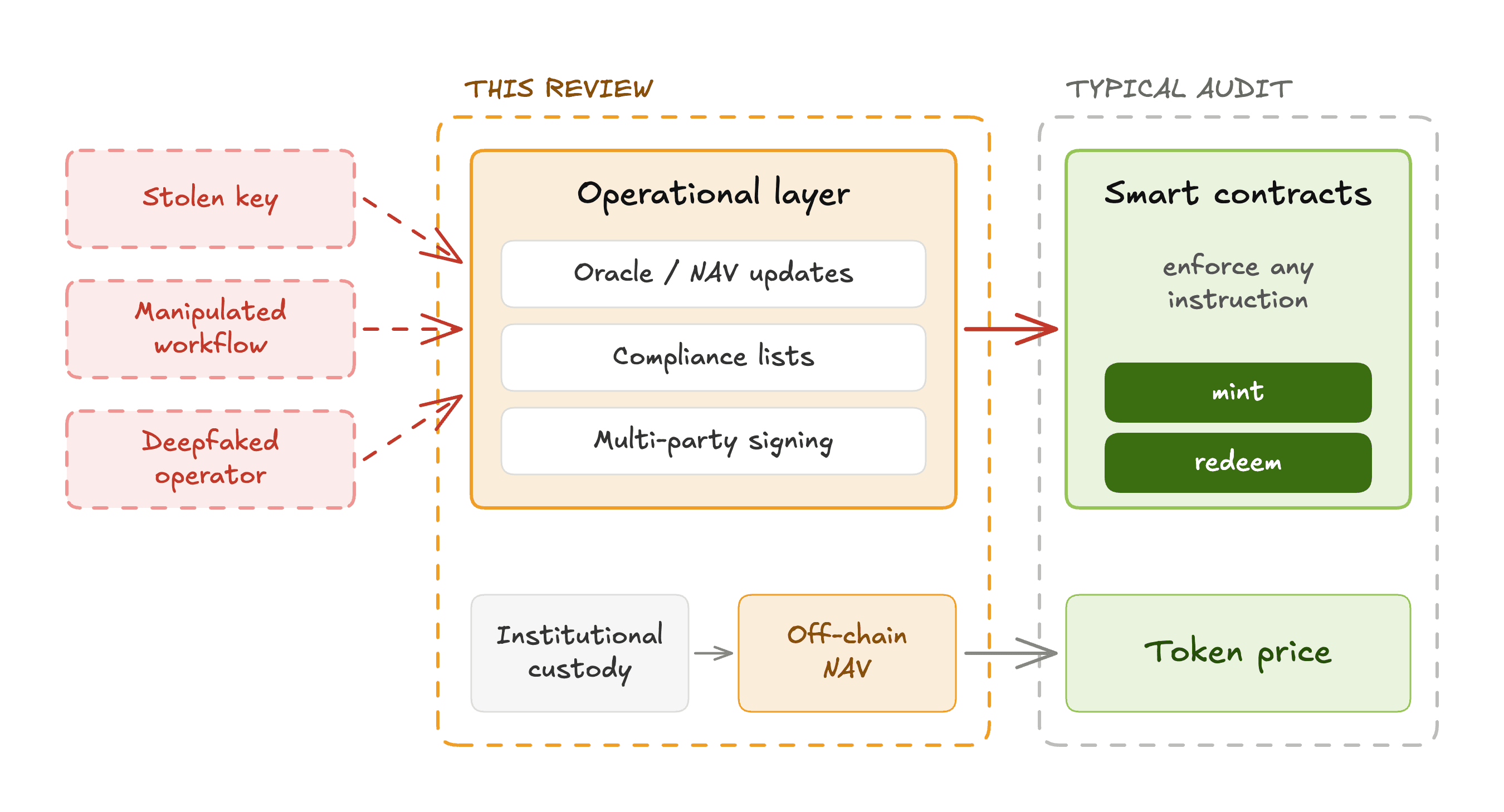
The protocol issues a token priced to an off-chain NAV. Every mint and redemption depends on that price being accurate, timely, and untampered. The assets backing those tokens sit in institutional custody, and daily operations involve privileged roles updating oracles, managing compliance lists, and coordinating multi-party signatures. If an attacker compromises the operational layer, whether by stealing a key, manipulating a workflow, or deceiving an operator with a deepfake, the contracts would dutifully enforce whatever fraudulent instruction they received.
This made the audit uniquely challenging: we had to assess invisible processes with on-chain footprints, evaluate trust assumptions in third-party infrastructure, and determine whether the day-to-day reality matched the documented security model.
Understanding the Attack Surface
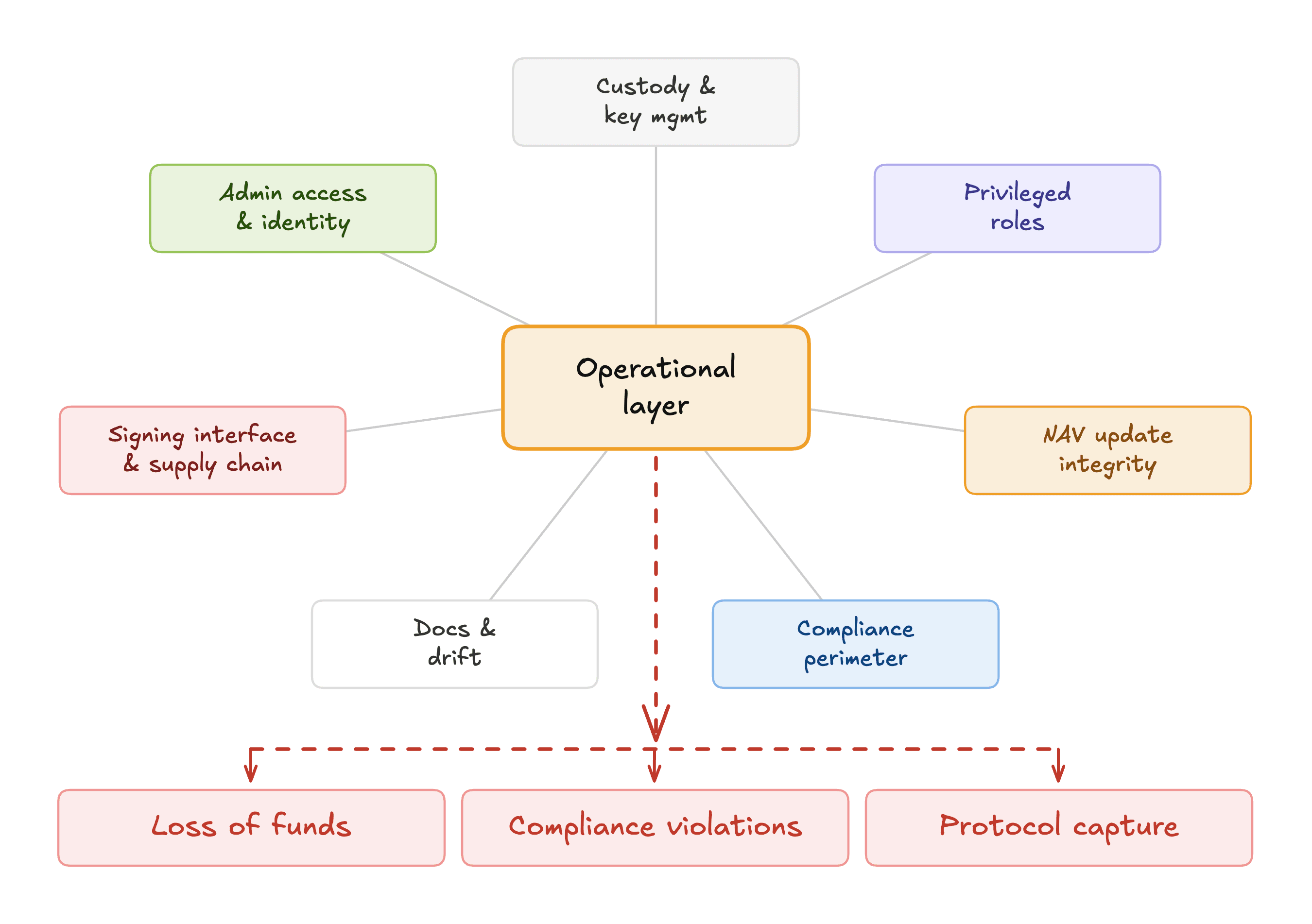
We examined seven interconnected domains where operational failures could translate into loss of funds, compliance violations, or protocol capture:
Custody and Key Management: How institutional assets were held, and whether signing required genuine multi-party authorization or merely single-key action masked by complex infrastructure.
Privileged Role Architecture: Whether administrative powers were distributed according to the principle of least privilege, or concentrated in ways that made a single compromise catastrophic.
NAV Update Integrity: The end-to-end process of computing, communicating, and attesting to the off-chain asset value that priced every user interaction.
Compliance Perimeter: Whether sanctions screening and access controls were enforced consistently across all entry and exit points, including secondary transfers.
Administrative Access and Identity: How operators reached admin functions, authenticated themselves, and confirmed sensitive actions.
Signing Interface and Supply Chain: Whether the final signing step was protected against frontend compromise, dependency injection, or display manipulation.
Operational Documentation and Drift: Whether the team's internal documentation accurately reflected the live deployment, a deceptively mundane factor that often separates secure operations from chaotic ones.
Our Audit Approach
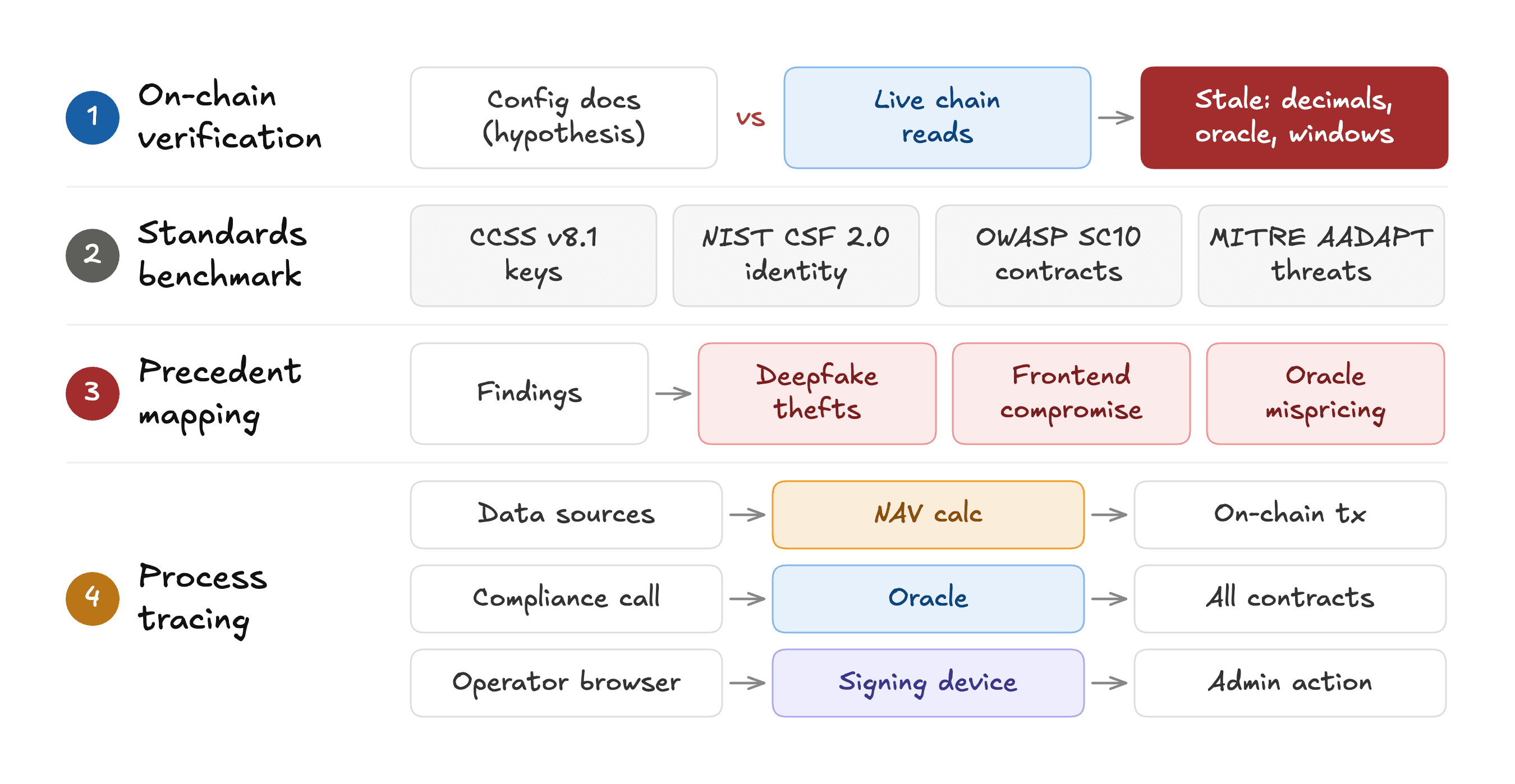
Independent On-Chain Verification: We treated client documentation as a hypothesis, not evidence. Every load-bearing parameter, role assignment, and configuration value was read directly from the live network. This proved essential: the configuration documentation was materially stale, misstating critical values including decimal precision, staleness windows, tolerance thresholds, and oracle addresses.
Standards-Based Benchmarking: We assessed maturity against CCSS v8.1 for key management, NIST CSF 2.0 for identity and access, OWASP Smart Contract Top 10 for contract-level controls, and MITRE AADAPT and ATT&CK for blockchain-specific and off-chain threat modeling.
Precedent Mapping: Each finding category was tied to independently fact-checked real-world incidents, from deepfake-enabled corporate thefts to billion-dollar frontend compromises, that demonstrated the same failure mode in production.
Architectural and Process Analysis: We traced how a NAV update traveled from data sources to an on-chain transaction, how a compliance decision propagated across contracts, and how a privileged action flowed from an operator's browser to a signing device.
What We Discovered
The findings clustered into six thematic areas that told a coherent story about operational risk.
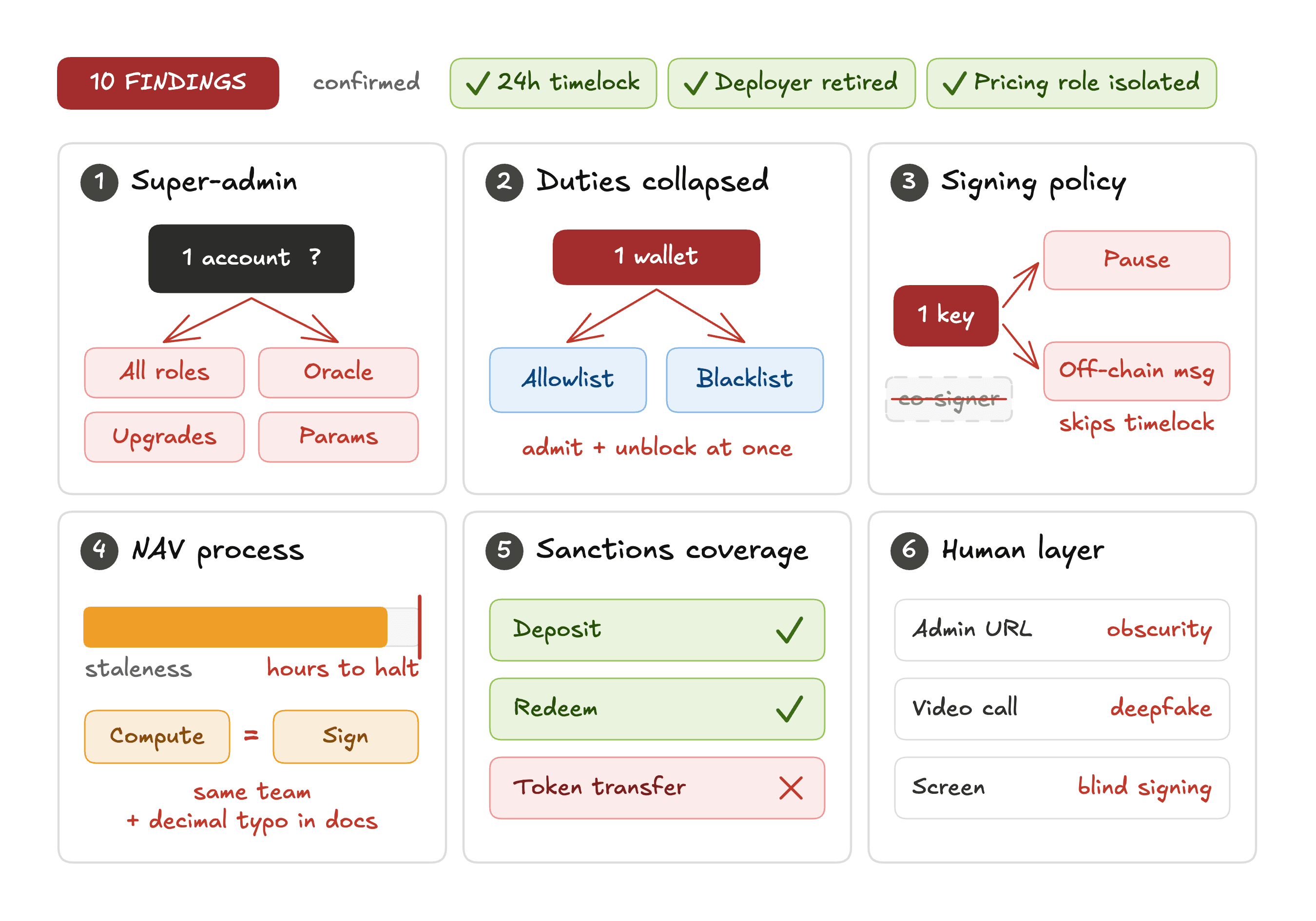
- Concentrated Super-Admin Authority A single operational account held the highest level of administrative authority across multiple critical contracts simultaneously. From this one account, an operator could grant or revoke every role, replace the compliance oracle, transfer upgrade administration, and modify core protocol parameters. On-chain inspection revealed it was not a standard multisig contract but carried a modern delegation pattern whose true authorization logic, whether it enforced a genuine multi-party quorum or merely a single key was opaque. This created a black box at the heart of protocol governance.
- Collapsed Separation of Duties Two opposing compliance functions, admitting addresses and blocking sanctioned ones, were controlled by the exact same wallet. This is not a technical subtlety; it is a fundamental control failure. A single compromised key could simultaneously greenlight a malicious actor and erase them from the blacklist, collapsing the entire compliance perimeter in one action.
- Signing Policy Weaknesses Within the institutional signing infrastructure, several high-impact policies permitted single-key actions without co-signer approval. This meant one compromised key could pause core contract functionality or authorize off-chain messages that entirely bypassed on-chain time delays. At the policy layer, this effectively neutralized the core security guarantee of the multi-party computation infrastructure.
- NAV Integrity and Cadence Gaps The NAV update process lacked separation of duties: the same small team both computed and signed the value. The on-chain guards were narrow, a tight tolerance band and a defined staleness window. At the time of review, the live NAV was already within hours of triggering an automatic protocol halt, indicating that the nominally daily update process was running significantly behind schedule. Furthermore, internal documentation contained a critical decimal precision error that, if followed by operators, would have mis-scaled prices by orders of magnitude.
- Incomplete Compliance Coverage While deposit and redemption entry points screened against a sanctions oracle, the protocol's transferable token did not. Secondary market transfers could occur without sanctions checks, creating a material compliance gap for a regulated RWA product and directly contradicting internal documentation.
- Social Engineering and Interface Trust Administrative access relied on URL obscurity rather than robust access controls. Sensitive actions were confirmed via live video calls, a method increasingly defeated by real-time deepfake synthesis. Additionally, the signing workflow presented a blind-signing risk: operators might approve what the interface displayed rather than independently verifying the decoded on-chain payload. In an era where frontend supply-chain attacks and interface manipulation have caused catastrophic losses, trusting the screen is no longer sufficient.
Going Beyond the Obvious
Several aspects of this review required reasoning beyond standard checklists.
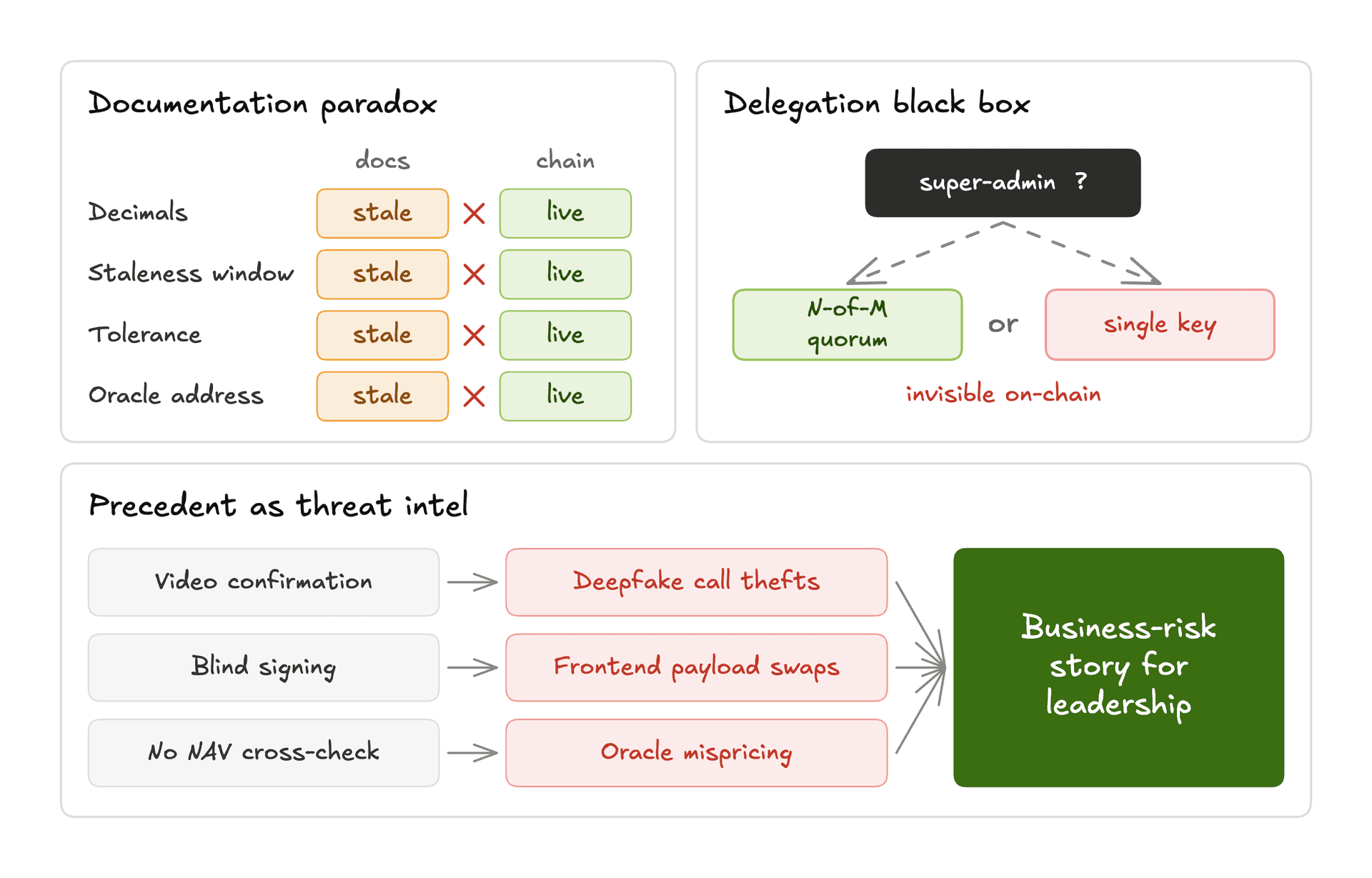
The Documentation Paradox: Most security reviews accept configuration documents as ground truth. We verified every parameter live on-chain and discovered the documentation was materially stale across multiple critical dimensions. This "configuration drift" is a recurring root cause of operational disasters, yet it is rarely caught because auditors seldom independently reconcile paper against chain state.
The Delegation Black Box: When we inspected the super-admin account, we found it was not a standard verified multisig contract. Its use of a modern delegation pattern meant its true signing requirements were invisible on-chain. Without off-chain confirmation, we could not distinguish between a robust multi-party setup and a single-key point of failure, a distinction worth millions.
Precedent as Threat Intelligence: Rather than presenting findings as abstract vulnerabilities, we mapped each to real-world catastrophes: the institutional thefts where every participant on a video call was an AI deepfake; the billion-dollar losses where signers approved manipulated frontend payloads despite having full multisig quorums; the oracle manipulation waves that mispriced assets because off-chain processes lacked cross-validation. This approach transformed technical findings into business-risk narratives that resonated with leadership.
Remediation & Collaboration
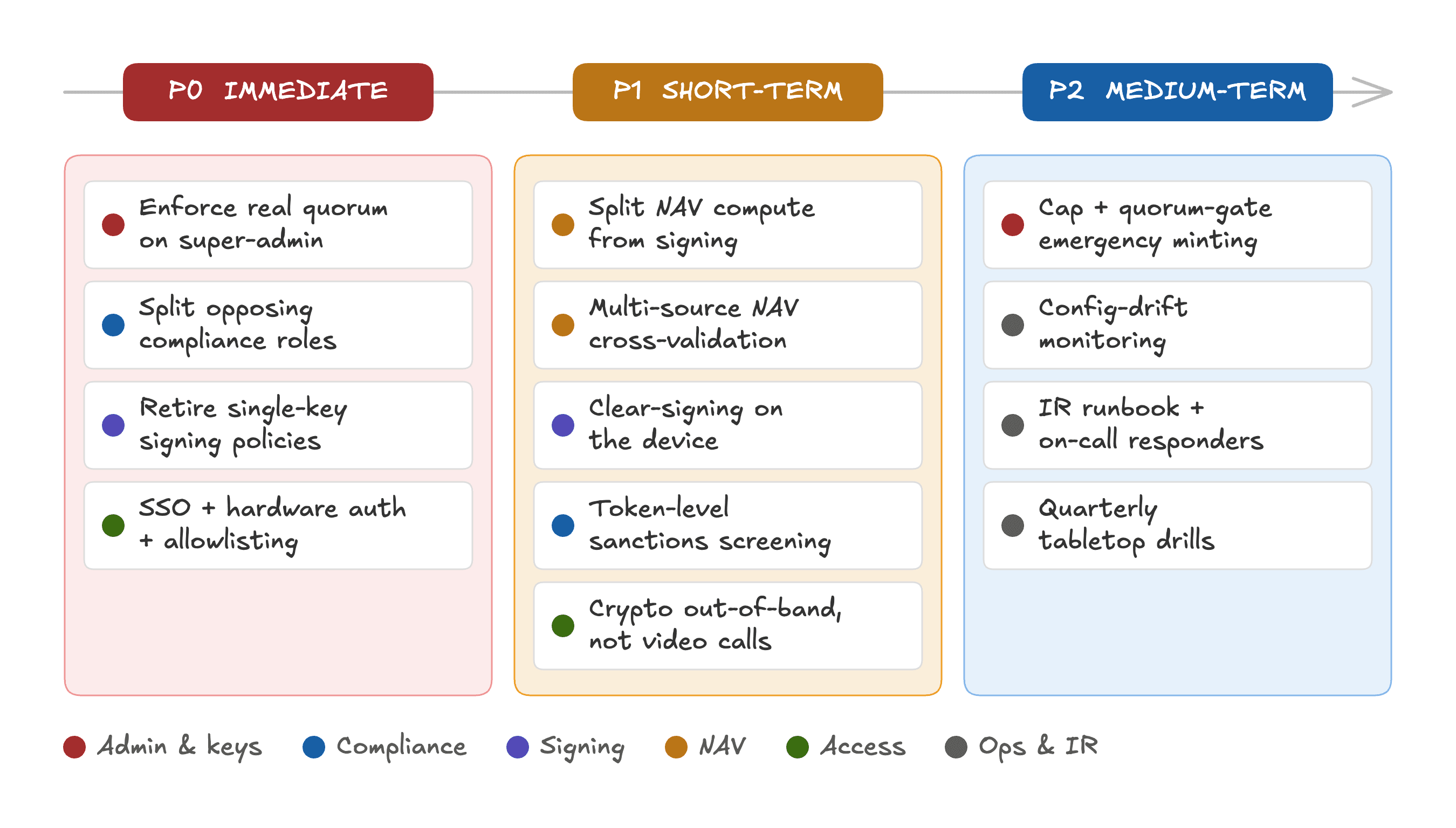
Findings were organized into a phased remediation roadmap:
Immediate (P0): Confirm and enforce a genuine multi-party quorum for the super-admin account; split opposing compliance roles to separate wallets; retire single-key signing policies for high-impact actions; and harden administrative access behind single sign-on, hardware-backed authentication, and network allowlisting.
Short-Term (P1): Separate NAV computation from signing roles, implement multi-source cross-validation before attestation; mandate clear-signing verification on the signing device for all privileged actions; wire token-level sanctions screening; and replace video-call confirmation with deepfake-resistant cryptographic out-of-band verification.
Medium-Term (P2): Cap and quorum-gate any emergency share-minting capability; implement automated configuration-drift monitoring reconciled against live chain state; establish an incident response runbook with pre-positioned responders; and conduct quarterly tabletop exercises simulating key compromise, deepfake confirmation, and oracle anomalies.
Key Security Lessons
- In RWA protocols, operational security is the security model. The most elegant smart contract architecture can be undermined by a compromised admin workflow, a manipulated NAV, or a deceived operator.
- Separation of duties is existential, not bureaucratic. Concentrating opposing functions in a single key is a single point of failure, not an efficiency.
- Documentation rots faster than code. Live on-chain verification must be standard practice, especially when operators make daily decisions from internal docs.
- The signing interface is the final frontier. Even perfect multisig quorums fail if signers trust a compromised screen. Clear-signing, decoding and verifying payloads on the device itself is non-negotiable.
- Deepfakes have shifted from novelty to operational threat. Live video confirmation is no longer a reliable security control; cryptographic challenge-response mechanisms are.
- Staleness guards need operational cadence, not just technical configuration. A time window means nothing if updates routinely approach the boundary. Alerting at two-thirds of the limit gives teams time to react.
Outcome
The protocol received a clear, prioritized security roadmap with immediate actions already underway. We validated several critical positive controls: a 24-hour timelock governing upgrades, full decommissioning of the deployer key, strict isolation of the pricing admin role, and graduated pause capabilities. The engagement elevated the team's operational maturity across key domains and, more importantly, shifted their security posture from pre-launch validation to continuous operational discipline.
Closing Takeaway
In DeFi, we obsess over contract bytecode because it is visible, verifiable, and deterministic. But in protocols that bridge real-world assets with on-chain tokens, the most dangerous vulnerabilities are often invisible, they hide in a stale configuration document, a single-signer policy buried in institutional infrastructure, an unauthenticated operational alert, or a video call that isn't what it seems. The teams that will survive the next evolution of Web3 threats are those that audit not just what runs on-chain, but how the humans behind the protocol actually operate.