Stop Auditing Base Like Ethereum: A DeFi Security Guide
Auditing Base like Ethereum is a costly mistake. This guide explains the critical DeFi security differences and how to audit Base protocols safely.

In the dynamic landscape of DeFi, L2 scaling solutions are pivotal for achieving Ethereum's vision of a scalable, secure blockchain ecosystem. Base, developed by Coinbase on the Optimism OP Stack, exemplifies this evolution by providing an EVM compatible environment with enhanced throughput and reduced costs. As of early 2026, Base DeFi TVL exceeds $4.14B, underscoring its growing prominence. However, this rapid adoption amplifies security imperatives. Traditional audits centered on EVM vulnerabilities, such as reentrancy, overflow issues, or access control flaws, are essential but inadequate for L2 contexts. Base introduces unique architectural elements that demand a specialized security framework.
This guide serves as a comprehensive resource for development and security teams building and auditing DeFi protocols on Base. By addressing sequencer centralization, optimistic rollup mechanics, cross-domain interactions, account abstraction nuances, and bridge composability, while incorporating additional considerations like data availability and governance, we aim to equip you with actionable insights.
Base Architecture Overview: Setting the Foundation
To contextualize the threats, let's outline Base's core architecture. As an optimistic rollup, Base processes transactions off-chain, batches them for submission to Ethereum (L1), and employs fraud proofs for validation. This setup relies on components like the sequencer, batcher, and bridge, which introduce dependencies absent in pure L1 environments.
The following diagram illustrates the end-to-end transaction lifecycle on Base, highlighting key audit focal points:
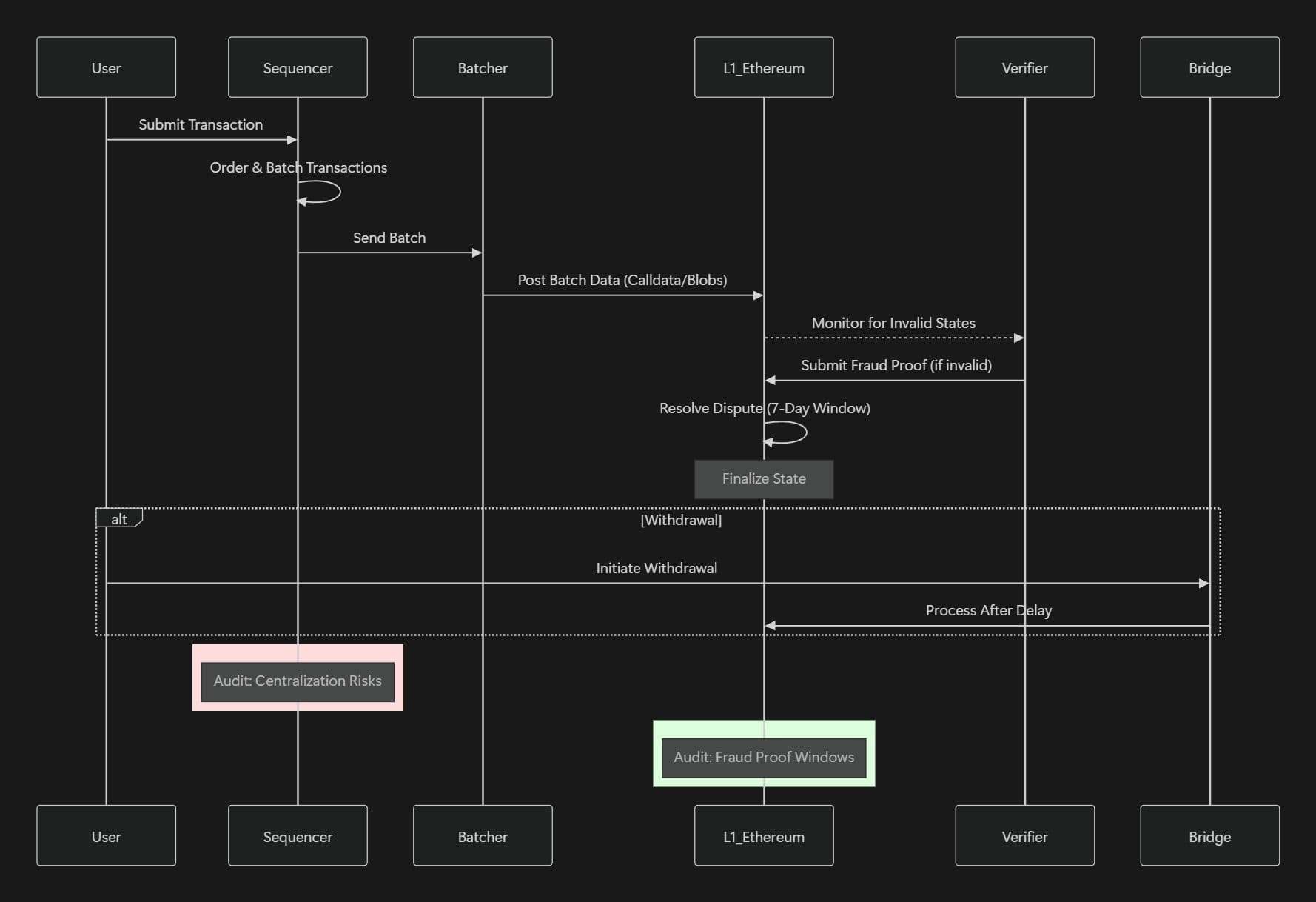
This diagram emphasizes the asynchronous nature of L2 operations, where delays and off-chain elements create exploitable gaps.
Sequencer Centralization: Evolving Threat Models and Assumptions
Sequencer centralization represents a fundamental shift from Ethereum's decentralized validation. Base's sequencer, currently operated solely by Coinbase, handles transaction ordering and batch submission. This single-entity control challenges assumptions of censorship resistance and fair ordering inherent in L1 audits.
Key threats include:
- Censorship Attacks: The sequencer can exclude specific transactions by ignoring them in the mempool, delaying operations like oracle updates or liquidations. For instance, in a lending protocol, censoring a price feed tx could maintain an outdated collateral ratio, allowing undercollateralized borrows to persist and leading to bad debt accumulation.
- MEV Reordering Exploits: By reordering batches (e.g., inserting front-running txs before user swaps in an AMM), the sequencer extracts value. Technically, this involves scanning the mempool for high-value txs, simulating their execution to compute profitable inserts, and adjusting the batch order without violating EVM rules, potentially draining liquidity pools via sandwich attacks.
- Liveness Failures and DoS: A sequencer outage halts batch submissions, freezing the chain. Attackers could DDoS the sequencer's API endpoint, causing tx backlogs and amplifying market slippage in DEXes.
- Batch Front-Running via Pre-Commitment Peeking: Sequencers might peek at pending batches to insert adversarial txs, exploiting time-bandit attacks where historical blocks are reordered post-submission but pre-finality.
Secure Your Base Protocol Against L2-Specific Threats
Secure Your Base Protocol Against L2-Specific Threats
From sequencer abuse to cross-domain risks, Base needs L2-specific security. QuillAudits helps teams mitigate these threats early
To mitigate, protocols should incorporate L1 forced inclusions via the Optimism bridge, where users submit txs directly to L1 for eventual L2 processing, bypassing censorship with a ~12-hour delay. Audits must simulate adversarial sequencing, testing for reordering impacts on invariants like token balances.
Sequencer-Resilient Liquidation with Forced Inclusion
1
2import "@optimism/contracts/libraries/bridge/IOptimismBridge.sol";
3
4contract SequencerResilientLending {
5    IOptimismBridge public bridge;
6    uint256 public lastBlockTimestamp;
7    uint256 public constant CENSORSHIP_TIMEOUT = 3600; // 1 hour
8
9    constructor(address _bridge) {
10        bridge = IOptimismBridge(_bridge);
11        lastBlockTimestamp = block.timestamp;
12    }
13
14    modifier detectCensorship() {
15        require(block.timestamp - lastBlockTimestamp < CENSORSHIP_TIMEOUT, "Potential sequencer censorship or downtime");
16        lastBlockTimestamp = block.timestamp;
17        _;
18    }
19
20    function liquidateLoan(uint256 loanId) external detectCensorship {
21        // Execute liquidation: Transfer collateral, burn debt tokens
22        // Invariant check: Collateral ratio < 100% using Chainlink oracle
23    }
24
25    function forceLiquidationViaL1(uint256 loanId) external {
26        // Encode call for L1 enqueue
27        bytes memory data = abi.encodeWithSelector(this.liquidateLoan.selector, loanId);
28        bridge.enqueueTransaction(address(this), 0, data, 1000000); // Gas limit for L2 execution
29    }
30}
This contract detects liveness failures via timestamp deltas and falls back to L1 enqueuing, ensuring critical operations proceed despite sequencer malice.
Analyzing sequencer incentives under game theory, considering potential collusion with builders. Future decentralization (e.g., via shared sequencers) may introduce slashing risks, so audit for bond-related vulnerabilities.
Optimistic Rollup Fraud Proofs: Managing Windows and Withdrawal Delays
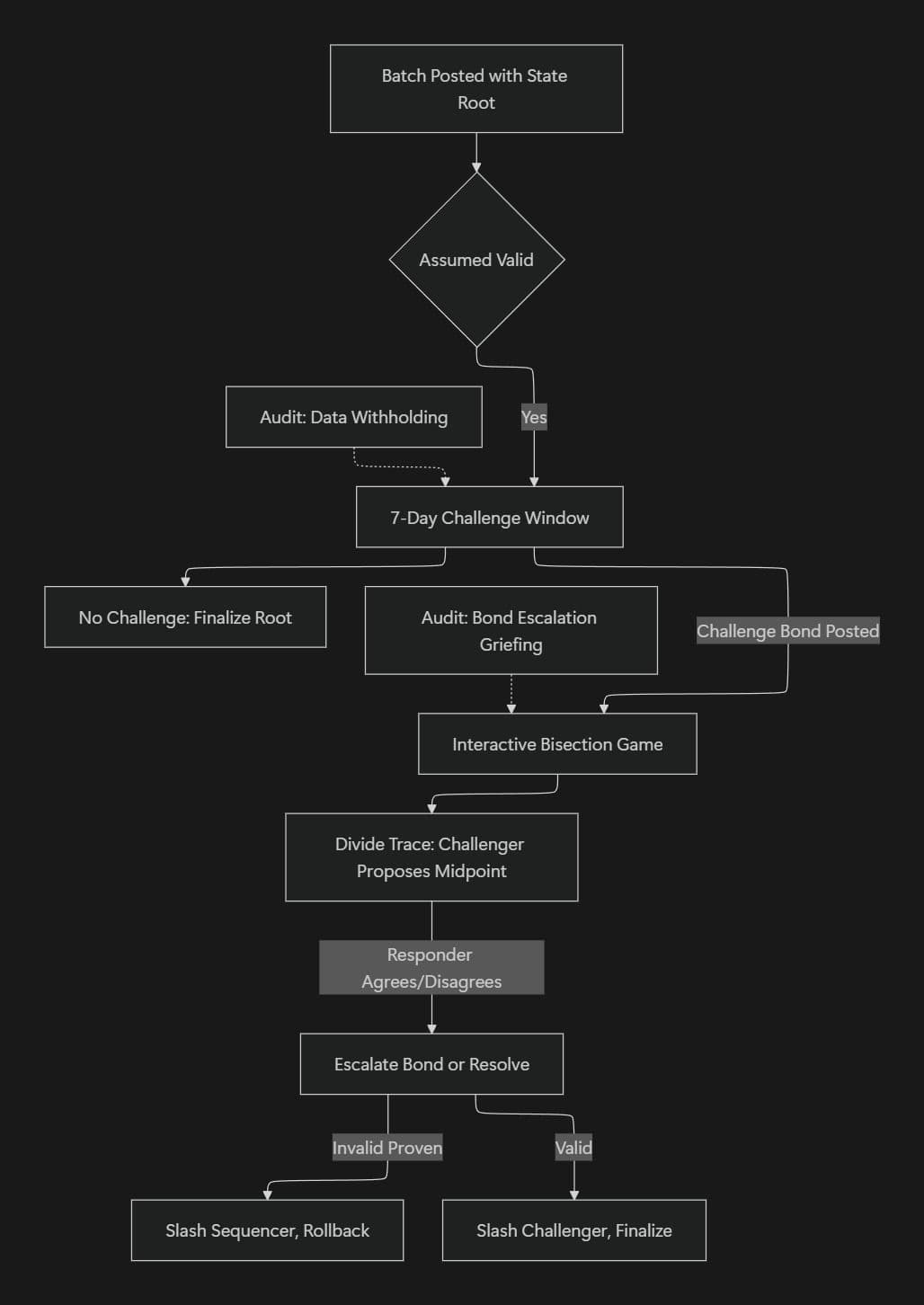
Optimistic rollups post state commitments to L1, presuming validity unless disproven via fraud proofs, interactive games on L1 where challengers bisect execution traces to isolate invalid opcodes (e.g., an invalid STORAGE or CALL). The 7-day challenge window allows verifiers to submit proofs, slashing sequencer bonds on success. However, this temporal gap creates exploitable delays.
Attack vectors:
- Fraudulent Batch Submission: A malicious sequencer submits a batch with an invalid state root (e.g., forging a balance transfer via a manipulated EVM stack). If unchallenged, funds are stolen, challenges require verifiers to replay the batch locally, computing merkle proofs for disputed storage slots.
- Griefing During Disputes: Attackers spam invalid challenges, forcing bond escalations in the bisection game (doubling stakes per step), exhausting honest verifier’s capital and delaying resolution.
- Withdrawal Delay Exploits: Exits require proving inclusion via merkle paths during the window, enabling exit griefing where spammers flood the bridge contract, inflating L1 gas costs, and preventing timely withdrawals, leading to opportunity losses in volatile markets.
- Data Withholding Attacks: Sequencers withhold batch data from L1 blobs, preventing verifiers from reconstructing states for proofs, effectively censoring challenges and enforcing invalid transitions.
The diagram below maps the fraud proof dispute process:
Fraud-Proof Aware Collateral Buffer
1contract FraudProofAwareVault {
2    uint256 public constant CHALLENGE_WINDOW = 7 days;
3    uint256 public baseHealthFactor = 120;
4
5    function computeAdjustedHealth(uint256 collateral, uint256 debt) internal view returns (uint256) {
6        // Buffer scales with window to account for volatility during disputes
7        uint256 buffer = (collateral * CHALLENGE_WINDOW / 1 days) / 100; // e.g., 7% buffer
8        return (collateral + buffer) * 100 / debt;
9    }
10
11    function isSolvent(uint256 collateral, uint256 debt) external view returns (bool) {
12        return computeAdjustedHealth(collateral, debt) >= baseHealthFactor;
13    }
14}
This dynamically inflates health factors to prevent liquidations during unresolved disputes.
Cross Domain Message Passing: Mitigating Reentrancy Like Vulnerabilities
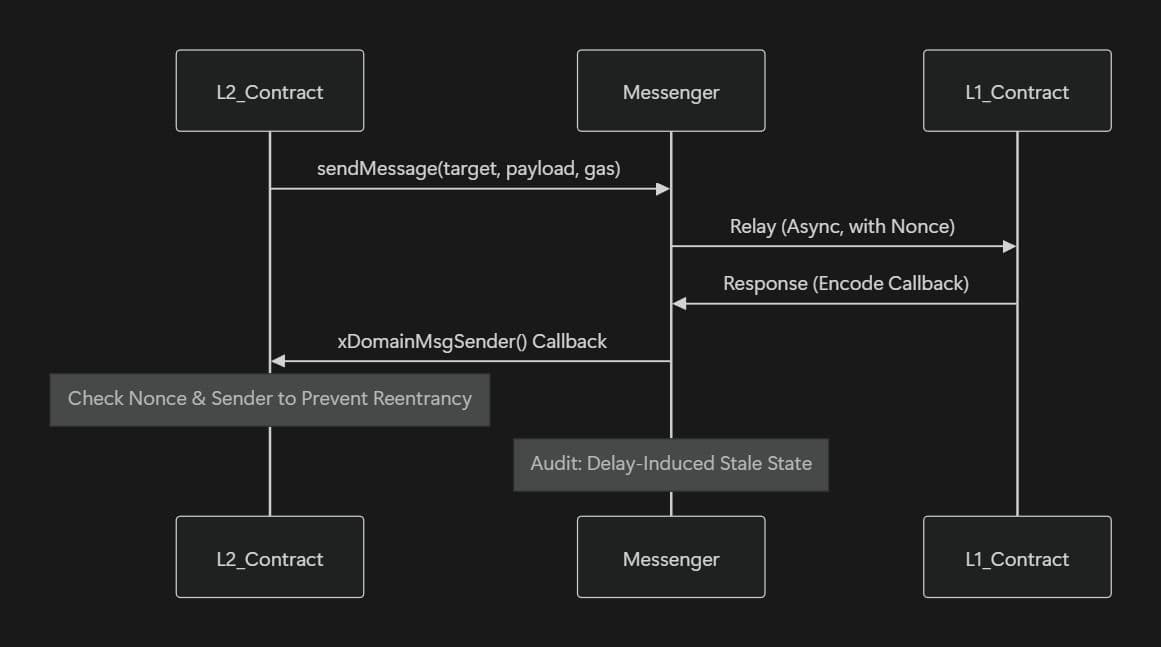
Cross domain messaging in Base uses the CrossDomainMessenger contract to relay calls between L1 and L2 via calldata posts, with nonces and sender verification to prevent forgeries. However, asynchrony where messages are queued and executed in future blocks creates reentrancy windows.
Attack vectors:
- Replay Attacks: Re-submitting a valid message nonce on L2 after L1 execution, draining vaults if callbacks lack idempotency checks.
- Asynchronous Reentrancy: A delayed callback executes on a stale state, e.g., borrowing against an unconfirmed deposit, leading to undercollateralization.
- Forgery via Sender Spoofing: Manipulating
xDomainMessageSender()if not properly gated, allowing unauthorized calls.
- Timelock Bypass: Attackers chain messages to evade contract timelocks, executing sensitive actions prematurely.
Use strict nonce tracking and require statements for sender validation. The sequence diagram visualizes the flow:
Secure Asynchronous Callback
1import "@optimism/contracts/libraries/bridge/ICrossDomainMessenger.sol";
2
3contract AsyncSafeCrossDomain {
4    ICrossDomainMessenger public messenger;
5    mapping(bytes32 => bool) public executedMessages;
6    uint256 public minTimelock = 1 hours;
7
8    function initiateCrossCall(address l1Target, bytes calldata data) external {
9        bytes32 msgId = keccak256(abi.encode(block.timestamp, msg.sender, data));
10        messenger.sendMessage(l1Target, abi.encode(msgId, data), 500000);
11    }
12
13    function handleCallback(bytes calldata response) external {
14        require(msg.sender == address(messenger), "Invalid messenger");
15        require(block.timestamp >= minTimelock, "Timelock not elapsed");
16        (bytes32 msgId, bytes memory inner) = abi.decode(response, (bytes32, bytes));
17        require(!executedMessages[msgId], "Replay attack");
18        executedMessages[msgId] = true;
19        // Process inner: e.g., update storage slot atomically
20    }
21}
This enforces timelocks and idempotency to block reentrancy.
Gas Abstraction in Account Abstraction: Where Transaction Origin Matters
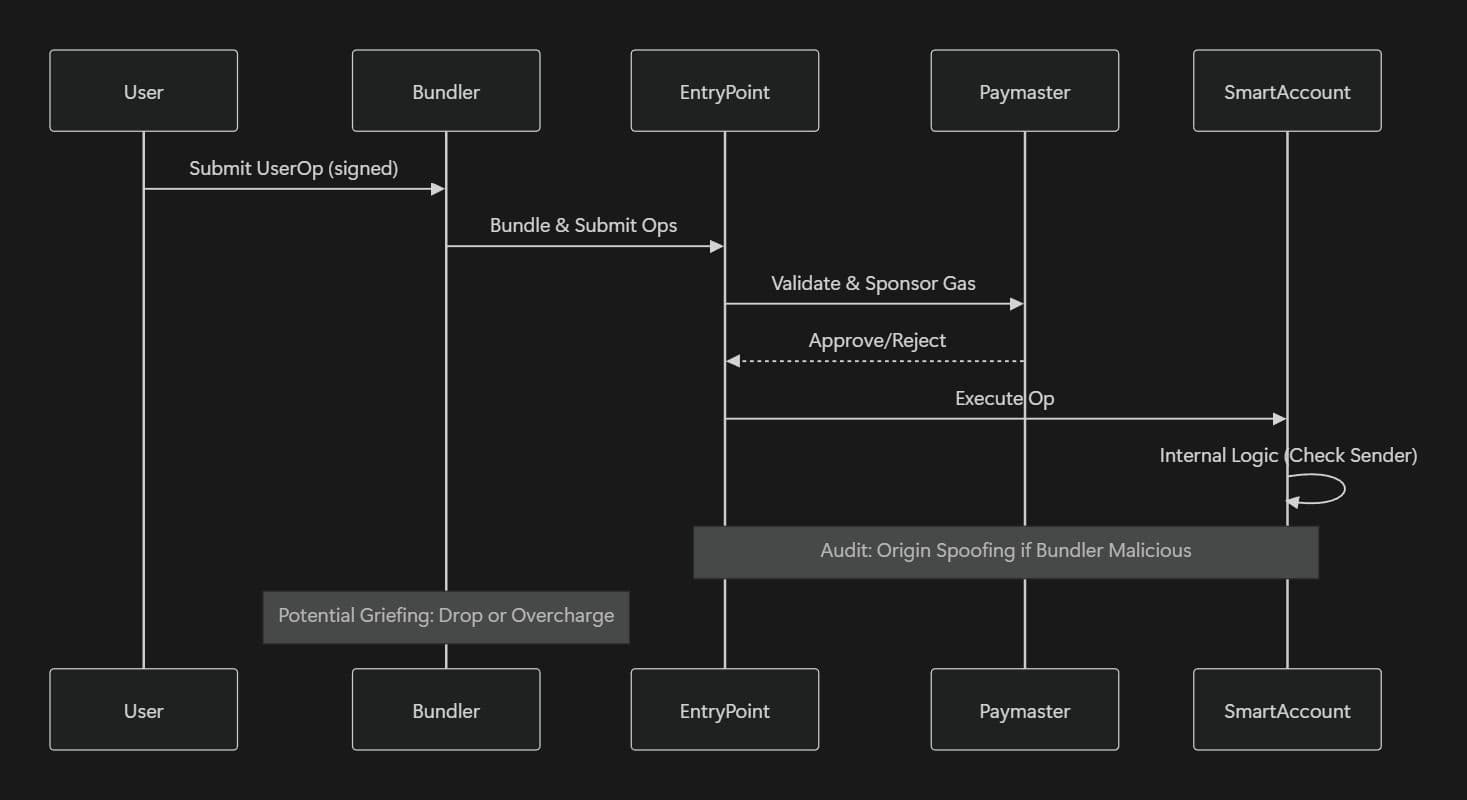
Base natively implements ERC4337, decoupling user operations (UserOps) from traditional txs via an EntryPoint contract that validates signatures, sponsors gas through paymasters, and executes via bundlers. This abstracts tx.origin, replacing it with recovered senders from UserOp signatures, but exposes new vectors.
Attack vectors:
- Origin Spoofing: Bundlers forge UserOps by mimicking signatures (if weak ECDSA recovery is used), impersonating users to approve transfers in ERC20 tokens or NFTs.
- Gas Griefing Attacks: Malicious bundlers submit valid UserOps but overestimate gas in the EntryPoint's
handleOps()call, causing partial executions that revert mid-operation, leaving protocols in inconsistent states (e.g., half-swapped tokens in a DEX).
- Paymaster Exploits: Paymasters sponsoring gas could be drained via reentrancy if they call back into user contracts without checks, or via DoS by spamming low-value ops that consume sponsored gas without reimbursement.
- Bundler Front-Running: Bundlers inspect UserOps in their private pool, inserting adversarial ops to sandwich trades, similar to L1 MEV but amplified by abstraction's opacity.
Mitigations require EntryPoint validations, using getSenderAddress() for origins, and rate-limiting ops per bundler.
Griefing-Resistant Paymaster Validation
1import "@account-abstraction/contracts/interfaces/IEntryPoint.sol";
2import "@account-abstraction/contracts/interfaces/IPaymaster.sol";
3
4contract SecurePaymaster is IPaymaster {
5    IEntryPoint public entryPoint;
6    mapping(address => uint256) public opCounts; // Rate limit per sender
7    uint256 public constant MAX_OPS_PER_BLOCK = 5;
8
9    function validatePaymasterUserOp(UserOperation calldata userOp, uint256 maxCost) external view override returns (bytes memory context, uint256 validationData) {
10        require(msg.sender == address(entryPoint), "Invalid caller");
11        address sender = entryPoint.getSenderAddress(userOp);
12        require(opCounts[sender] < MAX_OPS_PER_BLOCK, "Griefing detected: Too many ops");
13        // Simulate gas: Ensure maxCost < threshold to prevent overcharge
14        require(maxCost < 1e6, "Excessive gas estimate");
15        return ("", 0); // Approve
16    }
17
18    function postOp(PostOpMode mode, bytes calldata context, uint256 actualGasCost) external override {
19        // Increment count post-execution
20        address sender = entryPoint.getSenderAddress(abi.decode(context, (UserOperation)));
21        opCounts[sender]++;
22    }
23}
This paymaster rate-limits and caps gas to prevent griefing.
Bridge Composability Risks: Integrating Ethereum Mainnet Protocols
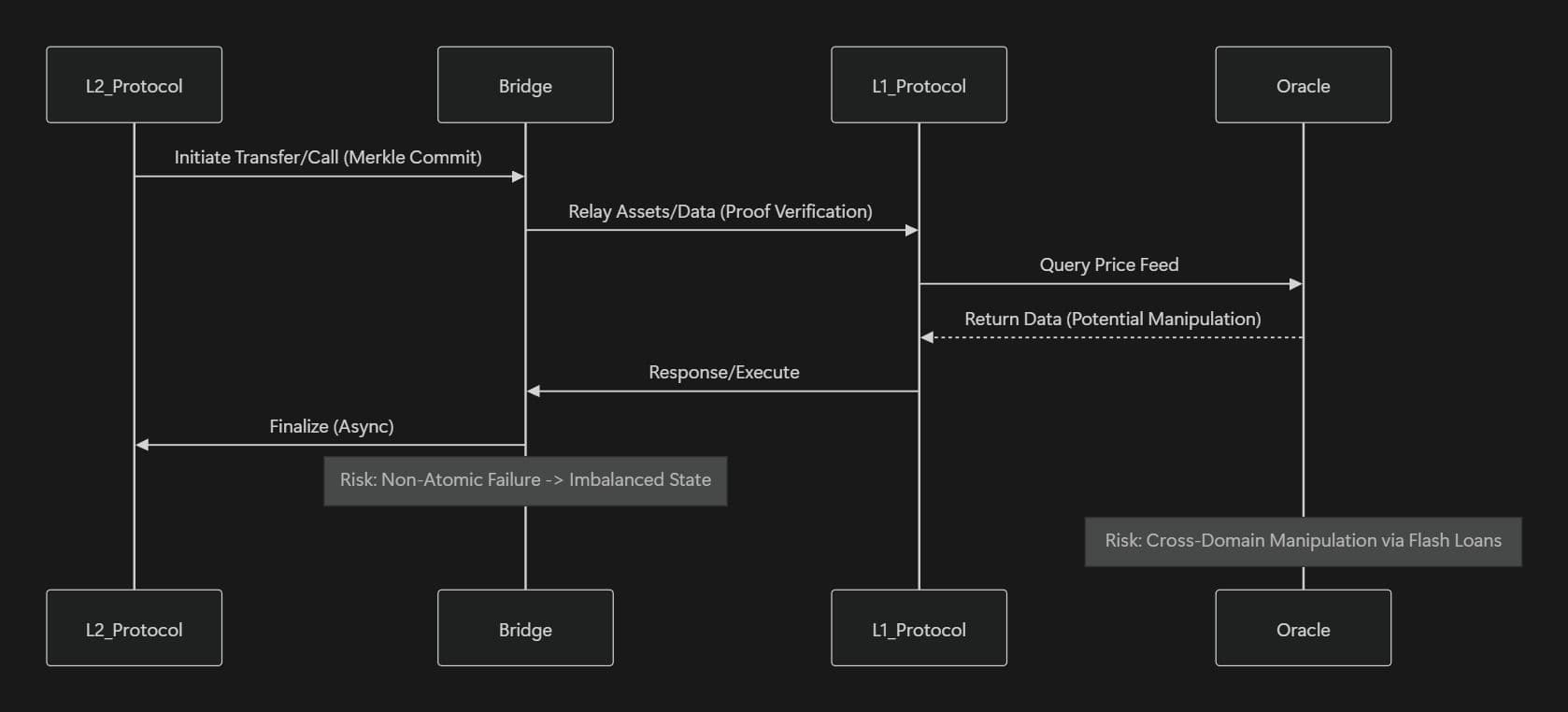
Base's bridges (e.g., StandardBridge) enable composability by relaying assets and messages via merklized commitments, verifying inclusions with proofs on the receiving chain. However, integrating L1 protocols (e.g., composing a Base DEX with an L1 oracle) exposes atomicity issues.
Attack vectors:
- Non-Atomic Execution Failures: Bridge calls are async, a failed L1-to-L2 relay (e.g., due to L1 revert from insufficient gas) leaves L2 in a partial state, such as minted tokens without corresponding L1 burn, enabling double-spends.
- Oracle Manipulation in Cross-Chain Contexts: Flash loans on L1 skew oracles (e.g., via large borrows manipulating TWAPs), relaying distorted prices to L2 for invalid liquidations or borrows exceeding collateral.
- Upgradeable Bridge Exploits: Proxies in bridge contracts allow admins to swap implementations, potentially inserting backdoors for draining escrows during upgrades without timelocks.
Mitigations include try-catch wrappers for atomicity and multi-oracle aggregation for prices.
Atomic Bridge Wrapper with Proof Validation
1import "@optimism/contracts/libraries/bridge/IBridge.sol";
2
3contract SecureBridgeCompositor {
4    IBridge public bridge;
5    bytes32 public lastRoot;
6
7    function atomicDepositAndCall(uint256 amount, bytes calldata l1Call, bytes32 proof) external payable {
8        // Verify merkle proof against known root
9        require(verifyMerkle(proof, keccak256(abi.encode(amount, msg.sender))), "Invalid proof");
10        try bridge.depositETH{value: amount}(500000, "") returns (bool success) {
11            require(success, "Deposit failed");
12            // Execute l1Call if bridged
13        } catch {
14            revert("Non-atomic failure: Revert to safe state");
15        }
16        lastRoot = bridge.stateRoot(); // Update for next proof
17    }
18
19    function verifyMerkle(bytes32 proof, bytes32 leaf) internal view returns (bool) {
20        // Simplified merkle verification logic
21        return true; // Implement full path hashing
22    }
23}
This ensures atomicity and proof integrity.
Base-Specific Security Requirements Checklist
- Sequencer Trust Assumptions: Actively simulate adversarial sequencing scenarios such as transaction reordering, censorship, and delayed inclusion. Ensure critical actions have L1 forced-inclusion or fallback paths to preserve liveness under sequencer failure or malice.
- Fraud Proof & Challenge Window Handling: Model fraud-proof timelines and stress-test bond escalation mechanics against griefing attacks. Maintain data availability and redundancy so state transitions can always be reconstructed and challenged when required.
- Cross-Domain Messaging Safety: Enforce strict nonce tracking, timelocks, and sender validation for L1-L2 messages. Guard against stale-state execution and asynchronous reentrancy caused by delayed message delivery.
- Account Abstraction & Bundler Risks: Apply bundler level rate limits and validate gas estimates to prevent griefing or partial execution attacks. Never rely on
tx.origin, always verify UserOp senders explicitly.
- Bridge Composability & Atomicity: Verify Merkle proofs rigorously for cross-chain actions and wrap bridge interactions in atomic execution guards to prevent partial state updates or double-spend conditions.
- General L2 Security Practices: Use differential fuzzing across L1 and L2 to detect behavioral drift, and enforce protocol level invariants that hold across delayed finality and asynchronous execution environments.
Conclusion
Auditing DeFi protocols on Base requires moving beyond traditional EVM centric checks. While classic smart contract vulnerabilities still matter, Base introduces L2 specific risks around sequencer behavior, delayed finality, cross-domain messaging, and gas abstraction. Effective audits must explicitly model adversarial infrastructure, time based attack windows, and non-atomic cross-chain flows. Protocols that incorporate forced inclusion paths, fraudproof awareness, and defensive composability are significantly more resilient as Base adoption and economic value continue to grow.

Contents