Security Risk In Dubai Tokenized Asset Borrowing Markets
Dubai property tokens can be resold by verified residents. Borrowing against them is not live, and a loan needs four controls before it can clear.


Dubai already lets a resident sell a slice of a tokenized property. Borrowing against that slice is the part that is not built yet, and it is the part that breaks first if the controls are thin.
This is a look at how the secondary market works in Dubai tokenization today, using land as the live example. Other asset classes, including the silver and gold pilots, follow later. The property market is the one with a regulator, a registry, and a resale screen you can actually open.
A market that can take a sell order
On 20 February 2026 the Dubai Land Department opened Phase Two of its real estate tokenization pilot. About 7.8 million tokens from the first ten properties, worth a little over AED 18.5 million, became eligible for resale. The venue is the Prypco Mint app. Ctrl Alt issues and runs the tokens on the XRP Ledger. Ripple Custody holds them. Ctrl Alt holds the VARA licence for the stack. Every trade is meant to stay in step with the land registry.
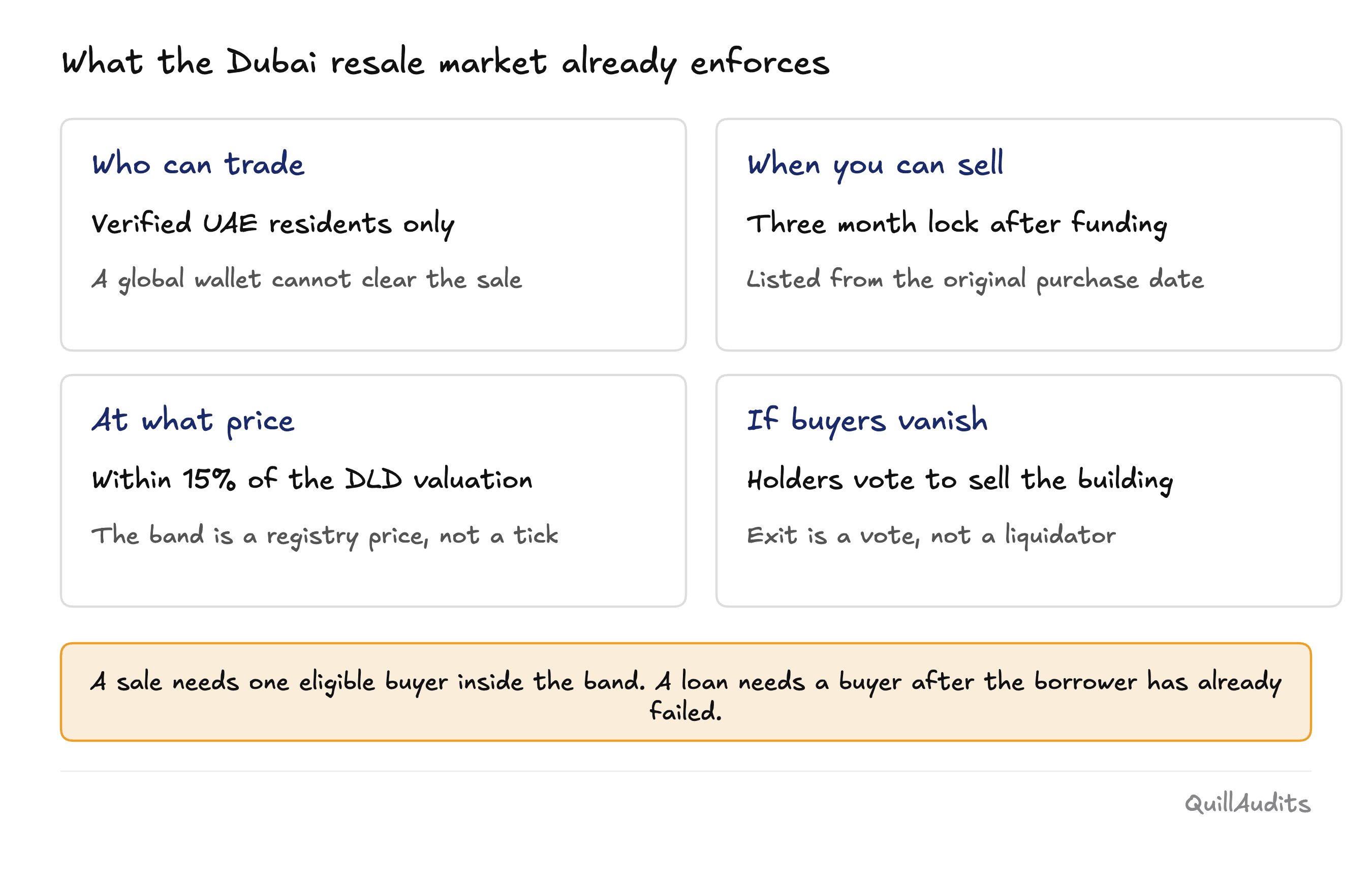
The rules are tighter than a typical crypto market. Only verified UAE residents can trade. Prypco’s own terms put a three month lock on tokens after the original funding, and a seller has to list within 15 percent of the latest DLD valuation. In July 2026 the marketplace minimum dropped to AED 1,000 for tokens already in circulation. New offerings still start at AED 2,000. If buyers disappear, holders can vote to sell the building.
Matt Acheson, chief product officer at Ctrl Alt, described the aim in the Phase Two release as a secondary market infrastructure that is “efficient for the entire ecosystem while maintaining the controls and governance required by the DLD and VARA.”
That sentence is the whole design. Efficiency is allowed only inside the controls. The buyer on the other side of a sale is a verified resident, the price band is tied to a government valuation, and the title record is supposed to move with the token. For a first resale market, that is a serious setup. It is also a closed one. A token nobody eligible can hold cannot clear, even if the chain itself is happy to move it.
Selling is not the same as borrowing
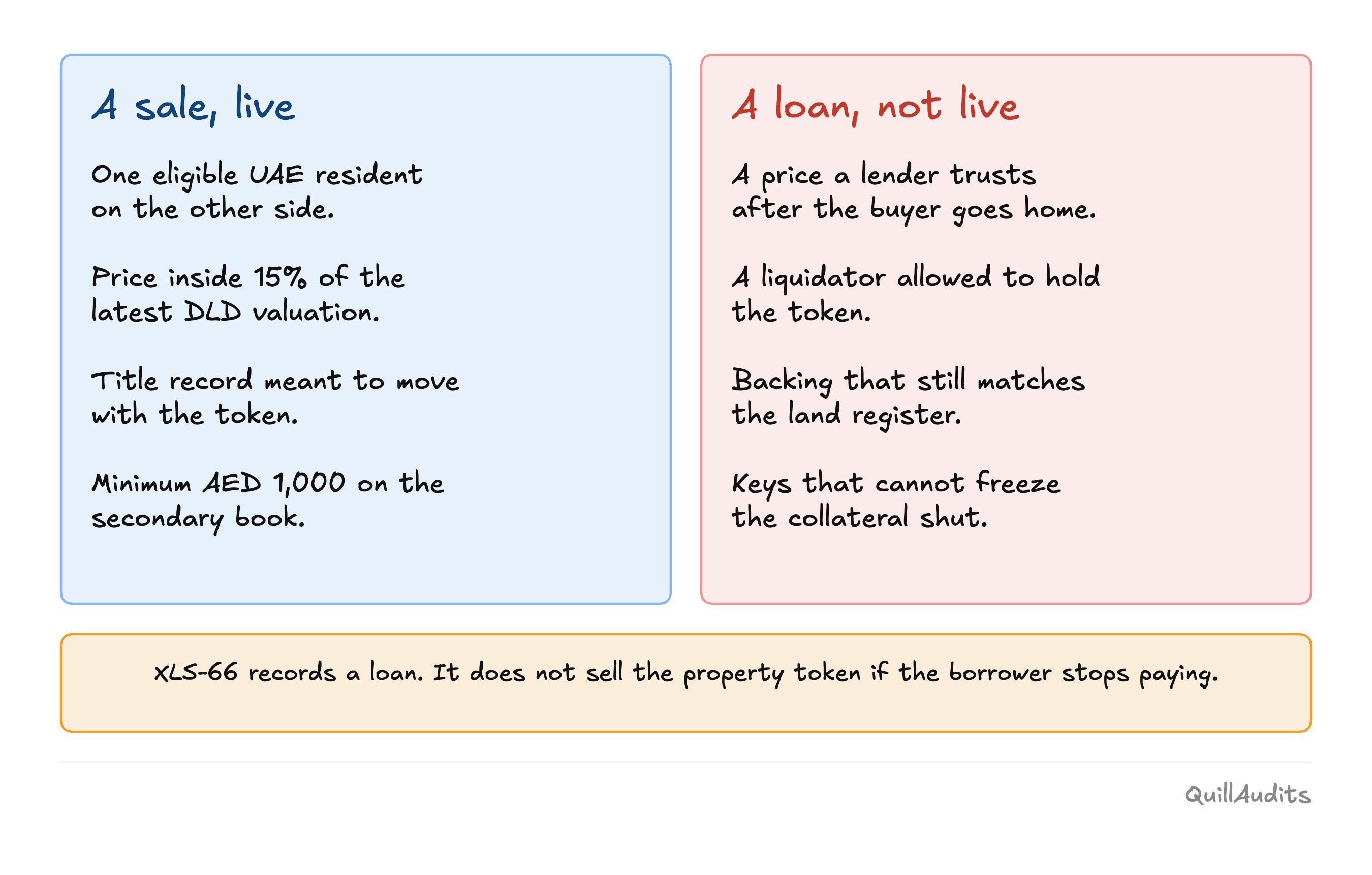
A sale needs one eligible buyer. A loan needs a price that a lender will trust after the buyer has gone home, a party who can take the collateral if the borrower stops paying, and a legal path that still works when the token is frozen. None of that is live on Prypco Mint. As of early October 2026 there is no VARA supervised borrow book against these property tokens.
The demand is obvious. People do not buy a fractional title so it can sit in an app. Markus Infanger, SVP of RippleX, put the longer aim in a Ripple Insights piece on 12 August 2025: “The true transformation lies in natively-issued onchain assets, securities, credit instruments, and real estate that are born digital, enforce compliance through code, and settle atomically without legal wrappers.” Real estate is in that sentence on purpose. A token that cannot be financed is a receipt. A token that can be financed is a balance sheet item.
The catch is what “finance” means on this ledger. XRP Ledger validators have been voting for months on XLS-65 and XLS-66, the Single Asset Vault and the Lending Protocol. A follow-on package, LendingProtocolV1_1, opened for voting at the start of October 2026. Activation still needs 80 percent of trusted validators for two straight weeks. The design underwrites the borrower off chain. Loan creation, repayment, and default are recorded on the ledger. There is no automatic on-chain liquidation.
That is institutional credit from a pooled vault. It is not an overcollateralized money market where a property token sits as collateral and a bot sells it if the loan to value breaks. Treating the two as the same product is how a lending market gets announced before it can clear.
What already went wrong elsewhere
Other chains have already tried to lend against tokens that look safer than a Dubai apartment share. The failures are useful because they are boring. They are not novel hacks. They are price, eligibility, backing, and keys.
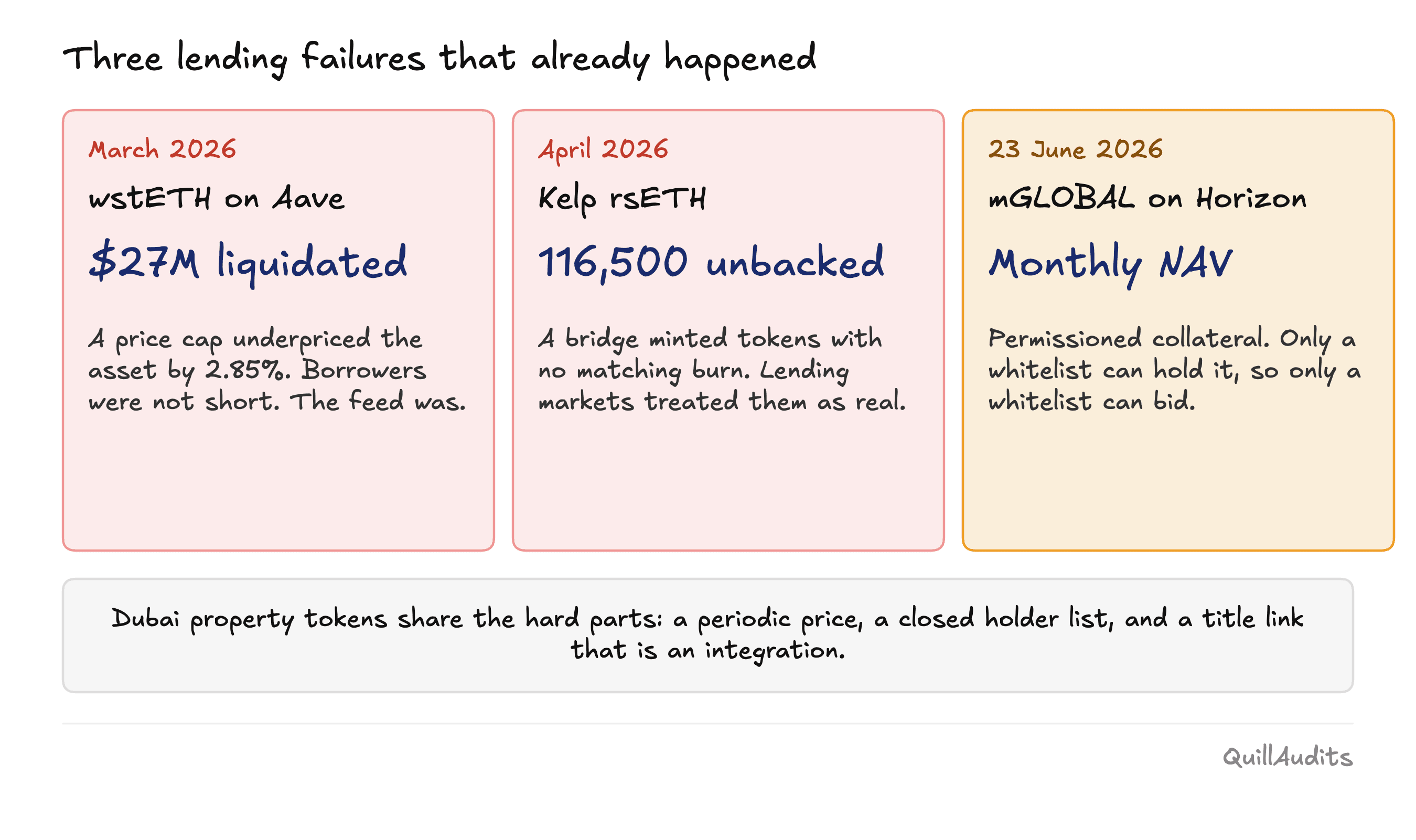
In March 2026 a misconfigured price cap on Aave underpriced wstETH by about 2.85 percent against its real exchange rate. Thirty-four positions, roughly $27 million, were liquidated even though the borrowers were not actually short of collateral. The protocol did not take bad debt. The users did. Chaos Labs, which runs the oracle, said the affected accounts would be reimbursed. Reimbursement after the fact is not a control. A stale or capped feed that can move a liquidation threshold is the control that was missing.
In April 2026 an attacker minted about 116,500 unbacked rsETH through a Kelp DAO bridge flaw and posted a large share of it on Aave and Compound. Aave later modelled bad debt in the nine figures, depending on how the loss was shared. The token still looked like rsETH to the lending market. The backing was not there. Supply checks against the issuer’s own register would have stopped the deposit. A bridge that can mint without a matching burn is a second ledger, and a second ledger is where the title link dies.
On 23 June 2026 Midas listed mGLOBAL, a token tied to a Fasanara receivables strategy, on Aave Horizon. MidasRWA later described it as collateral holders can post to borrow stablecoins while keeping exposure to the strategy.
Horizon is permissioned. Only whitelisted institutions can hold the token. The price comes from a monthly net asset value, not from a live order book. That is a reasonable way to admit a private credit product. It is a poor way to liquidate one. A monthly NAV does not move when the market does. A whitelist means the liquidator has to already be on the list. If the only firm allowed to bid is also the largest holder, the auction is a conversation, not a market.
Dubai’s property tokens share the hard parts of all three cases. The reference price updates on a government schedule, not tick by tick. Only residents can hold the token. The link to the title is an integration, not a law of physics. And the token standard used for regulated assets carries freeze and forced transfer powers, because a land department cannot issue a title it cannot claw back.
Four controls before the first loan
Jasmine Cooper, head of product at RippleX, said in October 2025 that the point of the Immunefi review was “making sure the proposed Lending Protocol is thoroughly tested and resilient before launch, so developers and institutions can build with confidence.” Property collateral needs the same bar, in four places.
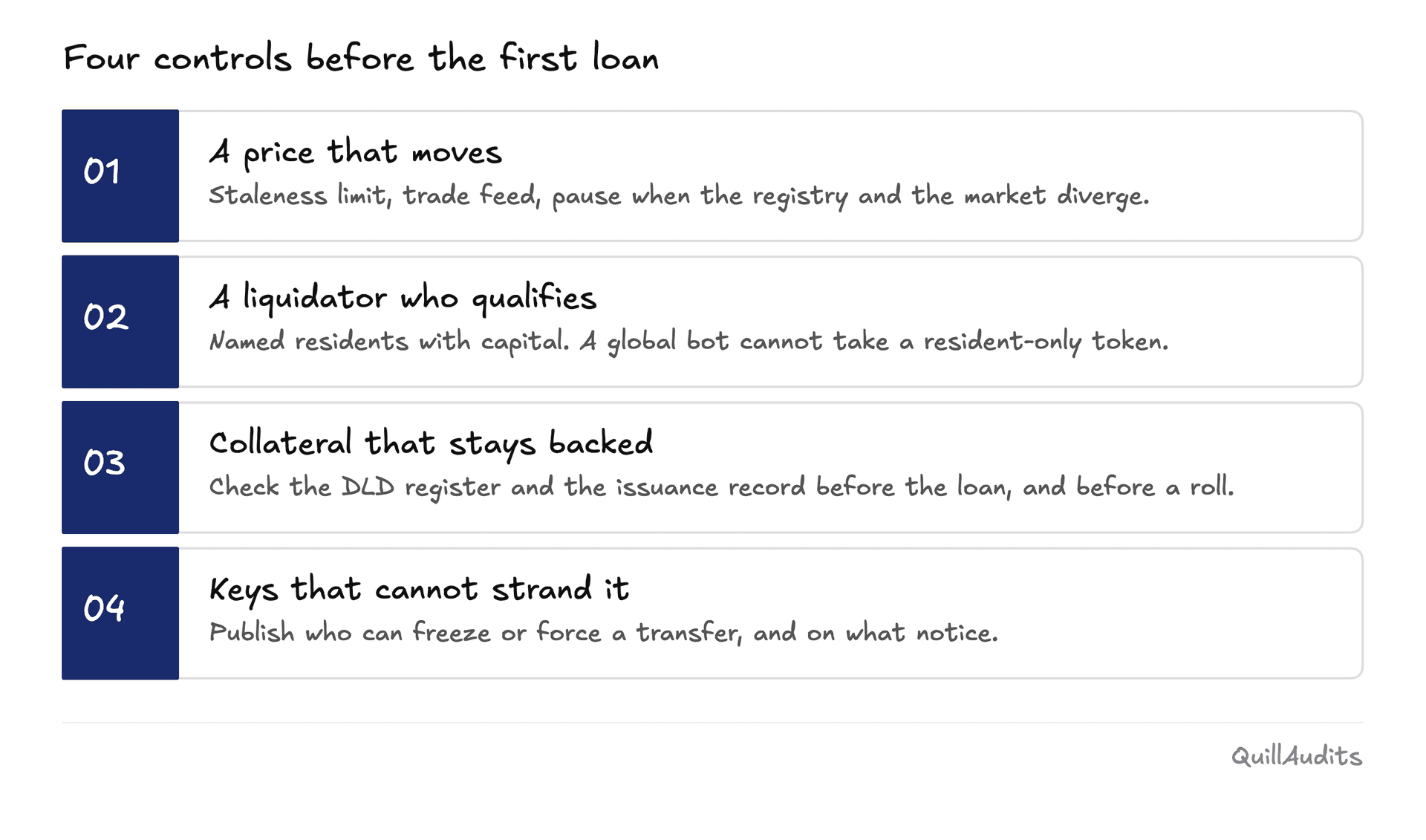
A price that can move. DLD valuations are periodic. An oracle that only reads the registry will lag a falling market, and a lender who trusts it will lend against yesterday. The feed needs a staleness limit, a second source from actual marketplace trades, and a pause when the two diverge. The wstETH episode was a 2.85 percent error. Real estate can gap by more than that between valuations.
A liquidator who can take delivery. If only verified residents can hold the token, a global liquidation bot is useless. Collateral nobody eligible can receive does not clear. Lenders need named, pre-approved liquidators with committed capital and a current eligibility check, not a hope that a buyer appears inside the 15 percent band.
Collateral that stays backed. Any wrapper, bridge, or receipt token weakens the registry link. Deposits into a lending pool should be checked against the DLD register and against Ctrl Alt’s issuance record before the loan is opened, and again before it can be rolled. The Kelp loss was a backing failure that the lending market treated as a price failure. Those are different bugs.
Admin keys that cannot strand a loan. Freeze and forced transfer are reasonable powers for a title token. They are dangerous powers for pledged collateral. A freeze that lands after the loan is open can block liquidation and leave the lender with a claim on an asset the chain will not move. Key holders, multisig thresholds, and timelocks should be public before the first loan. A lender should know who can stop a transfer, and on what notice.
What native does not yet mean
Infanger’s line about the token as the legal instrument is the destination, not the current file. The DLD pilot is the closest thing in the region to that destination, because the registry is in the loop. It is still a pilot. Ten properties. A resident-only book. A price band. A vote to sell the whole asset if the order book dies. That is a controlled secondary market. It is not a credit market.
Reece Merrick, Ripple’s managing director for the Middle East and Africa, called the project in July 2025 “a perfect example of how Dubai continues to lead in digital asset innovation.” The lead is real on issuance and on resale. It is not yet a lead on collateral. Leading on collateral means publishing the four controls before anyone is allowed to borrow, and saying plainly that XLS-66 is a different product from a property backed loan.
Conclusion
The Dubai pilot has done the hard part of a secondary market. A resident can sell a slice of a title, inside a price band, to another resident, with the registry in the loop. Borrowing is a different market. It needs a price that moves, a liquidator who is allowed to hold the token, backing that still matches the land register, and admin keys that cannot freeze a loan shut. Until those four are published, the honest line is short. You can sell. You cannot yet borrow against it and expect the loan to clear.
Contents