RWA Settlement & Redemption (A Clear Guide)
Learn how RWA settlement & redemption work from queues to NAV updates. Build secure & scalable redemption flows for tokenized real-world assets

With tokenized real world assets (RWAs) crossing $50B TVL in 2025, boosted by institutional products like BlackRock’s BUIDL and Ondo’s USDY, the industry is finally realizing something important, the real challenge isn’t tokenization, it’s liquidity and redemption.
Issuing tokens backed by T-bills or real estate is relatively straightforward. You can wrap an asset into an ERC-20 within days. But building a reliable redemption system that can handle large withdrawals, meet compliance requirements, and avoid regulatory issues? That’s where most protocols start breaking down.
One pattern is clear that many teams over-optimize minting and trading mechanics, while the exit ramp settlement, redemption, and cash-out flow is poorly designed or completely overlooked. And when redemptions surge, these weak points become catastrophic.
This guide is built to fix that. It’s a practical, developer-focused blueprint on how to design, implement, and secure the full RWA lifecycle.
Knowing redemption is hard is the first step. Knowing exactly where your protocol's redemption design falls short is the next. The RWA Security Score includes a dedicated Redemption & Liquidity Safety category that evaluates your protocol's queue design, liquidity buffer, and bank-run protection. Takes minutes to run and gives you an objective, weighted rating before you go to mainnet.
Redemption design is only one piece of the standard you choose. If you're still deciding between ERC-3643, ERC-4626, or another standard for your asset class, Tokenization 101 can help you settle that before you architect the redemption flow around it.
We break down models, off-chain processes, on-chain logic, risk areas, and real-world failure modes. For readers looking to understand RWAs in depth, including architecture, compliance design and production-ready frameworks, our comprehensive RWA handbook provides the broader foundation that this guide builds upon.
Why Settlement Is the Core of Any RWA System?
Tokenization opens access, but redemption is what builds trust. In the usual mint/burn flow, issuance is straightforward, assets are deposited off-chain, tokens are minted on-chain, and supply expands. But redemption works in the opposite direction, it's the process of turning on-chain tokens back into cash or underlying assets, often across jurisdictions, business days, and compliance rules.
The common mistake developers make is assuming redemption is just a _burn() call. In reality, it’s a coordinated workflow involving queues, NAV updates, custodian transfers, settlement windows, and regulatory checks. When this system is well-designed, it supports deep, reliable secondary markets like Ondo’s. When it isn’t, you get redemption freezes and liquidity scares, as several protocols experienced in 2024.
The Lifecycle of a Tokenized RWA
A tokenized RWA is not a static asset, it’s a continuous loop connecting on-chain tokens to off-chain value. Understanding this full cycle is the foundation for designing settlement systems that remain reliable under real-world redemption pressure. Here's the end-to-end lifecycle:
- Off-Chain Asset Acquisition: Issuer (e.g., fund manager) buys underlying assets via TradFi rails, T-bills from brokers, and real estate via SPVs. Custodians like Anchorage or BNY Mellon take legal title.
- Token Minting: On-chain, smart contracts mint tokens proportional to asset value (e.g., 1 token = $1 NAV). Compliance hooks (KYC via ONCHAINID) gate entry.
- Trading on Secondary Markets: Tokens circulate on DEXs (Uniswap) or permissioned venues (Polymesh), with partitions enforcing transfer rules.
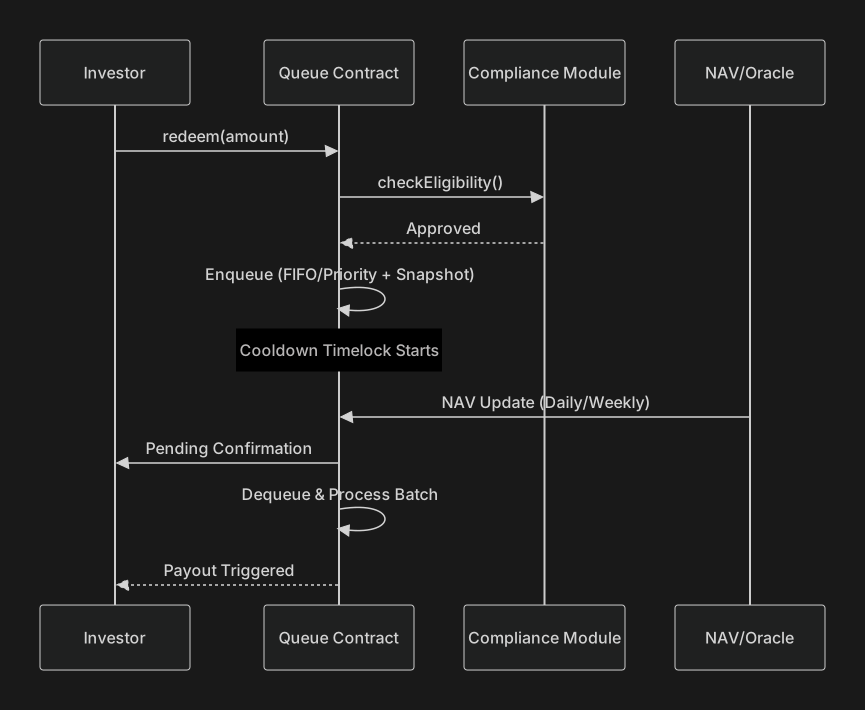
- Redemption Request: Holder submits
redeem(amount), triggering queue entry and eligibility checks.
- Off-Chain Settlement: Custodian liquidates fractions, disburses via wire/SWIFT. Oracles attest to delivery.
- Token Burn: Post-confirmation, tokens are burned, supply contracts, and events log for audits.

This cycle needs to stay tightly synchronized, any mismatch in timing (for example, burning tokens before funds are delivered) can lead to over-issuance or trapped capital.
What Redemption Actually Means?
Redemption isn’t a single action, it’s a coordinated workflow involving queues, valuation checks, and cash settlement. Many teams treat it as a black box, but breaking it into its core components reveals why it’s often the most complex part of an RWA system.
Redemption Queue
A queue system governs the processing of withdrawal requests. It prevents liquidity shocks, enforces fairness, and ensures that large redemptions don’t overwhelm the issuer.
Common models include:
- FIFO Queues: First-in, first-out ordering for fairness. Can be implemented fully on-chain or managed off-chain with Merkle proof verification.
- Priority Queues: High-value or institutional investors can be processed earlier. ERC-3643’s
IModularComplianceallows flexible rule sets for this.
- Cooldown / Locking Windows: A 24–72 hour delay after a request to prevent spam, abuse, or panic-driven runs. Typically enforced through timelocks.
For robustness, queue contracts often take block-level snapshots to prevent manipulation or replay inconsistencies.
NAV (Net Asset Value) Updates
NAV determines the redemption price, users redeem at the current asset value, not the historical mint value.
Key considerations:
- Update Frequency: Liquid assets (e.g., T-bills) rely on daily oracle feeds, illiquid assets (e.g., real estate) may only update weekly due to appraisal costs.
- NAV & Redemption Timing: Requests usually wait for the next NAV snapshot. In volatile markets, this can create pricing gaps or require haircuts.
- Stale/Incorrect NAV Risks: If the NAV drops after a user submits a request, they may receive less. Circuit breakers and bounded deltas help mitigate manipulation.
Cashflow Cycles
Redemption ultimately depends on fiat movement, which operates at TradFi speed, not blockchain speed.
Core elements:
- Cash Buffers / Parking: Idle capital is often held in money market vehicles or yield accounts until redemptions occur.
- Custodian Transfers: Funds move via automated APIs like Fireblocks or via traditional rails such as ACH and SWIFT.
- T+1 / T+2 Settlement: Many assets still follow traditional settlement cycles. RWA systems must align with these timelines to stay compliant.
Types of RWA Redemption Models
There’s no universal redemption design, each model optimizes differently for speed, capital efficiency, regulatory constraints, and user experience. Below is a practical taxonomy, along with real 2025 examples:
| Model | Description & Examples | Pros | Cons |
|---|---|---|---|
| Instant | Tokens are burned immediately and paid out from pre-funded stablecoin buffers. Example: Aave-style money markets. | Very liquid, seamless DeFi experience. | Requires large idle capital, can fail during stress events. |
| Delayed | Requests wait for NAV or oracle confirmation before payout. Standard for treasury-backed assets. Examples: Ondo USDY, Backed bIB01, Matrixdock SDI. | Good balance between safety and liquidity. | Users wait 1–3 days, higher opportunity cost. |
| Batch | Multiple requests are grouped into scheduled batches for efficiency. Example: Franklin Templeton’s FOBLX on-chain fund. | Saves gas, simplifies compliance and accounting. | Queues can pile up during heavy redemptions. |
| Secondary Exit | Holders sell to other investors via OTC or DEX instead of redeeming from the issuer. Example: Centrifuge pools. | No custodian delays, 24/7 liquidity. | Liquidity may be shallow, pricing can diverge from NAV. |
| No-Redemption | Holders cannot redeem directly, only secondary trading is allowed. Common in Reg S real estate structures (e.g., RealT). | Simplifies regulatory obligations. | Capital becomes locked, poor UX for investors. |
The right model depends on the underlying asset, use instant redemptions for highly liquid assets like cash equivalents, and delayed or batch models for credit or illiquid instruments.

Off-Chain Settlement: How Money Actually Moves
Burning tokens on-chain is only half the story, real redemption happens through traditional financial rails. Here’s what the off-chain side actually looks like:
Custodians
Custodians are responsible for holding both the underlying assets and the cash used for payouts.
- Qualified Custodians: Entities like Anchorage, BitGo, or banks such as BNY Mellon. These must meet strict standards (e.g., SOC 2 compliance).
- Account Structures:
- Omnibus accounts pool funds for operational efficiency.
- Segregated accounts isolate client assets, providing bankruptcy protection, now common post-FTX.
- Transfer Methods:
- ACH for domestic U.S. transfers (typically T+1)
- SWIFT for cross-border wires (T+3 or more)
- Stablecoin rails via Circle APIs for faster settlement
Broker Dealers
Broker-dealers execute the actual asset sales required to fund redemptions.
- Why They’re Needed: Issuers generally cannot liquidate regulated instruments themselves. Firms like Jane Street or Goldman Sachs handle the sale of T-bill holdings.
- Settlement Flow: When a redemption request is approved, broker sells the necessary asset fraction, cash is wired to the custodian’s omnibus account, and funds are distributed to investors on a pro-rata basis.
Fund Administrators & Compliance
This layer ensures that redemptions remain compliant with regulatory requirements.
- Sanctions Screening: Real-time OFAC and sanctions checks performed through providers such as Theta Lake.
- KYC Verification: Additional identity verification for large redemption amounts (commonly above 10% of AUM).
- AML Monitoring: Automatic suspicious activity reports (SARs) generated via tools like Chainalysis.

On-Chain Settlement Logic
Smart contracts manage the on-chain portion of redemption, but they must stay aligned with off-chain settlement through oracle-driven confirmations.
Burn & Redeem Patterns
There are two primary ways protocols structure redemption flows:
- Burn-First Model: Tokens are burned immediately (
_burn()), and the issuer is trusted to complete the payout off-chain. This is simple but introduces settlement and solvency risk.
- Request-Then-Burn Model: The contract records a
RedemptionRequestedevent and only burns tokens after an oracle confirms off-chain settlement. This reduces risk and is preferred for regulated assets.
1// Example (ERC-7943 style):
2function redeem(uint256 amount) external {
3    require(queue.canEnqueue(msg.sender, amount), "Queue full");
4    _transferByPartition(ISSUED_PARTITION, msg.sender, address(this), amount);
5    emit RedemptionRequested(msg.sender, amount, block.timestamp);
6    // Await batch finalization and oracle confirmation
7}
8
Timelocks enforce cooldown periods, and blockhash snapshots provide tamper-resistant audit trails.
Settlement Proofs
Redemption should never rely on unilateral trust. Use cryptographic attestations:
- NAV Attestations: Chainlink or similar feeds provide verified daily NAV values.
- Proof of Reserves: Merkle roots of custodian balances, updated regularly.
- Real-Time Confirmations: RedStone oracles can confirm settlement events within minutes.
These proofs ensure on-chain state reflects real-world asset movement.
The oracle delivery mechanisms referenced above, Chainlink Automation, API3 Airnode, UMA's optimistic verification, are covered in much greater technical depth in our handbook's RWA System Design chapter, including a full EIP-712 reserve-proof Solidity implementation and the ERC-7540 async settlement pattern that underlies the request-then-burn model described here.
Settlement Risks & Failure Scenarios
These risks are not theoretical, several RWA protocols have already run into major settlement issues, and the categories below outline the most critical vulnerabilities developers need to consider.
Secure Your RWA Settlement & Compliance Flows
Secure Your RWA Settlement & Compliance Flows
RWA redemptions have risks standard audits miss. QuillAudits secures your workflows to prevent freezes, mismatches and compliance issues.
Liquidity Crunch
A liquidity crunch occurs when issuers don’t have enough readily available cash to fulfill redemption requests. This is one of the most common failure modes in RWA systems and often results in temporary freezes or redemption gates, similar to the pressure seen during the 2023 USDC de-peg. Maintaining sufficient liquidity and modeling worst-case redemption spikes is essential to keep the system stable during stress.
Asset Liquidation Delays
Different assets unwind at very different speeds. Treasury bills can be liquidated almost immediately, but real estate, credit products, or private loans may take weeks to appraise and sell. This delay creates a timing mismatch between when users expect funds and when issuers can actually deliver them. Systems that rely on illiquid positions must account for these long settlement cycles to avoid bottlenecks during demand surges.
Oracle / NAV Manipulation
When NAV updates are infrequent or rely on a single oracle source, the system becomes vulnerable to price manipulation and arbitrage. Stale NAV feeds can be exploited through rapid trading or flash-loan attacks, allowing redemptions at inaccurate valuations. Ensuring reliable updates and cross-checking NAV sources helps maintain fair and accurate redemption pricing.
Bank / Custodian Failure
Custodians represent a significant concentration point in the redemption pipeline. If a bank or custodian experiences insolvency, regulatory intervention, cyberattacks, or operational downtime, as seen in events like SVB’s collapse or the Ronin hack, redemption capital can become temporarily inaccessible. Diversified custodial structures reduce reliance on any single institution.
On-Chain - Off-Chain Mismatch
One of the most subtle risks is a desynchronization between on-chain state and off-chain settlement. If tokens are burned before off-chain transfers are confirmed, the system may accidentally inflate supply or leave users without access to funds. Redemption flows must ensure that burns only occur once off-chain settlement is cryptographically or operationally verified.
Conclusion
The sustainability of any RWA system depends on the integrity of its redemption pipeline. From NAV alignment to custodian workflows to on-chain burn sequencing, each component must operate in sync with deterministic guarantees. Protocols that architect this pipeline correctly will offer predictable liquidity, withstand stress events, and earn institutional trust. Those who ignore it will continue to face freezes, mismatches, and solvency scares.
In the end, redemption architecture isn’t just a subsystem, it is the backbone of institutional-scale tokenized finance. To ensure your pipeline is secure, compliant and resilient, explore how our RWA security solutions can help you safeguard every stage of the lifecycle.

Contents