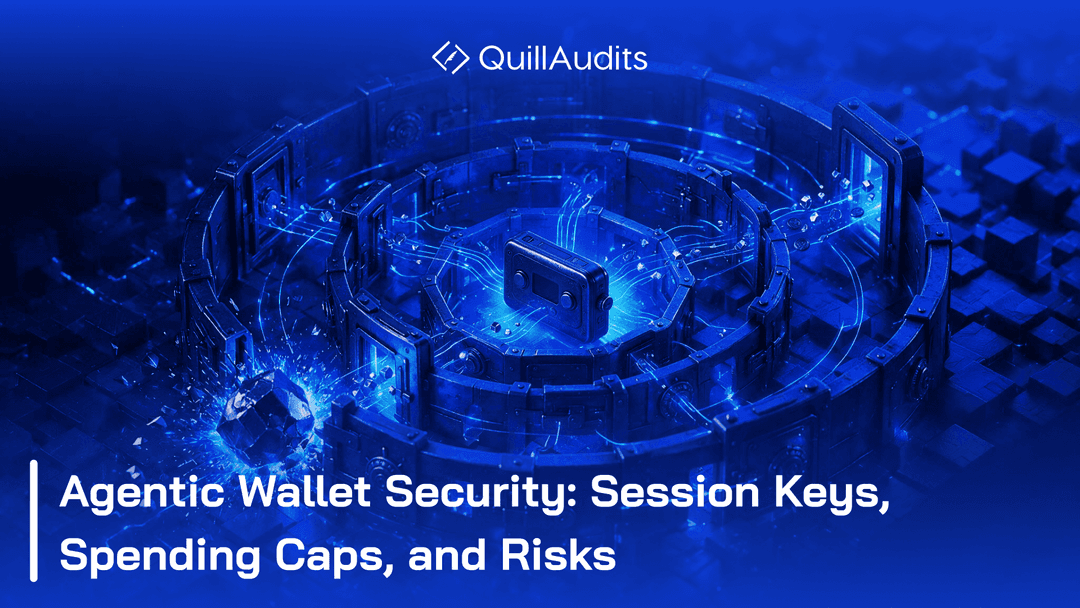
Agentic Wallet Security: Session Keys, Spending Caps, and Risks
Agentic wallets let AI agents move assets without approving every transaction, relying on session keys and spending caps enforced in code rather than the agent's judgment. Learn how ERC-4337, ERC-7715, and ERC-7710 enable scoped permissions, and why prompt injection, overbroad session keys, and unlimited approvals are the biggest risks a security audit must address in 2026.

An agentic wallet lets an AI move real assets without a human signing each transaction. Its security rests on one simple rule: never let the agent decide everything on its own. Instead, set clear limits in code. Session keys and spending policies make that possible.
What an agentic wallet actually is
A traditional wallet needs a person to approve every transaction. An agentic wallet is built for software that must act repeatedly, across many apps, and at machine speed. Rather than just holding private keys, it adds a control layer that says what an AI can do, when it can do it, and what checks must pass before a transaction is signed.
The need for this wallet is becoming clear. An AI can take one instruction and turn it into a chain of financial actions across different protocols—something regular wallets weren’t made to handle. The shift is already happening. Coinbase launched Agentic Wallets in February 2026, MetaMask released its Agent Wallet, and similar tools are spreading through the ecosystem.
Session keys, the core primitive
Session keys let an AI transact without ever seeing the master key. The wallet creates a temporary secondary key with tightly defined permissions. That key might only spend a set amount, interact with approved addresses, call certain functions, and stay valid for a short time. The master key stays locked away; the session key does the day‑to‑day signing. If the agent behaves oddly or the session key is stolen, the damage is limited by those built‑in restrictions. The session can be revoked instantly and replaced with a new one. The tighter the permissions, the smaller the impact of a breach.
Spending caps and policy
Modern agentic wallets use rule‑based controls instead of constant human approvals. The wallet enforces limits such as maximum transaction size, daily spending caps, approved recipients, allowed chains, and expiration windows. These rules must be enforced by the wallet or the underlying smart contract, not by the agent itself. An AI should never be trusted to police its own actions because it is the part most likely to be manipulated. For example, MetaMask’s Guard Mode applies daily caps and protocol allowlists at the wallet level, stopping the agent from bypassing them even if its behavior changes.
The standards doing the work
Most agentic wallets rely on account abstraction.
ERC‑4337 smart accounts let developers encode authorization rules directly in on‑chain validation logic session keys, expiration times, function allowlists, and value limits are checked automatically for every transaction.
ERC‑7579 adds a modular architecture for smart accounts. Newer standards expand the permission model: ERC‑7715 lets applications or AI agents request scoped, time‑limited permissions, while ERC‑7710 defines how those delegated permissions are redeemed and validated on‑chain. Outside the EVM, similar models are often built with MPC policy engines instead of smart contracts. All these pieces enforce security, but each is code that can contain flaws, so careful review is essential.
Where the real risks are
One major challenge is prompt injection. An AI may read untrusted content—from a webpage, token metadata, email, or message—and that content can contain instructions meant to steer the agent. Because the agent can’t reliably tell good prompts from bad, protection must come from on‑chain spending limits and allowlists, not from the model’s judgment.
Another risk is overbroad session keys. If a session key has wide permissions or lives too long, a compromise gives an attacker far more access than intended. Limiting its scope, shortening its lifetime, and allowing only specific actions are key defenses.
The agentic runtime environment matters too. If the system storing the session key is breached, the attacker gains the same capabilities as the agent. Many designs protect key material with MPC or secure enclaves instead of exposing it directly.
Traditional Web3 risks remain. Unlimited token approvals are a common way wallets get drained, and the problem grows when software grants approvals automatically. Approvals should be bounded, revocable, and reviewed as carefully as token transfers. For large transactions, keeping a human in the loop is still wise. Most agentic wallets let the AI act freely within set limits but require manual approval for anything above a threshold.
Finally, malicious contracts pose a danger. An AI can be tricked into interacting with a hostile contract without realizing it. Simulating transactions and checking for threats before signing helps catch suspicious behavior early.
Quick reference
| Risk | mitigation |
| Prompt injection | enforce on‑chain caps and allowlists, don’t trust prompts. |
| Overbroad session key | restrict permissions, shorten expiry, limit functions. |
| Runtime compromise | protect keys with MPC or secure enclaves. |
| Unlimited approvals | use bounded, revocable token approvals. |
| High‑value actions | require human approval above set thresholds. |
| Misbehaving agent | enable fast session revocation and hard spending limits. |
What an audit looks at
When auditors review an agentic wallet, they examine every component that enforces permissions: session‑key validation, the ERC‑7715/7710 delegation contracts, the code that applies spending limits and allowlists, the session‑revocation mechanism, and the way token approvals are created and limited. Throughout, they keep asking: if the AI is compromised or behaves oddly, how much damage can it cause? A solid wallet answers that in code, not by assuming the AI will always act correctly.
Conclusion
Agentic wallets change how digital assets are managed, swapping constant human approvals for policy‑driven automation. That convenience reshapes the security model. Instead of trusting an AI to make the right calls, we make sure it can only operate within clearly defined boundaries enforced by code. Session keys, spending limits, permission frameworks, and thorough audits work together to let agents act independently without giving them unchecked control over real assets.
Contents