Crypto Rug Pulls and How Legitimate Web3 Projects Can Prove They Are Built to Stay
Learn how legitimate Web3 projects can prevent crypto rug pulls by limiting admin permissions, securing liquidity, using multisigs, enforcing vesting, verifying smart contract deployments, and monitoring on-chain activity. Discover how audits and transparent security practices can help founders prove their projects are built to protect users and maintain trust.

At 9:12 on launch morning, a founder opens Telegram and sees a message spreading through the community:
“Liquidity is not locked. The developer wallet can mint more tokens. This could be a rug pull.”
Within minutes, screenshots reach X. Token holders start selling. A planned exchange announcement is put on hold.
The team has spent months building the project and has no intention of stealing funds. But the smart contract gives one wallet broad control over token supply, fees, and liquidity. The founders understand why those permissions exist. Investors only see what those permissions could potentially be used to do.
That is the uncomfortable reality of trust in Web3. Good intentions are invisible on-chain.
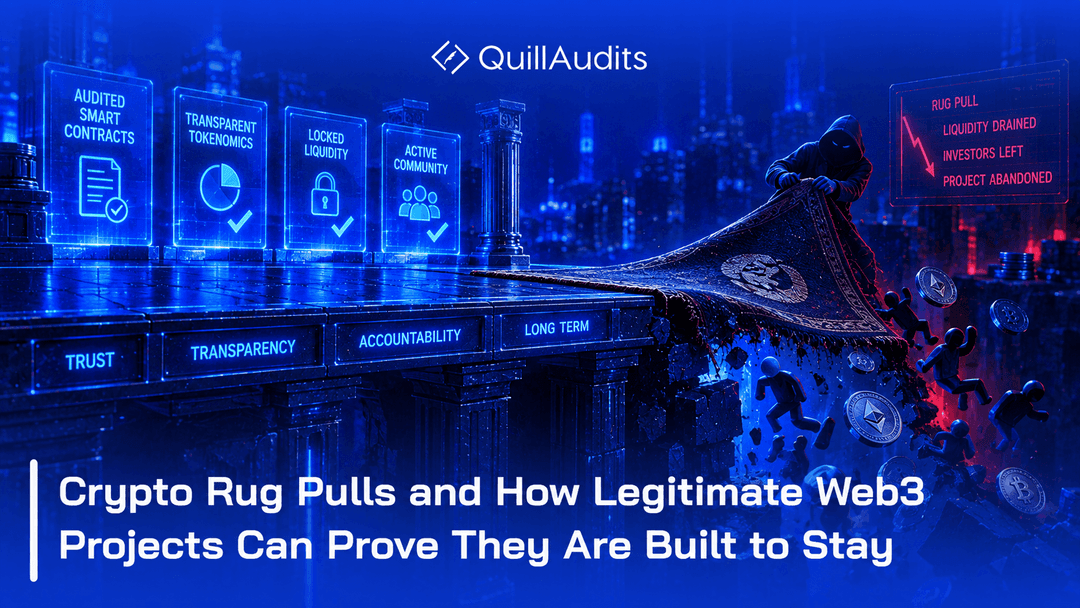
For serious founders, preventing a crypto rug pull is not just about avoiding fraud. It is about building a project that cannot easily be mistaken for one.
What Is a Crypto Rug Pull
A crypto rug pull occurs when project insiders extract value from a token or protocol and leave investors holding assets that are worthless, illiquid, or impossible to sell.
Some rug pulls happen almost immediately. Developers remove liquidity, mint and sell a large number of tokens, or move treasury assets into personal wallets.
Others unfold gradually. The team changes transaction fees, sells unlocked allocations, stops development, or quietly drains value while continuing to reassure the community.
Our earlier guide on what a crypto rug pull is and how to avoid one explains the common warning signs from an investor's perspective. For founders and technical leaders, however, the more important question is different: What does your protocol allow insiders to do?
Rug Pull Risk Often Hides in Legitimate Features
The dangerous part is that rug-pull mechanisms rarely come with suspicious names. They are often built into ordinary administrative functions.
A mint function may exist to support rewards. An adjustable tax may be used to fund operations. An upgradeable proxy may give the team a way to fix bugs. A blacklist may have been added for compliance purposes.
Each of these features can have a legitimate purpose. Each can also become a single point of failure.
Consider a token owner who can increase the transfer tax from 2% to 100%. The contract may technically allow users to buy while making it economically impossible to sell. From the user's perspective, it behaves like a honeypot.
An unrestricted mint function creates another risk. If an administrator can create unlimited tokens, a single compromised or dishonest wallet can inflate the supply and sell those tokens into the liquidity pool.
Liquidity control matters as well. Locking liquidity can make an abrupt withdrawal harder, but a liquidity lock is not complete proof of safety. A team may still control concentrated token allocations, upgrade permissions, treasury wallets, or fee settings.
The same applies to ownership renunciation. Giving up ownership may look reassuring, but it can also leave a contract permanently unable to respond to vulnerabilities. Strong security comes from limiting administrative capabilities, distributing control, and making the use of those permissions transparent.
Why an Audit Does Not Automatically Mean Rug Proof
Undeniably, obtaining an audit badge gives a sense of trust to one. Though nowadays investors and partners are not just simply taking the badge for granted - they are digging deeper into what the real meaning behind it is.
Was it the same audited smart contract that was deployed? Have the fixes been made for the identified critical issues only? Has the audit coverage also been extended to vesting staking liquidity and treasury contracts? Will new functionalities be added to the upgrade that hasn't been audited yet?
A smart contract audit cannot guarantee that every team member will behave honestly. What it can do is identify the technical powers available to insiders and show whether those powers are unnecessarily broad, poorly protected, or inconsistent with the project's public claims.
A useful audit should examine:
- Unrestricted minting and burning permissions
- Hidden transfer restrictions or sell conditions
- Adjustable taxes and transaction limits
- Liquidity withdrawal controls
- Token allocation and vesting logic
- Owner, administrator, and operator roles
- Proxy upgrades and storage safety
- Emergency pause and blacklist functions
- Multisig configuration and signer concentration
- Differences between documented and actual contract behaviour
The smart contract audit process at Quill Auditors covers manual reviews as well as fuzzing. With these it has also got independent validation, mitigation reviews, and deployment checks. The main reason why such multi-layered approach should be considered is rugs-pull risk may emerge from the interaction between code, company policies (governance) and operational control, rather than in a single clearly detrimental function.
How Founders Can Build Verifiable Trust
The strongest response to rug-pull concerns is evidence that users can verify for themselves.
Start by publishing token allocations in a format that users can verify on-chain. Team, advisor, and treasury allocations should use transparent vesting contracts rather than relying on informal commitments.
Put sensitive actions behind a multisig. Min or any externally owned account shouldn't have control of minting upgrades, liquidity, and treasury money. Employ timelocks wherever feasible to allow the community to have a sneak peek at major changes.
Define explicit limits within contract. If transaction charges are to be limited to a percentage, then code must be written so. If supply is not una line, eliminate unrestricted minting. Define upgrades, give details on approvals, input from users, a time period etc.
Make the complete audit report public, including unresolved findings and the reviewed commit hash. Then verify that the deployed bytecode matches the audited version.
Monitoring should continue after launch. Alerts for ownership transfers, role changes, unusual minting, liquidity movements, and proxy upgrades can help identify compromised keys or unexpected behaviour before the wider community notices. QuillAudits' on-chain monitoring service is designed to track these protocol-specific events in production.
This kind of proof matters in a market where scams remain a serious trust problem. Chainalysis estimated that cryptocurrency scams received at least $14 billion on-chain during 2025, with the figure likely to rise as more illicit addresses are identified. Rug pulls represent only one part of that total, but they have made users far less willing to treat trust in the team as a sufficient security model.
Conclusion
A legitimate project can still create the technical conditions associated with a crypto rug pull.
For founders, CTOs, and token issuers, the solution is to make trust measurable. Limit privileged functions, distribute authority, enforce vesting, verify deployments, and monitor sensitive activity after launch.
An audit cannot certify someone's intentions. It can show investors, exchanges, and partners that the project has reduced the opportunities for those intentions to become the only thing protecting their funds.
Before launching a token or opening liquidity, speak with QuillAudits about a smart contract audit. It is easier to explain strong controls before launch than to rebuild trust after the community starts asking whether the project is a rug pull.
Contents