EIP-7702 Delegation Phishing: Inside the $1.5M Drainer Wave
EIP-7702 delegation phishing lets one signature hand an attacker full control of your wallet. See how the October 2026 drainer wave cost users $1.54M and $22.7K through the same CrimeEnjoyor sweeper, how fake smart account upgrades trick signers, and how users, wallets, and dApps can protect themselves with safer authorization prompts and delegation checks.

The decision · answer in brief
EIP-7702 delegation phishing lets one signature hand an attacker full control of your wallet. See how the October 2026 drainer wave cost users $1.54M and $22.7K through the same CrimeEnjoyor sweeper, how fake smart account upgrades trick signers, and how users, wallets, and dApps can protect themselves with safer authorization prompts and delegation checks.
EIP-7702 Delegation Phishing: Inside the $1.5M Drainer Wave
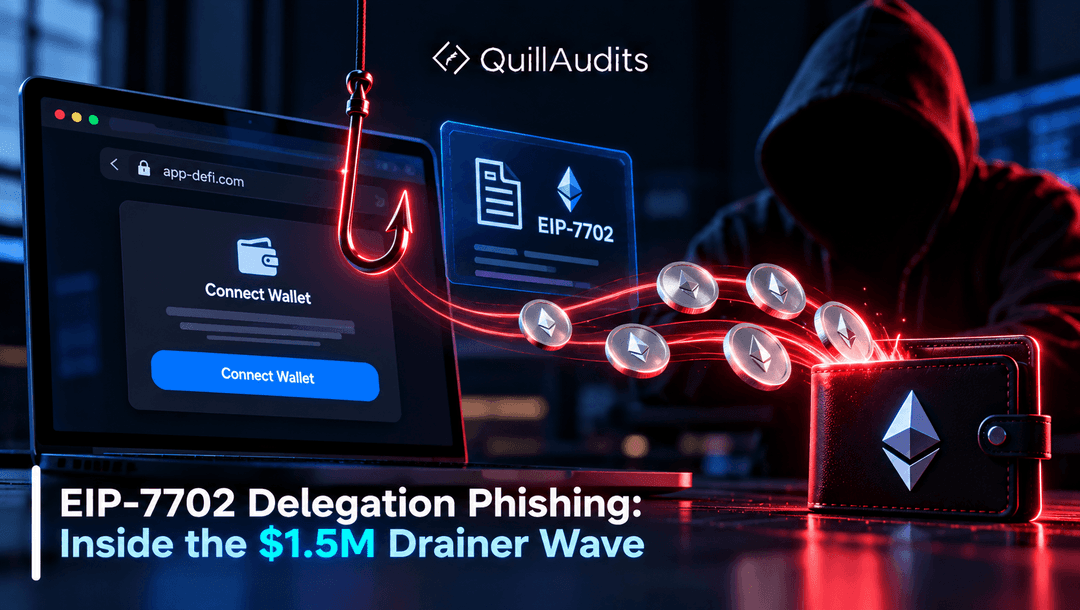
EIP-7702 delegation phishing collapses the entire wallet-draining funnel into a single signature. Instead of tricking you into approving one token, a malicious 7702 authorization hands an attacker's contract standing permission to act as your wallet, for everything in it. In October 2026, that shortcut cost one Ethereum user roughly $1.54 million and another $22.7K four days later, both traced to the same reusable sweeper code. Here's how the mechanism works and how to stop being the next line item.
What Is EIP-7702 Delegation Phishing?
EIP-7702, short for Ethereum Improvement Proposal 7702, is the Pectra upgrade's account-abstraction standard. It lets a normal Externally Owned Account (EOA), the kind controlled by a private key, temporarily attach smart contract code to itself through a new transaction type. The delegation is written on-chain as a 0xef0100 prefix plus the delegate's 20-byte address, packed into a 23-byte code slot, inside a six-element authorization tuple of chain_id, address, nonce, y_parity, r, and s.
That's a legitimate upgrade: it's how wallets add gas sponsorship, batched transactions, and session keys without migrating users to a separate smart contract wallet. Delegation phishing is what happens when an attacker gets you to sign that authorization tuple pointing at a contract they control instead of your wallet provider's. Once it's signed, the attacker's code runs with your EOA's full authority, and every asset in that address becomes reachable in a single transaction.
What Is a Wallet Drainer, and Why Does EIP-7702 Make It Worse?
A wallet drainer is malicious code, usually delivered through a phishing site or fake dApp, that moves a victim's crypto to an attacker's address as soon as the victim signs a transaction or message. Classic drainers trick users into approving token spend limits or signing permit messages one asset at a time, so the theft is bounded by what was approved and often takes several interactions. EIP-7702 collapses that multi-step funnel into one event: because the authorization grants code execution rights over the whole account rather than spend rights over one token, a single signed delegation can sweep ETH, NFTs, and every approved or approvable token in the wallet at once, with no further clicks from the victim.
Drainer kits have already adapted: Inferno Drainer, Pink Drainer, and the newer Angel kit all shipped EIP-7702-flavored modules through 2025 and 2026. QuillAudits has flagged this risk since the EIP-3074 era, the predecessor standard: delegating authority to a malicious contract can drain everything, a mechanic our EIP-7702 explainer covers in detail. This post covers the attack side.
How Does One Signature Hand Over Full Wallet Control?
The authorization tuple a victim signs is a standard off-chain signature, not a full on-chain transaction, which is exactly why it's easy to disguise. A phishing site can present it as a routine wallet action, a gasless approval, or a "smart account upgrade" prompt, then submit the signed tuple itself, or have a sponsor submit it, to install the delegation on-chain.
Once installed, the delegate contract's code executes with the EOA's own address and balance context every time that account is touched. In the sven.eth incident below, the attacker's delegated contract called PodMining.claim() to mint TAPEETH rewards, then swept both the newly minted tokens and the account's ETH in the same transaction. ExVul's analysis found no bug in TAPEETH or PodMining themselves; the entry point was the delegated authorization sitting on the victim's own address. The malicious delegation stayed active on-chain after the theft too, leaving the address exposed to repeat draining on any future deposit until revoked.
The October 2026 Drainer Wave by the Numbers
The theoretical risk became a live wave fast. Within the first week after Pectra activated, roughly 11,000 EIP-7702 authorizations were already recorded on Ethereum mainnet.
- October 10, 2026: A staking user lost approximately $1.54 million in ETH and BTC-pegged staked tokens through a malicious 7702 authorization; Scam Sniffer flagged the theft, and SlowMist founder Yu Xian forwarded the alert. Neither party published the victim's wallet address alongside the alert, unlike the sven.eth case four days later.
- October 14, 2026: The sven.eth address lost $22.7K when an attacker's delegated contract claimed and swept staking rewards in one transaction.
- Scale of the campaign: one observed operation spent just 2.88 ETH to authorize malicious delegations across roughly 79,000 addresses.
Both October incidents trace back to the same reusable sweeper bytecode. Wintermute researchers reverse-engineered it and named it CrimeEnjoyor, bytecode that automatically drains ETH, NFTs, and tokens from any address that has signed a malicious 7702 authorization pointing to it.
How Do Attackers Trick Users Into Signing?
The lure rarely looks like a scam. Documented 7702 phishing campaigns rely on three recurring tricks:
- Fake "smart account upgrade" prompts that offer gas sponsorship or batched transactions, framing the malicious authorization as a convenience feature.
- Pixel-perfect clones of legitimate wallet flows, such as MetaMask's own smart-account upgrade UI, with the delegate address swapped for the attacker's contract.
- Last-second substitution, where a user expects a routine EIP-712 message signature and instead signs a
0x04set code transaction type authorization without noticing the switch.
Yu Xian described the victim experience in plain terms: "From the perspective of a phished user, it goes like this: the user opens a phishing website, a wallet signature prompt pops up, the user clicks confirm, and with just that one action, all valuable assets in the wallet address vanish in a snap." It's the same blind-signing failure mode behind the $444M+ in losses QuillAudits tracked across H1 2026, covered in our piece on wallet security protocols and key compromise. EIP-7702 just raised the ceiling on what one blind signature hands over.
How Can You Protect Your Wallet From 7702 Delegation Phishing?
- Verify the site before connecting. Check the URL character by character and confirm you reached it through a bookmark or the project's own documented link, not a search ad or a Discord DM.
- Read what you're signing, not just what the prompt says. If a wallet interface describes an action as a routine approval but the underlying payload is a set code transaction type (
0x04), that mismatch is the tell. A wallet that decodes 7702 authorizations in plain language is worth the extra click. - Check your account's delegation status periodically. A block explorer shows whether your EOA has an active
0xef0100code pointer. If one exists and you didn't knowingly set it, revoke it immediately, since an old malicious delegation stays live until removed. - Keep high-value funds in a separate, rarely-signed address. A hot wallet used for daily signing is the wrong place to hold a staking position worth six figures.
- Treat "upgrade your wallet" prompts like a token approval request. As Rahul Rumalla, Chief Product Officer at Safe, put it: "7702 was never meant to be a silver bullet and it does have great use cases." The feature isn't the problem; signing it blind is.
How Should Wallets and dApps Design Safer 7702 Authorization Prompts?
For wallet and dApp teams, the fix sits upstream of user vigilance. A safer 7702 authorization prompt should give the user, before they can confirm, all of the following:
- The delegate contract's full address, displayed uncut rather than truncated to a few leading and trailing characters.
- A verification flag showing whether that address matches the wallet's own known-good delegate or is unrecognized.
- A plain-language description of the actual 0x04 payload, not a generic "upgrade your wallet" or "enable new features" label.
- A visual treatment that can't be cloned into a cosmetic update, so a set code transaction type authorization never looks identical to a routine UI prompt.
- A persistent on-screen indicator once a delegation is active, so the user isn't relying on memory to know their EOA has standing code attached to it.
Treating a 0x04 authorization identically to a cosmetic UI update, as several cloned phishing flows do, is what makes this attack class work.
This is what an authorization-flow review is for. QuillAudits' Web3 Wallet Security Audit tests authentication mechanisms and checks for proper authorization flow and permission checks to prevent unauthorized transactions, delivered as a report with concrete recommendations rather than a pass-or-fail stamp. That audit covers the wallet or dApp's own code and prompts, not an end user's judgment: it can't stop someone from signing on a cloned phishing site, only harden the legitimate flow so a real request is harder to spoof. Teams building 7702 support should confirm delegation-specific review is explicitly in scope before commissioning one.
Final Thoughts
EIP-7702 did what account abstraction was supposed to do: it made wallets more flexible. It also became a phishing vector the moment attackers found a way to disguise a delegation as something routine. The $1.54 million and $22.7K incidents four days apart in October 2026, both running on the same CrimeEnjoyor sweeper, show the drainer wave is operating at scale already, not waiting in theory.
Treating a delegation authorization with the same caution as a seed phrase request is the cheapest defense available right now. For projects shipping 7702 support, a smart contract audit of the authorization flow itself is the next step. Read more security research at QuillAudits' research hub.
Contents