


ERC-721 vs ERC-1155: Security and Gas Tradeoffs When Choosing a Token Standard
Compare ERC-721 vs ERC-1155 NFT standards to understand their differences in security, gas costs, ownership models, and scalability. Explore how batch transfers, receiver hooks, and reentrancy vulnerabilities affect each standard, with real-world exploit examples. Learn which NFT standard best suits your project and how smart contract audits can identify security risks before deployment.

The decision · answer in brief
Compare ERC-721 vs ERC-1155 NFT standards to understand their differences in security, gas costs, ownership models, and scalability. Explore how batch transfers, receiver hooks, and reentrancy vulnerabilities affect each standard, with real-world exploit examples. Learn which NFT standard best suits your project and how smart contract audits can identify security risks before deployment.
Understanding ERC-721 vs ERC-1155: Security and Gas Tradeoffs
Picking an NFT standard sounds like a product decision, but it's really a security decision with a feature list attached. Most ERC-721 vs ERC-1155 comparisons stop at "single token" versus "multi-token," but an auditor cares about something narrower: which standard's internals create more ways for a balance to drift, a hook to be abused, or a batch call to be re-entered. This post compares ERC-721 and ERC-1155 on security surface, reentrancy risk, and gas cost at scale, using a real exploit as evidence, so you can make the call before an audit forces you to.
What Actually Differs: ERC-721 vs ERC-1155 Ownership and State Design
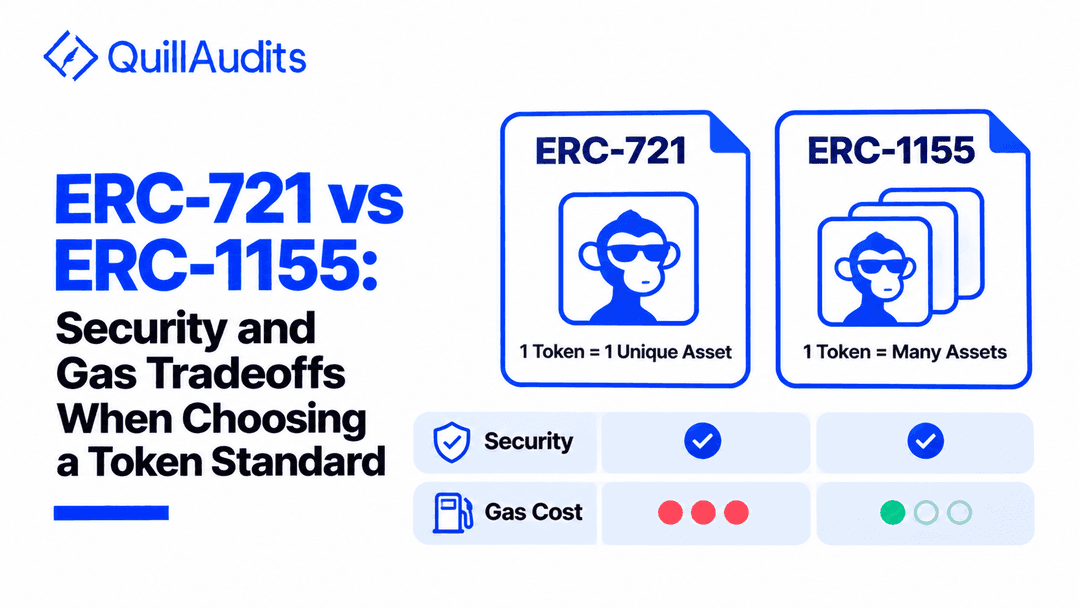
ERC-721 stands for Ethereum Request for Comments 721, the standard for non-fungible tokens where every token ID has exactly one owner, recorded in a single ownerOf(tokenId) mapping. Each ERC-721 token is one-of-one by design: unique metadata, unique ID, unique owner slot. ERC-1155, the Multi Token Standard, takes a different shape. Instead of one owner per ID, it tracks a balance per address per ID, so a single contract can hold fungible items, non-fungible items, and semi-fungible editions side by side (EIP-1155).
That structural difference is the whole story. Here's how it plays out in practice:
| Aspect | ERC-721 | ERC-1155 |
|---|---|---|
| Ownership record | One owner per token ID (ownerOf(tokenId)) | Per-address balance per token ID (balanceOf(owner, id)) |
| Fungibility | Strictly non-fungible, one-of-one | Fungible, non-fungible, or semi-fungible in the same contract |
| Batch operations | None in the base standard; one transaction per token unless a project adds custom extensions (dev.to) | Native safeBatchTransferFrom and balanceOfBatch for multiple IDs in one call (EIP-1155) |
| Receiver hook |
|
|
| Typical use case | 1-of-1 art, collectibles, deeds | Game items, editions, event tickets, tokenized Real World Asset (RWA) share classes |
A plain ERC-721 contract has fewer moving parts: one mapping, one hook, one token per transfer. ERC-1155 trades that simplicity for throughput, and that trade is exactly where its risk profile changes.
Where ERC-1155's Shared-Balance Design Changes the Attack Surface
ERC-1155 stores balances in a nested mapping, owner address to token ID to quantity, rather than a flat list of single owners. That means one piece of accounting logic, a staking multiplier, a snapshot counter, a claim tracker, can touch many addresses and many IDs at once instead of a single owner slot. A bug in that logic has a wider blast radius in an ERC-1155 contract than the equivalent bug would in ERC-721, simply because more state hangs off the same code path.
balanceOfBatch itself is harmless: it's a read-only function that returns balances for multiple owner and token-ID pairs in one call and holds no state of its own (EIP-1155). The risk sits in the application-level logic built around batched writes: reward accrual, allowlist consumption, and inventory caps that assume a single-item mental model but now have to stay correct across an entire batch in one transaction.
Batch-Transfer Hooks and Reentrancy: What Each Standard Exposes
ERC-1155's safeTransferFrom and safeBatchTransferFrom must call onERC1155Received or onERC1155BatchReceived on any contract recipient, and those hooks must return fixed magic values, 0xf23a6e61 for a single transfer and 0xbc197c81 for a batch, or the entire transfer reverts (EIP-1155). The spec requires balances to be updated before that hook fires for the transfer in question, so a malicious receiver can't rewrite its own balance mid-callback. But it can still re-enter the surrounding function before the rest of a batch finishes, or before external protocol state, staking rewards, snapshot totals, allowlist counts, has settled. Because onERC1155BatchReceived fires once per batch rather than once per item, the reentrancy window spans the whole batch, a materially different risk shape than a single ERC-721 transfer.
ERC-721's base hook, onERC721Received, is narrower by comparison: it only fires on safeTransferFrom and only concerns one token. Where ERC-721 contracts actually get hit is in custom transfer hooks projects bolt on themselves, _beforeTokenTransfer or _afterTokenTransfer overrides added for royalties, staking, or reward snapshots. That's what happened to Idols NFT on January 14, 2025: the project's _beforeTokenTransfer hook was abused through repeated self-transfers that reset a claimedSnapshots counter to zero, letting the attacker re-claim inflated rewards in stETH, Lido's liquid staking token, and drain roughly $340,000 (QuillAudits hack analysis). The base standard didn't fail; the custom logic layered on top of its hook did, the same lesson ERC-1155's batch hooks teach from the other direction.
Reentrancy itself isn't standard-specific. QuillAudits' broader catalog of Solidity attack vectors lists it as one of more than 30 recurring risk patterns, citing the DAO hack as the canonical case of recursive calls draining funds before balances update (QuillAudits). What changes between the two standards is the size of the window and how much state sits inside it when a hook calls back into untrusted code. QuillAudits' NFT security attack vectors guide walks through the unsafe transfer patterns and guard placements auditors check for.
Gas Tradeoffs That Matter at Scale
ERC-721 has no native batch-mint or batch-transfer function; moving or minting many tokens means one transaction per token unless a project adds its own extension (dev.to). That fixed per-transaction overhead, base gas plus calldata plus storage writes, gets paid every single time, which adds up fast for a large drop, an airdrop, or a marketplace settling many trades at once.
ERC-1155's safeBatchTransferFrom and batch-minting patterns amortize that fixed overhead across many token IDs in a single transaction, and balanceOfBatch does the same for reads, letting a marketplace fetch many balances in one call instead of looping over ownerOf. That's why high-volume use cases, game inventories, event ticketing, tokenized RWA share classes, tend to land on ERC-1155 once item counts run into the hundreds or thousands, while 1-of-1 art and deeds have less to gain from batching and more to lose in tooling maturity if they move off ERC-721.
Gas efficiency and security sit on different axes, though. The same batch hook that amortizes gas cost is the one that widens the reentrancy window described above. A cheaper transaction isn't automatically a safer one.
Which One Audits Flag More Often, and Why
In practice, findings rarely land on the base standard itself. Both ERC-721 and ERC-1155 reference implementations are widely used and heavily reviewed, so the standard's own transfer and hook logic is not where bugs tend to hide. Findings cluster in the custom code wrapped around those hooks: reward multipliers, royalty splits, snapshot trackers, and allowlist logic the base standard never specifies.
ERC-1155 surfaces that class of bug more often for a structural reason: one batch call path touches more balances, more IDs, and more application state than a single ERC-721 transfer does, so there's more surface for a custom hook to get wrong in one transaction. ERC-721 isn't immune, as the Idols NFT exploit shows, but its single-token transfer path gives an auditor a smaller unit of logic to verify at a time. QuillAudits applies the same checklist mindset across token types; its ERC-20 audit checklist breaks down what gets checked for fungible tokens, and the same framing applies to NFTs: hook placement, state-update ordering, and whether batch operations can be partially exploited mid-loop.
Which NFT Standard Should You Choose: ERC-721 vs ERC-1155?
If your project is 1-of-1 art, deeds, or anything where provenance and marketplace compatibility matter more than volume, ERC-721 is the safer default: fewer moving parts and a transfer path that's easier to reason about. If you're minting or moving large catalogs, game items, memberships, tickets, or RWA share classes, ERC-1155's batching pays for itself in gas and UX, provided your team reviews the batch-hook reentrancy window as carefully as the gas savings. Projects wanting fractionalized ownership with ERC-721-like scarcity are also worth pointing at ERC-404, a separate standard blending ERC-20 and ERC-721 traits, though it carries its own, less battle-tested risk profile.
An audit won't make this architectural call for you, that depends on your catalog size, mint pattern, and which marketplaces you need to stay compatible with. What an audit does catch is whether your hook overrides, batch logic, and balance accounting correctly implement whichever standard you chose, the gap a dedicated NFT smart contract audit is built to close.
Final Thoughts
Not all blockchains are created equal, and neither are the two most common NFT standards sitting on top of them. ERC-721 keeps your attack surface small and your transfer path simple; ERC-1155 buys you gas efficiency and flexibility at the cost of a wider reentrancy window around every batch call. Neither choice is free, and the standard you pick should follow from your catalog size and mint pattern, not from whichever one is trending.
Once you've made that call, get the implementation checked. A smart contract audit traces every path through your transfer hooks, snapshot logic, and batch loops before an attacker finds the one you missed. You can browse QuillAudits' published hack analyses and research at quillaudits.com/research for more standard-specific findings like the ones referenced here.
Contents









