Governance Attacks and How DAOs Can Protect Protocol Control
Learn how DAO governance attacks exploit voting power, low participation, malicious proposals, and privileged roles. Discover how timelocks, historical snapshots, quorum requirements, proposal monitoring, multisigs, and emergency controls can reduce governance attack risks and help protect protocol assets, upgrades, and critical decision-making from malicious governance actions.

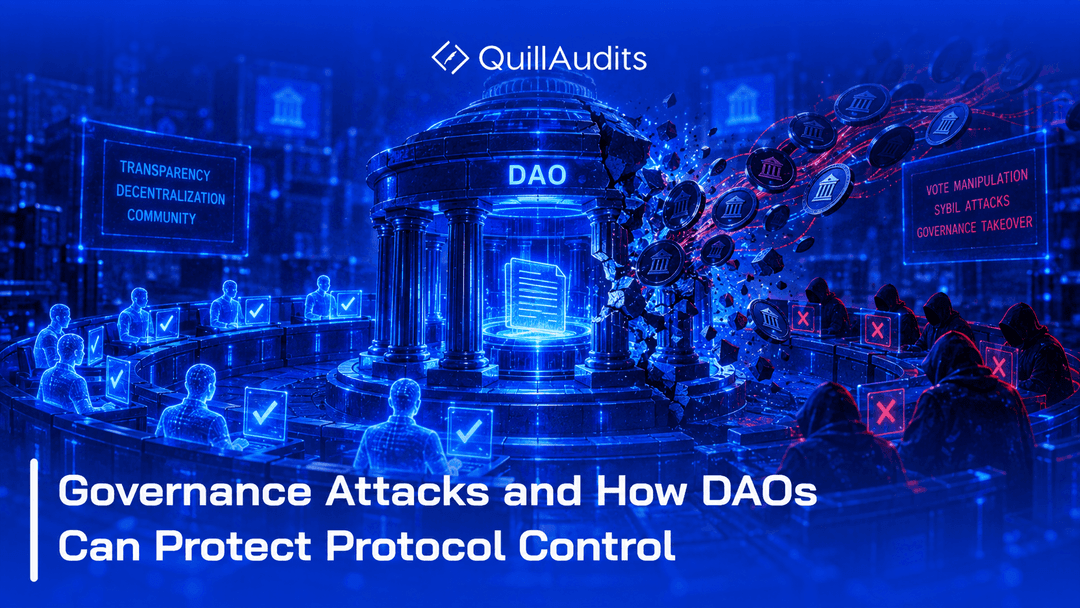
A governance proposal appears late on a quiet weekend. The title sounds like a routine emergency update. The calldata is long, participation is low, and most token holders assume the proposal will fail. Then a new wallet acquires enough voting power to push it through The proposal executes, moves protocol assets, and the attacker gives up the borrowed voting position. By the time delegates understand what happened, governance has already used its own permissions to approve the loss. A governance attack is particularly dangerous because the malicious transaction may technically follow all the rules. The weakness can instead lie in how voting power is measured, how proposals are reviewed, or how quickly approved actions can reach critical contracts. For a DAO, governance is part of the protocol's security boundary. It needs the same level of threat modelling as custody, accounting, and access control.
What Is a Governance Attack
A governance attack manipulates a DAO's decision-making process to gain control, move assets, or change protocol rules for the attacker's benefit. An attacker might buy or borrow voting tokens, abuse delegated voting power, hide malicious calldata behind an innocent-looking proposal, take advantage of an inactive vote, or compromise a privileged governance role. The final transaction can still appear legitimate because the governance contracts themselves approved it. Token-based governance creates an economic security model. If controlling a protocol is worth more than the cost of acquiring enough voting power to influence it, the governance system can become an attractive target.
Borrowed Voting Power Can Break Instant Governance
Flash loans can make the capital side of a governance attack much easier. If voting power is based on a wallet's current token balance, an attacker may be able to borrow a large position, vote with it, and return the tokens without maintaining any long-term exposure OWASP's governance security guidance recommends historical balance snapshots, token locking, and voting periods that span multiple blocks. These measures help distinguish genuine, longer-term voting power from temporary liquidity. The 2022 Beanstalk exploit remains one of the clearest examples. According to Beanstalk's own incident statement, the attacker used a flash loan to exploit the governance system and stole approximately $77 million in non-Beanstalk user assets. The lesson is straightforward. A proposal shouldn't be able to acquire enough voting power to take control and execute a treasury-moving action within the same transaction.
Governance Attacks Do Not Require a Flash Loan
Low participation can leave a DAO exposed even when voting balances are properly snapshotted. An attacker can accumulate tokens over time, borrow through regular lending markets, or convince a small group of delegates to support a proposal. Proposal design can introduce another layer of risk. A harmless-sounding title may conceal calls that upgrade an implementation, grant a privileged role, or transfer assets. Voters who rely on proposal summaries instead of reviewing the executable calldata may end up approving something they never intended to approve. Delegation can also concentrate a significant amount of influence. A compromised delegate key or an undisclosed voting agreement can shift control without changing who actually owns the tokens. Governance administrators, timelock proposers, and emergency councils create additional privileged paths that need to be secured. Operational failures matter as well. Even when a malicious proposal is visible on-chain, it can still execute if nobody is actively monitoring governance activity and prepared to intervene.
A Timelock Creates Time but Not Judgement
OpenZeppelin's TimelockController introduces a delay between proposal approval and execution. That window gives users and security teams time to review the operation, identify suspicious actions, and respond before the transaction reaches critical contracts.A timelock is only useful when someone is watching it and there is a defined response process. If a malicious proposal sits in the queue unnoticed, the delay only changes when the attack happens, not necessarily whether it succeeds. Role configuration matters too. Additional proposers or cancellers can end up with powers that token holders expect to belong only to the Governor. The timelock should hold the relevant assets and permissions, while its administrative roles should follow the principle of least privilege.Emergency controls should have equally narrow authority. A security council can be useful for pausing a vulnerable action, but it should not become an alternative path to unrestricted treasury control.
How DAOs Can Reduce Governance Attack Risk
Governance security should be designed around the value a successful proposal can control. Treasury transfers, protocol upgrades, and role changes should face stronger thresholds and longer review periods than routine parameter updates.
- Measure voting power using historical snapshots
- Require a meaningful proposal threshold and quorum
- Separate voting from execution with a monitored timelock
- Decode and simulate every proposal before voting closes
- Limit the actions governance can execute directly
- Protect delegate, administrator, and council keys with multisigs
- Define cancellation and emergency response responsibilities
- Set up alerts for proposals, votes, role changes, and queued executions
QuillAudits' earlier guide to DAO governance attacks covers the main attack categories. A production security review should go further by testing the exact Governor, token, timelock, and executor configuration deployed by the protocol.
Auditors should simulate borrowed voting power, proposal cancellation, quorum edge cases, batched calls, and upgrade execution. They should also verify that the roles actually deployed on-chain match the governance model described to the community.
Conclusion
A DAO can decentralise decision-making and still concentrate dangerous execution power inside a single proposal. Secure governance connects voting power to durable stake, gives the community enough time to inspect proposed actions, and limits what a successful vote can do without additional safeguards. Monitoring and a rehearsed response process turn those delays into actual protection. Before transferring treasury control or upgrade authority to a DAO, ask QuillAudits to review the governance contracts and the complete execution path. Governance should be able to change the protocol without becoming the shortest route to draining it.
Contents