


MakerDAO $538K Keeper Bot Access Control Exploit (Explained)
Learn how a six-year-old access control flaw in a third-party MakerDAO keeper bot led to a $538,000 exploit involving 200 WETH. Discover how dormant liquidation auctions and an unprotected function enabled the theft, why MakerDAO’s core protocol was not compromised, and how smart contract audits, access controls, on-chain monitoring, and legacy contract management can help prevent similar DeFi security incidents.

The decision · answer in brief
Learn how a six-year-old access control flaw in a third-party MakerDAO keeper bot led to a $538,000 exploit involving 200 WETH. Discover how dormant liquidation auctions and an unprotected function enabled the theft, why MakerDAO’s core protocol was not compromised, and how smart contract audits, access controls, on-chain monitoring, and legacy contract management can help prevent similar DeFi security incidents.
MakerDAO Keeper Bot Exploit: $538K Hack (Explained)
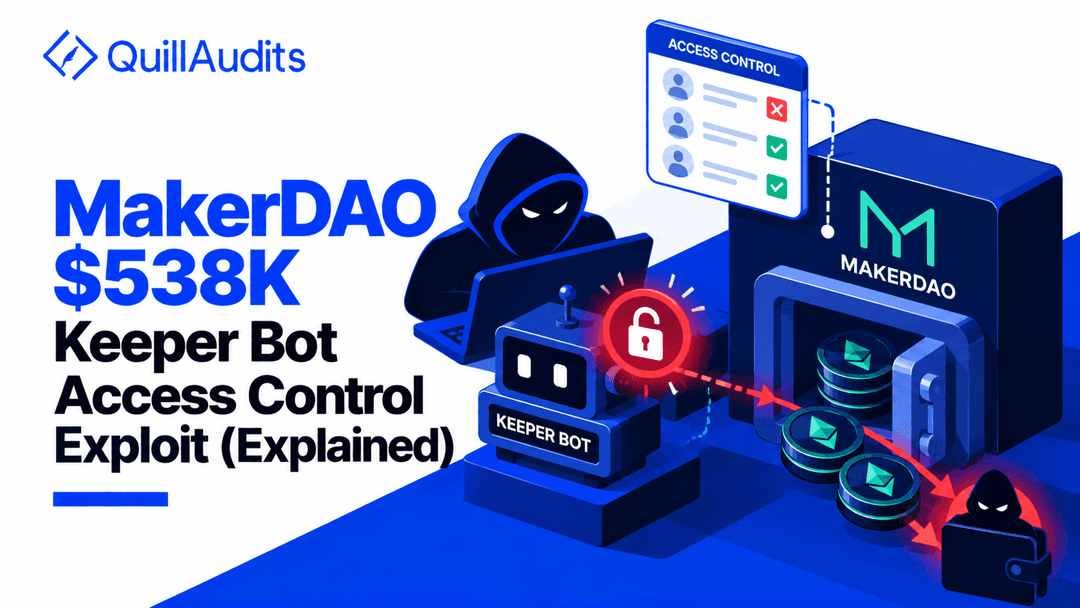
A six-year-old access control flaw in a dormant, unaudited third-party contract let an attacker drain roughly $538,000 from a MakerDAO liquidation keeper bot, not a flaw in MakerDAO's own core protocol. The MakerDAO keeper bot exploit pulled 200 WETH out of four auctions unsettled since 2020, through a satellite contract nobody had looked at in years.
Overview
The keeper bot in question was built to bid on and settle ETH-A collateral auctions on MakerDAO, the oldest and largest decentralized stablecoin protocol on Ethereum. In 2020, the bot won four of those auctions, numbered #1457 through #1460, at 50 WETH each, for 200 WETH total. Nobody ever called the deal() function to settle them, and the won collateral sat untouched in the bot's implementation contract for roughly six years.
An attacker noticed, and on-chain researchers at CertiK traced the resulting loss to a missing access control check on a single function, according to KuCoin's incident report. The attacker settled the auctions, moved the collateral out through MakerDAO's own Vat.flux function, unwrapped it into ETH, and laundered it through Tornado Cash in 10 ETH batches from a freshly funded address, per KuCoin's follow-up analysis.
Smart Contract Vulnerabilities: Where This Exploit Fits
Smart contract vulnerabilities generally fall into a short list of recurring categories, and the MakerDAO keeper bot exploit is a clean example of the first one on this list:
- Access control flaws - a function that moves funds but never checks who is calling it, so any address can trigger logic meant for an operator. This is exactly what happened here.
- Logic errors - code that executes as written but produces an outcome the designers never intended, such as a settlement step that was never required to run before funds became withdrawable.
- Reentrancy - an external call that hands control back to an attacker's contract before the calling contract finishes updating its own state.
- Oracle manipulation - price feeds pushed off their real market value long enough for an attacker to profit from the distortion.
- Integer overflow and underflow - arithmetic that wraps past its storage limits, largely mitigated in Solidity 0.8 and later.
The MakerDAO case stacks the first two: a logic error, since the bot never required deal() to run before a withdrawal was possible, plus the access control flaw that let anyone exploit that gap. Either alone would have been less costly; together they produced a $538,000 withdrawal.
Exploit Details: Inside the MakerDAO Keeper Bot Exploit
The vulnerable code was not part of MakerDAO's governed, audited core. It was an implementation contract behind a third-party keeper bot, a type of automated agent that liquidation systems use to bid in and settle collateral auctions. CertiK traced the flaw to missing access control on function selector 0x8804d1de inside that implementation contract, as reported by ChainCatcher: "the lack of access control for the 0x8804d1de function in the keeper implementation contract." The function should have required ds-auth, Maker's standard authorization module, but didn't, so any wallet could call it.
Attack Process
The attacker's path ran through three steps, each using functions that behaved exactly as designed, just not for the caller invoking them:
- Settle the dormant auctions. Call
deal()on auctions #1457 through #1460, finalizing the bot's ownership of 200 WETH in collateral it had won back in 2020. - Move the collateral. Use MakerDAO's own
Vat.fluxfunction to shift that collateral from the auction's internal accounting into a balance the keeper's contract controlled. - Unwrap and exit. Call
GemJoin.exitto convert the internal WETH balance into standard ERC-20 WETH, then into ETH, draining the keeper's contract.
None of these three calls touched a bug in MakerDAO's Vat or GemJoin contracts; both executed their documented behavior correctly. The exploit lived entirely in the unprotected withdrawal function on the third-party bot that was supposed to gate access to step three.
Root Cause: Missing Access Control on a 2020-Era Contract
The root cause is narrow: a withdrawal-adjacent function deployed around 2020 never got a ds-auth modifier, so it treated every caller as authorized. That gap sat unexploited for roughly six years simply because nobody tried it, not because anything about the contract changed. Sky is the rebranded entity now governing the MakerDAO protocol, and a contract's irrelevance to current operations says nothing about whether it still holds exploitable value.
Prevention Measures for Legacy Satellite Contracts
Satellite contracts, meaning bots, adapters, and integrations that sit next to a core protocol rather than inside it, routinely get less security scrutiny than the protocol they serve. A few habits close that gap:
- Inventory every contract still holding funds, not just the ones in active development. A spreadsheet of deployed addresses with non-zero balances would have flagged this bot years before the attacker did.
- Audit third-party and satellite code to the same standard as core contracts. A smart contract audit scoped only to a protocol's primary repository will miss a keeper bot sitting one layer away, exactly the gap that cost $538,000 here.
- Apply access control checks to every fund-moving function, including ones a team treats as internal-only or that "obviously" require a prior step, like
deal()here. Obvious sequencing is not enforcement. - Monitor old contracts, not just new deployments. An on-chain monitoring service that watches every transaction and state change per block, such as QuillAudits' offering, can flag an unusual call to a long-dormant function before funds leave.
- Sunset or sweep dormant balances. If a contract is no longer active but still holds assets, migrate those assets to an audited, access-controlled successor or document who can safely move them.
Two limits are worth naming: an audit only catches this if explicitly scoped to include legacy contracts, and monitoring only protects a contract a project actually enrolls.
Conclusion
The MakerDAO keeper bot exploit didn't come from a flaw in MakerDAO's governed, audited core, it came from an access control oversight in a third-party contract quietly holding unsettled collateral since 2020. The lesson generalizes: any contract that still holds funds is still in scope for an attacker, whether or not it's still in scope for your team's attention.
Projects running auction bots, adapters, or other satellite contracts alongside a core protocol should treat them with the same rigor. A comprehensive Smart Contract Audit can catch missing access control before deployment, and ongoing monitoring can catch an attempt against old code long after. For more insights on securing Web3 projects, visit QuillAudits' research hub.
Contents









