


Papertrade $1.28M Oracle Manipulation Exploit (Explained)
Explore the Papertrade exploit that generated $1.28 million through price oracle manipulation on Hyperliquid-linked perpetuals. Learn how a single-source BBO mid-price, excessive leverage, and inadequate risk controls enabled the attack within eight hours. Discover the root cause, key lessons from similar DeFi exploits, and essential security measures, including oracle aggregation, TWAP pricing, liquidity-based leverage limits, and smart contract audits.

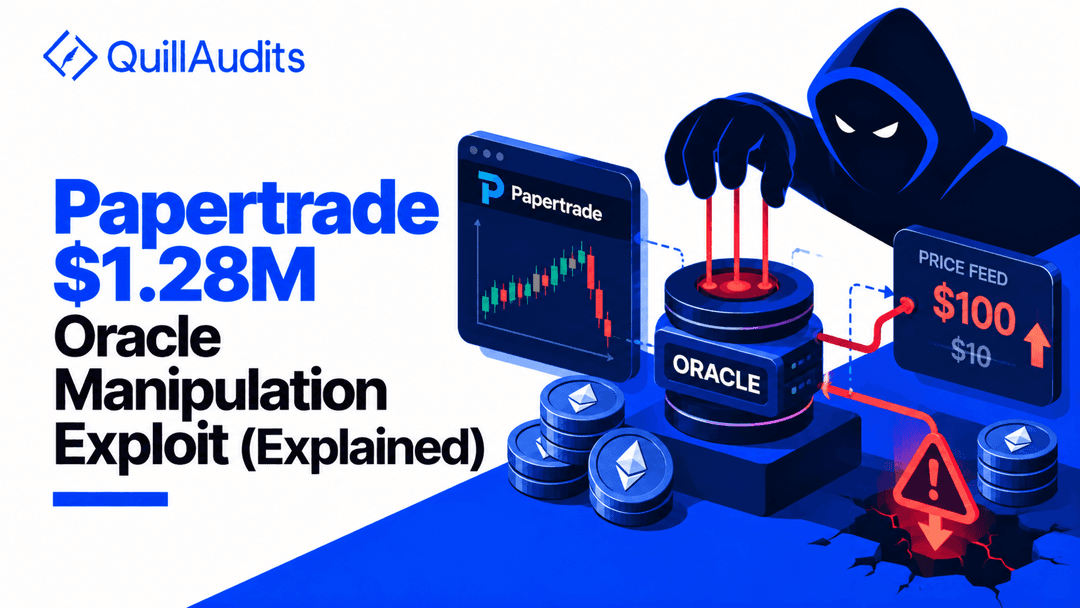
The decision · answer in brief
Explore the Papertrade exploit that generated $1.28 million through price oracle manipulation on Hyperliquid-linked perpetuals. Learn how a single-source BBO mid-price, excessive leverage, and inadequate risk controls enabled the attack within eight hours. Discover the root cause, key lessons from similar DeFi exploits, and essential security measures, including oracle aggregation, TWAP pricing, liquidity-based leverage limits, and smart contract audits.
Papertrade Exploit Explained: $1.28M Oracle Manipulation Hack
A trader turned Hyperliquid's spot best-bid-offer, or BBO, mid-price into $1.28 million of profit against Papertrade's leveraged perpetuals pool within eight hours of the platform going live. The Papertrade exploit explained here is not a novel attack technique.
It is the same price oracle manipulation playbook that has hit perp DEXs before, run against a launch-day protocol with no second price source to fall back on. The trade-by-trade record left behind doubles as a concrete case study: a single trader, with no exploit of Papertrade's contract code at all, turned a thin reference price into seven figures in under a day.
The incident happened on October 10-11, 2026, and on-chain analysts quickly attributed it to wallet 0x2025137a136bea7446deba681cbfc7cf1970840e, according to a trade-by-trade breakdown posted on X. The wallet was not a newcomer. Per KuCoin's writeup of the exploit, the same address had already run up more than $13 million in cumulative all-time profit and roughly $14 billion in trading volume on Hyperliquid before touching Papertrade.
Exploit Details: Reference Price vs Market Price
Papertrade priced its perpetual contracts off a reference price pulled from a single source: the mid-price between the best bid and best offer on Hyperliquid's spot order book for the underlying asset. That single number stood in for a full price oracle. It had no aggregation across venues and no time-weighting to smooth out short-lived moves.
The gap this created was between the reference price Papertrade used to mark positions and the real market price a trader would actually pay to move size on Hyperliquid's spot book. When an attacker pushed the spot mid-price even slightly, Papertrade's contracts repriced instantly to match, while the attacker's own cost to create that move stayed small relative to the leveraged exposure it unlocked on the other side.
At the time of the exploit, Papertrade's liquidity pool held around $54 million in capital against roughly $10-11 billion in open interest, as reported by CryptoTicker. That put open interest at roughly 185 to 204 times pool capital. A pool that thin, carrying that much notional risk, has almost no room to absorb a mispriced reference feed before the mispricing becomes extractable profit.
Attack Process
The attacker did not need a complex exploit chain. The process was mechanical, repeated at speed:
- Open a position on Papertrade sized to benefit from a specific small move in the reference price.
- Place a trade on Hyperliquid's spot order book large enough to nudge the best bid or best offer, shifting the BBO mid-price that Papertrade read as its reference price.
- Let Papertrade's contracts repose to the shifted reference price, which moved the attacker's leveraged position into profit.
- Close the position and collect the gain before the spot price reverted.
- Repeat.
KuCoin's analysis counted 305 trades executed this way, of which 296 were profitable, a roughly 97% win rate, with an average holding time of just 98 seconds per position. A win rate that high over that many trades is not luck. It is the signature of a trader who could predictably force the input the pricing formula depended on.
The capital flows around the exploit were visible in Papertrade's own growth numbers. Total value locked on the platform rose from about $14.3 million on October 9 to a $102.1 million peak on October 11, 2026, per DeFi Education's account of the incident, the same window in which the exploit took place. Liquidity rushed in just as the reference price was being gamed on the other side of the ledger.
Root Cause: Price Oracle Manipulation via a Single BBO Source
Price oracle manipulation is an attack where someone feeds a decentralized application a distorted price by moving the specific, narrow data source that application treats as truth, rather than by breaking its code. A blockchain oracle's job is to bring external, real-world data such as asset prices onto a smart contract, since contracts cannot query off-chain markets directly. When that oracle is a single spot order book's mid-price instead of an aggregate across multiple venues, moving the one source moves the "truth" the contract acts on.
This is exactly the gap Papertrade left open. Its contracts trusted Hyperliquid's BBO mid-price as if it were a tamper-resistant feed, when it was really one order book that a sufficiently funded trader could push with a single well-timed trade. Analysts who reviewed the exploit recommended Papertrade move to Hyperliquid's own official oracle instead, which aggregates quotes across multiple exchanges specifically to reduce single-source manipulation risk. Papertrade's own co-founder, known publicly as Kain, later made the point directly, warning that highly leveraged systems relying on oracle price inputs are particularly easy to manipulate.
The lesson generalizes past Papertrade, even when the underlying bug differs. QuillAudits has previously broken down the KiloEx exploit, where an attacker skipped signature validation in a price-forwarding contract and pushed a market straight to $10,000, costing the protocol $7.4 million. That was a signature-validation flaw, not a single-source feed problem, but it produced the same outcome: a price that should have taken real capital to move, moved for free. QuillAudits also covered the Loopscale incident, where a manipulated pricing mechanism drained $5.8 million. Three protocols, three chains, three different bugs, one recurring category of loss: a pricing input an attacker can move directly or cheaply. For how oracles are meant to work before they fail this way, see QuillAudits' explainer on blockchain oracles.
Post-Exploit Response
Papertrade disputed that its wide initial risk limits were an overlooked bug. The team stated the limits "had been set deliberately wide to give the launch room," according to CryptoTicker's reporting. That framing matters: it positions the incident as a design trade-off that failed rather than a pure coding error, which is a harder problem to fully patch after the fact.
On October 19, 2026, Papertrade confirmed its PAPER reward token would remain permanently non-transferable, a decision the team tied in part to concerns raised by the oracle manipulation episode, as reported by Crypto Briefing. Keeping the token locked removes one obvious channel for an exploiter to immediately liquidate manipulated rewards into an open market.
Prevention Measures for Perp DEX Builders
A single-venue spot mid-price is not a price oracle, it is a rumor with a timestamp. QuillAudits' own breakdown of perp DEX architecture and security covers related design choices, including how funding-rate calculations lean on TWAPs to dampen manipulation. The short list of concrete changes a team can make before launch looks like this:
- Aggregate across venues. Pull from multiple independent spot and derivatives order books, not one, so moving a single book no longer moves the contract's view of price.
- Time-weight the feed. A time-weighted average price (TWAP) over a short window absorbs a single large, fast trade far better than an instantaneous mid-price snapshot.
- Size leverage and open interest to pool depth. An exposure ratio near 185 to 204 times open interest to pool capital, as Papertrade carried at the time of its exploit, leaves no margin for a mispriced tick to become unaffordable.
- Cap position size relative to the reference market's own liquidity. If a trade large enough to move the underlying spot book is also large enough to open a dominant position on the perp DEX, the two markets are too easy to arbitrage against each other.
- Monitor for abnormal win rates and hold times. A 97% win rate across 305 trades with a 98-second average hold is the kind of pattern real-time anomaly detection should flag before it reaches eight figures.
A DeFi Protocol Audit that reviews pricing and oracle-integration logic, not just contract logic in isolation, is the point where a single-source reference price like Papertrade's gets caught before mainnet. QuillAudits' own research and audit services cover that day-zero risk mapping for perp DEX and RWA builders across EVM, Solana, and other ecosystems, with post-launch smart contract monitoring for the kind of abnormal trading pattern this exploit produced.
An audit of the contract's pricing logic can't stop manipulation happening on an external venue the contract merely reads from. Order-book depth on the reference exchange still needs separate scrutiny. Teams building specifically on Hyperliquid or HyperEVM should also confirm chain coverage directly rather than assume it.
Conclusion
Papertrade's $1.28 million loss was not caused by a bug in the traditional sense. It was caused by a pricing design that treated one exchange's order book as ground truth for a platform carrying billions in open interest. The attacker didn't need to find a flaw in the contract code; they needed to find the one number the contract trusted and move it. That is the recurring shape of price oracle manipulation across perp DEXs, and it is a design question that has to be answered before launch, not patched after the first exploit. Teams shipping a new perp DEX in 2026 should treat reference-price design, not just smart contract logic, as a dedicated QuillAudits Smart Contract Audit line item.
Contents









