The UAE RWA Tokenisation Security Guide 2026
UAE RWA tokenization needs more than a clean smart contract. This 2026 guide explains VARA, DFSA, FSRA, and CMA classification, how to keep asset registries and token ledgers aligned, oracle and custody risks, key management, and independent testing, plus a pre-launch UAE RWA security audit checklist for issuers, fund managers, and platform teams building tokenized assets in Dubai.

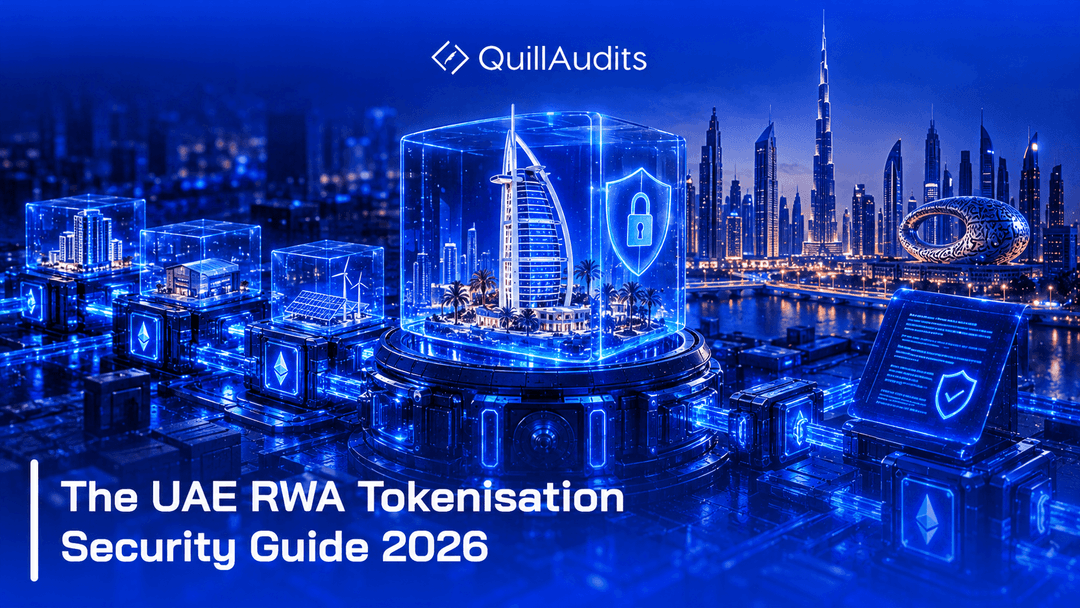
Imagine a property token changing wallets in seconds. The property register still lists the previous owner. Who now receives the rent, and who can sell the interest?
That mismatch is one of the practical risks behind UAE RWA tokenization. A secure platform must connect blockchain transactions with enforceable rights, reliable asset records and operational controls. This guide explains what issuers, fund managers and platform teams should check before launch, from regulatory classification to incident response.
The UAE tokenisation landscape in 2026
Dubai Land Department launched its real estate tokenisation pilot in 2025. Its announcement projected AED 60 billion in tokenised real estate by 2033, representing 7% of Dubai’s total real estate transactions. These are DLD projections, not achieved market figures.
The opportunity extends beyond property. Commodities, fund units, credit exposures and securities each introduce different obligations. A gold token needs evidence of allocated metal and workable redemption. A fund token needs accurate investor records and valuation controls. A credit token needs servicing and default arrangements. Teams pursuing asset tokenization in Dubai should start with those differences before choosing a blockchain.
Who oversees regulated tokenization in the UAE
There is no single approval that covers every asset and activity. The relevant framework depends on location, token rights and the services provided.
VARA regulates virtual assets across Dubai’s mainland and free zones, excluding DIFC. Its issuance rules apply to entities issuing virtual assets in the course of business within its jurisdiction. An RWA label alone does not establish the correct classification.
DFSA regulates financial services in or from DIFC. Its Investment Token framework covers security and derivative tokens. Its separate Crypto Token framework was updated in January 2026; teams must identify which regime fits their instrument.
FSRA regulates financial services within ADGM. Tokens exhibiting securities characteristics are regulated as securities, with dedicated Digital Securities guidance.
CMA, the federal Capital Market Authority, succeeded the Securities and Commodities Authority under laws effective from 1 January 2026. Federal capital markets requirements can matter for tokenised securities outside the financial free zones.
DLD is Dubai’s real estate registration authority, central to the property records behind its tokenisation initiative. DMCC is a free zone and commodities ecosystem. Its partnership with VARA supports commodities tokenisation; DMCC incorporation does not replace financial regulatory authorisation.
Obtain a documented legal classification covering issuance, distribution, custody and trading. Payment arrangements may also bring Central Bank requirements into scope.
Define what token holders actually own
Token ownership and ownership of the underlying asset are separate questions. The token might represent a registered property interest, shares in a holding company, fund units or a contractual claim.
For real world asset tokenization platforms in Dubai, documents should explain who holds title, which rights transfer with the token, how income reaches investors and what happens on insolvency. For commodities, identify the custodian, allocation records and delivery conditions. For credit, clarify repayment priority and enforcement.
Technical reviewers should compare these promises with the implemented transfer and redemption logic. Legal enforceability requires qualified legal review; clean code cannot establish it.
Keep the registry and token ledger aligned
Name the authoritative record for each asset and define how it reconciles with blockchain balances. Issuance should follow confirmed asset or entitlement records. Redemption must coordinate token cancellation with the release of the underlying claim.
Consider a platform where a registry update fails after an on-chain transfer succeeds. Can distributions go to the wrong person? Can an operator replay the request and duplicate an entitlement?
Test delayed updates, duplicate messages, failed transactions and chain reorganisations. Assign reconciliation owners, preserve an audit trail and stop affected operations when material discrepancies remain unresolved. This is a recommended control design, tailored to the asset and legal structure.
Build smart contract controls around the asset
Review minting, burning, transfer restrictions, distributions and redemption as one lifecycle. Check that authorised roles cannot create unsupported supply or bypass investor eligibility rules.
Administrative powers need particular attention. Who can freeze balances, replace a compliance module or upgrade the implementation? Separate routine operations from sensitive approvals, and test emergency powers as carefully as normal transactions.
Where appropriate, use multisignature approval and delays for non-emergency changes. Review rounding, reentrancy and redemption accounting. A contract can pass a transfer test while still distributing the wrong amount when investors enter or exit mid-period.
Check oracles custody and integrations
An oracle delivers information; it does not prove legal title or guarantee that an asset exists. Check source authority, timestamps, update permissions and behaviour when data becomes stale. Feed-specific freshness checks should reflect the underlying valuation process.
Review custody across both layers: control of tokens and custody of the physical asset or financial instrument. Identify segregation arrangements, access rights and redemption dependencies.
To strengthen tokenization platform security in the UAE, include registry connectors, onboarding services, payment APIs and administrator dashboards. Test forged callbacks, repeated requests and vendor outages. A compromised integration may change entitlements without exploiting the token contract. Cross-chain designs also need explicit supply accounting to prevent duplicate representation.
Protect keys and rehearse recovery
Map every key that can mint, upgrade, move custody assets or change data sources. Use protected signing infrastructure, separate signers and independently verify transaction details. Hardware security modules or multiparty computation can support protection, but their configuration and recovery processes still need review.
Remove access promptly when staff leave. Test backup recovery and compromised-signer replacement. A multisignature wallet provides limited protection if all signers depend on the same compromised interface. VARA’s technology guidance addresses key management and transaction verification alongside contract security.
Test independently and monitor after launch
For VARA-regulated VASPs, the Technology and Information Rulebook requires qualified independent vulnerability assessments and penetration testing at least annually and before introducing new systems, applications and products. Relevant smart contracts are included. This requirement should not be presented as a universal rule for every UAE issuer.
A meaningful RWA security audit in the UAE combines code review with lifecycle testing, configuration checks and agreed integration testing. Verify fixes against the release intended for deployment.
Monitor supply discrepancies, privileged changes, stale data and unusual withdrawals. Define who investigates alerts, pauses operations and contacts counterparties. Rehearse a registry outage and a compromised signing key. Record evidence and applicable notification obligations in the incident plan.
A practical UAE RWA security audit checklist
Before launch, ask for evidence of the following:
- Documented jurisdiction, token classification and holder rights.
- Asset records reconciled with issuance, transfers and redemption.
- Controlled minting, upgrades, freezes and investor eligibility.
- Validated oracle inputs and tested integration failure handling.
- Protected custody keys and demonstrated recovery procedures.
- Independent testing, verified fixes and deployment version records.
- Live monitoring, incident owners and rehearsed response procedures.
How QuillAudits scopes a UAE RWA security review
QuillAudits’ published RWA audit offering covers smart contracts, oracle security, interoperability and storage security. For a UAE project, start the scoping discussion with the asset structure, legal classification, architecture, repository version, privileged roles and third-party dependencies.
Agree which contracts, integrations and operational controls are included, which documents support the review and which assumptions remain outside testing. Request findings with remediation priorities and a defined retesting scope. Keep legal opinions, asset valuation and regulatory approval distinct from technical assurance.
Share your asset model and architecture with QuillAudits to define a review around the risks your platform actually carries.
Contents