What's Inside a Smart Contract Audit Report
Learn what a smart contract audit report actually contains, from scope and commit hash to severity ratings, findings, and fix status, plus how to read one in five minutes.

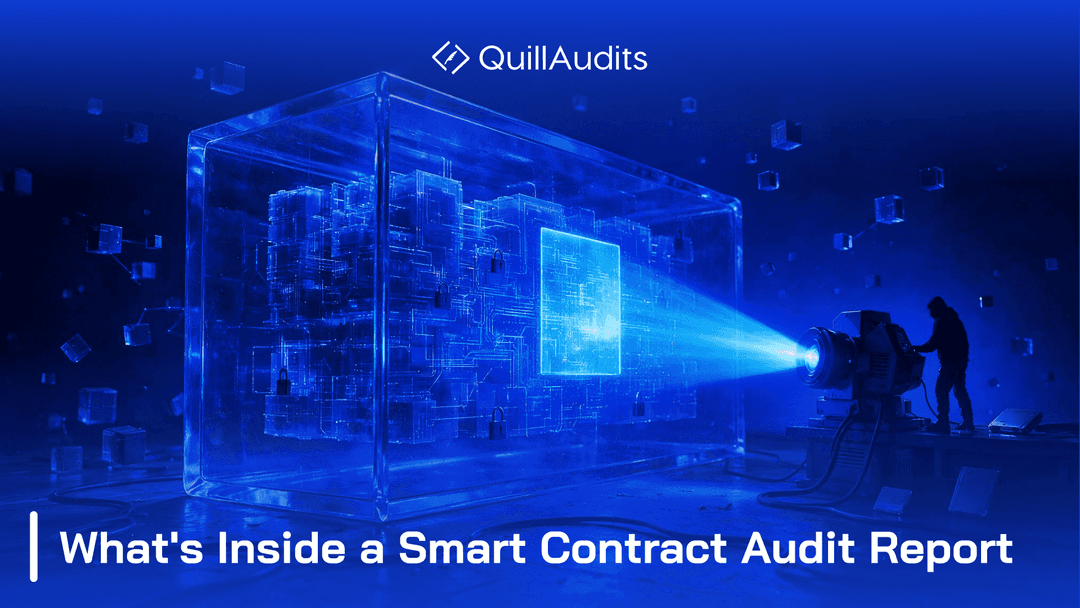
A smart contract audit report isn't a pass-or-fail certificate.
It's a detailed document that explains exactly what was reviewed, what vulnerabilities were discovered, how serious each one is, and whether those issues were addressed. Once you know how to read an audit report, you can usually tell the difference between a thorough security review and a superficial one in just a few minutes.
Let's go through the key sections and what each one tells you.
The scope and summary
This is usually the first section of the report, and it's one of the most important.
It tells you exactly what the auditors reviewed and, just as importantly, what they didn't.
One detail you should always look for is the commit hash or the specific repository snapshot included in the report. It may seem like a small detail, but it matters a lot. If the commit hash doesn't match the version of the code you eventually deployed, the audit no longer reflects what's running in production.
The summary should also identify the contracts that were reviewed, the blockchain they belong to, and the dates when the audit was performed.
The methodology
This section explains how the audit was carried out.
A thorough audit combines manual code review with automated analysis and testing. That typically includes static analysis using tools like Slither, fuzz testing with Foundry, and a careful manual review of the protocol's business logic.
If this section simply says something like "we reviewed the code" without describing the process, it's worth asking how much work actually went into the engagement.
The methodology is often the easiest way to distinguish a genuine security review from a report generated primarily by automated tools.
The severity ratings
Every finding in the report is assigned a severity level.
That rating is generally based on two factors: the impact if the vulnerability is exploited and the likelihood of that exploit occurring.
Most audit firms classify findings using a scale similar to this.
Critical findings allow an attacker to steal funds or take control of the protocol directly. These issues should always be resolved before launch.
High severity findings can still cause significant damage, although they usually require specific conditions to be exploited. These should also be fixed before deployment.
Medium findings represent genuine security risks, but exploitation is typically more difficult or the impact is less severe. They should still be addressed before launch whenever possible.
Low severity findings usually involve minor issues with limited security impact. They're worth fixing, but they aren't generally considered launch blockers.
Informational findings aren't vulnerabilities at all. They typically cover code quality improvements, gas optimizations, or recommendations based on industry best practices.
The findings
This is the section that deserves the most attention.
Each finding should clearly explain what the issue is, where it exists in the code, including the relevant file and line number, how severe it is, what impact it could have if left unresolved, and how the issue should be fixed.
A finding that simply says "reentrancy risk" without identifying where it occurs or explaining how to address it isn't particularly useful.
A well-written audit report gives developers enough context to understand both the vulnerability and the recommended solution.
Each finding should also include its remediation status, which is one of the most overlooked parts of an audit report and one of the most important things to review
The remediation status
After you've fixed the issues, a good auditor reviews the updated code and assigns a status to every finding. The most common ones are Resolved, Acknowledged, and Won't Fix.
Resolved means the issue was fixed and the auditors confirmed the fix works as intended. Acknowledged means your team understands the risk and has consciously decided to accept it without changing the code. Won't Fix usually means the issue has been intentionally left as-is because the trade-offs of changing it outweigh the benefit.
A report full of unresolved critical findings is not a clean audit. It's a list of outstanding work. What you want to see is that the serious issues have been marked Resolved after the auditors have verified the fixes.
The overall assessment
Most reports include a short overall assessment near the beginning or end. Think of it as a summary of the auditors' view of the protocol's security posture.
It's useful for getting a quick sense of the review, but it should never replace reading the findings themselves. A positive conclusion means very little if the report still contains unresolved critical or high-severity issues.
How to actually read one in five minutes
Start with the commit hash. Make sure it matches the version of the code you actually deployed. If it doesn't, the report covers different code.
Next, look at the Critical and High severity findings, then check whether they're marked Resolved. Finding serious issues isn't unusual. Leaving them unresolved is.
Then read the out-of-scope section. It's the fastest way to understand what the auditors never reviewed in the first place.
Finally, spend a minute on the methodology. A proper audit combines manual review, automated tooling, and testing. If the methodology is vague or looks like little more than a scanner output, the depth of the review is worth questioning.
Red flags in a report
Some warning signs are easy to spot once you know where to look.
No commit hash or version reference anywhere in the report is one of them. Without it, there's no reliable way to know exactly which code was reviewed.
A report with zero findings and zero recommendations should also make you pause. Even mature codebases usually have at least a few low-severity or informational observations.
Another red flag is a report that never explains how severity was determined or doesn't include a remediation status for each finding. If you can't tell whether an issue was fixed, the report is incomplete.
Finally, don't be impressed by a polished cover page, a security score, or a collection of logos if the report doesn't contain detailed technical write-ups. The substance of the findings matters far more than the presentation.
Firms like QuillAudits, OpenZeppelin, and Trail of Bits publish complete audit reports publicly. Reading a few of them is one of the quickest ways to understand what a thorough audit report should look like before commissioning your own.
Conclusion
A good audit report is more than a list of vulnerabilities. It tells the story of what was reviewed, what risks were identified, how those risks were addressed, and how much confidence you can place in the deployed code. Knowing how to read that report helps you look beyond the headline and evaluate the quality of the audit itself. In the end, the value of an audit isn't measured by how many findings it contains, but by how clearly it helps you understand and reduce the risks in your protocol.
Contents