Are AI-Generated Smart Contracts Safe? What Audits of Copilot/ChatGPT Code Reveal
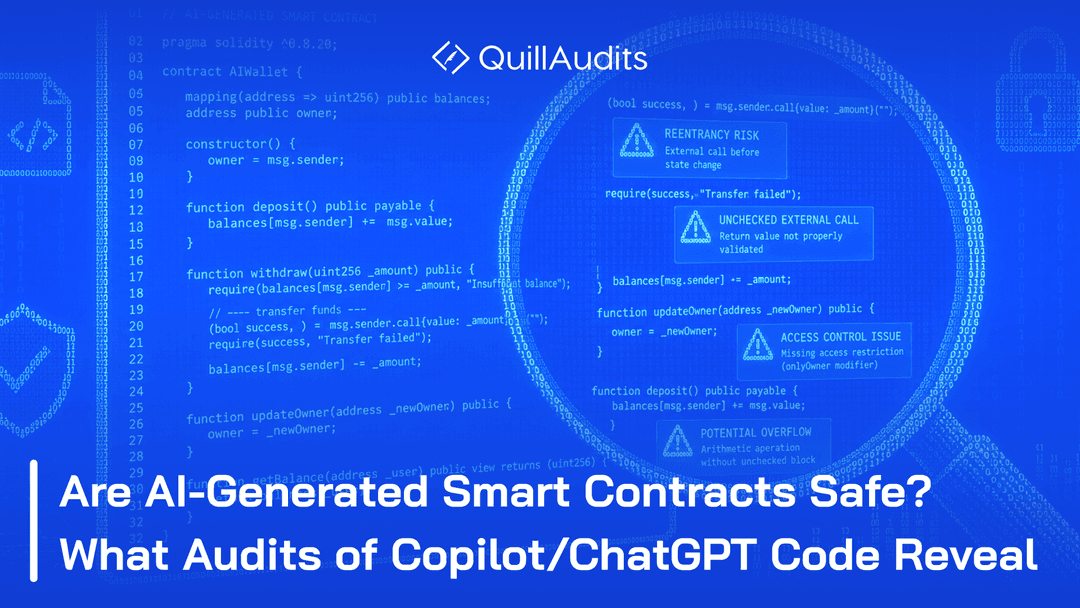
ChatGPT and Copilot can write Solidity in seconds, but is AI-generated smart contract code safe? Here's what real audits reveal, and what CXOs must do before mainnet.

The $2M Contract Written in 40 Minutes
Last quarter, a DeFi founder deployed a staking contract that his team had "built" in a single afternoon. Copilot generated much of the logic, ChatGPT wrote the tests, and everything compiled without errors. The demo impressed investors, and within weeks, the protocol had attracted $2M in TVL.
Then someone asked the question that had been overlooked throughout the entire sprint:
Who actually read this code?
If your engineering team is using AI to write Solidity, and in 2026, almost every team is, that's a question you need to answer too. Because the answer could determine whether your protocol becomes a successful product or a bug bounty waiting for an attacker to collect.
AI Writes Code That Looks Right. That's the Problem.
What makes AI-generated smart contracts particularly risky is that they often fail quietly.
When a junior developer writes poor code, the mistakes are usually obvious. AI-generated code is different. It often looks like it came from an experienced engineer, with clean naming conventions, organized structure, and convincing comments. But once that code is examined under professional audit conditions, the weaknesses start to appear.
Across the AI-assisted contracts our auditors review, the same patterns continue to surface.
Missing access controls. Functions are left callable by anyone because the AI optimizes for getting code to work, not for keeping it secure. Access control remains the #1 vulnerability category in the OWASP Smart Contract Top 10 (2026), based on real-world incidents from 2025.
Business logic flaws. AI can generate code, but it doesn't truly understand your protocol's tokenomics, reward calculations, or edge cases. Business logic failures alone were responsible for roughly $188M in losses during 2025.
Outdated patterns. Large language models are trained on historical GitHub repositories, so they often reproduce vulnerable coding practices from before 2022, deprecated compiler behavior, and unsafe external call patterns with complete confidence.
Hallucinated safety. AI may import libraries that don't exist, reference nonexistent modifiers, or generate security checks that don't actually verify anything.
Researchers have also tested AI in the opposite role, as the auditor instead of the developer. One GPT-4 evaluation reported high precision but a recall of only about 38%, meaning it failed to identify most of the vulnerabilities present. In other words, AI still can't reliably detect everything that AI creates.
Meanwhile, Attackers Have AI Too
This is the part that should concern every CXO.
Anthropic's December 2025 research found that AI agents improved their success rate at exploiting real-world vulnerable smart contracts from 2% to more than 55% in just one year. Separate research from the A1 agent study showed AI successfully extracting up to $8.59M in a single simulated exploit.
The takeaway is simple: AI has dramatically shortened the time between a vulnerable contract being deployed and that vulnerability being discovered.
The race now comes down to one question: will your auditors find the issue first, or will an attacker's AI agent?
The Boardroom Takeaway: AI Speed Needs Human-Grade Security
To be clear, this isn't an argument against using Copilot or ChatGPT. AI-assisted development is a real competitive advantage, helping teams build and ship faster than ever before.
The problem begins when AI-generated code reaches production without proper security review. At that point, the risk isn't just technical, it becomes financial, reputational, and increasingly, regulatory.
The teams succeeding in 2026 aren't avoiding AI. They're using it as a fast first draft while treating adversarial smart contract audits as the final, non-negotiable security checkpoint.
That's the approach QuillAudits follows. With 1,500+ protocols secured, $3B+ in TVL protected, and more than 10,000 issues identified, our audits combine AI-powered scanning through QuillShield with a Vigilant Squad of 10–12 independent researchers who think like attackers. They go beyond automated scanning to uncover economic exploits, business logic flaws, and complex attack paths that today's LLMs still fail to detect.

Contents