Auditing the Rulebook, Not Just the Code: Zoniqx ERC-7518 Pilot Audit
How QuillAudits pilot-audited Zoniqx’s compliance-first ERC-7518 token standard: 18 contracts reviewed, 17 findings identified, and remediation verified in May 2024.
Get an Audit done today for your Smart Contract
Join 1500+ leaders who secured themselves from losing Billion Dollars



Securing the standard behind compliant asset tokenization
Zoniqx, a Silicon Valley fintech, asked us to audit the reference implementation of ERC-7518, a security-token standard its own engineers authored and proposed to the Ethereum community. This was a pilot engagement, and an unusual one. Most audits look at a single application. ERC-7518 is meant to be the rulebook that other tokenization platforms build on, so a flaw here wouldn’t hurt one protocol. It would echo into every asset ever issued on top of it.
Over eight days in May 2024 we reviewed 18 contracts spanning the token core, its compliance modules and its marketplace. We came back with 17 findings, four of them high severity. These included an allowance bug that would have let a delegated operator move ten times their authorized amount, and a side door that let locked tokens escape through the batch-transfer function. Zoniqx’s team fixed sixteen of the seventeen findings. The last was partially resolved, with the residual risk documented and accepted. Every fix was verified in a second review round on 29 May 2024.
Table 1 · Engagement at a glance
| Client | Zoniqx Inc. (formerly Tassets), tokenization infrastructure, Silicon Valley |
| Subject | Reference implementation of ERC-7518 “DyCIST” (Dynamic Compliant Interoperable Security Token) |
| Engagement type | Pilot audit: the first independent security review of the standard’s implementation |
| Chain | EVM (Solidity, upgradeable OpenZeppelin-based architecture) |
| Timeline | 6–13 May 2024, updated code received 28 May, second review 29 May |
| Scope | 18 contracts: token core, compliance & control modules, marketplace, oracle interface |
| Method | Manual review, functional testing with runnable proof-of-concepts, automated analysis, with every automated flag re-checked by hand |
| Result | 17 findings: 4 high, 5 low, 8 informational. 16 resolved and verified, 1 partially resolved |
A quick word on the client
Zoniqx builds Tokenized Asset Lifecycle Management (TALM) infrastructure: the plumbing that lets institutions turn real estate, private equity, bonds and other real-world assets into tokens that can be issued, managed and traded on-chain without stepping outside regulatory lines. Instead of keeping that know-how behind closed doors, the team distilled it into a proposed Ethereum standard, ERC-7518, and open-sourced the reference implementation. Our pilot audit covered that codebase on its main branch.
So what exactly is ERC-7518?
ERC-7518, the Dynamic Compliant Interoperable Security Token standard, shortened to DyCIST, was proposed to the Ethereum community in September 2023 by four Zoniqx engineers. It starts from ERC-1155, the multi-token standard, and adds the controls that regulated assets can’t live without. Four ideas do most of the work:
- Partitions. Each token ID is its own partition with its own rules, rights and metadata. Tokens are fungible within a partition and non-fungible across them. One contract can therefore hold a Reg D tranche for U.S. accredited investors and a Reg S tranche for everyone else. Same asset, different rulebooks, no duplicate deployments.
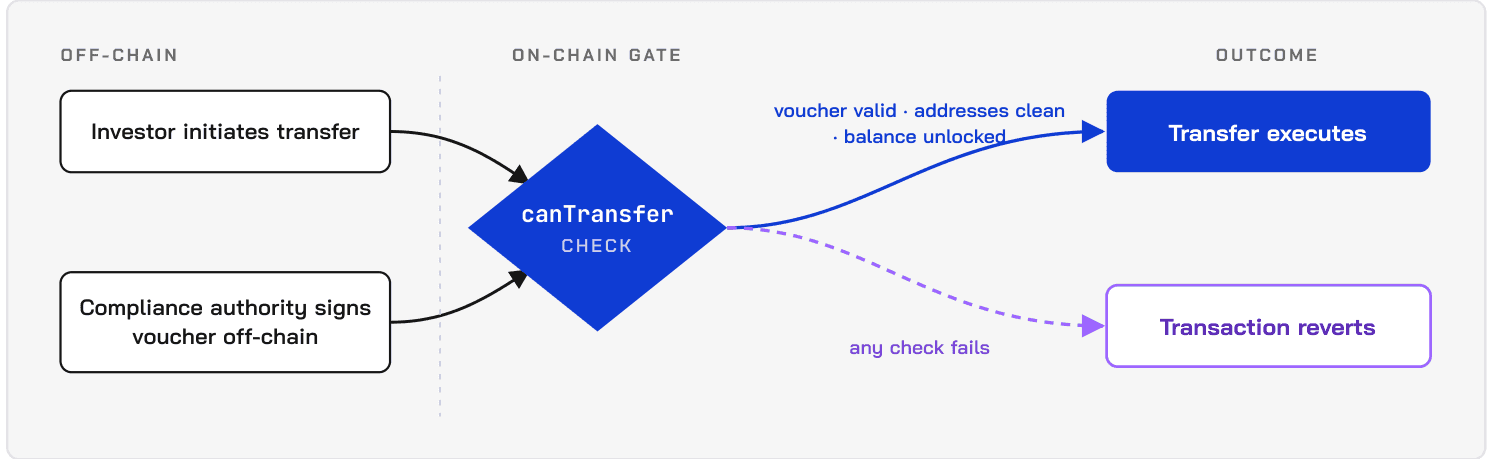
- Dynamic compliance via vouchers. KYC/AML logic isn’t hardcoded into the contract. An authorized compliance service evaluates a transfer off-chain and signs a short-lived cryptographic voucher, and the on-chain
canTransfercheck validates that voucher before any tokens move. When regulation changes, the off-chain policy changes and the contract doesn’t have to be redeployed. - Enforcement primitives. The standard specifies exactly the verbs a regulator or transfer agent will ask about:
freezean address,restrictTransferon a partition,lockTokensuntil a release time,forceTransferfor court orders or lost-key recovery, andpayout/batchPayoutfor dividends and coupons. - Interoperability. Wrapping functions let assets move across token standards and chains while carrying their compliance metadata with them.
ERC-7518 tries to do for security tokens what ERC-20 did for utility tokens: give everyone one agreed way to build. That’s precisely why its implementation deserved an audit of its own.
What we audited
The audit covered the complete ERC-7518 reference suite: the token core itself, the pluggable compliance and control modules it inherits, the marketplace contract that sits on top, and the Chainlink interface used for price data. The token contract (ERC7518.sol) is where the standard’s promises live—voucher-checked transfers, locking, freezing, force transfers and payouts—so it got the deepest attention.
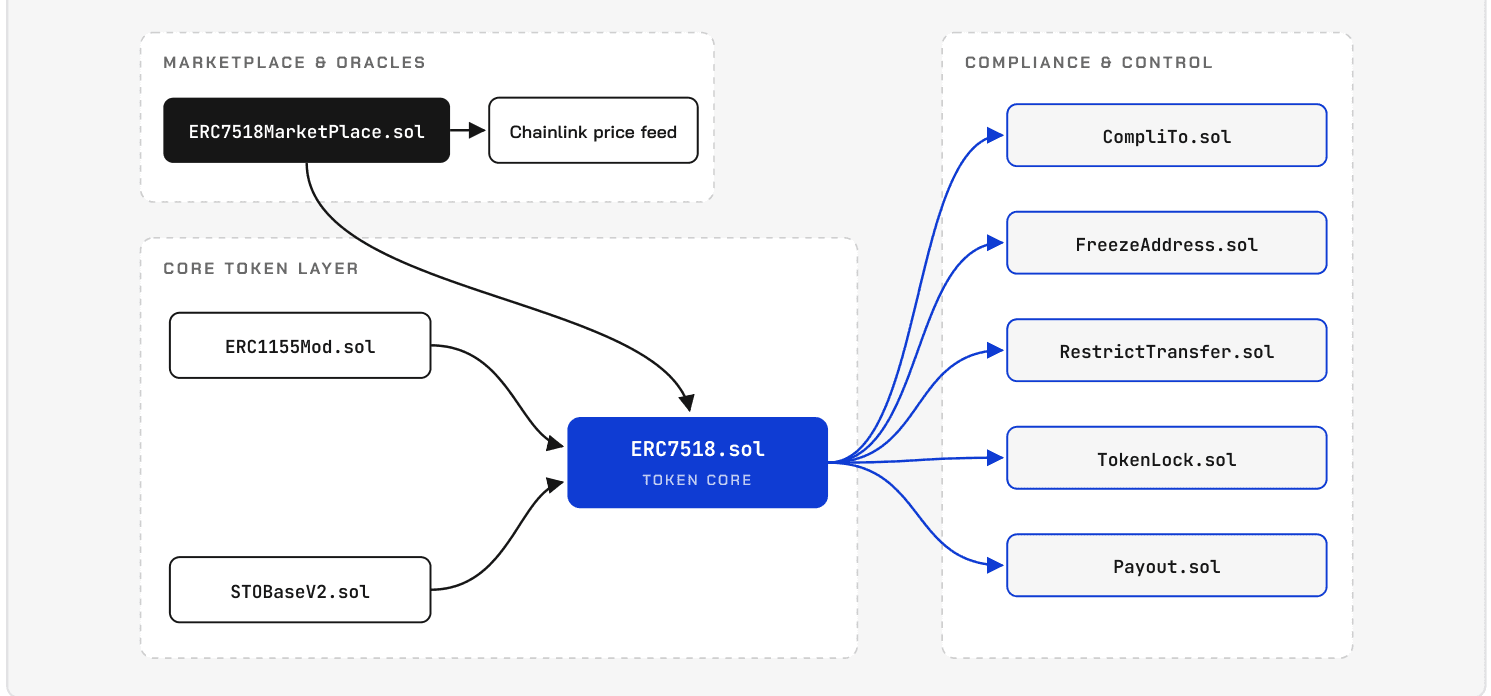
Table 2 · Contracts in scope (18 files, grouped by responsibility)
| Component | What it does |
|---|---|
| ERC7518.sol, ERC1155Mod.sol, STOBaseV2.sol | The token core: partitioned ERC-1155 balances, transfer gating, issuance and settlement logic for offerings |
| CompliTo.sol (+ ICompliTo.sol) | Compliance oracle: verifies the off-chain vouchers that authorize regulated transfers |
| FreezeAddress.sol, RestrictTransfer.sol, TokenLock.sol | The enforcement trio: address freezing, partition-level transfer restrictions, time-locked balances |
| Payout.sol, PaymentTracker.sol | Dividend/coupon distribution and investment bookkeeping |
| IssuerFactory.sol, Nonce.sol, ERC1155AllowanceWrapper.sol, ERC1155Permit.sol, ERC2771Context(Upgradeable).sol | Supporting machinery: issuer onboarding, signature nonces, per-partition allowances, permits and meta-transaction context |
| ERC7518MarketPlace.sol (+ IMarketPlace.sol), AggregatorV3Interface.sol | Primary/secondary marketplace and the Chainlink price-feed interface |
How we ran the pilot audit
Because this was a pilot, the first independent security review of the standard’s implementation, we set the engagement up a little differently from a routine token audit. Two choices mattered most: we audited against the published EIP-7518 specification, not just against general best practice, so “the code does X but the standard says it MUST do Y” counted as a finding. And every high-severity claim had to ship with a runnable proof-of-concept, so Zoniqx’s engineers and their future reviewers could watch the attack happen rather than take our word for it.
- Information gathering. We reviewed the EIP-7518 specification, Zoniqx’s technical documentation and the repository layout, and walked the intended user flows—issuance, compliant transfer, locking, payout—with the engineering team to pin down what the code was supposed to do.
- Manual code review. Line-by-line review of all 18 contracts, concentrating on access control, signature and nonce handling, the freeze/lock/restrict state machine, and conformance with both ERC-1155 and the ERC-7518 specification’s MUST statements.
- Functional testing. We wrote and executed targeted test cases for every suspected weakness, including adversarial ones: unauthorized locking, frozen-account payouts and batch-transfer bypasses. The proof-of-concepts quoted in this case study are those tests, trimmed for readability.
- Automated analysis. Static analysis and vulnerability scanning across the full SWC checklist—re-entrancy, oracle manipulation, front-running, integer issues, upgradeability safety and more. Every automated flag was manually re-tested to eliminate false positives before it reached the report.
- Reporting and remediation. Findings were delivered categorized by severity with concrete fix recommendations. Zoniqx returned updated code on 28 May, and we re-ran the relevant tests and verified the fixes in a second review on 29 May 2024.
What we found
Seventeen findings in total: four high severity, five low, eight informational. Sixteen were fully resolved and verified in the second review. One high-severity item, covering gaps in the freeze logic, was partially resolved, with the remaining edge cases documented and consciously accepted by the client.
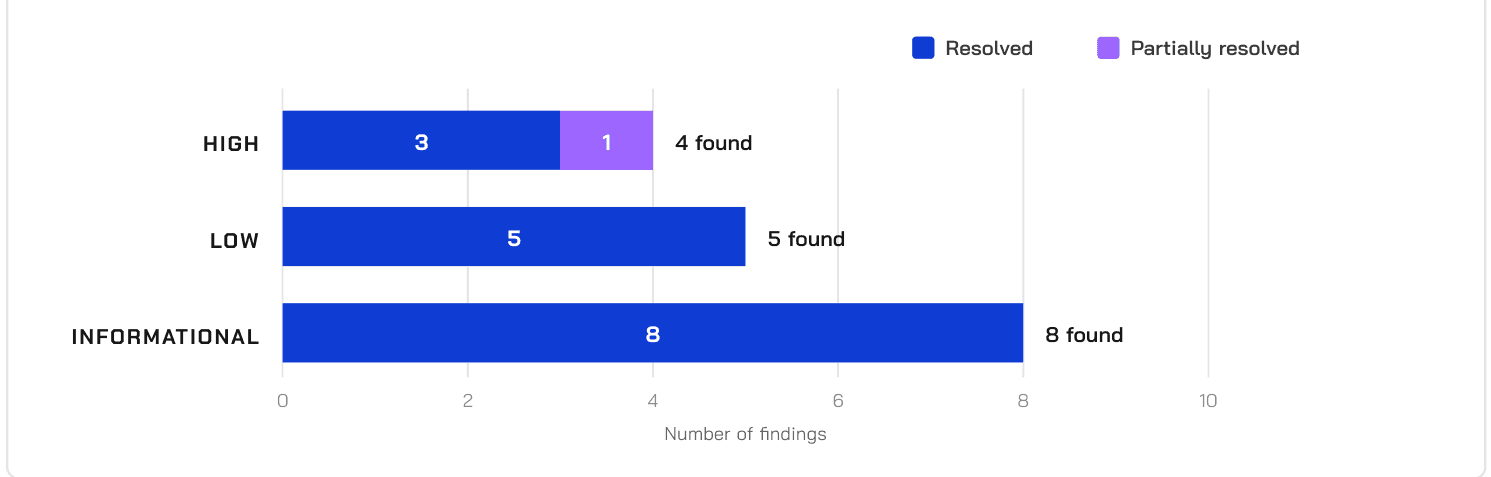
How to read the severities. High means exploitable: the contract can be made to do something its design forbids, and it must be fixed before mainnet. Low means minor impact: worth fixing, not an emergency. Informational means code-quality, documentation or style improvements that make the system safer to maintain and integrate.
The low and informational findings included missing input validation, a missing re-entrancy guard on batchPayout(), thin NatSpec documentation, events that didn’t say enough, and a typo in an interface. The four high-severity findings each struck at a capability the standard exists to provide.
The four findings that mattered
1. A hardcoded zero that broke allowances
High severity · Resolved
Where: ERC7518.sol :: safeTransferFrom and ERC1155AllowanceWrapper.sol :: _spendAllowance.
ERC-7518 lets an owner delegate limited transfer rights to an operator, say a broker allowed to move up to 100 tokens of a given partition. We found the code checked that allowance against the wrong token: safeTransferFrom passed a hardcoded 0 as the token ID instead of the ID actually being transferred, and inside _spendAllowance the amount and ID parameters were swapped. The net effect: the allowance check was being run against a partition the operator may never have been approved for.
The attack, as we demonstrated it: Alice approves Bob to manage 100 tokens of partition 1. Bob calls the transfer function asking to move 1,000. Because the allowance is debited against the wrong token ID, the check passes, and Bob walks away with ten times his authorization, straight to Charlie’s wallet.
1// Alice approved Bob for 100 tokens of id1. Bob moves 1000 instead.
2erc1155Contract.safeTransferFrom(aliceAddress, charlieAddress, id1, 1000, data);
The fix: Pass the real token ID through the whole call chain and un-swap the parameters, so allowance is verified and debited against the exact partition being moved. Verified in the second review.
2. Anyone could lock anyone else’s tokens
High severity · Resolved
Where: TokenLock.sol :: lockTokens.
Token locking exists for vesting schedules and holding periods, a legitimate, regulated feature. But the function that triggers it checked only that the target account had enough transferable balance. It never asked who was calling. Any address on the network could lock any amount of any other user’s tokens, for any duration.
The attack, as we demonstrated it: A stranger picks a victim’s address and token ID and locks 90 of their tokens for a day, freezing assets the victim still owns and should control. Repeated at scale, this is a denial-of-service against every holder of the token, and for a platform courting regulated issuers, assets frozen by random outsiders is a compliance incident.
The fix: Authorization checks so only the token owner or an explicitly delegated role can initiate a lock, backed by role-based access control for this and similar sensitive operations. Verified in the second review.
3. Freezing that didn’t actually freeze
High severity · Partially resolved
Where: ERC7518.sol :: freeze and its interaction with privileged roles.
Freezing is the emergency brake: the function a compliance team reaches for when a court order lands or an address is sanctioned. The EIP-7518 specification states that a frozen address must not transfer and must not receive payouts. We tested the implementation against those MUST statements and found three gaps. A frozen account could still have its funds force-transferred out by an authorized role. A frozen account could still receive payouts, with profits flowing into an address that had supposedly been cut off. And the freeze could be turned on the privileged roles themselves—admin, minter, paying agent—opening the door to the platform locking its own keys in the car.
We confirmed each gap with a dedicated test, quoting the specification line it violated.
The fix: Access-control and state checks were tightened so frozen addresses are excluded from transfers and payouts, and privileged operational roles are protected from being frozen into inactivity. One edge case in the role matrix remains consciously accepted by the client. It is documented in the report, which is why this item is marked partially resolved.
4. Locked tokens walked out through the batch door
High severity · Resolved
Where: ERC7518.sol :: safeBatchTransferFrom.
Zoniqx had done the right thing on the single-transfer path: safeTransferFrom was overridden with the full canTransfer ceremony—compliance voucher, freeze checks, lock checks, signatures. But safeBatchTransferFrom, the plural version of the same function, was inherited straight from the OpenZeppelin base contract with none of those checks. The front door had a guard, but the side door was propped open.
The attack, as we demonstrated it: We locked several accounts’ tokens for three days, then immediately moved those same locked balances out via safeBatchTransferFrom with no voucher, no signature, no complaint from the contract. Every guarantee the locking module was built to enforce evaporated the moment a transfer arrived in batches.
The fix: Route batch transfers through the same compliance and lock checks as single transfers, so the two paths can’t drift apart. Verified in the second review.
Fixes, verification, and where things stand
Zoniqx’s engineers moved fast. Updated code came back within two weeks of the report, and our second review on 29 May 2024 confirmed that 16 of the 17 findings were fully resolved, including all five low-severity and all eight informational items. The improvements also included input validation on payout addresses, a re-entrancy guard on batchPayout(), proper NatSpec documentation, and events that let an auditor reconstruct what happened. These changes make the codebase safer to maintain and integrate.
Why this engagement matters if you’re an institution
- Due diligence on a foundation. Anyone evaluating RWA tokenization infrastructure is ultimately evaluating the token standard underneath it. This audit examined the reference implementation of the standard itself, the layer every issuer, partition and payout would inherit.
- Compliance features were tested as attack surfaces. Freezing, locking, forced transfers and voucher-gated transfers are the exact capabilities regulators ask about, and they were exactly where the exploitable bugs lived. We test the promises, not just the code.
- Every high-severity claim came with evidence. Each high-severity finding shipped with a runnable proof-of-concept: an artifact an internal risk committee or external reviewer can execute and verify independently.
- The pilot model worked. A time-boxed pilot gave the client a full-scope security baseline of its standard in eight days, with a verified remediation loop inside the same month. It is a template for how first engagements with infrastructure teams can run.
A security audit identifies and mitigates risk at a point in time. It cannot guarantee protection against every possible threat. This case study summarizes the May 2024 pilot audit of the Zoniqx ERC-7518 contracts as delivered to the client. The full audit report remains the authoritative record of scope, findings and resolution status.