Someone Else Controls the Neobank Dollars
Stablecoins powering neobanks can be frozen by external parties. Over $5.8B already locked. Here’s what founders and investors need to know.


Stablecoins have become the quiet foundation of crypto neobanks. They sit underneath user balances, card programmes, merchant settlement, and yield products. For many platforms they function less like a feature and more like the unit of account itself.
As of mid-August 2026 the total stablecoin market stands near $290 billion. USDT accounts for roughly $183 billion. USDC holds approximately $72 billion. The market remains heavily concentrated in two issuers.
Most teams still evaluate these assets primarily through reserve quality and attestation frequency. Those factors are necessary. They are also incomplete.
A stablecoin is a smart contract. The ability to freeze addresses, mint new supply, and in most cases upgrade the implementation sits with specific parties. These controls are live. They are exercised regularly. And they sit outside the operational control of the neobanks that rely on them.
The Architecture Most Teams Underweight
When a neobank accepts stablecoin balances, it accepts more than a claim on reserves. It accepts a set of privileged roles defined in the token contract.
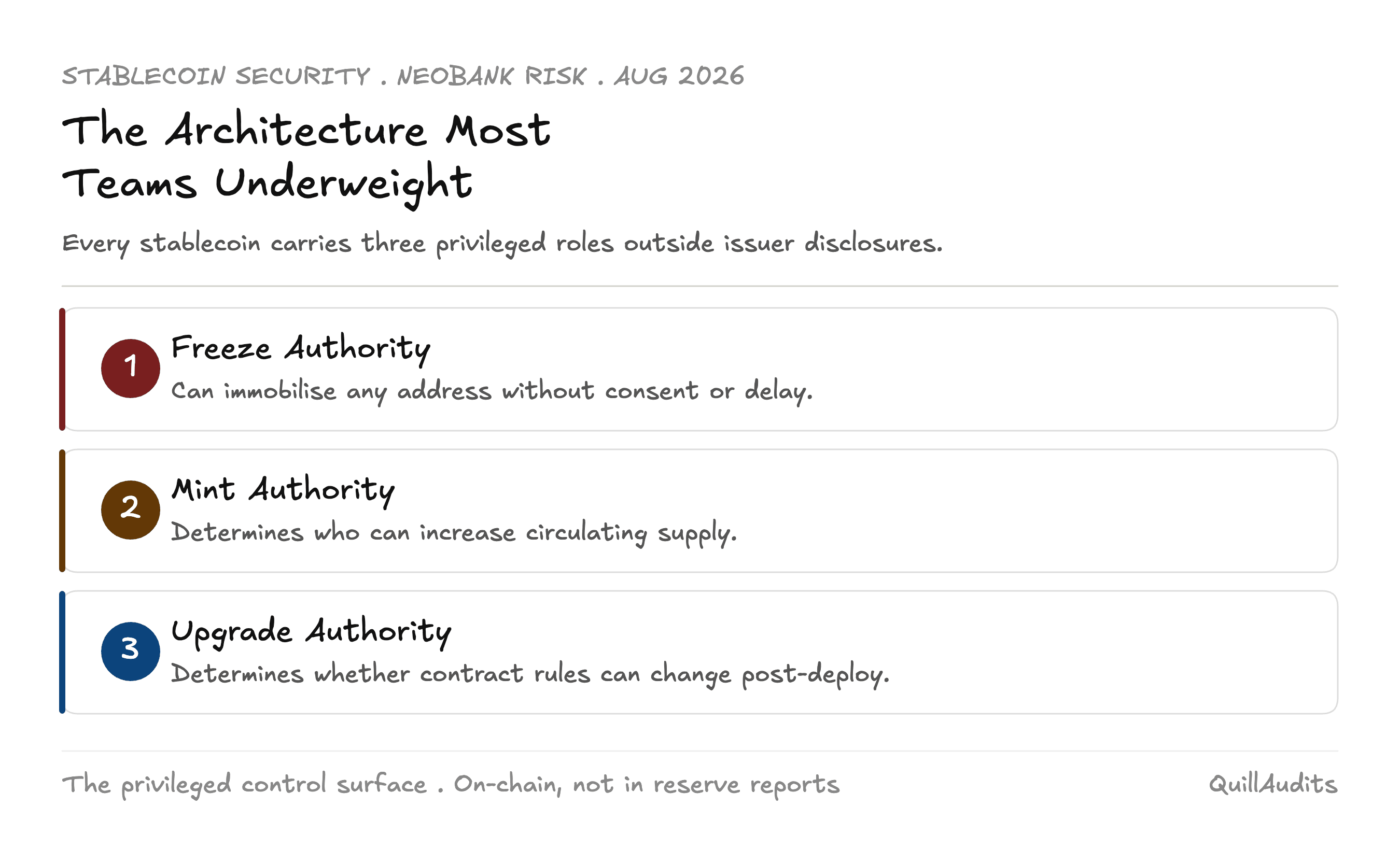
Three of those roles matter most in practice:
- The authority to freeze an address
- The authority to mint new supply
- The authority to upgrade the contract implementation
Freeze authority is the most immediately relevant. It allows a third party to prevent any address from transferring its balance. In Tether’s case the same party can also destroy the frozen balance permanently. These actions require no consent from the holder and, in most implementations, no on-chain delay.
Mint authority determines who can increase supply. Upgrade authority determines whether the rules of the token can change after deployment. Together they form a control surface that does not appear in a standard reserve report.
Freeze Activity Is Already Material
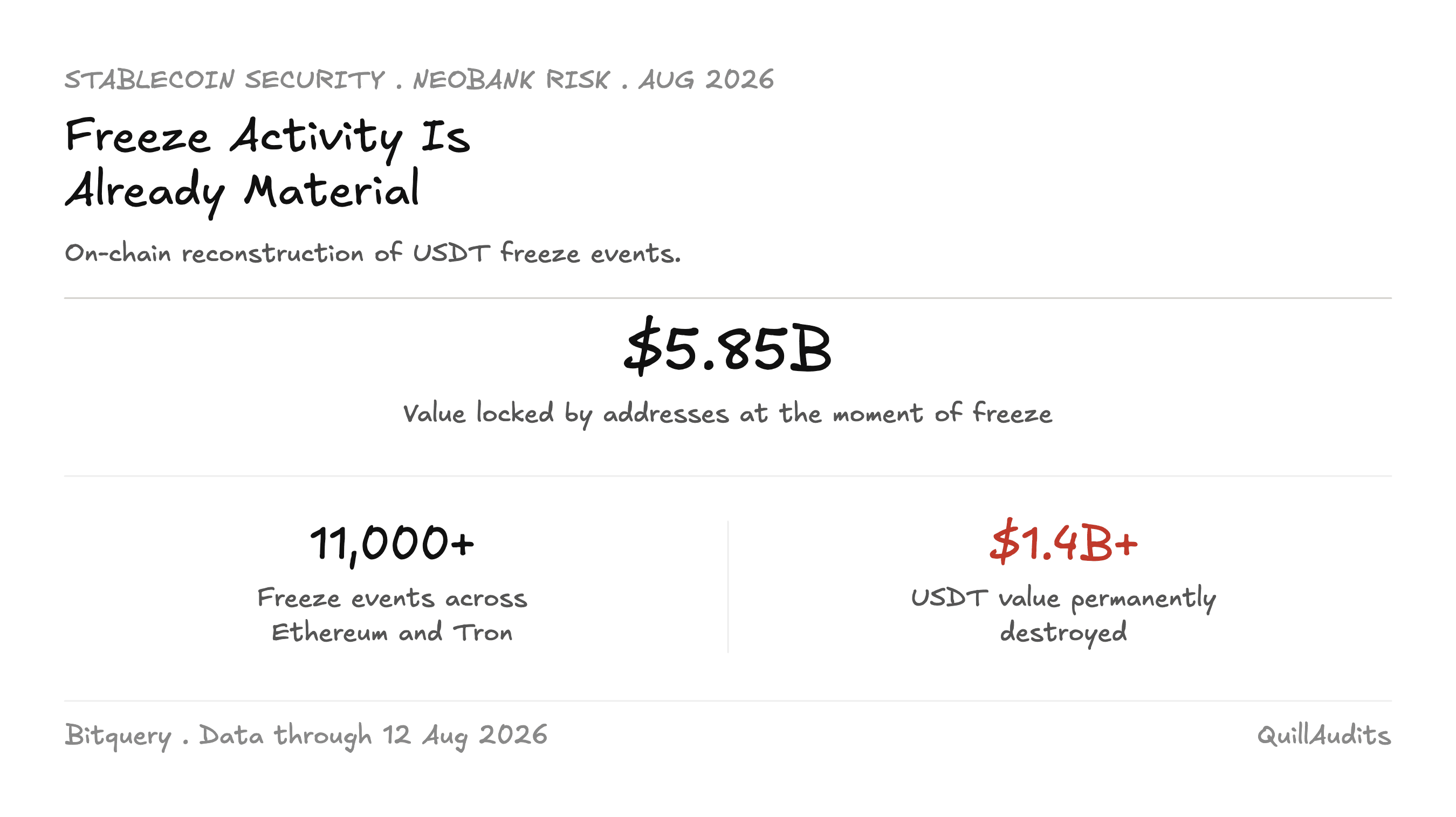
On-chain reconstruction of USDT freeze events through early August 2026 shows more than 11,000 freeze actions across Ethereum and Tron. At the moment those addresses were frozen they held approximately $5.85 billion. Over $1.4 billion of that value was later permanently destroyed.
Circle has exercised freeze authority far less frequently. The technical capability, however, exists in both major contracts. When issuers choose to act, freezes can execute quickly. Reversals remain the minority outcome.
This data changes the risk conversation. Freeze authority is no longer an abstract governance feature. It is an active operational tool that has already constrained billions of dollars in value.
Why This Matters Specifically for Neobanks
Crypto neobanks sit at a higher concentration of this risk than most other crypto products.
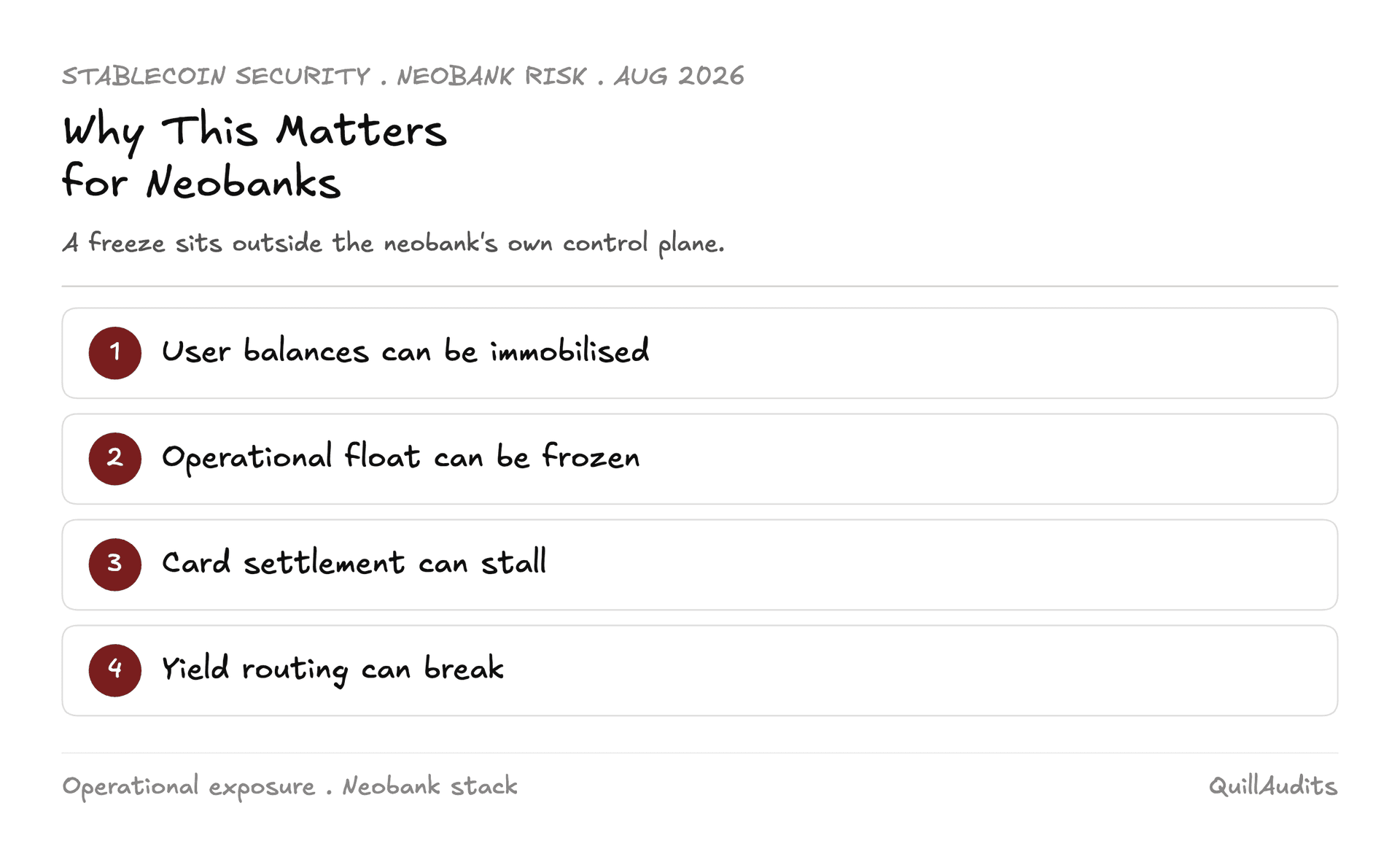
They hold user funds. They maintain operational float. They settle card transactions and merchant payments. In many cases they also route balances into yield strategies. All of these flows typically depend on stablecoins remaining transferable.
When freeze authority is exercised against an address controlled by the platform or by its users, the impact is immediate. Balances stop moving. Card programmes can stall. Settlement can fail. Internal accounting can break if the frozen assets were assumed to be liquid.
The risk is not only that a freeze happens. It is that the decision to freeze sits outside the neobank’s own control plane. Internal access reviews, multi-signature policies, and incident response playbooks cannot override an issuer-level freeze.
This risk sits on top of the broader attack surface that crypto neobanks already face. We previously mapped the full stack of overlooked vectors here.
Bridged Representations and Synthetic Designs
The risk surface expands further once teams look beyond the primary token.
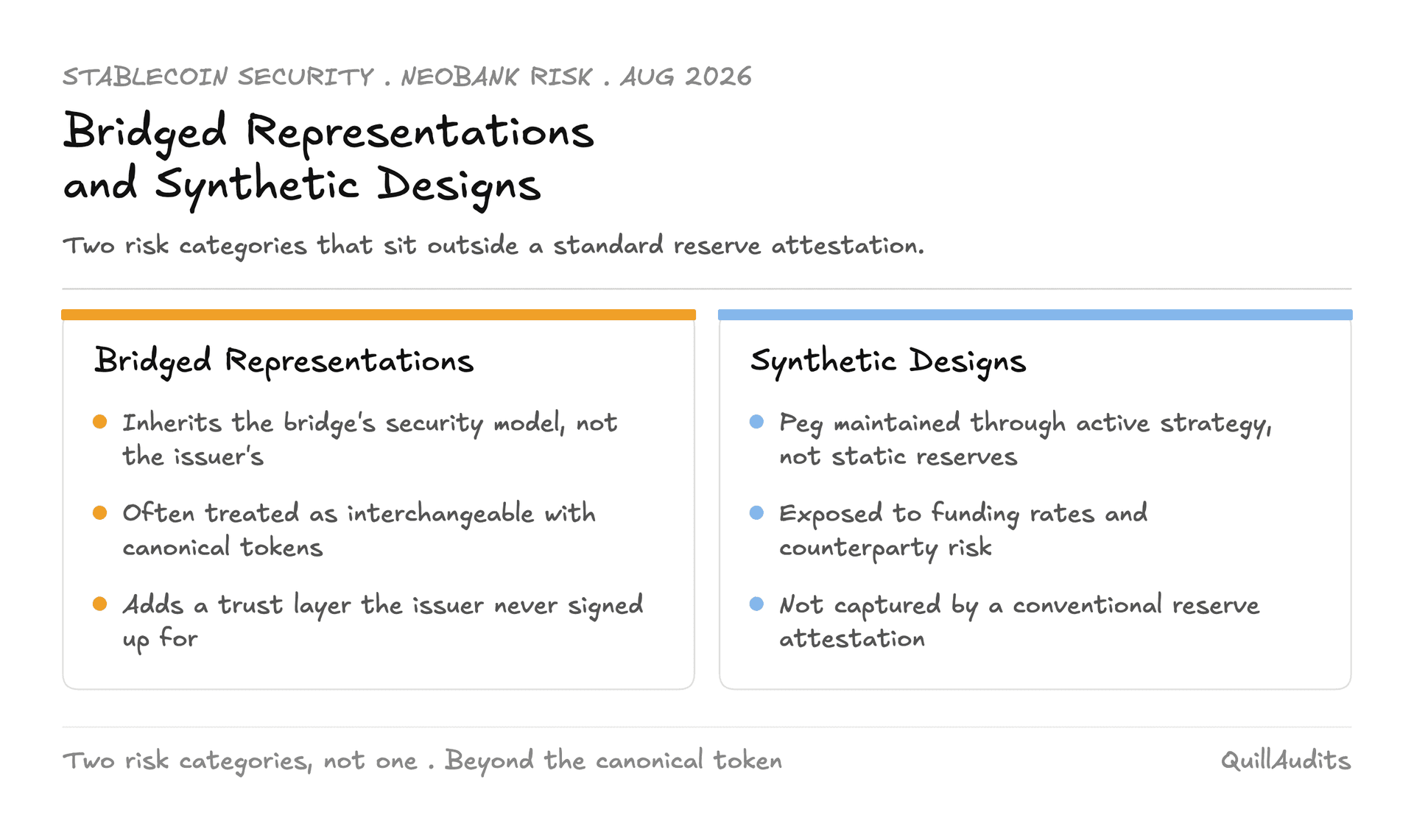
A significant share of circulating supply under familiar tickers is not the issuer’s native version. It is a bridged representation. These versions inherit the security model of the bridge rather than the original issuer. When platforms treat bridged and canonical balances as interchangeable, they accept an additional layer of risk that does not appear in the issuer’s disclosures.
Synthetic stablecoins introduce a different profile. Designs such as USDe maintain their peg through active strategies rather than static reserves. Their risk sits in funding rates, exchange counterparty exposure, and the integrity of the accounting that determines share price. A conventional reserve attestation does not surface these factors.
Both categories appear on neobank balance sheets and in product flows. Both require separate analysis from the canonical fiat-backed tokens.
Where Current Diligence Falls Short
Most security and treasury reviews still stop at the attestation document. That document answers a narrow question: what assets backed the token on a specific reporting date.
It does not answer the questions that determine whether balances remain usable under stress:
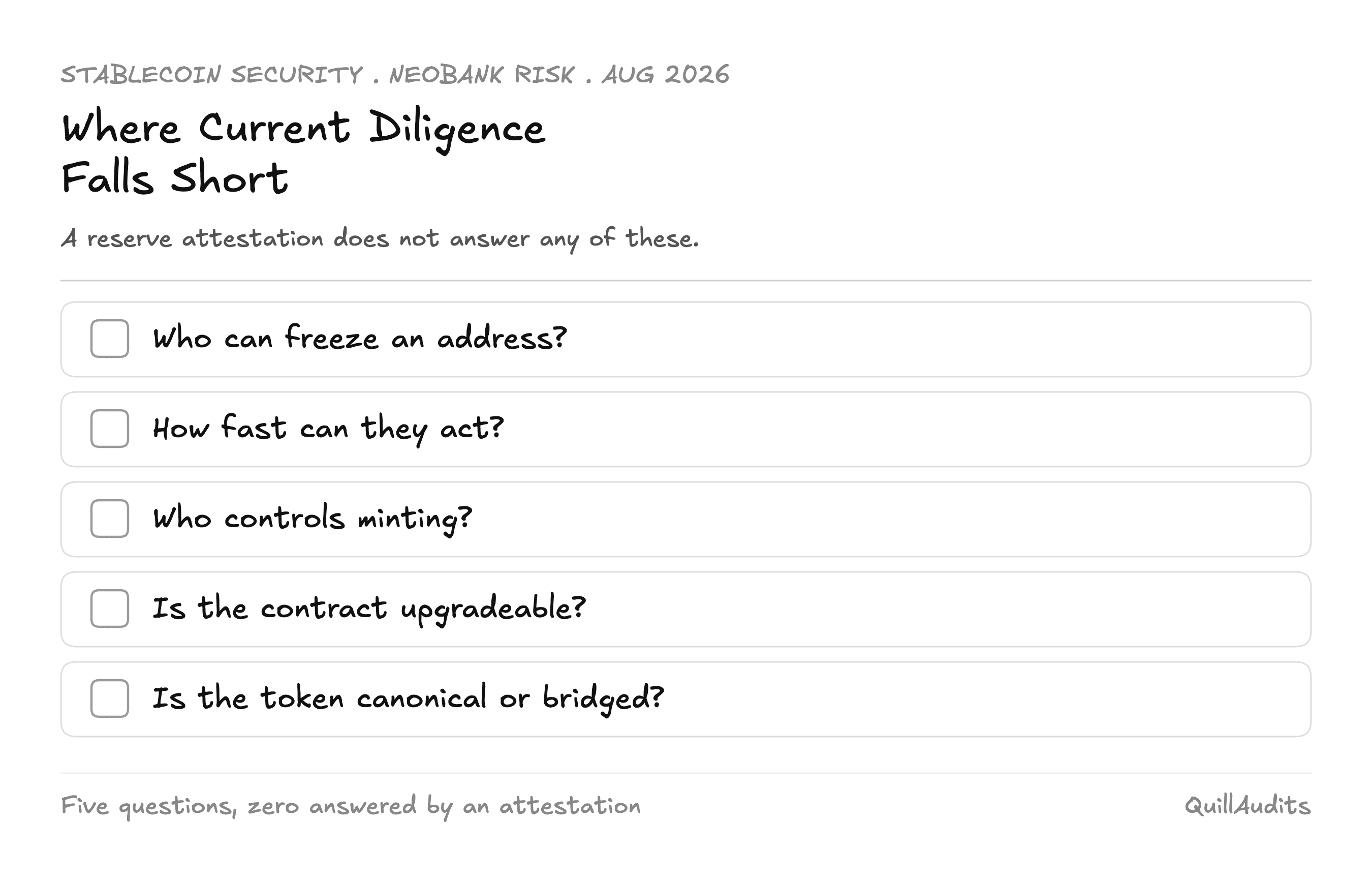
These details decide whether the “dollar” sitting in the product can actually move when the platform needs it to.
Practical Steps for Neobank Teams
Teams operating or building neobanks should treat stablecoin admin controls as a first-class risk category.
Begin with a full inventory of every stablecoin used in the product and on the balance sheet. For each one, document:
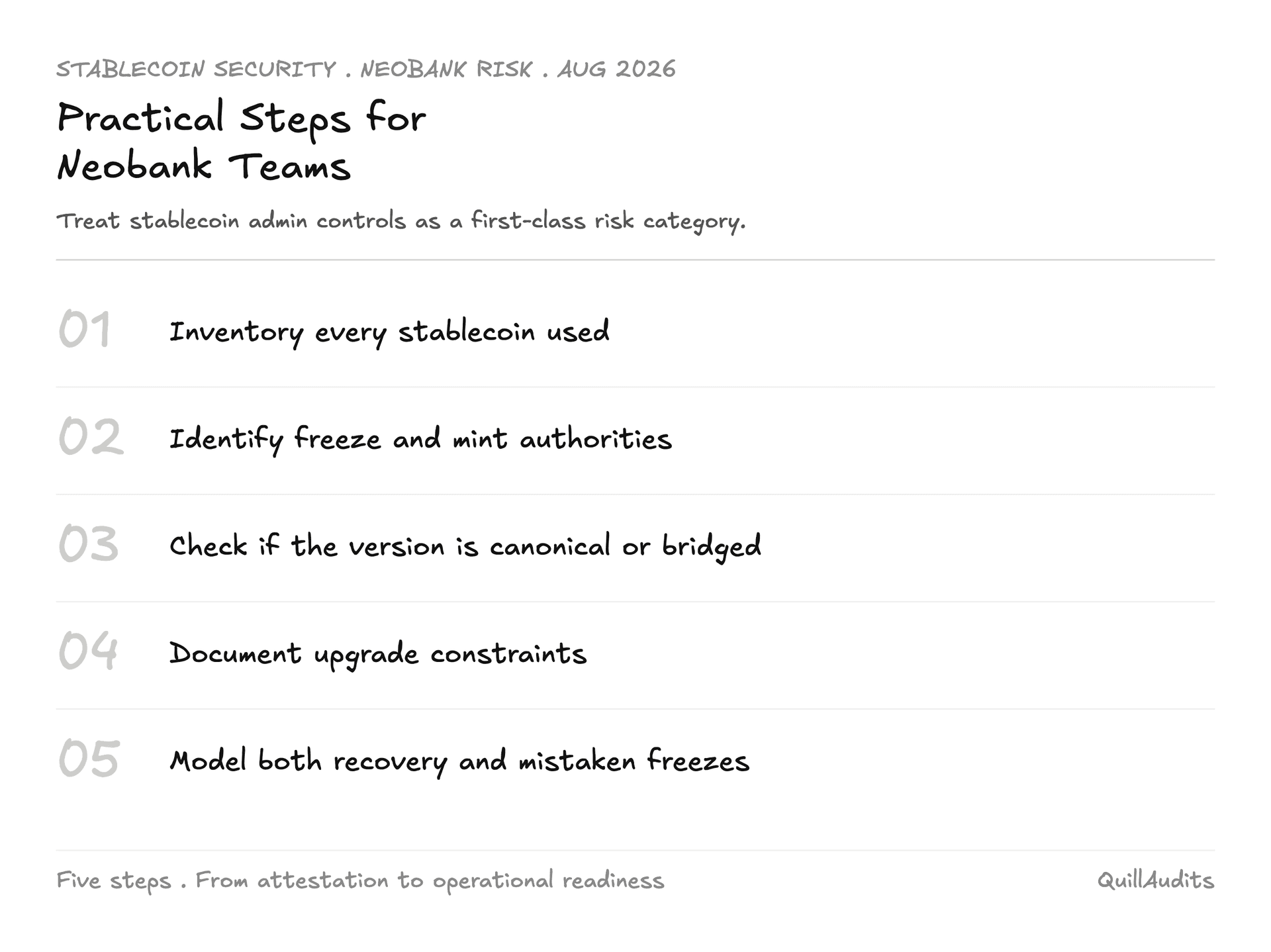
Once the inventory exists, incorporate both recovery freezes and erroneous freezes into the risk model. The objective is not to eliminate the risk. It is to stop treating it as invisible.
Teams should also examine how their internal systems would behave if a material balance became non-transferable. Card settlement logic, yield routing, and user withdrawal flows all need to be tested against that scenario.
Mapping freeze and mint authorities is only useful if someone owns the ongoing process. We previously covered why most neobanks still lack proper security ownership here.
Once you've mapped freeze and mint authorities across your stablecoin inventory, the RWA Security Score gives you a structured way to benchmark the rest of your custody and compliance posture, including the redemption and governance controls that determine how a freeze event actually plays out operationally.
Guidance for Investors
Investors evaluating neobank raises should expand diligence beyond code audits and reserve reports.
Relevant questions include:
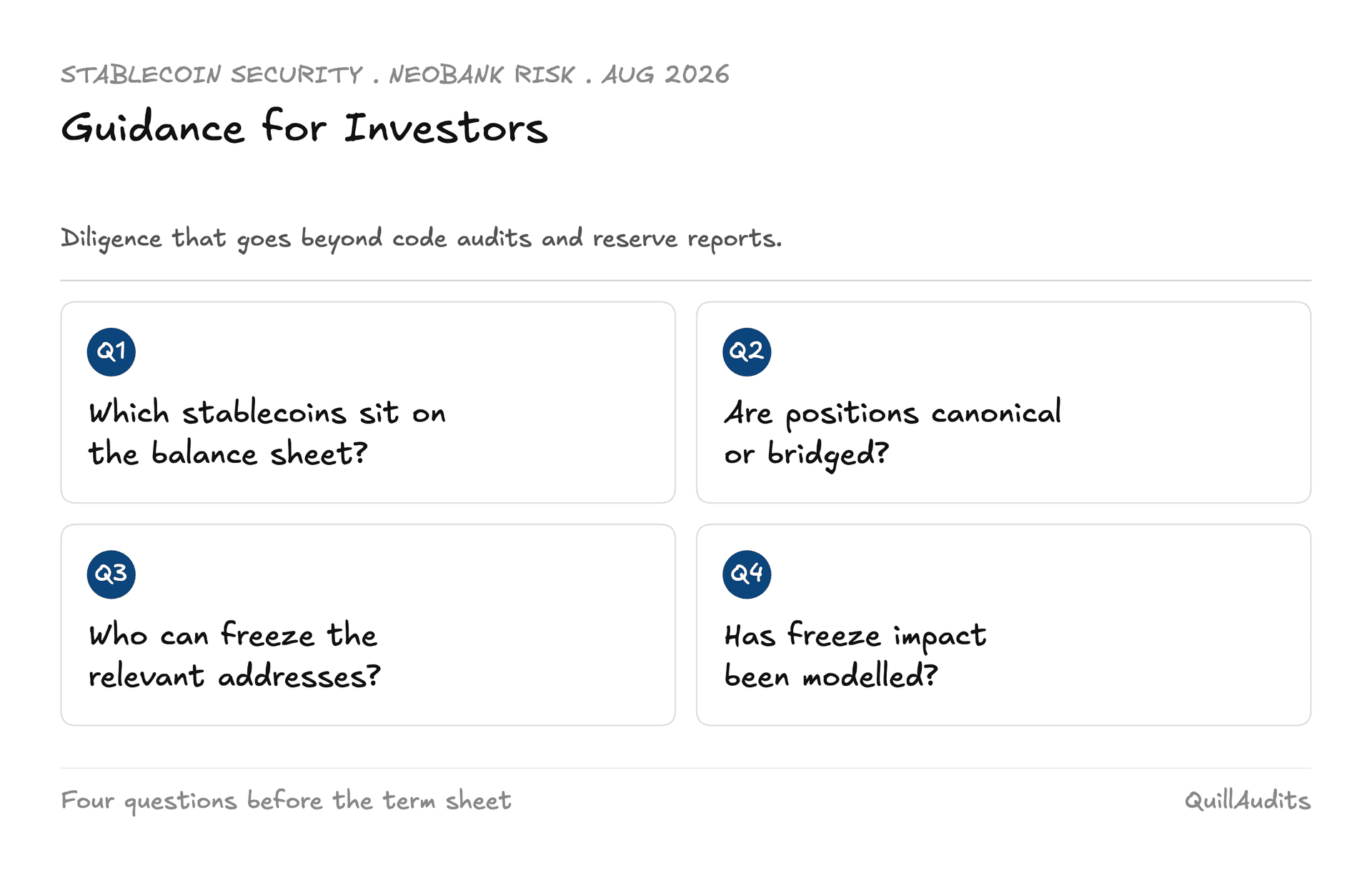
These questions test whether the team understands the actual control surface of the assets it relies on. A platform that cannot answer them cleanly is carrying unexamined risk.
Conclusion
Stablecoins gave crypto neobanks an efficient and scalable settlement layer. They also introduced a concentrated form of administrative control that most platforms have not fully priced into their risk models.
The freeze keys sit with someone else. On-chain data shows those keys are already in active use at meaningful scale. Platforms that map this risk and treat it as operational reality will be more resilient than those that continue to treat stablecoins as neutral dollars.
Reserve reports answer one question. The contract answers the question that determines whether funds can move.

Contents