


Circle's CCTP: How Burn-and-Mint Changes Bridge Risk
Circle’s CCTP removes the locked-pool risk that sank Wormhole, Ronin, and Nomad, but it doesn’t make cross-chain USDC transfers trustless. This guide explains how burn-and-mint works, what trust moves to Circle’s attestation service, attester keys, and upgrade admins, how Fast Transfer handles source-chain reorgs, and what builders should verify before integrating.

The decision · answer in brief
Circle’s CCTP removes the locked-pool risk that sank Wormhole, Ronin, and Nomad, but it doesn’t make cross-chain USDC transfers trustless. This guide explains how burn-and-mint works, what trust moves to Circle’s attestation service, attester keys, and upgrade admins, how Fast Transfer handles source-chain reorgs, and what builders should verify before integrating.
Cross-Chain USDC Transfer Security: Inside Circle's CCTP
Cross-chain USDC transfer security used to mean one thing: how big is the locked pool, and who can drain it? Circle's Cross-Chain Transfer Protocol, or CCTP, burns USDC on the source chain and mints native USDC on the destination chain instead of locking it in a pool, which removes that specific attack surface. It does not remove trust from the transfer. It moves that trust onto Circle's attestation service, its attester keys, and its contract-upgrade admins, and this post names exactly what a builder is relying on when they use it.
What Is Circle's CCTP and How Does Burn-and-Mint Change Cross-Chain USDC Transfer Security?
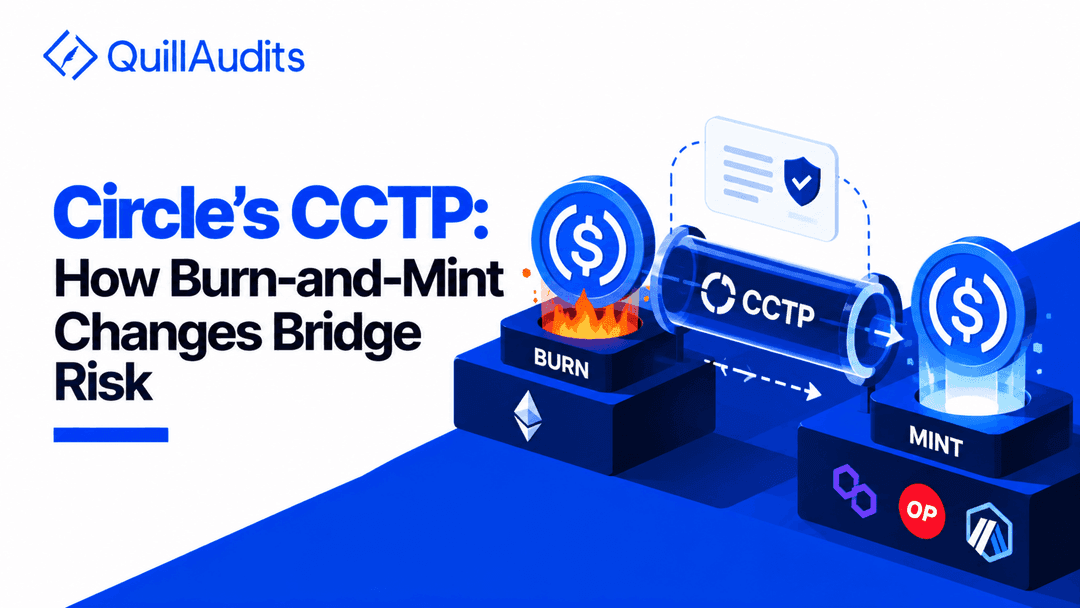
CCTP has no wrapped token and no liquidity pool on either side of a transfer. A transfer moves through four steps:
- A user calls
depositForBurnon the source chain, burning their USDC through Circle's TokenMessenger contract. - Circle's off-chain attestation service, Iris, observes the burn event and waits for the chain's finality threshold.
- Once finality is reached, Iris signs a message attesting that the burn happened.
- The user, or a relayer, submits that signed attestation to the MessageTransmitter contract on the destination chain, which mints an equivalent amount of native USDC.
Because the destination-chain USDC is minted directly by Circle's contracts rather than released from an escrow, there's no pool balance an attacker can inflate or drain. That's the core design claim, and Circle's own CCTP V1 documentation describes the mechanism in exactly those terms: burn-and-mint, not lock-and-mint.
How Does Burn-and-Mint Remove the Locked-Pool Attack Surface That Sank Wormhole, Ronin, and Nomad?
Bridge exploits have cost the crypto industry more than $4 billion since 2021, and the biggest losses share a pattern: a validator set or verification contract is tricked into approving a withdrawal from a pool that was never funded on the other side. Nomad is the cleanest example. On August 1, 2022, a routine contract upgrade initialized a trusted Merkle root to zero, letting any message be proven valid against that root, and attackers plus opportunistic copycats drained roughly $190 million from its locked funds within hours. Wormhole and Ronin followed the same shape at larger scale: a forged or stolen signature authorized a withdrawal against a pool holding real, lockable assets.
Burn-and-mint structurally can't fail this way, since there's no pool balance to forge a claim against. If an attacker fabricated a fraudulent attestation, the worst case is Circle minting USDC it didn't burn, a liability on Circle's own ledger rather than a drained community pool. That's a real improvement, and it's also the full extent of what burn-and-mint fixes. It says nothing about who can create a fraudulent attestation in the first place, which is where CCTP's own risk actually lives.
What Happens If Circle's Attestation Service Fails, Gets Censored, or Mis-signs?
Every CCTP transfer depends on Circle's attestation service signing off, a centralized point builders have to trust rather than verify on-chain. CCTP V2 message signing uses a 2-of-2 attester threshold, more redundant than a single key but still a set fully controlled by Circle, whose attester-manager role can change which attesters are enabled or adjust the threshold itself.
That centralization is operational by design, not an oversight. Pause functions across CCTP's contracts let Circle halt attestation or minting during an incident, which L2BEAT's risk assessment of CCTP V2 treats as a centralized control rather than a trust-minimizing property. The same assessment flags that Circle-controlled proxy administrators can upgrade the core TokenMessengerV2 and MessageTransmitterV2 contracts with no on-chain timelock delay, and that the USDC token contract itself can be upgraded by a single externally owned account.
So the practical failure modes aren't "a liquidity pool gets drained." They're the attestation service going offline, a legal order pressuring Circle to censor a transfer, an attester key getting compromised, or an admin key pushing an upgrade with no delay for the ecosystem to react. None of that requires breaking cryptography; it requires trusting Circle's operational security, a different flavor of USDC attestation service risk than forging a Merkle proof.
What Happens During a Source-Chain Reorg Under CCTP V2's Fast Transfer?
CCTP V1 waits for hard finality, the point past which a chain reorganization is extremely unlikely to reverse a transaction, before Iris will sign an attestation. On Ethereum and its L2s that wait runs roughly 13 to 19 minutes. CCTP V2's Fast Transfer feature attests on soft, confirmatory finality instead, which is why it can settle in as little as 8 to 20 seconds on chains like Arbitrum, Base, and Unichain, and under a second on Solana.
That speed is the headline feature of Fast Transfer, and it's also where a source-chain reorg becomes a live question. Finality windows vary a lot by chain: per Circle's own finality documentation, Standard Transfer settles in under 10 seconds on chains like Avalanche, BNB Smart Chain, Polygon PoS, and Sui, mirrors the roughly 13 to 19 minute hard-finality wait described above on Ethereum and most EVM L2s, and stretches as long as 6 to 32 hours on Linea. Fast Transfer backs its soft-finality attestations with Circle's Fast Transfer Allowance (FTA), a reserve covering a reorg that reverses a burn after an attestation already went out, so Circle absorbs the gap instead of leaving the destination mint unbacked.
Picture a protocol routing a $2 million Fast Transfer out of Base. Iris signs the attestation within 8 to 20 seconds of the burn, well before Base's block is economically final in the way Ethereum's is. If the source block then gets reorganized and the burn disappears, there's no second burn to back the mint that already happened on the destination chain, so the FTA reserve has to cover it. That's a real backstop, but it's Circle's balance sheet standing behind the reorg risk, not a cryptographic guarantee, worth knowing before routing large Fast Transfer volume through a chain with a short soft-finality window.
What Should You Still Verify for Cross-Chain USDC Transfer Security Before Building on CCTP?
Before wiring CCTP into a protocol, check these against Circle's current configuration rather than assuming they match what shipped at launch:
- Confirm the current attester threshold and the attester set itself, since Circle's attester-manager role can change either one.
- Check whether TokenMessengerV2 or MessageTransmitterV2 have been paused or upgraded recently, and whether any upgrade shipped without a visible delay.
- Compare Standard Transfer and Fast Transfer finality windows for your specific deployment chain, since your target may sit far outside the fast end of that range.
- Size any Fast Transfer volume against FTA exposure, since the reorg backstop is a finite allowance rather than an unlimited guarantee, so very large transfers deserve a second look at Standard Transfer.
- Review your own mint-callback handling, since CCTP changes what you trust externally but doesn't audit how your contracts consume the minted USDC or who can call your side of the integration.
That last point sits outside CCTP's scope, and it's where most integration bugs show up. QuillAudits' research and audit resources, spanning chains like Ethereum, Solana, Arbitrum, and Base, can help review how a protocol's own contracts handle CCTP's mint and burn calls and where admin-role exposure sits in that integration. None of that changes Circle's attestation service, attester-key custody, or its unilateral pause and upgrade authority; those risks live inside Circle's infrastructure, and no audit of a client's contracts reaches them. Tracking Circle's attester threshold, pause history, and finality settings stays an operational job for the builder. For how other designs assign trust, see QuillAudits' review of Cross-Chain Messaging Security and its cross-chain RWA architecture comparison of CCIP, LayerZero OFT, and Wormhole NTT.
Final Thoughts
CCTP's burn-and-mint design genuinely closes the locked-pool attack surface that cost Wormhole, Ronin, and Nomad hundreds of millions of dollars combined. It doesn't make a cross-chain USDC transfer trustless; it makes the trust explicit: a 2-of-2 attester set, no-timelock contract upgrades, unilateral pause authority, and an FTA reserve backing fast settlement. Not all blockchains are created equal in how fast they finalize, and not all cross-chain designs move risk to the same place. Knowing exactly where CCTP put it is the first step to deciding whether that's acceptable for what you're building.
Contents









