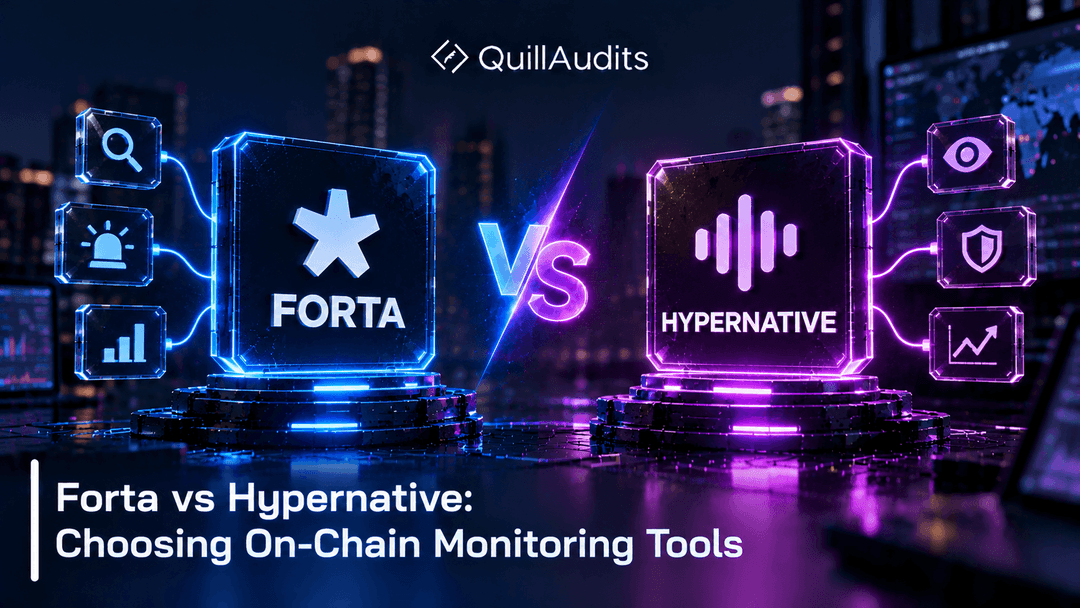
Forta vs Hypernative: Choosing On-Chain Monitoring Tools
Your audit is done, but who watches the protocol after launch? This DeFi security monitoring platform comparison breaks down Forta’s decentralized detector network and Firewall against Hypernative’s AI risk engine and Transaction Guard, explains inline blocking versus alert-only feeds, and shows how to choose by protocol size, including an audit-bundled option for earlier-stage teams.

The decision · answer in brief
Your audit is done, but who watches the protocol after launch? This DeFi security monitoring platform comparison breaks down Forta’s decentralized detector network and Firewall against Hypernative’s AI risk engine and Transaction Guard, explains inline blocking versus alert-only feeds, and shows how to choose by protocol size, including an audit-bundled option for earlier-stage teams.
Picking a DeFi Security Monitoring Platform: Forta vs Hypernative
Your audit report just landed, the fixes are merged, and the findings are closed out. The question that follows is rarely asked early enough: who is watching the protocol on the days after launch, when a new attack path shows up that no audit scope could have covered? Picking a defi security monitoring platform is that next decision, and the two names that come up most often, Forta and Hypernative, solve the problem in genuinely different ways, with a third, audit-bundled option worth weighing if your protocol is still early stage.
This post compares what each one actually detects and blocks, how their response models differ, and how to size the choice to your protocol's stage. Right after the audit is the moment this decision usually gets made.
What Continuous Monitoring Catches That an Audit Can't
An audit is a point-in-time review of code as it exists on a given day. Continuous monitoring watches the protocol's live state, every transaction, every admin call, every price feed update, for as long as the protocol runs. The two are complementary, not substitutes.
Monitoring catches things an audit structurally cannot, because they only exist once the protocol is live and under real market conditions:
- Oracle price manipulation that depends on live liquidity depth and pool composition at the moment of the attack.
- Flash loan sequences that combine several individually safe calls into an economic exploit.
- Governance attacks, such as a malicious proposal or a timelock change pushed through by a compromised or coerced signer.
- Abnormal fund flows and oversized withdrawals that only look wrong against the protocol's normal operating pattern.
QuillAudits has made this case directly in its own hack write-ups. Its analysis of the Thala DeFi exploit recommends real-time detection of oversized withdrawals paired with an emergency halt mechanism, a control an audit report can recommend but cannot itself operate. For a broader map of the attack surface these platforms are built to watch, QuillAudits' DeFi attack vectors breakdown catalogs oracle manipulation, flash loan abuse, and governance attacks in more depth. QuillAudits also has its own conceptual explainer of on-chain security monitoring worth reading before comparing vendors.
What Happens in a Security Audit (and Where It Stops)
A security audit is a manual and automated review of a smart contract's source code against a fixed scope and a fixed commit hash. Auditors trace logic for reentrancy, access control gaps, arithmetic errors, and deviations from the intended design, then deliver a report with severity-ranked findings and remediation guidance.
That scope stops at deployment. Once the contract is live, the protocol's state, its liquidity, its governance configuration, its integrations with other protocols, keeps changing in ways no static review can anticipate. QuillAudits makes this argument in its own writing on why a one-time audit isn't enough: an audit verifies the code as written, continuous monitoring verifies the system as it actually behaves in production. Teams that want the pre-deployment side covered as well can pair an audit with the static analysis, fuzzing, and formal verification tools in QuillAudits' smart contract security tools guide.
Forta's Decentralized Detector Model
Forta runs on a distributed network of independently operated scan nodes rather than a single vendor's infrastructure. Anyone can write and publish a detection bot, and anyone can run a node that executes those bots against live transaction data.
Scan Nodes, Detection Bots, and the FORT Token
Forta's network is powered by the FORT token. Node operators run community-created detection bots, and token holders can stake FORT to earn rewards for contributing to network security, according to Forta's own site. That structure means detection coverage grows as more developers publish bots for new attack patterns, rather than depending on one company's internal research team to write every rule.
Forta Firewall: Inline Blocking at the Sequencer
Forta Firewall is the part of the stack that moves past alerting. It lets teams choose what to block, flag, or allow before a transaction hits the chain, according to Forta's Firewall page, rather than only notifying someone after funds are already gone. That is the defining feature of an inline transaction firewall in defi: the decision happens pre-execution, at the sequencer or rollup layer, not after the block is finalized.
Forta reports that Firewall achieves greater than 99% recall and under 0.0002% false positives at under 10ms latency for pre-execution transaction screening, per Forta's Firewall page. Latency matters here because a firewall sitting in the hot path of every transaction has to clear it fast enough that it doesn't become the bottleneck itself.
Deployment is also built to avoid custom engineering work: Firewall integrates with the rollup-as-a-service providers Conduit, QuickNode, and Zeeve, so any rollup built on one of those stacks can activate it without a bespoke integration, per the same source.
Hypernative's AI Risk Detection
Hypernative takes a centralized, ML-driven approach instead of a decentralized bot marketplace. A single platform runs hundreds of pre-built detection templates and custom models against on-chain and off-chain data across a wide set of chains.
300+ Risk Agents Across 70+ Chains
Hypernative's platform includes more than 300 pre-built risk and threat detection templates plus custom detection logic, with machine learning models trained on years of on-chain and off-chain data, covering more than 70 chains and growing, according to Hypernative's own site. The chain count matters for any protocol that deploys across several EVM chains plus a non-EVM chain like Solana: a single pane of detection coverage avoids stitching together separate tools per chain.
Hypernative's enterprise focus shows up in its customer base. Bitwise Asset Management, which manages more than $15 billion in assets under management, selected Hypernative to strengthen DeFi risk management across its platform, per Hypernative's own announcement. Hypernative has also partnered with TRM Labs to deliver pre-transaction enforcement and on-chain security for Web3, according to TRM Labs, pairing Hypernative's detection with TRM's blockchain intelligence data.
Hypernative CEO Gal Sagie has framed the company's thesis around combining pre-launch and live-defense layers: "To make Web3 hacks a thing of the past, we need to combine smart contract audits and bug bounties with an active security component," he said in Hypernative's Series A announcement. It's a framing that applies just as well to the audit-plus-monitoring pairing this post is built around.
Transaction Guard and Automated Response
Hypernative's Transaction Guard performs transaction simulation, intent verification, and policy enforcement before a transaction executes, per Hypernative's site. Like Forta Firewall, this puts Hypernative in the pre-execution category rather than the alert-only category, with the policy engine deciding whether a transaction's actual effect matches its declared intent before it is allowed through.
Inline Firewalls vs Alert-Only Feeds: Forta and Hypernative Compared
The fastest way to tell these two apart is by response model: does the tool only tell you something bad happened, or can it stop the transaction before it settles? Both Forta and Hypernative now sit in the pre-execution category, which is the real dividing line in this market, not detection volume.
| Capability | Forta | Hypernative |
|---|---|---|
| Detection model | Decentralized scan nodes running community-built detection bots, secured by FORT token staking, per forta.org | Centralized ML platform with 300+ pre-built risk templates plus custom detection logic, per hypernative.io |
| Pre-execution blocking | Forta Firewall blocks, flags, or allows transactions before they hit the chain, per forta.org/firewall | Transaction Guard runs simulation, intent verification, and policy enforcement before execution, per hypernative.io |
| Chain / rollup coverage | Any rollup built on Conduit, QuickNode, or Zeeve can activate Firewall without custom development, per forta.org/firewall | More than 70 chains and growing, per hypernative.io |
| Published performance | Greater than 99% recall, under 0.0002% false positives, under 10ms latency, per forta.org/firewall | No independently published latency or false-positive figures found at time of writing |
| Notable deployments | Open network of independent node operators and bot authors, per forta.org | Bitwise Asset Management ($15B+ AUM) and a TRM Labs integration, per hypernative.io and TRM Labs |
Neither row above includes pricing, since both vendors negotiate contracts directly rather than publishing rate cards, and any figure quoted here would be stale within a quarter. Confirm current terms directly with each vendor before budgeting.
Walk through a single attack attempt and the difference between the two response models gets concrete. Say an attacker takes out a flash loan, swaps it through a thin pool to push a lending protocol's price oracle away from its real value, then calls the lending contract in the same transaction to borrow against the now-inflated collateral valuation, the same oracle-and-liquidity pattern QuillAudits has flagged in its DeFi attack vectors breakdown. Under an alert-only feed, that transaction settles first; the monitoring system fires a notification afterward, and whatever happens next depends on how fast a human or an automated script can react, usually after the funds have already moved. Under Forta Firewall or Hypernative's Transaction Guard, the same transaction is screened before it is allowed to execute: Firewall checks it against the blocking rules a team has configured, at the sub-10ms, greater-than-99%-recall rate Forta publishes, while Transaction Guard simulates the transaction's actual effect and checks whether it matches its declared intent. In both inline models, a transaction built around that pattern can be blocked outright rather than merely reported.
How to Pick a DeFi Security Monitoring Platform by Protocol Size
There's no single right answer here. The right platform depends on what stage your protocol is at, how many chains it touches, and what you're already paying for.
- Enterprise protocols and funds managing nine-figure TVL or more, where third-party-verified scale and a named enterprise customer list matter to your own stakeholders, are the profile Hypernative is built for, given its published Bitwise and TRM Labs relationships.
- Protocols that want detection logic they can see, extend, or run themselves, rather than a black-box vendor model, fit Forta's decentralized bot marketplace, especially if the team is already comfortable auditing open detection code the way it audits its own contracts.
- Teams coming straight out of an audit engagement, especially earlier-stage protocols not yet ready for an enterprise monitoring contract, can use QuillAudits' own on-chain monitoring service, which bundles up to two months of free monitoring for projects that launch audits with QuillAudits. It uses Custom Guards to model a protocol's specific business logic, economic assumptions, and invariants, rather than only generic detection rules, and routes alerts into Slack, PagerDuty, and existing ops pipelines with support for automated pauses or mitigation actions. Its QuillMonitor component also tracks signer activity anomalies, suspicious governance proposals, timelock changes, unusual admin function calls, and abnormal fund flows, closing the operational and governance gap that a purely on-chain-economic monitor can miss.
It's worth being direct about where each option is weaker, too. QuillAudits hasn't published scale metrics comparable to Hypernative's disclosed enterprise customer base, so teams that need third-party-verified scale proof for their own investors or regulators should look at Hypernative instead. QuillAudits also doesn't offer a sequencer-level inline firewall on the order of Forta Firewall; its response model is alert-plus-automated-pause rather than pre-execution blocking at the chain or rollup layer. And because it's framed around an existing QuillAudits audit engagement, it isn't a standalone, chain-agnostic network spanning the breadth of ecosystems that Forta's independent node operators or Hypernative's 70-plus chains cover.
For protocols running any kind of multisig admin setup alongside monitoring, QuillAudits' multisig security habits guide covers the operational hygiene that complements signer-anomaly detection, regardless of which monitoring platform you choose.
Final Thoughts
Not all defi security monitoring platforms work the same way, and the gap between an alert-only feed and an inline firewall is the one that decides whether your team reads about an exploit after the fact or stops it before it settles. Forta's decentralized detector network and Firewall product, Hypernative's AI risk engine and Transaction Guard, and an audit-bundled option for earlier-stage teams all solve for the same post-audit gap at different scales. Line the choice up against your protocol's stage and chain footprint before the next audit report lands, not after.
Paired with an audit, continuous monitoring closes the gap between a point-in-time review and live protocol risk; explore QuillAudits' on-chain monitoring service to see how Custom Guards and QuillMonitor fit into that plan.
Contents