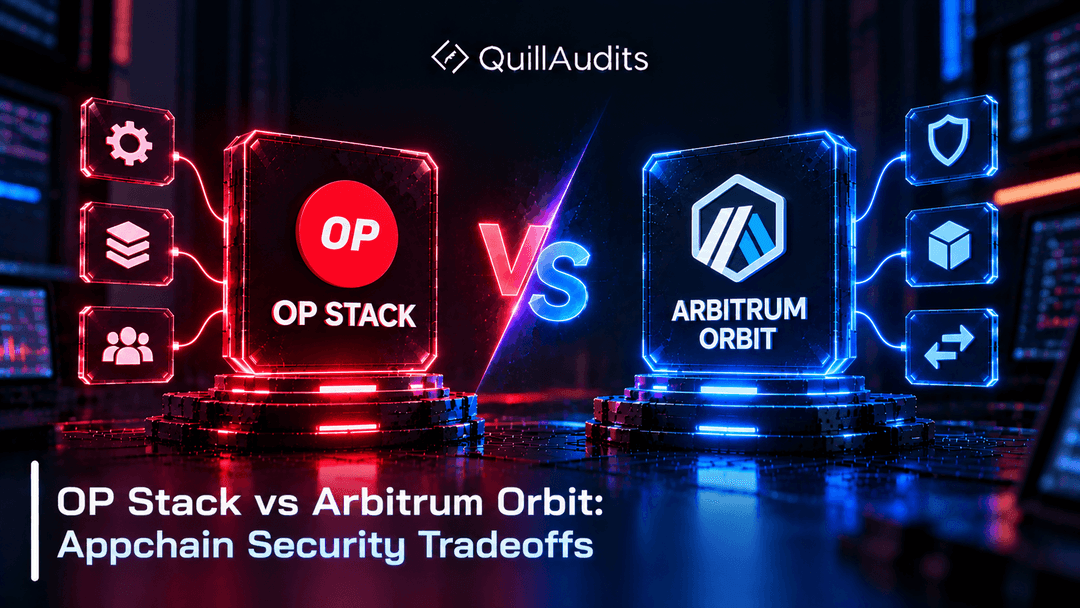
OP Stack vs Arbitrum Orbit: Appchain Security Tradeoffs
Choosing a rollup stack sets your fraud-proof system, data availability, and who can upgrade your chain overnight. This OP Stack vs Arbitrum Orbit comparison covers Cannon and BoLD dispute systems, L2 vs L3 settlement, Security Council and chain-owner key risks, and a pre-mainnet audit checklist for appchain teams deciding which framework to fork.

The decision · answer in brief
Choosing a rollup stack sets your fraud-proof system, data availability, and who can upgrade your chain overnight. This OP Stack vs Arbitrum Orbit comparison covers Cannon and BoLD dispute systems, L2 vs L3 settlement, Security Council and chain-owner key risks, and a pre-mainnet audit checklist for appchain teams deciding which framework to fork.
Choosing a Rollup Stack: OP Stack vs Arbitrum Orbit Security
Choosing a rollup stack is one of the few decisions in an appchain launch you can't easily undo later: it sets your fraud-proof system, your data-availability options, and who holds the key to upgrade your chain overnight. This guide compares OP Stack and Arbitrum Orbit on exactly those terms, not as a generic optimistic-vs-zk primer, so you can weigh the tradeoffs before committing a founding team's roadmap to one framework.
Both stacks let you spin up a dedicated chain in days using mature, audited code. The differences that matter show up later: when a dispute needs resolving, when a validator set needs decentralizing, or when someone has to push an emergency upgrade at 2 a.m. Here's what to check before you pick one.
Choosing a Rollup Stack: OP Stack vs Arbitrum Orbit at a Glance
| Dimension | OP Stack | Arbitrum Orbit |
|---|---|---|
| Underlying design | Optimistic rollup (Bedrock/OP Stack) | Optimistic rollup (Nitro) |
| Fault-proof system | Cannon-based permissionless Fault Proof System, live on OP Mainnet since June 10, 2024 | BoLD dispute protocol, opens validation to any bonded party once the chain owner removes the permissioned allowlist |
| Settlement layer | Settles as an L2 on Ethereum, or as an L3 on another OP Stack chain | You choose at launch: settle as an L2 on Ethereum or as an L3 on Arbitrum One or Nova |
| Data availability | Follows the parent chain's DA model | Choose Rollup, AnyTrust, or Alt-DA at launch |
| Validator set | Permissionless at the protocol level once Fault Proofs are enabled | Can launch with a permissioned set and decentralize later |
| Upgrade key holder | Security Council plus Optimism Foundation (L2BEAT Stage 1) | Chain owner (EOA, multisig, or DAO) via the UpgradeExecutor contract |
| Emergency upgrade delay | None on OP Mainnet; Security Council and Foundation act jointly | None on Arbitrum One by default; configurable per Orbit chain owner |
You should treat this table as a starting point, not a verdict. Both frameworks are still maturing their decentralization, and the right pick depends on who you trust to hold the upgrade key for your specific chain.
What Is a Rollup Stack, and Why the Choice Shapes Appchain Security
A rollup stack is the open-source codebase a team forks to launch its own chain: the sequencer, the bridge contracts, the proof system, and the governance scaffolding that controls upgrades. OP Stack, built by OP Labs around the Bedrock architecture, and Arbitrum Orbit, built on Arbitrum's Nitro stack, are the two most widely deployed options.
It's worth separating "rollup" from "appchain" here, since the two terms get used interchangeably. A rollup is a scaling technique: it executes transactions off-chain and posts proofs or data back to a settlement layer. An appchain is a deployment choice: a single application, game, or protocol gets its own dedicated chain instead of sharing blockspace with everyone else. OP Stack and Arbitrum Orbit are both rollup frameworks you'd use to build an appchain, and the stack you choose determines which security assumptions your appchain inherits on day one.
That inheritance is the real risk a generic rollup explainer skips over. Knowing that "fraud proofs make it secure" doesn't tell you whose fraud-proof system is actually live in production, who can veto a dispute outcome, or who holds the key that can rewrite your chain's rules tomorrow. Those are the questions this guide answers for each stack.
Optimistic Rollups: The Shared Foundation Under Both Stacks
OP Stack and Arbitrum Orbit both build on optimistic rollups, which assume transactions are valid by default and rely on a challenge window, typically seven days, during which anyone can dispute an incorrect state root. That's a different trust model from a zk-rollup's validity-proof approach, where a cryptographic proof settles finality immediately with no challenge period to exploit, but also no second chance if the proof itself is flawed.
Because both OP Stack and Orbit are optimistic, their security ultimately rests on the same two questions: can anyone actually submit a fraud proof when it's needed, and does the dispute resolve correctly within the challenge window? That's where the two frameworks start to diverge.
Sequencer and Fraud-Proof Differences
Both stacks use a sequencer to order and batch transactions before posting them to the settlement layer, and both have historically run that sequencer as a single, centralized operator. The real divergence is in how each framework proves a sequencer wrong, and how far that proof system has actually shipped.
OP Stack's Cannon Fault Proof System
OP Stack's fraud-proof mechanism is Cannon: it reproduces disputed transactions inside a MIPS-based virtual machine onchain so anyone can challenge an incorrect state claim. The permissionless version, OP Mainnet's Fault Proof System, went live on June 10, 2024, letting any party, not just an allowlisted set, submit and contest fraud proofs.
OP Labs was candid that this was a first step rather than a finished system. As the team put it in its own announcement, "[l]aunching with limited training wheels in production is a necessary step for ensuring code quality before removing safeguards," and it's why the Security Council was kept in place as a temporary override on top of the new permissionless proofs.
Fork OP Stack today and you inherit that same posture: a real, live fault-proof system, plus a multisig that can still intervene. OP Mainnet sits at L2BEAT Stage 1, where regular contract upgrades face no delay and both regular and emergency upgrades can be approved jointly by the Security Council and the Optimism Foundation.
Arbitrum Orbit's BoLD Dispute Protocol
Arbitrum's answer is BoLD (Bounded Liquidity Delay), a dispute protocol that replaces Arbitrum's older permissioned challenge system. Before BoLD, only a permissioned list of proposers could post and challenge assertions on Arbitrum; BoLD lets the chain owner, such as a DAO, remove that allowlist so any bonded party can validate and dispute state transitions.
BoLD's economic design is built so an honest defender wins cheaply and a dishonest challenger pays heavily for stalling. The protocol is designed so an attacker spends roughly $6.46 for every $1 a defender needs to successfully resolve a dispute, a roughly 6.46x cost asymmetry that favors the honest party. BoLD also guarantees dispute resolution within seven days as long as one honest party defends, which caps how long an attacker can stall a withdrawal.
As with OP Stack, decentralizing the dispute process is a configuration choice the chain owner makes, not something that happens automatically the moment you fork the code. An Orbit chain can launch with BoLD disabled and a permissioned validator set, then switch on open disputes later.
Shared Security vs Standalone Validator Sets
Here's a question that trips up a lot of founding teams: does your appchain need its own validator set, or can it borrow someone else's? The answer depends on whether you settle as an L2 or an L3, and it changes your security budget considerably.
L2 vs L3 Settlement: Who Actually Verifies Your Chain
An OP Stack or Orbit chain that settles directly on Ethereum is an L2: it posts its own proofs, and if disputed, its own fraud proof gets checked against Ethereum's consensus. A chain that instead settles onto another rollup, say an Orbit chain settling on Arbitrum One, is an L3: Arbitrum One becomes the chain's settlement layer, and Ethereum only ever sees Arbitrum One's own proofs.
This is where the "is Orbit an L2 or an L3?" question gets its real answer: Arbitrum Orbit chains aren't locked into either tier. You choose at launch whether your Orbit chain settles on Ethereum directly or on Arbitrum One or Nova instead. OP Stack chains have similar optionality, settling on Ethereum or on another OP Stack chain, like Base.
Settling as an L3 means you inherit your parent chain's validator set and dispute process instead of bootstrapping your own, which lowers the bar to launch but also means your chain's worst-case security is bounded by how decentralized that parent chain actually is. If the parent chain's own fault-proof system is still permissioned, or still backed by a Security Council override, your appchain inherits that same ceiling.
Rollup, AnyTrust, or Alt-DA: Orbit's Data Availability Menu
Arbitrum Orbit is explicit about this tradeoff in a way OP Stack currently isn't. At launch, an Orbit chain picks one of three data-availability models: Rollup mode posts full transaction data to Ethereum for maximum transparency and cost; AnyTrust relies on a data-availability committee that's cheaper but introduces a trust assumption in the committee members; and Alt-DA routes data through an external availability solution instead of Ethereum.
Picking AnyTrust or Alt-DA isn't the wrong call for every use case; a high-throughput game or social app may genuinely need the lower cost. But it changes what a validator can actually prove. If the underlying transaction data isn't guaranteed available on Ethereum, a fraud proof can't be reconstructed from first principles should the committee go dark. That's a tradeoff worth writing down explicitly in your own chain's documentation, not one to discover during an incident.
Orbit also lets a team launch with a permissioned validator set and decentralize it later rather than bootstrapping an independent, permissionless validator set from day one. That's a pragmatic default for a new appchain, but it means the "trustless rollup" security story doesn't fully apply until that validator set actually opens up.
Upgrade Key and Governance Risk in Each Framework
If you only check one thing before mainnet, check this: who can change your chain's rules after launch, and how fast can they do it? Both OP Stack and Arbitrum Orbit answer this with a privileged multisig, and neither has fully removed that privilege yet.
Security Council Powers on OP Stack Chains
On OP Mainnet, the Security Council is a 10/13 multisig with staggered two-year terms, and its authority runs wider than its name suggests. L2BEAT's own assessment is that OP Mainnet can't reach Stage 2 of rollup decentralization because the Security Council's power isn't limited to onchain-provable bugs, and there's no exit window that lets users leave before an unwanted upgrade lands.
Fork OP Stack and you decide who sits on your own chain's equivalent council and what their authority covers. That's a governance design decision, not a default you should leave unexamined.
Chain Owner and UpgradeExecutor Control on Arbitrum Orbit
Arbitrum Orbit centralizes this differently, but just as directly. Every Orbit chain has a "chain owner," which can be an externally owned account, a multisig, or a DAO token system, holding the EXECUTOR_ROLE and ADMIN_ROLE on the chain's UpgradeExecutor contract, giving it direct control over protocol upgrades and system parameters.
Arbitrum One, the flagship Orbit-adjacent chain, shows what this looks like at scale. Its Security Council is a 9/12 multisig, and non-emergency upgrades currently give roughly 17.4 days for users to exit before they land, short of the 30-day window L2BEAT requires for Stage 2. Emergency upgrades on Arbitrum One can execute instantly, with no timelock and no exit window at all.
The practical takeaway for a founding team: whichever stack you pick, you're choosing, or inheriting, a privileged key holder, not eliminating one. Treat that key with the same operational discipline you'd apply to any high-value multisig, including the signer hygiene and verification habits that keep a multisig from failing quietly.
What to Audit Before Choosing a Rollup Stack for Mainnet
A rollup-stack fork isn't just another smart contract deployment, and a standard contract audit won't catch everything that can go wrong with one. Picture a mid-sized gaming studio weighing OP Stack against Orbit for a new in-game economy chain: its security review needs to cover the sequencer, the bridge, the proof system configuration, and the governance keys, not just the game contracts sitting on top of them. That's the scope this checklist is built around.
Rollup-Specific Attack Surface Checklist
Before mainnet, confirm each of the following for whichever stack you pick:
- Fault-proof or dispute status: is the permissionless proof system (Cannon or BoLD) actually enabled, or is your chain still relying on a permissioned validator allowlist?
- DA configuration: if you're on Orbit, which of Rollup, AnyTrust, or Alt-DA did you select, and does your team understand what happens if that DA layer becomes unavailable?
- Settlement tier: are you an L2 or an L3, and have you reviewed the security posture of whatever chain you settle onto?
- Upgrade key custody: who holds the Security Council seats or the chain-owner multisig keys, what's the signing threshold, and is there any timelock on non-emergency changes?
- Bridge contract review: the canonical bridge between your chain and its parent is usually the single highest-value target on an appchain, and it deserves its own line item.
- Sequencer failover: what happens to withdrawals and transaction ordering if the sequencer goes offline or censors transactions?
A general pre-launch security checklist covers the contract-level and operational basics every project needs, but it won't walk through items 1 through 4 above, since those only exist because you're forking a rollup framework rather than deploying to an existing chain.
This is also where QuillAudits' own service lineup is worth a mention, caveats included. Its research page lists Arbitrum, Optimism, and Base among its supported chains, and offers a Blockchain Audit service alongside Smart Contract Audit and dApp Pentest Audit, covering infrastructure-level review rather than only contract code. That's useful for the bridge and sequencer items above. What the page doesn't itemize, as far as it states, is a dedicated line for reviewing Cannon's fault-proof VM internals, BoLD's bonding economics, or a chain owner's governance design specifically, so ask directly about that scope rather than assuming it from the general chain list.
Security doesn't end at mainnet, either. An ongoing continuous security program that re-checks your contracts as they change, paired with monitoring your deployed contracts for anomalous transaction activity like reentrancy attempts or flash-loan abuse, closes the gap a one-time pre-launch audit leaves open. Neither of those replaces a dedicated review of your sequencer, bridge, and upgrade-key setup, which stays a rollup-specific job.
Final Thoughts
Not all rollup stacks are created equal, and the differences only show up once you look past the marketing comparison and into who holds the fraud-proof keys and the upgrade keys on the chain you're about to fork. OP Stack has a permissionless fault-proof system that's been running in production since mid-2024, backed by a Security Council that still holds broad override power. Arbitrum Orbit offers a newer, economically aggressive dispute protocol in BoLD and a flexible data-availability menu, with upgrade authority concentrated in whatever chain owner you configure.
Neither framework is a finished, fully decentralized product yet, which is exactly why the pre-mainnet review matters: confirm what's actually live on your fork, not what's live on the flagship chain it's based on. A Blockchain Audit or Smart Contract Audit that includes rollup-specific review of your fraud-proof configuration, bridge contracts, and upgrade-key setup is a reasonable place to start that confirmation before you launch.
Contents