Passkey Wallet Security for Web3: Risks Before You Build
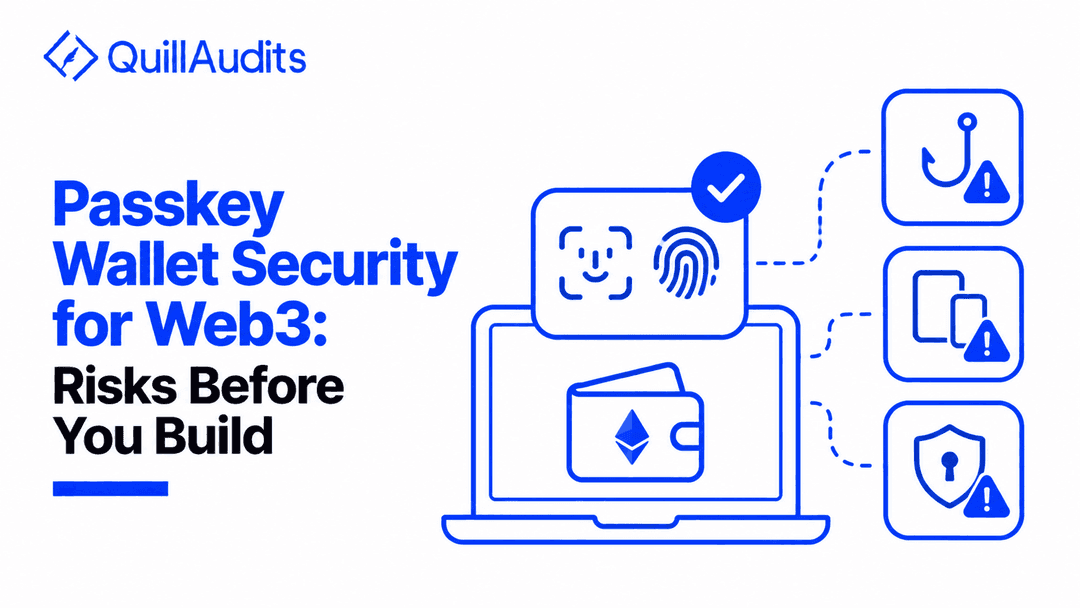
Explore seedless wallet security and how passkeys, WebAuthn, and ERC-4337 smart accounts eliminate traditional seed phrase risks. Understand cloud account vulnerabilities, recovery mechanisms, session key permissions, and potential attack surfaces. Discover essential security considerations and audit checklists for building secure passkey-based crypto wallets while protecting users against account compromise, unauthorized access, and permanent fund loss.

The decision · answer in brief
Explore seedless wallet security and how passkeys, WebAuthn, and ERC-4337 smart accounts eliminate traditional seed phrase risks. Understand cloud account vulnerabilities, recovery mechanisms, session key permissions, and potential attack surfaces. Discover essential security considerations and audit checklists for building secure passkey-based crypto wallets while protecting users against account compromise, unauthorized access, and permanent fund loss.
Understanding Seedless Wallet Security Before You Build
Seedless wallet security sounds like a solved problem: swap the 12-word seed phrase for a fingerprint or face scan, and users stop losing funds to screenshots and phishing pages. What actually happens is narrower. Passkey smart accounts remove the seed phrase from the user's hands, but the single point of failure doesn't disappear, it moves into the user's cloud account and into whatever relying-party settings the wallet team chose at launch. That's a risk builders can design around and auditors can test for before shipping, not a lesson learned from a drained wallet afterward.
How Does Seedless Wallet Security Actually Work?
A seedless wallet replaces the 12-word recovery phrase with a passkey: a credential generated and verified through WebAuthn, the browser and OS API behind "sign in with Face ID" prompts, paired with an ERC-4337 smart contract account. Instead of a private key the user holds, the smart contract verifies a signature from that passkey, usually using the secp256r1 elliptic curve mobile secure enclaves support natively.
Can a 12-word seed phrase be hacked? Not by brute force; a BIP-39 phrase draws from a keyspace too large for current computing to search. It's hacked the way most crypto theft happens: phishing pages that collect the words, malware that reads a clipboard or screenshot, or a photo of a sticky note. That's the exact attack surface seedless wallets are built to close, since there's no string of words to copy, paste, or photograph in the first place.
Coinbase Smart Wallet is the clearest reference implementation. Onboarding creates a passkey on the device, backs it up through the device's password manager, such as iCloud Keychain or Google Password Manager, and uses the resulting public key as the signer on a smart contract account at a predictable address. Coinbase has also described a planned self-custodied "recovery signer" for when a passkey is lost or the Coinbase-hosted site is unavailable, a sign the team already treats backup as a separate risk to manage, not a detail to leave to the OS.
Two properties make this attractive. There's no seed phrase to write down, photograph, or paste into a phishing site, and the signature ceremony is phishing-resistant by design, since WebAuthn binds the credential to the origin that created it, so a cloned login page can't capture a usable signature the way it can capture a seed phrase.
What Happens When the Cloud Account Is the Real Key?
The question worth asking before launch isn't "can WebAuthn be broken," it's "what controls the account WebAuthn is backed by." Removing the seed phrase doesn't remove a single point of failure, it relocates one. Synced passkeys live inside the user's cloud account keychain, not only on device hardware, so wallet security ultimately inherits the strength of the user's Apple ID or Google account.
Zelcore Academy frames the risk directly: "The dangerous pattern is the 'sign in with a passkey' wallet where the passkey, or the cloud that syncs it, is effectively the only thing between an attacker and the funds." The same analysis adds: "A passkey is a great way to prove 'this is me, right now, on a real site.' It is a poor choice as the only thing that proves 'this money is mine forever.'"
Two 2026 disclosures show what that inheritance looks like, and neither broke the WebAuthn protocol itself. Unit 42 published "Pass-ta-key," showing Google Password Manager in Chrome on Windows protects synced passkeys with a single 32-byte Security Domain Secret with no rotation or revocation mechanism, so extracting that secret from process memory permanently recovers the user's synced private keys. Separately, SpecterOps disclosed CVE-2026-34348, where Windows wrote YubiKey WebAuthn signatures into an event log in cleartext, readable by any unprivileged local user and replayable against Microsoft Entra ID. In both cases the cryptography held; the failure sat in the sync, logging, and session infrastructure around it, exactly the layer a wallet team tests less.
Scale makes this worth getting right now. FIDO Alliance counted 7 billion passkeys in use worldwide as of its 2026 reporting, so a systemic sync-layer flaw carries a large blast radius. It also tracks a pattern QuillAudits has already quantified on the custody side: wallet and private-key compromise drove more than $444 million in crypto losses in H1 2026, including the $291 million Kelp DAO breach and the $1.45 billion Bybit breach.
Two second-order effects follow. One is reduced self-sovereignty: a user no longer fully self-custodies if a platform account can gate or reset the signer, a different trust model than a seed phrase a user alone holds, hacked or not. The other is vendor lock-in: a passkey is scoped to the relying-party domain that created it, so switching wallet providers usually means re-enrolling a new credential rather than exporting the old one, unlike a seed phrase importable into any compatible wallet.
Recovery Design Patterns That Reduce Single-Point Failure
A passkey wallet's recovery design, not its signature scheme, determines whether a lost phone or a compromised cloud account is an inconvenience or a total loss. Builders shipping a passkey-based smart account should evaluate recovery against these patterns before launch:
- Multi-device passkey registration. Let users register a second passkey, on a separate device or hardware security key, as a signer at setup time, not after the first one is lost.
- Quorum-based guardian recovery. Require signatures from multiple independent guardians to replace a lost passkey signer, the same quorum logic that makes meaningful multisig thresholds work for treasury wallets.
- A self-custodied fallback signer. Provision a backup key outside any single cloud account, the direction Coinbase has signaled with its planned recovery-signer design, so one Apple ID or Google account compromise isn't also a wallet compromise.
- Time-locked recovery with monitoring. Require a delay window on any signer-replacement transaction, with user-facing alerts, so a hijacked cloud account can't silently swap in a new passkey and sweep funds in one session.
- Session-scoped keys for routine activity. Where the account supports ERC-4337 session keys, scope day-to-day signing to narrow, time-limited permissions instead of a master signer.
None of these are mutually exclusive, and a production wallet typically layers two or three. The failure mode to avoid is shipping one recovery path with no fallback, which turns a lost phone into a support ticket nobody can resolve.
What Should Builders Audit for Seedless Wallet Security?
Passkey smart accounts introduce an attack surface a standard smart contract audit doesn't automatically cover, since the vulnerability often sits in the relying-party configuration rather than the Solidity code. Before shipping, confirm each of the following:
| Audit area | What to check | Why it matters |
|---|---|---|
WebAuthn userVerification setting | Confirm the relying party requires "required", not "preferred" |
|
| Cloud-sync recovery secret handling | Document whether the wallet relies on iCloud Keychain or Google Password Manager sync, and what happens if that account is compromised | Determines whether the wallet inherits the user's cloud-account security posture by default |
| Signer-replacement transaction flow | Verify replacing a lost passkey signer requires a delay, a guardian quorum, or both | Prevents an attacker with cloud-account access from instantly rotating in a new signer |
| Session key scoping | Confirm session keys used for routine signing carry narrow permissions and expiry | Limits blast radius if a session key or its device is compromised |
| Mobile and browser-extension attack surface | Review how the WebAuthn ceremony is invoked from the wallet's app or extension, not just the smart contract | The ceremony runs through the OS and browser layer, outside the scope a typical contract audit covers |
Most of this checklist sits outside what a generic audit scope assumes. QuillAudits lists a Wallet Audit among its named services, alongside Smart Contract, Blockchain, and dApp Pentest audits, and its published scope covers encryption, authentication, and communication protocols, plus an architecture review of authentication mechanisms and data storage. It doesn't yet itemize WebAuthn parameters like userVerification or cloud-sync recovery-secret handling as explicit line items, so a team building a passkey wallet should confirm that specific scope directly with the auditor rather than assume it by default. Teams publishing consumer-facing guidance rather than shipping a wallet won't get much from a Wallet Audit; it's built for teams with contracts and infrastructure to review.
Final Thoughts
No single wallet design is secure in the abstract, passkey or seed phrase alike; security comes from how an implementation handles recovery, not the credential type on the label. Seedless wallet security is a genuine improvement over seed phrases sitting in screenshots and password managers, and WebAuthn's phishing resistance is real. But "seedless" describes what the user no longer has to hold, not what the wallet no longer has to protect. The single point of failure a seed phrase used to represent now lives in a cloud account's sync infrastructure and the relying-party settings a team chose, often by default, before launch.
Builders who map that failure point early, and design recovery around guardians, delays, or self-custodied fallback signers instead of a single cloud identity, turn a design decision into an advantage instead of a postmortem. A Wallet Audit is a reasonable place to start that conversation before launch, not after one.
Contents