


What Is Address Poisoning? How Lookalike Transactions Trick You Into Paying the Wrong Wallet
Learn how crypto address poisoning attacks exploit transaction history to steal funds through lookalike wallet addresses. Discover how zero-value transfers, vanity addresses, and dusting campaigns trick users into sending crypto to attackers. Explore the impact of Ethereum's Fusaka upgrade, real-world attack trends, and practical security measures for wallet users, exchanges, and Web3 protocols to prevent address poisoning scams.

The decision · answer in brief
Learn how crypto address poisoning attacks exploit transaction history to steal funds through lookalike wallet addresses. Discover how zero-value transfers, vanity addresses, and dusting campaigns trick users into sending crypto to attackers. Explore the impact of Ethereum's Fusaka upgrade, real-world attack trends, and practical security measures for wallet users, exchanges, and Web3 protocols to prevent address poisoning scams.
Address Poisoning Attack: How Lookalike Wallets Steal Crypto
An address poisoning attack tricks you into copying a lookalike wallet address from your own transaction history, sending your next transfer straight to an attacker instead of your intended recipient. It costs attackers almost nothing to run at scale, and it is getting worse: attempts jumped 5.5x in the two months after Ethereum's Fusaka upgrade alone.
What Is an Address Poisoning Attack?
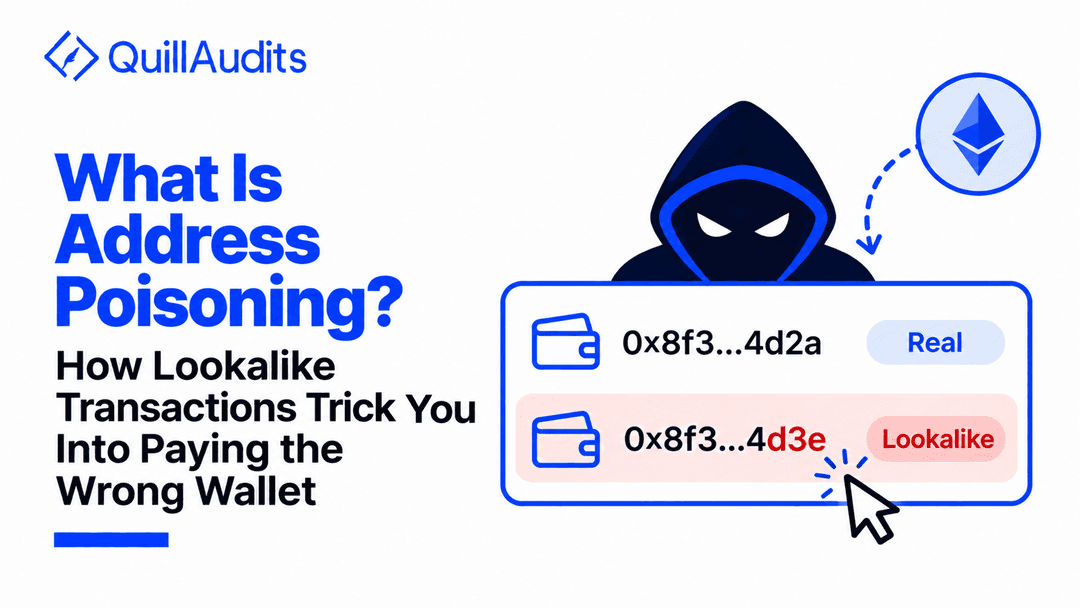
An address poisoning attack is a scam in which someone sends you a zero-value or dust transaction from a wallet address crafted to look almost identical to one you already trust, usually matching the first and last few characters of a recipient you have paid before. The fake transfer "poisons" your transaction history, so when you later reuse that address, you risk copying the attacker's lookalike instead of the real one.
Unlike phishing links or malicious contracts, the attacker never asks you to sign anything or approve a token. They rely entirely on you trusting your own transaction log instead of checking every character of an address.
How an Address Poisoning Attack Works: Zero-Value Transfers and Vanity Addresses
- The attacker watches the chain for wallets moving meaningful amounts, often exchange withdrawals or recurring transfers between known addresses.
- They generate a vanity address: a wallet ground out by brute-force key generation until its opening and closing characters match the real recipient's.
- They send a zero-value or dust transfer from the lookalike address. It costs the attacker almost nothing and needs no victim action to land in the history.
- The victim later copies what looks like the correct address from recent activity and sends funds to the attacker instead.
A crypto dusting attack is a close cousin: the attacker blankets thousands of wallets with negligible amounts, either to poison addresses directly or to de-anonymize wallet clusters for a later, more targeted attempt.
A public address alone can't drain a wallet, since moving funds still needs the private key, so handing one to a scammer or getting dusted isn't itself a loss. What it exposes is activity: a known address lets an attacker time a dust drop or cluster wallets for a later, more targeted attempt. If funds have already gone to a lookalike address, there's no reversal on a public blockchain; the only realistic move is flagging the receiving address to the exchange or wallet provider it eventually touches, in case it gets blacklisted before a cash-out.
Why Copying Addresses From Transaction History Backfires
The standard advice, "just copy the address from your last transaction," is exactly the habit this scam exploits. Most wallets and block explorers truncate addresses to their first and last 4 to 6 characters for readability, the exact portion a vanity-address scam is built to match. A victim scanning for "0x7a3f...9d2c" has no visual way to catch that the middle 36 characters belong to a stranger, and an address book carries the same risk if an entry was saved from a partial-match glance rather than a full-string check. Checksum capitalization (EIP-55 on Ethereum) catches typos, not a deliberately generated collision, since the attacker's address is a real, validly checksummed wallet.
Recent Losses: The Post-Fusaka Surge
Address poisoning used to be dismissed as a 2023-era nuisance worth a few hundred dollars per incident. That is no longer accurate. Blockaid has flagged more than 65.4 million address-poisoning transactions on-chain since January 2025, averaging over 160,000 attempts per day, and roughly 1 in 200 attempts, about 316,000, has succeeded.
Volume accelerated sharply after Ethereum's Fusaka upgrade went live on December 3, 2025 and cut transaction fees roughly sixfold. With dust transfers suddenly far cheaper to broadcast, poisoning attempts rose from 628,000 in November 2025 to 3.4 million in January 2026, a 5.5x jump in two months. One attacker exploited the cheaper fees to send 3 million dust transfers across 1 million addresses for a total cost of just $5,175, and Ethereum overtook BNB Smart Chain as the most-poisoned chain for the first time.
Wallet and UX Defenses: What Wallets Are (and Aren't) Building
A few habits cut your exposure meaningfully: verify the full address on high-value transfers rather than just its ends; save frequent recipients to an address-book entry built from a verified source, not one auto-populated from history; treat an unexpected dust transfer as a red flag, not routine noise; and use a hardware wallet with an on-device address display, so a clipboard hijacker on your computer can't alter what you confirm.
Most mainstream wallets still truncate addresses by default and few flag an incoming transfer that resembles a known contact, so this remains a gap the ecosystem hasn't closed at the interface level. For the fuller operational security picture, see QuillAudits' guide to crypto OpSec.
What Protocols and Exchanges Can Do to Reduce Exposure
Individual vigilance only goes so far against a scam built on volume. Exchanges and protocols have levers most wallet holders don't. Dust-transaction filtering can hide zero-value and sub-threshold transfers from the default activity view so they never reach the screen a user scans for a recipient. Lookalike-pattern detection can compare an incoming withdrawal address against a user's frequent recipients and flag a near-match before the transaction confirms. Withdrawal allowlisting can require a cooldown or secondary confirmation for any address not previously verified through a trusted channel, and frontend transaction simulation can surface a recipient's labeled identity instead of leaving a user to eyeball a raw address string.
A dApp Pentest Audit can test whether that allowlisting, simulation, and pattern-flagging logic holds up against real attack scenarios before a dust campaign finds the gap instead. This sits alongside the broader shift QuillAudits has tracked toward wallet and key-compromise losses overtaking smart contract bugs as 2026's costliest attack category, and it's a different social-engineering pattern than a honeypot scam. Address poisoning is unrelated to the denom-mapping exploit in QuillAudits' Gravity Bridge analysis, which shares the word "poisoning" but targets a token registry, not copy-paste habits.
Final Thoughts
Address poisoning works because it targets a habit, not a flaw in your wallet's cryptography. As fees keep falling and dusting campaigns get cheaper to run, the only durable defense is verifying the full address, not a truncated match from history. Teams building wallets or withdrawal flows can track how these social-engineering patterns evolve alongside the broader hack landscape in QuillAudits' research hub.
Contents









