


What Is MEV? How Transaction Ordering Becomes an Attack Surface
What is MEV in crypto? Maximal Extractable Value is the profit earned by reordering transactions, from sandwich attacks and front-running to arbitrage and liquidation races. Learn how each attack works, why MEV is a protocol design problem rather than just a mempool problem, how founders can mitigate it, and which design patterns auditors flag before mainnet.

The decision · answer in brief
What is MEV in crypto? Maximal Extractable Value is the profit earned by reordering transactions, from sandwich attacks and front-running to arbitrage and liquidation races. Learn how each attack works, why MEV is a protocol design problem rather than just a mempool problem, how founders can mitigate it, and which design patterns auditors flag before mainnet.
What Is MEV in Crypto? Sandwich Attacks Explained
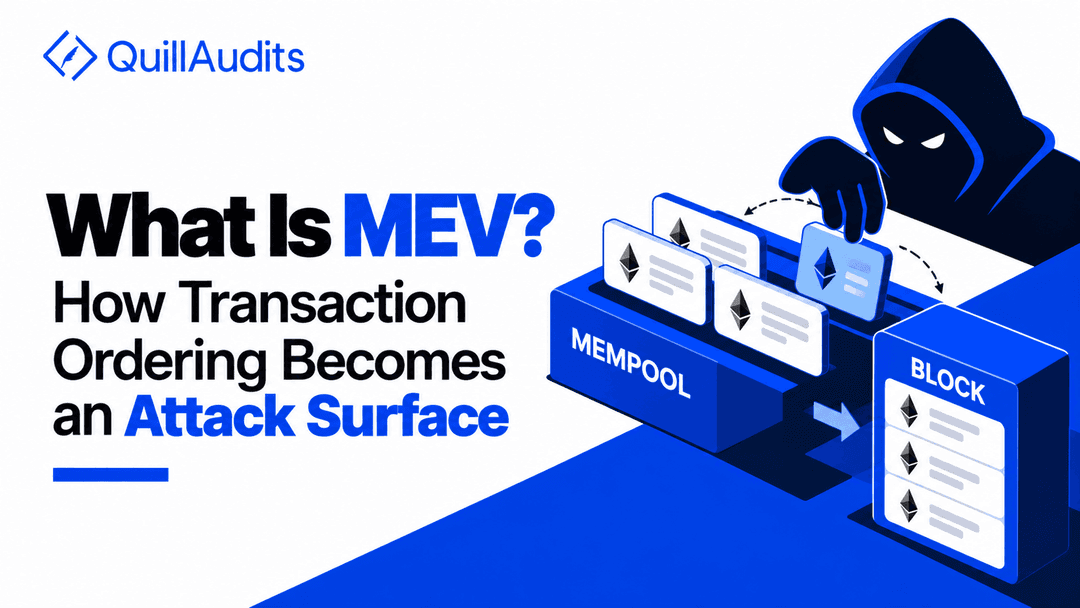
What is MEV in crypto? Maximal Extractable Value, or MEV, is the profit a validator (or a bot paying that validator) can earn by choosing which transactions go into a block and in what order, ahead of, behind, or wrapped around a victim's trade. It covers sandwich attacks, front-running, back-running arbitrage, and liquidation-sniping alike. As a trader, you feel MEV as a cost on a swap. If you're building a DeFi protocol, it's a design surface you need to review during an audit, the same way you'd review reentrancy or oracle manipulation.
What Is MEV in Crypto?
MEV stands for Maximal Extractable Value: the maximum profit obtainable by adding, removing, or reordering transactions within a block, beyond the standard block reward and gas fees. The term started life as "miner extractable value" under Ethereum's proof-of-work rules, when miners picked transaction order. After Ethereum moved to proof-of-stake, the name shifted to "maximal extractable value", per ethereum.org's own documentation, since validators are now the ones who control ordering.
Whoever controls ordering controls the opportunity. Ethereum.org's MEV documentation puts it plainly: "In theory MEV accrues entirely to validators because they are the only party that can guarantee the execution of a profitable MEV opportunity." In practice, most MEV is found and packaged by independent searchers running bots, who then pay validators, directly or through a block builder, for the right to have their bundle included in a specific position. That pay-for-position mechanic is what makes MEV structural rather than incidental: it exists wherever your chain or contract lets someone see pending transactions and reorder them before they settle.
What Is MEV in Crypto? The Main Attack Types
MEV is not one attack, it is a category. The same ordering power gets used for several distinct extraction techniques, and ethereum.org's documentation groups decentralized exchange, or DEX, arbitrage, liquidations, and newer NFT-related front-running alongside sandwiching as variants of the same underlying mechanism.
- Front-running: a searcher spots a profitable pending transaction, such as a large buy order, and submits its own with a higher gas fee so it lands first, capturing the price move before the original trade executes.
- Back-running: the searcher places a transaction right after a target transaction, often to capture an arbitrage opportunity the target just created, such as a price gap across two pools.
- Sandwich attacks: a combination of both. A buy order pushes the price up ahead of a victim's swap, the victim executes at the worse price, then a sell order right after captures the difference. If you're the victim, the attacker just harvested your own slippage tolerance.
- Arbitrage: not inherently malicious. Bots that close price gaps between pools or exchanges are also doing MEV, and this flavor improves price consistency across a fragmented DeFi market.
- Liquidations: when a loan crosses its collateral threshold, whoever submits the liquidation transaction first usually collects the bonus, and your protocol's ordering rules decide who wins the race.
If you want a deeper walkthrough of the displacement, suppression, and insertion mechanics behind front-running specifically, QuillAudits' front-running in blockchain deep dive covers it. MEV is the umbrella; front-running and sandwiching are two techniques under it, alongside arbitrage and liquidation-racing.
Why MEV Is a Protocol Design Problem, Not Just a Mempool Problem
Most explainers frame MEV as something that happens to a transaction sitting in the mempool, waiting to be mined. That's true, but it puts the fix entirely on the trader: set tighter slippage, use a private RPC (a remote procedure call endpoint that submits your transaction directly to a node instead of the public pool), and hope for the best. As a founder, that framing skips the part you actually control: whether your contract's own logic hands a searcher a clean, race-able opportunity in the first place.
If your contract settles a trade in a single transaction at whatever price the pool happens to show at execution, it's exposed to ordering games by construction. A liquidation function anyone can call, with no cooldown or batching, is a standing invitation to race. A payout formula that depends on a publicly readable on-chain price at the instant of execution hands a searcher the exact information needed to compute an attack before it ever enters the mempool. None of these are bugs in the traditional sense; each passes a functional test. Each is still an MEV-exposed design decision, and that's the kind of thing you want an audit to catch rather than a unit test failure.
Loopscale's $5.8 million exploit illustrates how far a pricing and ordering flaw can travel: mispriced collateral let an attacker borrow against inflated value, and that same family of risk, an on-chain price computed at a predictable moment an adversary can manipulate or race ahead of, is what makes a protocol MEV-exposed more broadly. Treating ordering as part of your threat model, not an afterthought for the frontend team, is the difference between catching this in review and reading about it in a post-mortem.
When Does MEV Cross From a Cost Into a Security Risk?
Most MEV is a tax, not a theft. If you get sandwiched as a trader, you lose money to slippage you technically agreed to by setting a loose tolerance, which is the cost of using an automated market maker, or AMM, on a public chain. It becomes a security risk, the kind an audit needs to flag rather than something a trader needs to tolerate, when the ordering advantage lets someone extract value your protocol's own logic never intended to expose, or threatens solvency or fairness guarantees rather than just one trader's execution price.
Scale is part of what turns a tolerated cost into a design problem: EigenPhi data put Ethereum traders' sandwich-attack losses at roughly $60 million a year. That figure has been falling: monthly extraction dropped from nearly $10 million in late 2024 to about $2.5 million by October 2025, even as attack volume held steady at 60,000 to 90,000 attacks per month over that period. Falling profit per attack with steady volume suggests searchers are still finding exposed trades constantly, just extracting less from each one, likely as more flow moves to private mempools.
Concentration is the other signal worth noting. Per the same EigenPhi-sourced analysis, roughly 70% of all sandwich attacks on Ethereum are attributed to a single entity, jaredfromsubway.eth. That concentration became a liability for the bot itself: on June 21, 2026, an attacker drained more than $7.5 million from jaredfromsubway.eth by deploying fake token contracts and liquidity pools over several weeks until the bot's own logic granted standing token approvals that the attacker then exploited. Security firm Blockaid told CoinDesk the exploit "was not a normal phishing attack and not a simple bug in the victim contract," but an attack on the bot's own decision-making logic, worth keeping in mind if your own protocol grants any kind of standing or automated approval.
How Can Founders Mitigate MEV?
There's no single fix, because MEV isn't a single vulnerability, it's an incentive that exists wherever ordering is visible and valuable. As a founder, your realistic options change how much ordering power an attacker can exploit against your protocol, rather than removing the incentive outright.
| Approach | What it does | Trade-off |
|---|---|---|
| Private mempools / RPCs | Routes a transaction directly to a builder, hidden from public searchers | Requires user opt-in; doesn't protect default public-node transactions |
| Batch auctions | Settles grouped orders at one clearing price, removing the first/last advantage | Adds latency; needs careful auction design |
| Commit-reveal schemes | Users submit a hashed commitment first, reveal the real order later | Adds a transaction and a delay to every trade |
| Encrypted mempools / threshold decryption | Keeps transaction contents hidden until a block is finalized | Still maturing; depends on the threshold network's security |
| Fair sequencing services | A decentralized oracle network orders transactions, often first-in-first-out, then reveals content for execution | Adds a dependency on the sequencer's liveness and honesty |
Chainlink describes its own Fair Sequencing Services approach as encrypting transaction details, ordering them through a decentralized oracle network, and only decrypting for execution once ordering is locked in, enforcing first-in-first-out handling rather than letting gas price decide order. That's a concrete example of a design that removes the information a searcher needs, rather than asking your users to defend against it after the fact. The common thread across the table above: if you want to mitigate MEV, the fix lives in your protocol's architecture, decided before launch.
What Do Auditors Flag as MEV-Exposed Design Patterns?
If you're preparing your protocol for an audit, MEV exposure shows up as a handful of recurring patterns rather than one checklist item. These are the patterns QuillAudits flags most often when reviewing a DeFi protocol:
- Single-transaction settlement at spot price. If your swap, mint, or redemption reads the current pool price and settles immediately, with no time-weighted average or batching step, it gives a searcher a clean target to sandwich.
- Publicly computable, high-value payouts. Any function where the exact profit from calling it, such as a liquidation bonus, can be calculated from public state before the call is made is a standing invitation to race.
- Unprotected liquidation triggers. A liquidation function with no access control, cooldown, or batching turns every underwater position into a public race condition, which can be unfair or gas-wasteful at scale.
- Naive AMM ordering assumptions. Pricing logic that assumes trades execute in the order you submitted them, rather than the order a builder chooses, will behave differently in production than it did in testing.
- On-chain randomness or price reads mid-transaction. If a value your contract depends on can be seen and acted on by a searcher before the dependent transaction lands, it isn't doing the job you built it for.
None of these will show up as a failing test case in your test suite. They show up as a question an auditor asks about the order in which things can happen, which is the kind of review QuillAudits' security assessments are built around, alongside the oracle manipulation and sandwich-attack scenarios described in QuillAudits' writeup on securing a crypto protocol. The broader list of attack vectors, including bot-driven sandwich and arbitrage exploitation, is cataloged in QuillAudits' DeFi attack vectors roundup.
Final Thoughts
MEV is not a bug, it's a property of any system where someone controls transaction order and that order has value attached to it. Front-running, sandwich attacks, back-running arbitrage, and liquidation races are all expressions of the same underlying incentive, and treating them as separate problems misses the common fix: reduce how much a searcher can see and predict before a transaction settles. If your protocol is still in design or pre-audit, that means walking through every function that pays out based on order or timing and asking who benefits from going first. A thorough Smart Contract Audit is a good place to have that conversation before mainnet, not after a post-mortem.
Contents









