


How to Audit Permissioned Tokens: ERC-3643, ERC-7943 and MPL-3643
A security guide to auditing permissioned tokens across ERC-3643, ERC-7943, Token ACL and MPL-3643. Five surfaces to test, from eligibility checks and forced transfers to freeze keys, Solana thaw gates and wrappers, with what to check in each before launch.

An ERC-20 audit asks whether balances add up. A permissioned token audit asks two more things: who is allowed to hold the token, and who is allowed to override a holder. The token carries an allow list, a freeze switch, a forced transfer function and usually a recovery path for lost wallets. Each one is a power held by a key, and each has to behave correctly on every route that changes a balance.
This guide covers how to audit the permissioned token standards used for real world assets today: ERC-3643 and ERC-7943 on EVM chains, Token ACL and the new MPL-3643 on Solana. The standards differ in design and fail in the same five places.
Key Takeaways
- A permissioned token has five surfaces to audit: eligibility, transfer rules, enforcement powers, keys and perimeter. Every standard implements all five somewhere.
- In the ERC-3643 reference implementation, a transfer verifies the identity of the receiver only. A holder whose KYC claim was revoked can still send tokens until an agent freezes the wallet.
- Mint, burn, forced transfer and recovery skip checks that a normal transfer runs. Restrictions leak on these side paths first.
- ERC-7943 is an interface. Two tokens can expose the same six functions and enforce different rules behind them.
- On Solana, Token ACL and MPL-3643 check eligibility when an account is thawed or frozen. A plain transfer between thawed accounts runs no compliance code.
- MPL-3643 is in alpha, and its documentation says it has not been audited yet.
- A restricted token is only as restricted as its least restricted wrapper, vault share or bridged copy.
What Is a Permissioned Token Standard?
A permissioned token is a token that only approved wallets can hold, and that an issuer can freeze or move when the law requires it. Tokenized funds, bonds, private credit notes and equity use them because the issuer has to know every holder and has to be able to act on a court order or a lost key.
A permissioned token standard fixes how those controls are exposed, so wallets, custodians and exchanges can integrate once. Five are worth knowing in 2026.
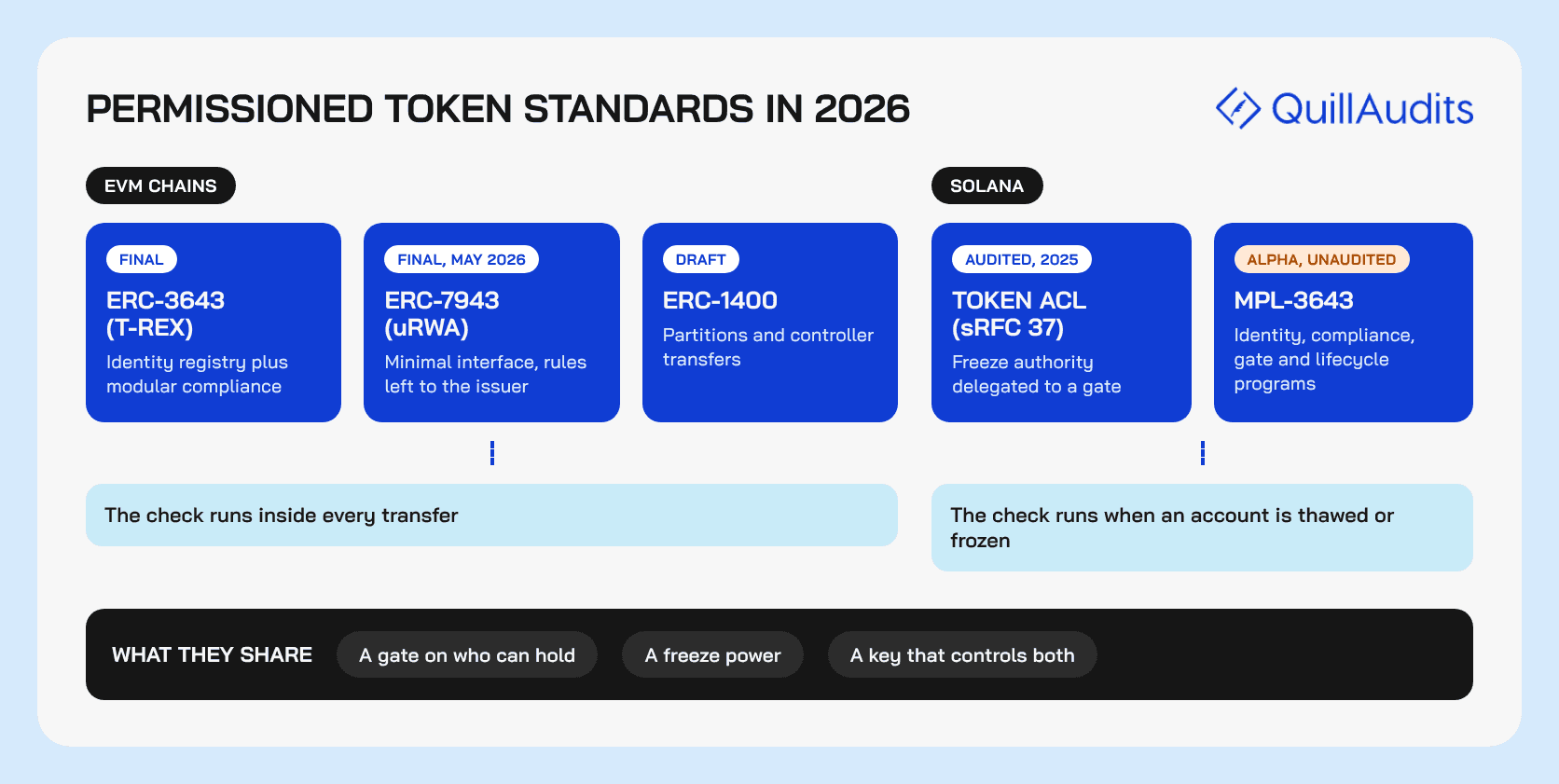
| Standard | Chain | Status | Where the eligibility check runs | Read this first |
|---|---|---|---|---|
| ERC-3643 (T-REX) | EVM | Final | Inside every transfer, against an Identity Registry and a Compliance contract | Token, registries, compliance modules, agent list |
| ERC-7943 (uRWA) | EVM | Final since May 2026 | Inside every transfer, behind canTransfer | The implementation behind the interface |
| ERC-1400 | EVM | Draft | Inside every transfer, per partition | Partition logic and the controller role |
| Token ACL (sRFC 37) | Solana | Audited in 2025 | When a token account is thawed or frozen | MintConfig authority and the Gate Program |
| MPL-3643 | Solana | Alpha, not yet audited | At thaw and freeze, plus an optional transfer hook | Four programs and the authorities set at mint creation |
ERC-3643 carries the most value. T-REX Network puts the assets tokenized with it at more than $32 billion. ERC-7943 reached Final status in May 2026, and ERC-1400 is still a Draft. On Solana, Metaplex announced MPL-3643 on 28 September 2026, modeled on ERC-3643 and built on Token-2022, Token ACL and the Solana Attestation Service.
What Changes When You Audit a Permissioned Token?
The scope grows from one contract to five surfaces:
- Eligibility. Who may hold the token: registries, claims, allow lists, attestations.
- Transfer rules. What an eligible holder may do: holder caps, country rules, lockups, volume limits.
- Enforcement powers. Freeze, forced transfer, recovery, burn and pause.
- Keys. Who holds each power, and who can swap a module or upgrade the token.
- Perimeter. Every contract that holds the token on behalf of someone else.
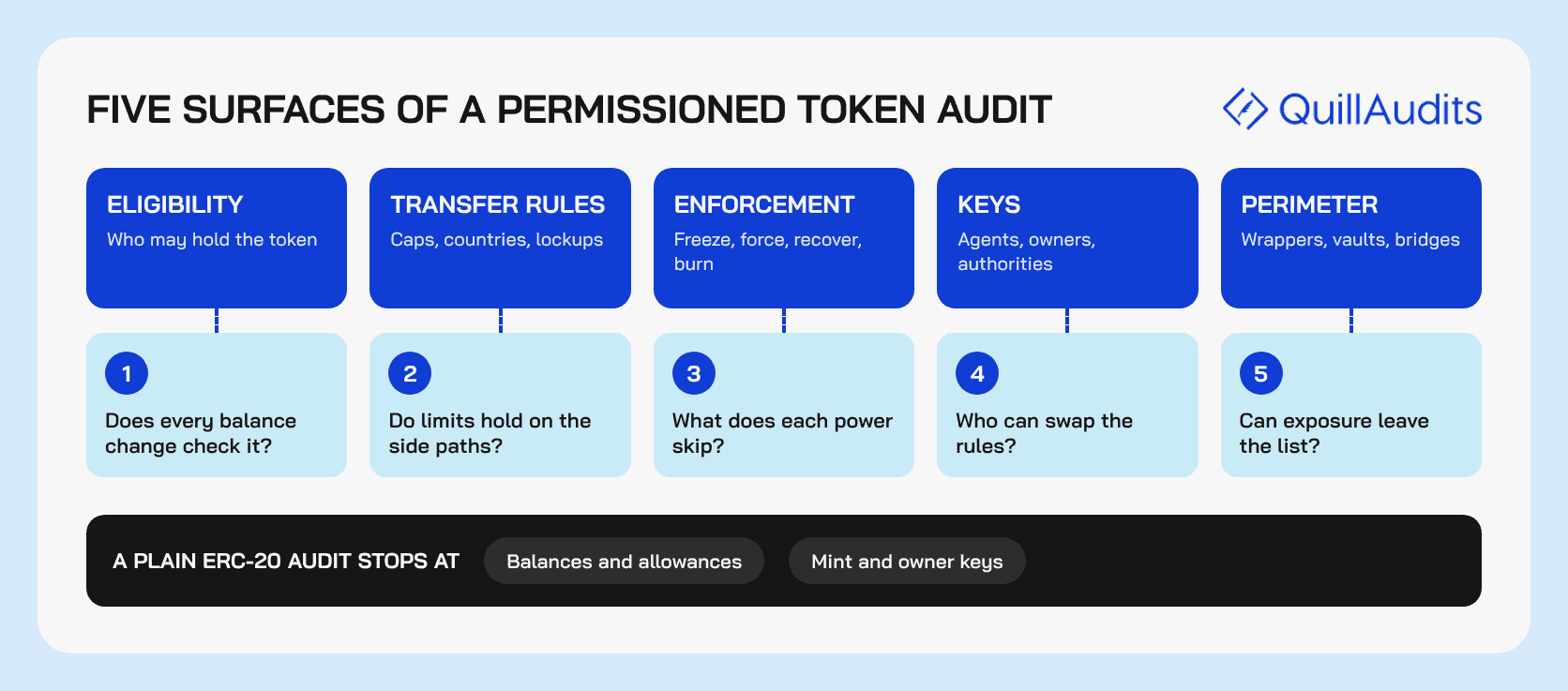
A plain ERC-20 audit covers balances, allowances and the owner key. The rest of this guide takes one question per surface.
1. Does Every Balance Change Run the Eligibility Check?
Start with ERC-3643, because its reference implementation is public and widely forked. In T-REX 4.1.6, transfer and transferFrom run four checks: the token is not paused, neither wallet is frozen, the sender has enough unfrozen balance, and the receiver passes isVerified on the Identity Registry and canTransfer on the Compliance contract.
Two details matter for an audit.
The first is that only the receiver has its identity verified. The sender is checked for a freeze and nothing else. If a claim issuer revokes an investor's KYC claim, that investor can no longer receive tokens but can still send them to any verified wallet. OpenZeppelin describes the same pattern in a recent review as 'gating on the recipient only'. Revocation has to be paired with a freeze, and the offboarding runbook should say so.
The second is that the other balance paths run fewer checks than a transfer does.
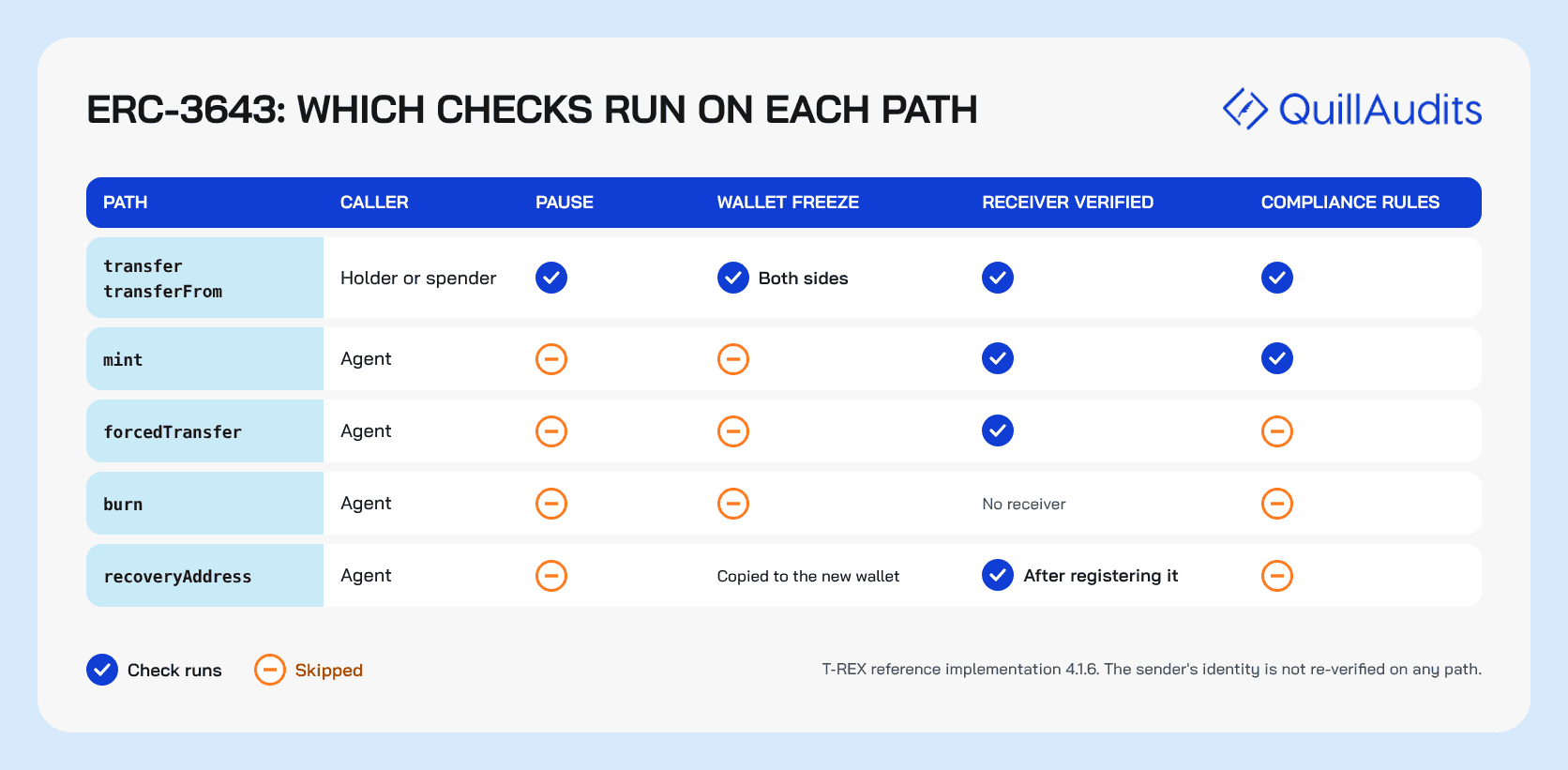
mintverifies the receiver and asks the Compliance contract, but ignores pause and wallet freezes.forcedTransferverifies the receiver only. It skipscanTransfer, works while the token is paused, unfreezes tokens in order to move them and can deliver into a frozen wallet.burnchecks nothing beyond the balance.recoveryAddresstrusts the agent. It takes the investor's ONCHAINID as an argument and checks that the new wallet is a management key on it. It does not compare that ONCHAINID with the identity registered for the lost wallet.
None of this is a bug in the standard. An issuer needs to move tokens under a court order while trading is paused. It becomes a finding when a fork changes one path and forgets the others, or when a compliance module assumes its limit can never be exceeded and a forced transfer pushes the token past the cap.
The registry has its own traps. In the reference code, isVerified returns true for any registered wallet when the Claim Topics Registry is empty, so a token deployed without required topics checks registration and nothing more. If a required topic has no trusted issuer, it returns false for everyone and every transfer reverts. The owner can replace the Identity Registry or the Compliance contract with one call to setIdentityRegistry or setCompliance, and the reference code puts no delay on either.
What to check:
- List every function that changes a balance and write down which of the four checks it runs. Any difference from the reference needs a documented reason.
- Offboarding freezes the wallet in the same transaction that removes or invalidates the identity.
- Holder caps, country limits and balance limits still hold after a forced transfer, a recovery and a batch mint.
- The Claim Topics Registry is not empty at launch, and every required topic has at least one trusted issuer.
- Registry and compliance swaps sit behind a multisig and a timelock.
Our ERC-3643 audit checklist goes through the full contract set item by item.
2. Who Can Freeze, Move or Burn Tokens?
Every permissioned standard gives someone the power to override a holder. The audit question is which key holds each power, and what stands between that key and an investor's balance.
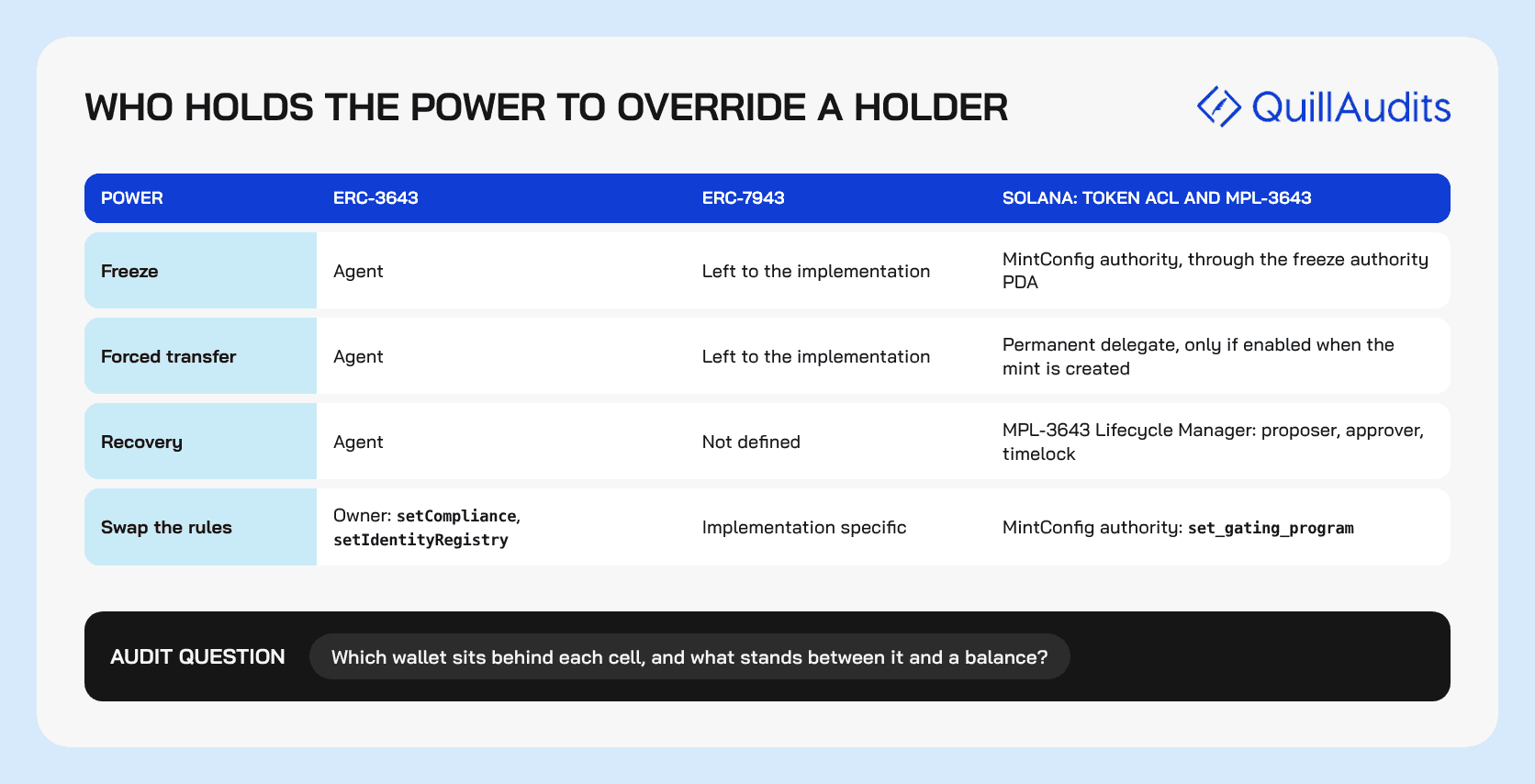
In ERC-3643 the agent role holds almost all of it. Mint, burn, freeze, forced transfer, recovery and pause are all agent functions, so an agent key on a hot wallet puts the whole compliance system on a hot wallet. We covered how teams misconfigure the agent model in an earlier post.
ERC-7943 names the functions and leaves access control to the implementer. The specification requires only that forcedTransfer and setFrozenTokens are restricted, and its security section warns that weak control over them could let assets be stolen. It also lets the frozen amount exceed the balance. An issuer can therefore freeze tokens before they arrive, and a holder watching the mempool can move tokens out before a freeze lands.
On Solana the powers are split by Token-2022 itself. The freeze authority can freeze any token account. A permanent delegate can transfer or burn from any account, and the extension has to be enabled when the mint is created. MPL-3643 sets a permanent delegate only on mints with recovery enabled and points it at a program address with no private key, with a proposer, an approver and a timelock in front of each recovery. A mint created without one cannot be clawed back at all. That is a decision for the issuer's counsel to make before the mint exists.
What to check:
- One table of every privileged function against every role, with the wallet type behind each role.
- Agent, freeze and recovery keys are multisigs or contracts with their own limits. A deployer wallet left over from launch holds none of them.
- Forced transfers and recoveries emit events that someone monitors.
- A freeze is tested against a pending transfer from the same wallet.
- Frozen balances stay correct after forced transfer, burn and recovery. In ERC-7943 the
Frozenevent must be emitted before the transfer event.
3. What Does an ERC-7943 Interface Guarantee?
ERC-7943 defines six functions for a fungible token: canSend, canReceive, canTransfer, getFrozenTokens, setFrozenTokens and forcedTransfer. It does not define an identity registry, a claim format or a rule engine. That is the point of the standard, and it is also why the audit cannot stop at the interface.
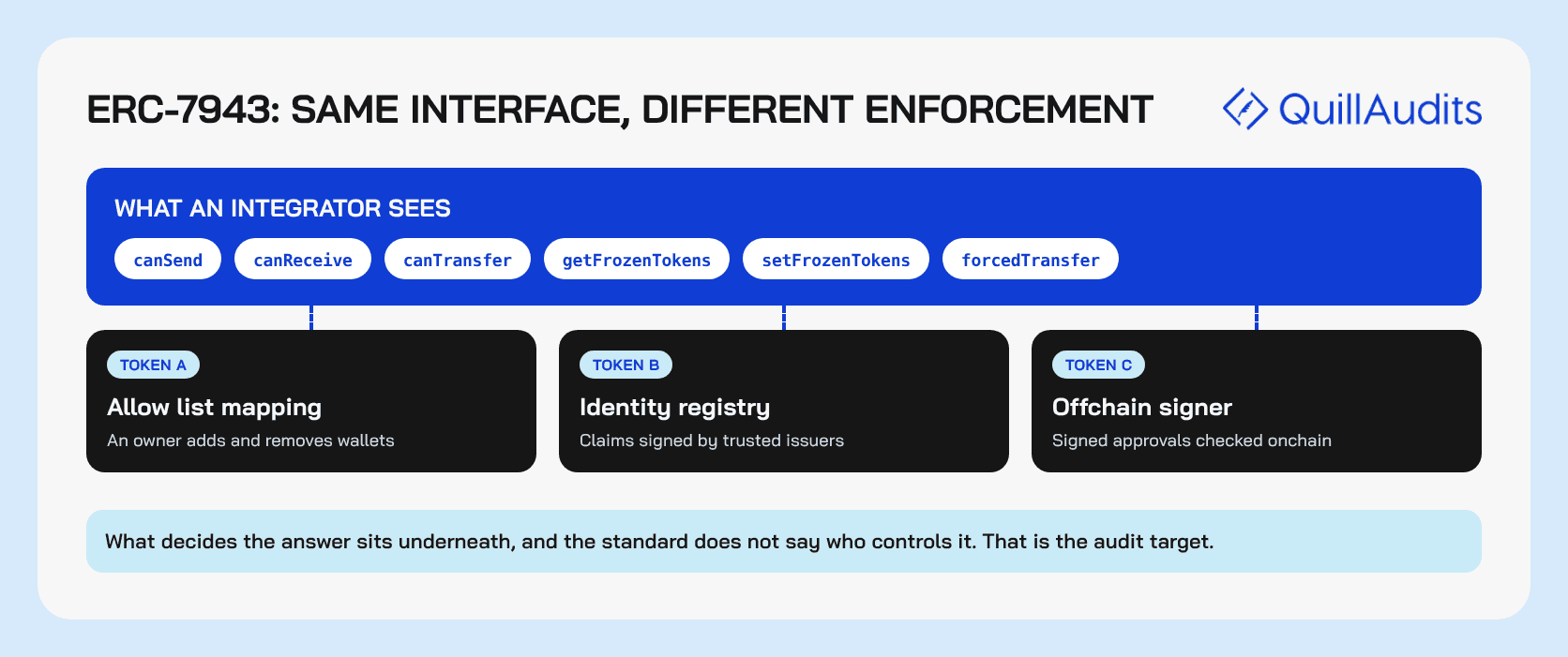
A wallet or lending market that integrates ERC-7943 calls canTransfer and trusts the answer. The specification sets rules for that answer:
- The three view functions must not revert and must not change state.
canTransfermust include thecanSendandcanReceivechecks, the unfrozen balance check and any pause.- Public transfers must fail whenever
canTransferwould return false. forcedTransfermay bypasscanTransfer, but if frozen tokens move it must reduce the frozen amount and emitFrozenfirst.- The token must report the right ERC-165 interface ID. For a fungible token that is
0x3edbb4c4.
Findings come from the gaps between those rules and the code. A canTransfer that returns true while the real transfer reverts breaks any integrator that prices or liquidates on the preview. A view function that reverts on an unknown address can stall a router. The reference implementations published with the standard are described there as unaudited and for educational use, so a token built by copying them has had no review until yours.
What to check:
- Fuzz
canTransferagainst the real transfer. For every input, the preview and the outcome agree. - Every rule lives in one internal function that transfer, mint, burn and the view functions all call.
supportsInterfacereturns true for the ID that matches the token type.- The contract behind
canSendandcanReceive, whether an allow list, an oracle or a registry, is in scope together with its keys.
If you are still choosing between the two EVM standards, we compared them in ERC-3643 vs ERC-7943.
4. Where Does Compliance Run on Solana?
Solana has no hook on a plain token transfer. Token-2022 offers a transfer hook extension, but it adds accounts and compute to every transfer, and the sRFC 37 proposal notes that most protocols respond by blacklisting mints that use it. Token ACL takes a different route, and MPL-3643 builds on it.
The mint is created with DefaultAccountState set to Frozen, so every new token account starts frozen. The freeze authority is handed to a MintConfig account owned by the Token ACL program. To activate an account, anyone calls a permissionless thaw, Token ACL asks the issuer's Gate Program whether the wallet qualifies, and the account is thawed if the answer is yes. After that, transfers between thawed accounts are ordinary Token-2022 transfers with no compliance code in the path.
MPL-3643 adds four programs on top: an Identity Registry for claims and trusted attestors, a Compliance Module for offering rules, a Gate Program that answers thaw and freeze decisions, and a Lifecycle Manager for vesting, yield, corporate actions and recovery. Rules that must run on every transfer, such as lockups and volume limits, use a Token-2022 transfer hook that the issuer opts into when the mint is created.
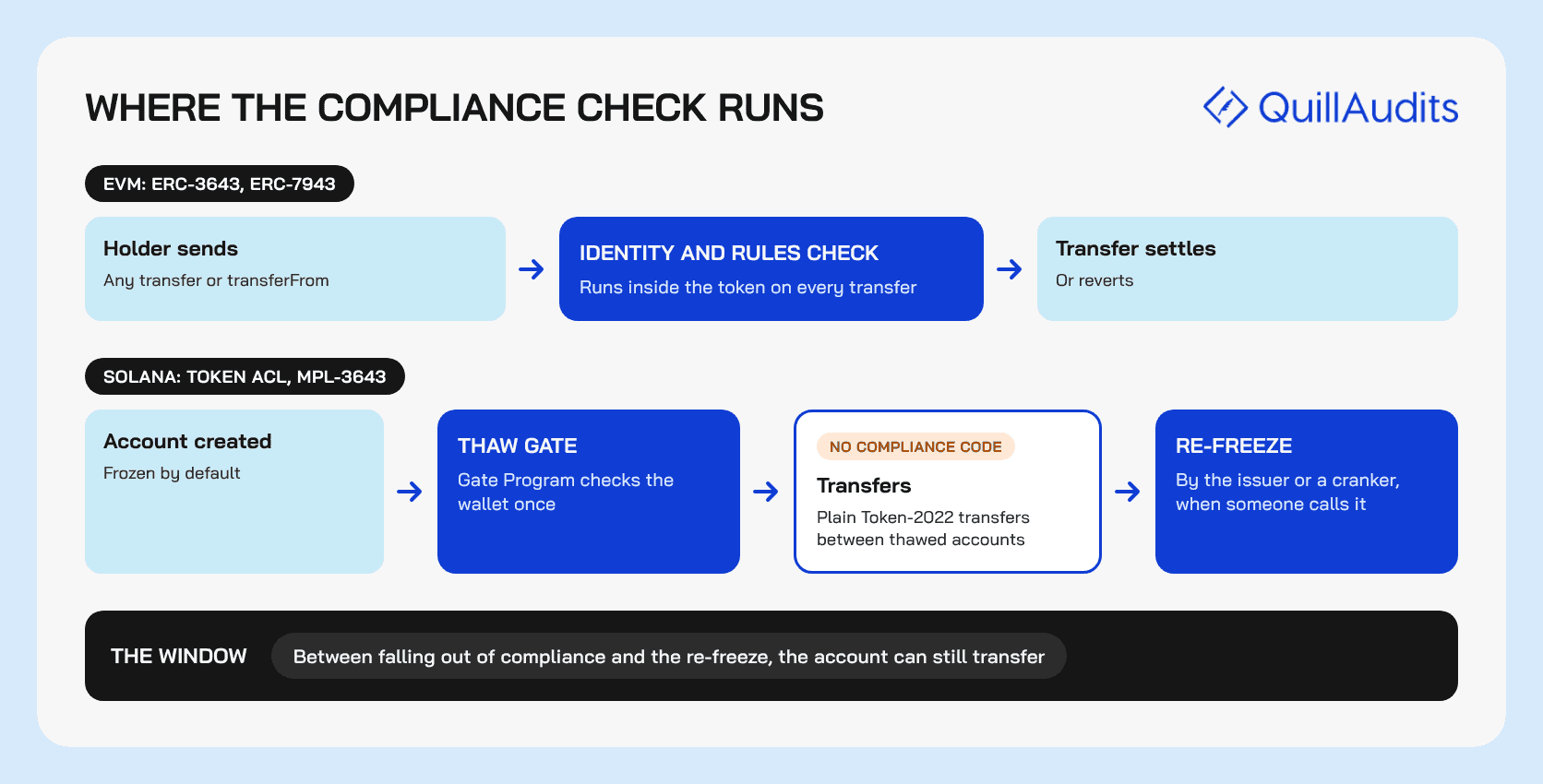
This moves the audit from the transfer to the boundary:
- Adding a wallet to a block list does not freeze an account that is already thawed. Solana's own guide says full blocking needs both steps.
- Refreezing a wallet that falls out of compliance depends on someone calling it. In MPL-3643 that job belongs to permissionless crankers, so the time between a claim expiring and the freeze landing is a window in which the account can still transfer.
- The MintConfig authority can replace the Gate Program in one instruction. Whoever holds that key can replace the allow list logic.
- MPL-3643 moves the mint authority to a program account when compliance is initialized, and its docs describe the move as irreversible. Anything that needs the raw mint authority has to happen first.
- A transfer hook cannot be added to an existing mint. A token launched without one can never enforce lockups or volume limits on each transfer.
MPL-3643 is in alpha. Its documentation says it has not been audited and lists it as experimental. An issuer building on it today inherits that status.
What to check:
- DefaultAccountState is Frozen and the freeze authority is the MintConfig account, with no second path to thaw.
- The Gate Program validates the token account, its owner and the mint, and checks the flag account that proves the call came from Token ACL.
- Offboarding freezes the account in the same transaction that removes the wallet from the list.
- Crankers are run and monitored by the issuer, with an alert when a refreeze is late.
- Every authority set at mint creation is written down: mint, freeze, permanent delegate, transfer hook and metadata.
- If a transfer hook is used, review it against our Token-2022 transfer hook checklist.
5. Can the Token Leave Its Own Perimeter?
A transfer restriction applies to the token contract. It does not follow the economic exposure once another contract holds the token.
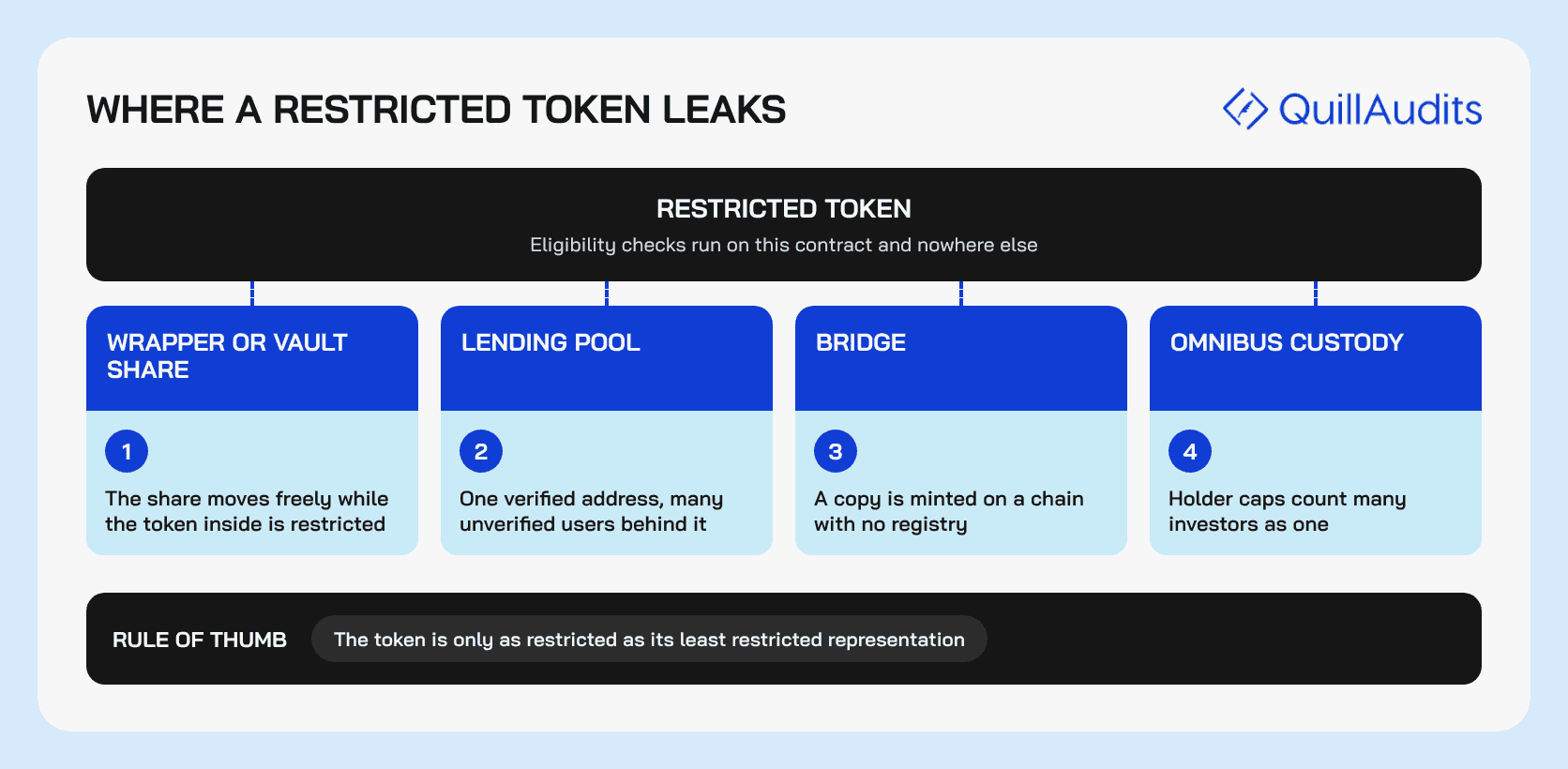
The patterns repeat:
- A vault share or wrapper moves freely while the token inside it is restricted. The wrapper address is verified once, and after that anyone can hold a claim on it.
- A lending market or pool is registered as a holder. Freezing or force transferring from that address breaks the accounting for every user in it.
- A bridge locks the token on one chain and mints a copy on another with no registry behind it.
- An omnibus custody wallet stands for many investors, and holder caps count it as one.
- On Solana, protocol accounts are program derived addresses. The Token ACL reference gate has a mode that lets every regular wallet thaw and blocks PDAs, so a token in that mode cannot enter a DeFi protocol until the gate allows it.
Wrappers are also where money has been lost. Edel Finance lost $403K in July 2026 through share price inflation in a wrapper around a tokenized stock, one of the cases on our RWA incidents map.
What to check:
- Every address that holds the token for others is listed, with a decision on whether its shares are restricted too.
- A wrapper or vault share runs the same eligibility check as the token on every transfer of the share.
- Freeze and forced transfer are tested against each integrated protocol address.
- Each bridged copy has a registry behind it, or the bridge route is closed.
What Should a Permissioned Token Audit Cover?
The token contract is the smallest part of the scope. A full review follows the five surfaces:
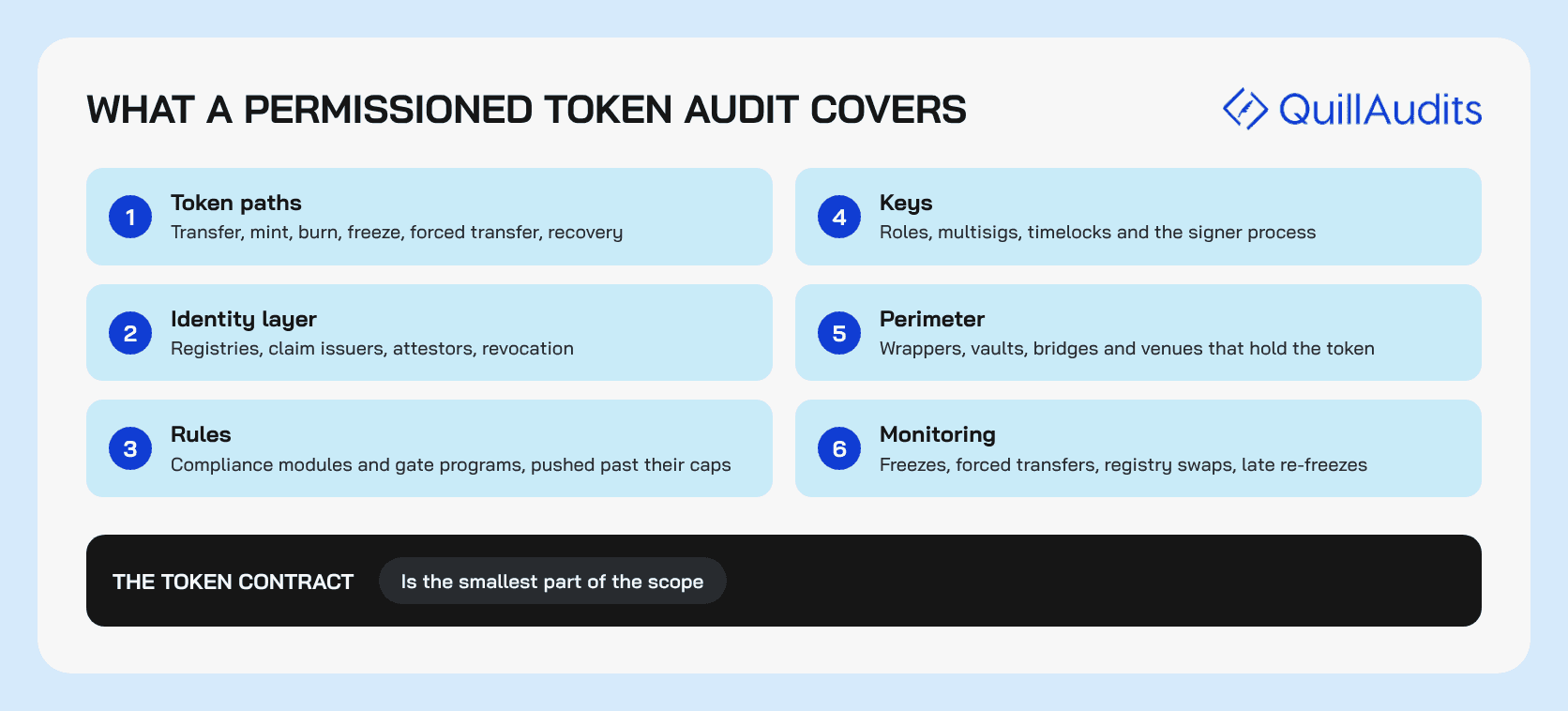
- The token and every contract or program it calls on transfer, mint, burn, freeze, forced transfer and recovery.
- The identity layer: registries, claim issuers, attestors and the process for revoking them.
- Each compliance module or gate program, tested with its limits pushed past the cap.
- Roles, multisigs, timelocks and the signer process behind them.
- Every wrapper, vault, bridge and venue that will hold the token.
- Monitoring for freezes, forced transfers, registry swaps and late refreezes.
One more item for teams on ERC-3643. OpenZeppelin and T-REX Network announced a partnership in July 2026 to harden the protocol, and the rebuilt ONCHAINID v3 identity contracts cannot be upgraded in place from 2.x. Moving the identity layer is a new deployment and needs its own review.
QuillAudits has worked with 1,500+ Web3 projects, including 20+ RWA teams, across EVM chains, Solana and Canton. If you are choosing a standard, start with Tokenization 101. When you want the token, the keys and the integrations reviewed together, talk to us.
Frequently Asked Questions
What is a permissioned token?
It is a token that only approved wallets can hold and that the issuer can freeze or move under defined conditions. Tokenized securities, funds and credit notes use permissioned tokens so the issuer knows every holder and can act on a court order or a lost key.
Is ERC-3643 the same as T-REX?
T-REX is the protocol and reference implementation that became ERC-3643. The standard defines the interfaces. The T-REX contracts are the code most issuers deploy or fork, which is why an audit should name the exact version in scope.
What is the difference between ERC-3643 and ERC-7943?
ERC-3643 is a full system with an identity registry, trusted claim issuers and a modular compliance contract. ERC-7943 is a minimal interface of six functions that leaves the rules to each issuer. With ERC-3643 the audit covers a known set of contracts. With ERC-7943 it covers whatever sits behind the interface.
Does revoking KYC stop an investor from transferring?
Not on its own. In the ERC-3643 reference implementation a transfer verifies the receiver, so a revoked holder can still send tokens until the wallet is frozen. In Token ACL, a wallet added to a block list keeps a working account until the issuer freezes it. Revocation and freeze have to happen together.
Is MPL-3643 audited?
As of November 2026 its documentation says it has not been audited and that an audit is planned. It is in alpha with access by request. Token ACL, which it builds on, has a published audit from 2025.
What does a permissioned token audit include?
It covers the token and every contract it calls, the identity layer, the compliance modules or gate programs, the roles and keys that hold freeze and forced transfer powers, and each wrapper, vault or bridge that will hold the token. Reviewing the token contract alone leaves most of the risk untested.
Contents









