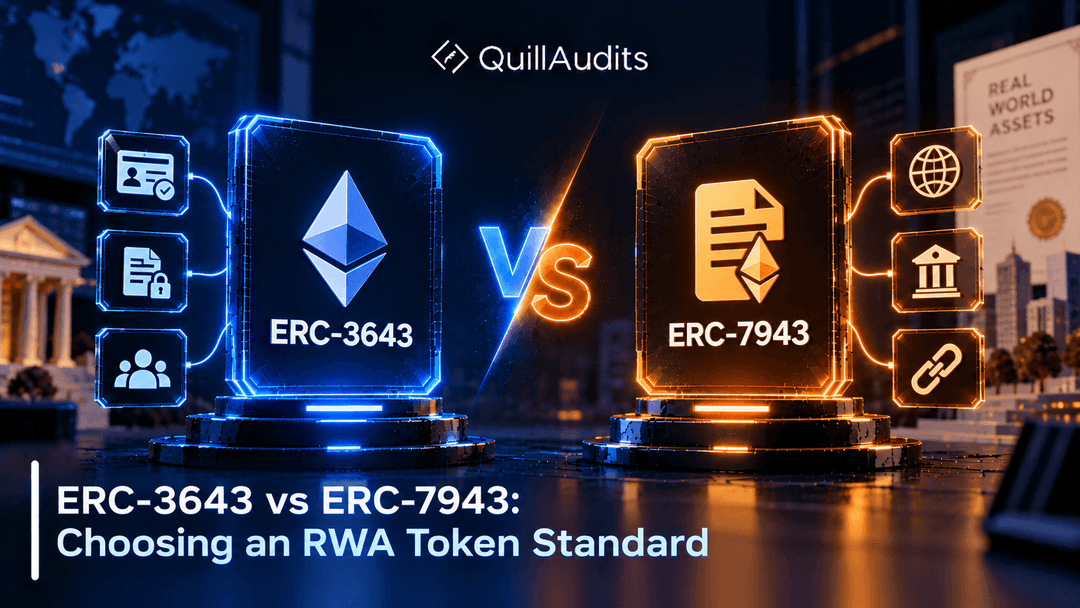
ERC-3643 vs ERC-7943: Choosing an RWA Token Standard
Which is the best token standard for RWA issuance: ERC-3643 or ERC-7943? This comparison breaks down identity registry versus lightweight compliance hooks, per-transfer gas costs, audit surface, and upgrade risks, then maps each standard to deal types like tokenized real estate, private credit, and treasury bills so you can pick the right fit before launch.

The decision · answer in brief
Which is the best token standard for RWA issuance: ERC-3643 or ERC-7943? This comparison breaks down identity registry versus lightweight compliance hooks, per-transfer gas costs, audit surface, and upgrade risks, then maps each standard to deal types like tokenized real estate, private credit, and treasury bills so you can pick the right fit before launch.
Best Token Standard for RWA: ERC-3643 vs ERC-7943 Compared
Finding the best token standard for RWA issuance usually comes down to two live, production-tested options: ERC-3643 and ERC-7943. Neither is a gamble at this point, both already secure real deals. What matters now is which one fits your specific deal: a regulated security that needs identity-bound transfer restrictions baked into the token, or a lighter compliance layer that needs to plug into an existing stack without forcing a rewrite. This comparison works through compliance-hook design, gas cost, and audit surface so you can make that call.
On-chain RWA value, excluding stablecoins, reached $38.6 billion as of September 27, 2026, up from $33.5 billion in July 2026, according to Stobox's State of RWA 2026 report. That growth is pulling more issuers into a standard-selection decision they can no longer put off.
What Problem Each Standard Solves
ERC-3643 and ERC-7943 both restrict who can hold and transfer a token, but they start from opposite design philosophies. ERC-3643 bakes identity verification into the token itself. ERC-7943 keeps the token thin and leaves identity and compliance logic to whatever the issuer already runs.
ERC-3643: Identity-Gated Tokens for Regulated Securities
ERC-3643, also known as T-REX (Token for Regulated EXchanges), builds compliance directly into an ERC-20 extension. Every transfer checks the receiving wallet against an on-chain Identity Registry before it settles. If you need a refresher on the full mechanics, QuillAudits' ERC-3643 explainer covers the T-REX architecture in depth.
This design suits securities offerings where regulators expect the token contract itself to enforce eligibility, not a side system that can be disabled or bypassed. Tokeny's ERC-3643 network has processed over $32 billion in tokenized value for its customers, which signals the standard has already cleared the diligence bar that matters most to banks and asset managers.
ERC-7943: A Minimal, Vendor-Neutral Compliance Layer
Rather than prescribing how compliance gets implemented, it defines a small set of required functions and leaves the identity system, role model, and enforcement logic entirely up to the issuer.
Lo Buglio, the EIP's author, framed the goal plainly: "Its primary goal is to solve the problem of industry fragmentation by providing a single, standardized set of functions for compliance," as he told Cointelegraph. He added that "EIP-7943 defines only what must exist, not how it's built, so any project or protocol can slot it into their stack without friction."
QuillAudits' own breakdown of the standard, ERC-7943 Explained, details the three interface variants the EIP ships: IERC7943Fungible, IERC7943NonFungible, and IERC7943MultiToken, built on top of ERC-20, ERC-721, ERC-1155, and ERC-6909 respectively, with hook-only logic and no separate compliance module to deploy.
A third option worth a mention here: ERC-7518 (DyCIST) extends ERC-1155 for multi-asset tokens with dynamic compliance and native cross-chain support, instead of the single-asset ERC-20 base both ERC-3643 and ERC-7943 use. If your deal structure involves multiple asset classes under one contract, it's worth reading QuillAudits' ERC-7518 breakdown before committing to either standard in this comparison.
Compliance Hooks: Identity Registry vs Enforcement Module
The practical difference between these standards shows up in how a transfer gets approved or blocked. ERC-3643 routes every check through a dedicated registry and module pair. ERC-7943 exposes a handful of functions that any compliance backend can implement.
ERC-3643's OnchainID, Trusted Issuers, and Compliance Module
ERC-3643 enforces compliance through three coordinated pieces, as described in QuillAudits' ERC-3643 explainer:
- Identity Registry - maps wallet addresses to verified on-chain identities (OnchainID) before allowing a transfer.
- Trusted Issuers - entities whose cryptographically signed claims (KYC status, accreditation, jurisdiction) the registry accepts as valid.
- Compliance Module - a separate contract that applies rule sets such as investor caps, jurisdiction limits, or lock-up periods on top of identity verification.
Because these pieces are separate contracts wired together, an auditor has to review the token, the registry, the claim-issuer logic, and the compliance module as one interconnected system. That's a wider surface, but it's also a well-trodden one: QuillAudits' research hub lists a named ERC-3643 (T-REX) audit checklist specifically because the standard's modular structure has been audited enough times to template.
ERC-7943's canTransfer, getFrozenTokens, and forcedTransfer Hooks
ERC-7943 collapses compliance into a small set of hook functions sitting directly on the token contract rather than a separate registry stack. The core functions include canTransfer (a pre-transfer eligibility check), getFrozenTokens (reporting how much of a holder's balance is locked), and forcedTransfer (letting an authorized party move tokens for recovery or regulatory action), per the EIP specification and QuillAudits' ERC-7943 explainer.
Because the EIP doesn't mandate how canTransfer resolves its logic internally, issuers can point it at an existing KYC provider, a DAO-governed allowlist, or a centralized compliance API, whatever they already run. That flexibility is the point, but it also means two ERC-7943 tokens can have wildly different enforcement quality behind an identical interface. An auditor reviewing an ERC-7943 token has to verify the hook implementation itself, not just confirm the interface is present.
Gas and Upgrade Tradeoffs
Compliance checks run on every transfer, so their gas cost compounds across a token's lifetime. This is where the two standards' architectural choices show up as a real line item.
Per-Transfer and Deployment Gas Costs Compared
| Standard | Gas per compliance check |
|---|---|
| ERC-1400 | ~100,000 gas |
| ERC-7518 (DyCIST) | 40,000-90,000 gas |
| ERC-3643 | 30,000-80,000 gas |
| ERC-7943 | 5,000-10,000 gas |
Those per-check figures come from QuillAudits' ERC-7943 gas comparison. ERC-3643's registry-and-module architecture costs more per transfer because each check touches multiple contracts (registry lookup, claim verification, compliance rule evaluation) instead of a single in-contract hook.
For a token with thousands of secondary transfers, the per-transfer gap compounds. For a token that trades rarely, such as a private real estate SPV token transferred a handful of times a year, the gas difference is close to irrelevant next to the compliance guarantees a given deal structure actually needs.
Upgrade Paths and Audit Surface
ERC-3643's modularity cuts both ways on upgrades. Because the Compliance Module is a separate contract, issuers can often swap or extend compliance rules without touching the core token contract, which limits the blast radius of a rule change. But that same separation means more total contracts to govern, more admin keys, and more places a misconfiguration can hide.
ERC-7943's minimalism means fewer contracts to reason about, but because the standard doesn't mandate an upgrade pattern, the issuer's choice of proxy pattern and timelock governance becomes the main upgrade-risk variable. QuillAudits has already flagged specific ERC-7943 audit edge cases worth checking before launch: front-running risk in setFrozenTokens calls, ERC-165 interface ID misdetection, and upgrade or timelock governance risk on whatever proxy pattern the issuer chooses, all covered in the ERC-7943 explainer.
Whichever standard you pick, the failure modes worth testing for are similar in spirit: incomplete freezing logic, checkpoint bypasses, and compliance checks that can be skipped under specific call paths. QuillAudits' top RWA attack vectors roundup walks through how these show up in practice, and its RWA security risks and best practices guide lays out guardrails that apply regardless of which standard you land on.
It's also worth sizing the audit itself against the realistic baseline risk: Web3 projects lost $3.1 billion in H1 2025, with a typical incident costing around $1.9 million, per QuillAudits' 2026 RWA tokenization security guide. That's the number a compliance-hook bug is competing against.
On the audit-checklist maturity specifically: QuillAudits' research hub lists a named, dedicated audit checklist for ERC-3643 (T-REX), reflecting the standard's 90-plus functions and multi-jurisdiction enforcement surface that institutional audits have had years to template. ERC-7943, being newer, doesn't have an equivalent standalone checklist product yet on that page, only the blog-level audit discussion referenced above covering its specific edge cases. That doesn't make ERC-7943 under-audited, but issuers choosing it should expect a less templated audit scope than ERC-3643 gets, and should budget review time accordingly. Checklist maturity is a useful signal, not the deciding factor: the standard you pick should match your compliance model first, and the audit follows that decision rather than driving it.
The Best Token Standard for RWA by Deal Type
The short answer: pick ERC-3643 when the deal is a regulated security with a legal requirement for on-chain identity enforcement, and pick ERC-7943 when you need a lighter compliance layer that plugs into an existing KYC or custody stack without the registry overhead. The table below breaks this down by common RWA deal types.
| Deal type | Better fit | Why |
|---|---|---|
| Tokenized real estate (equity or debt-backed) | ERC-3643 | Multi-investor cap tables and jurisdiction-based transfer restrictions map directly onto OnchainID claims and the Compliance Module's rule sets. |
| Private credit funds | ERC-3643 | Lock-up periods, investor accreditation limits, and lender eligibility are exactly what ERC-3643's registry and compliance module were built to enforce. |
| Tokenized treasury bills | Either, deal-dependent | Treasury products with simple eligible-investor lists can run on ERC-7943's lighter hooks; those layered with jurisdiction-specific restrictions lean toward ERC-3643's structure. |
| Protocols integrating compliance into an existing DeFi stack | ERC-7943 | The minimal hook interface avoids forcing an unrelated registry architecture onto a system that already has its own access control. |
| Multi-chain or multi-asset-class issuance | Consider ERC-7518 | Built for dynamic compliance and native cross-chain support across asset types, where neither ERC-3643 nor ERC-7943's single-asset ERC-20 base is the natural fit. |
If multi-chain distribution is part of the plan regardless of which standard you pick, QuillAudits' cross-chain RWA architecture piece compares ERC-3643, ERC-1400, and ERC-7518 specifically for that scenario.
Where Centrifuge, Ondo Finance, and Similar Platforms Land
Centrifuge and Ondo Finance are two of the platforms most commonly cited in RWA tokenization discussions, and both operate in the space this comparison covers: asset-backed and treasury-backed token issuance for institutional and retail-adjacent investors. Neither platform's standard choice changes the underlying tradeoff this post is built around. A platform issuing a regulated, multi-jurisdiction security still gets more out of ERC-3643's identity-registry model; a platform layering compliance onto an existing liquidity or custody stack has more reason to reach for ERC-7943's lighter hooks. The deal structure, not the platform's brand recognition, should drive the standard choice.
Final Thoughts
ERC-3643 and ERC-7943 aren't competing for the same deal in most cases, they're solving different problems that happen to overlap in the RWA space. ERC-3643's identity registry and compliance module fit regulated securities where the legal structure demands on-chain enforcement baked into the token. ERC-7943's minimal hooks fit issuers who already have a compliance stack and need a token standard that doesn't fight it. Gas cost and audit-checklist maturity are real factors, but they're tiebreakers, not the primary decision, the compliance model your deal legally requires should decide first.
Whichever standard you land on, get the implementation audited before mainnet. QuillAudits' RWA & Tokenization Audit service covers both ERC-3643's registry-and-module stack and ERC-7943's hook-based compliance logic, and its research hub is a useful starting point for the checklist depth available for each standard today.
Contents