$50M+ Lost in RWA Perps With Zero Contract Bugs
Oracle signer compromises, stolen bridge keys and thin weekend order books drained Ostium, AFX and more. Here's how each attack worked and what to audit.

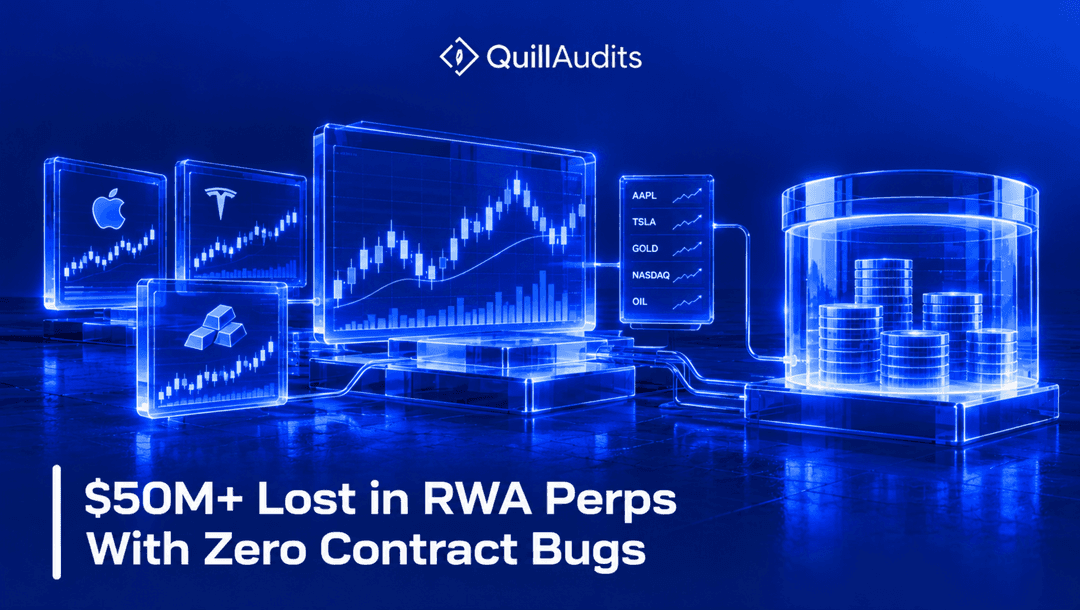
RWA perpetuals were the breakout DeFi product of 2026. They were also one of its most expensive lessons.
Across five incidents in under a year, more than $50M left traders and liquidity providers on perp venues. In none of them did an attacker exploit a broken line of Solidity. The contracts did exactly what they were written to do.
The money moved through price feeds, signer keys, bridges and risk parameters. It is the same pattern we tracked in The Admin Audit Checklist, where $2B was lost across major protocols without a single code bug. This post breaks down each incident, the design flaw behind it, and what auditors and builders should check before the next one.
How RWA perps actually work
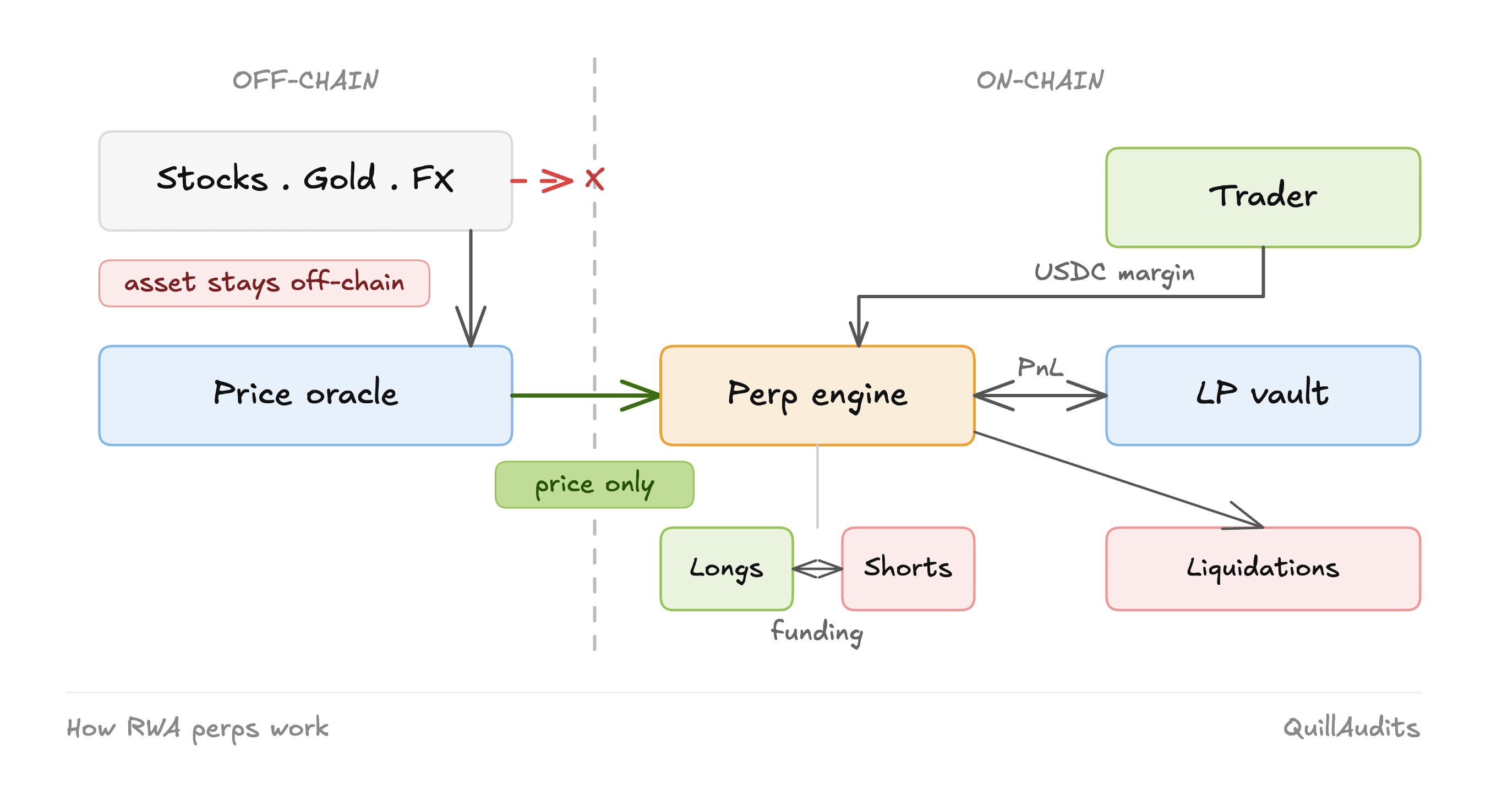
An RWA perp is a synthetic, cash-settled perpetual future on a real-world asset. Traders get leveraged long or short exposure to Nvidia, gold, oil, the Nasdaq-100 or even pre-IPO names, using USDC as collateral.
Nothing is tokenized. No share or barrel sits in custody. The protocol only needs one thing from the real world, and that is the price.
A funding rate keeps the perp aligned with an oracle index. Liquidations fire when margin falls below the maintenance level. Profit and loss settle in stablecoins, often against a shared LP vault.
Why this market matters now
Growth has been extreme. a16z crypto tracked $117.3B in RWA perp volume in August 2026, 44x the level a year earlier. Equities made up 48% of that volume, overtaking commodities.
At the quarterly level, RWA perp DEX volume reached $365B in Q3 2026, up 32% from Q2.
Infrastructure such as @HyperliquidX HIP-3 made this possible by letting builders deploy markets permissionlessly. That speed also means many markets go live with new oracle stacks, thin liquidity and untested risk settings.
Where the trust really sits
Every RWA perp depends on a price pipeline with several moving parts.
A data source supplies the underlying price. An aggregator or signer packages it into a report. A keeper, forwarder or relayer delivers that report on-chain. The contract then uses it to open, close and liquidate positions, with an LP vault paying out the difference.
Each of those links is a point of failure. Most audits focus only on the last one. The incidents below show why that is not enough, and why monitoring contracts alone leaves your servers exposed.
Ostium and the signer that became the oracle
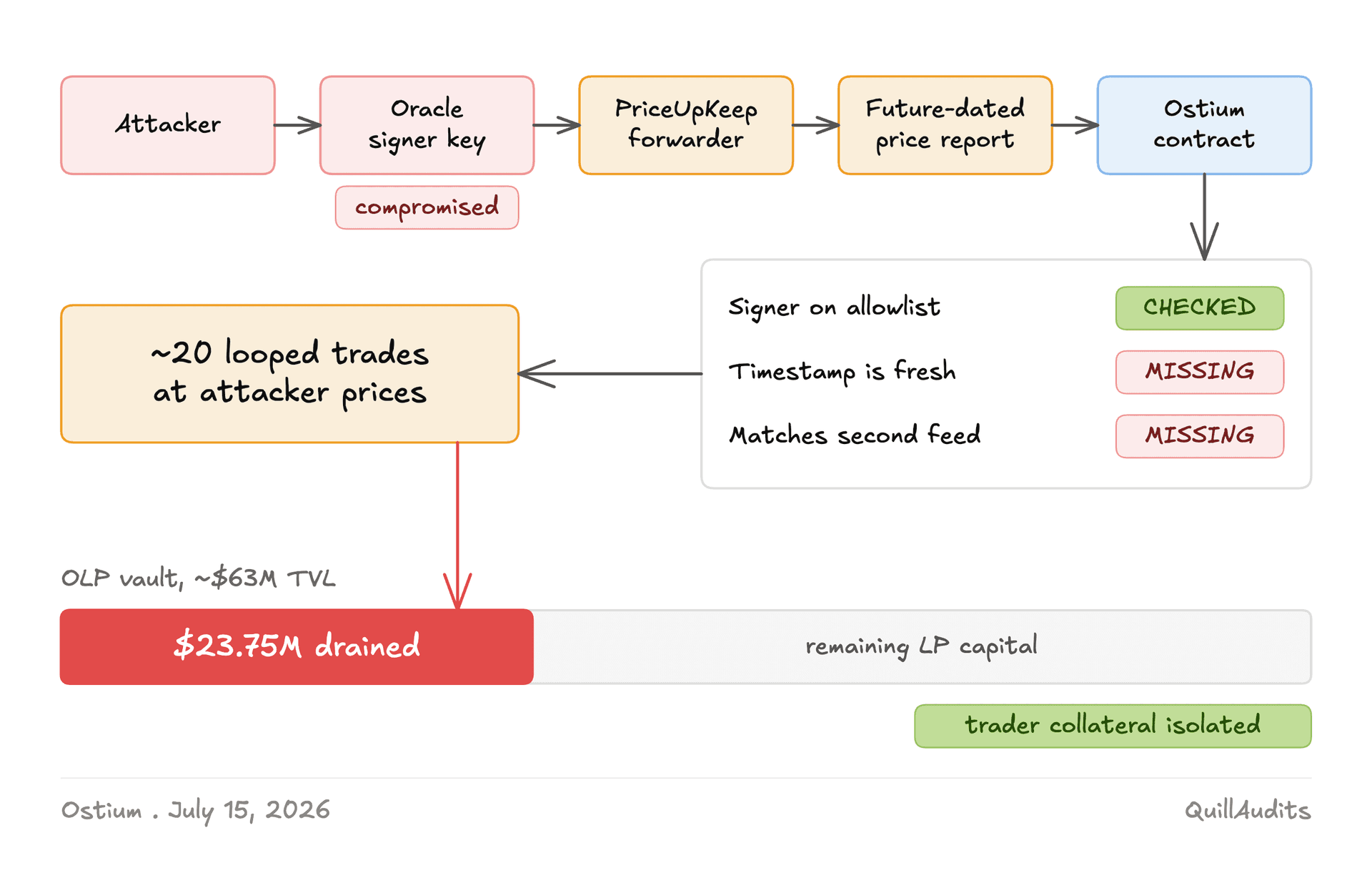
On July 15, 2026, @Ostium, an RWA perp DEX on @arbitrum offering stocks, commodities, FX and indices, lost $23.75M USDC from its public OLP vault.
The root cause was a compromised oracle signer private key. With it, the attacker used a registered PriceUpKeep forwarder to submit future-dated price reports that the system accepted as authorized.
The attacker then ran around 20 looped trades through delegated actions. Each trade was opened and settled against prices the attacker effectively chose. There was no real market exposure, only manufactured profit paid out of LP capital.
The vault held roughly $63M at the time. Close to one-third of it was drained in hours.
Trader collateral was isolated from the OLP vault, which limited the damage. Ostium paused trading and reopened on July 23.
For the full transaction-level breakdown, read our hack report, Ostium $23.75M Price Report Signer Compromise Exploit (Explained).
Why the contracts did not stop it
The contracts checked one thing about each price report, whether its signer was on the authorized list. They did not independently confirm that the price was current, plausible or consistent with another source.
That is the core lesson. A valid signature proves who sent a price. It does not prove the price is true.
Freshness bounds, deviation limits against a second feed, and per-block caps on vault outflows would each have made this attack harder or far smaller.
Oracle verification failures are not unique to RWA perps. The Bonzo Finance $9.05M oracle verifier exploit shows how a weak signature check on price data can be just as costly.
AFX Trade and the bridge nobody priced in
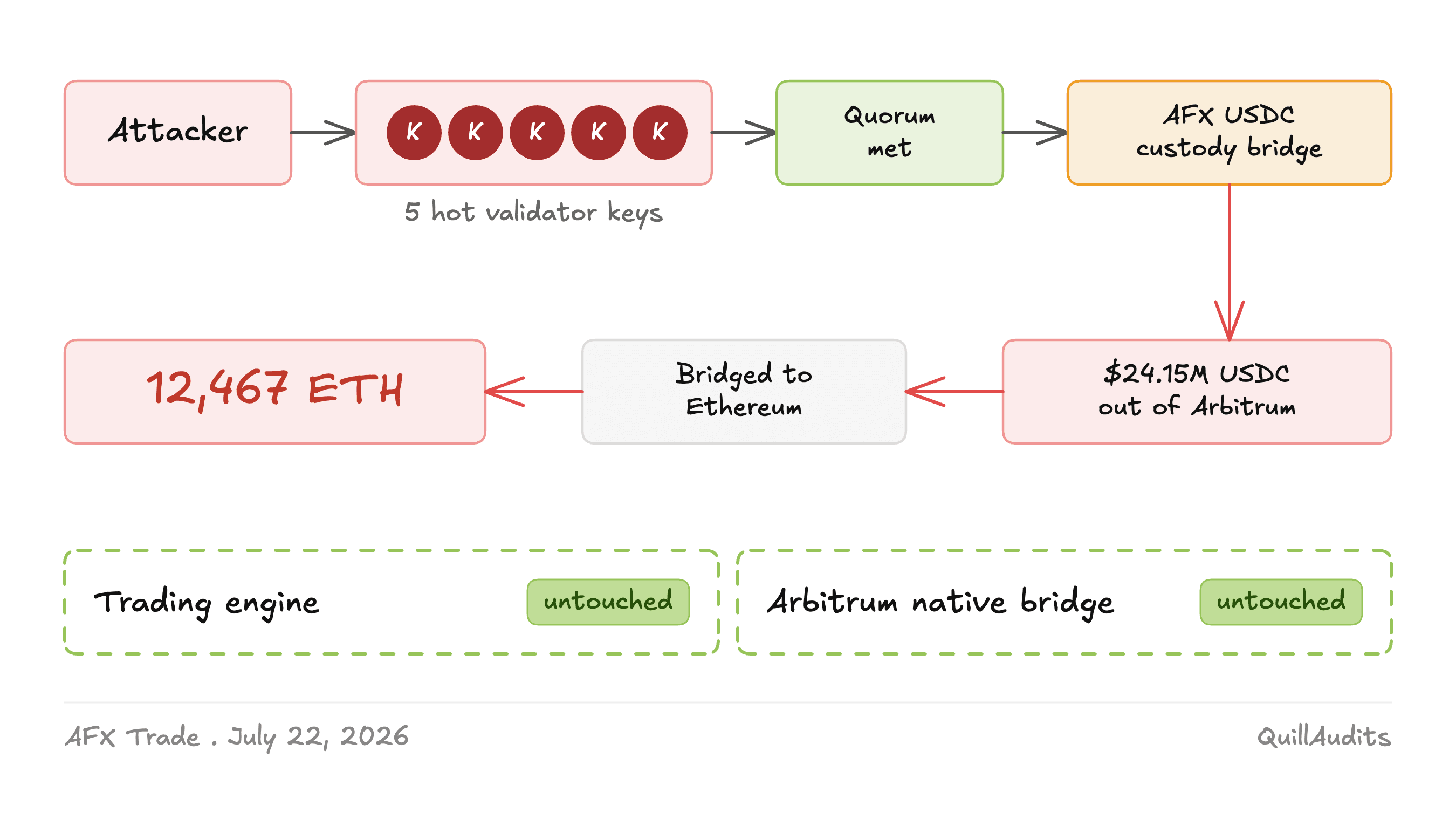
One week later, on July 22, perp DEX AFX Trade on Arbitrum lost about $24.15M USDC, close to its entire TVL.
The trading engine was never touched. The attacker gained control of the validator signing keys behind the USDC custody bridge that AFX operated itself.
Five hot-validator signatures met the bridge's approval threshold. The contract released the funds exactly as designed, because the withdrawal looked legitimately signed.
The attacker bridged the USDC to Ethereum and swapped it for roughly 12,467 ETH. AFX suspended the bridge and offered a 30% bounty for the return of the remaining funds.
@OffchainLabs confirmed Arbitrum's native bridge was not affected. This was an application-level failure.
For RWA perp builders, the takeaway is simple. Custody and bridging keys are part of your security perimeter. If a small set of hot keys can authorize withdrawals of the entire vault, the vault is only as safe as the laptop or server holding those keys.
The same failure has repeated across 2026. See how compromised signers drained Drift Protocol, KelpDAO and the Taiko Bridge.
Papertrade and the reference price problem
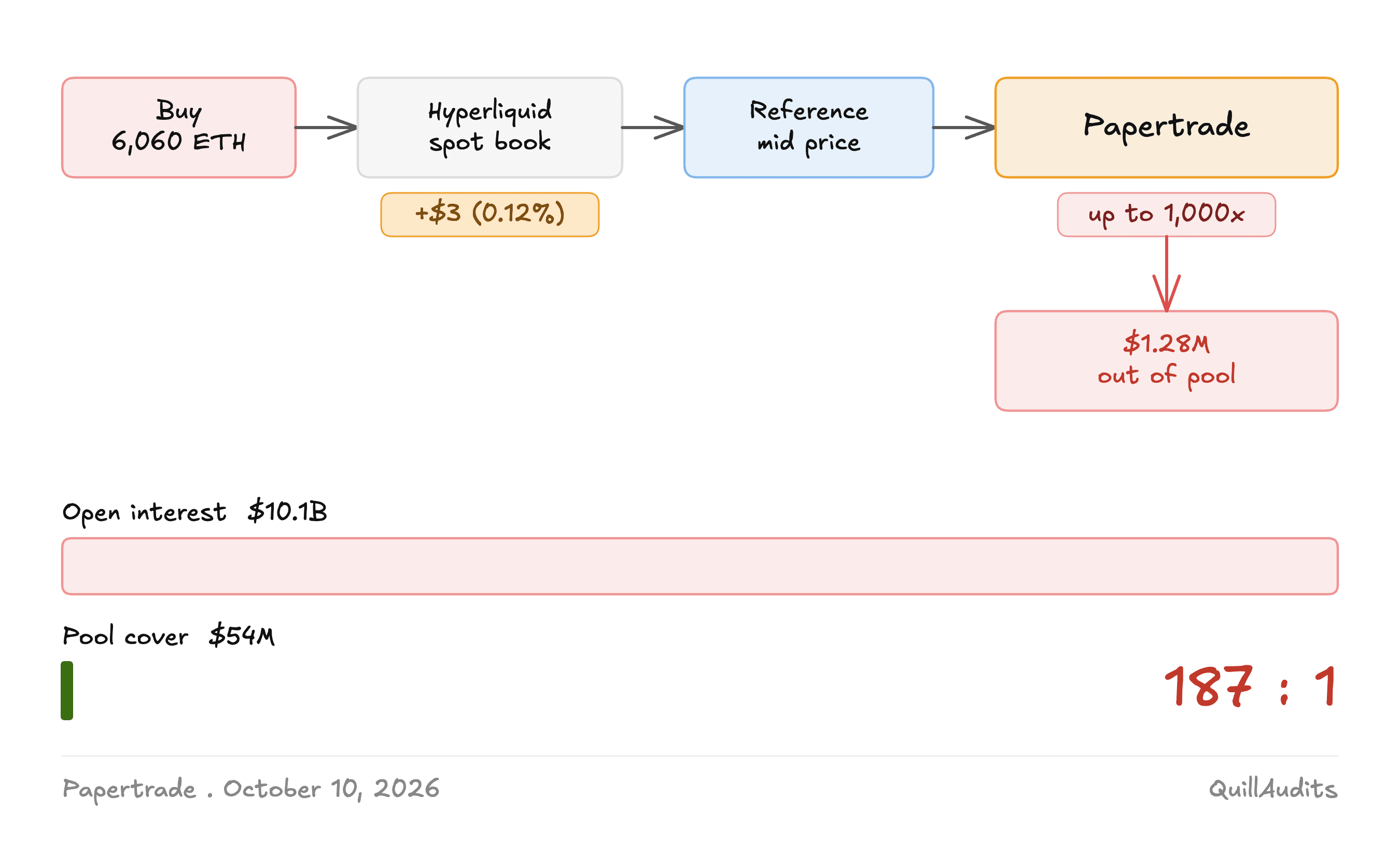
On October 10, 2026, Papertrade launched a perp venue with up to 1,000x leverage, using the Hyperliquid spot order book mid price as its execution reference.
A trader bought around 6,060 ETH, moving the spot price by roughly $3, or 0.12%. Paired with extreme leverage on Papertrade, that small move pulled about $1.28M out of the liquidity pool on launch day.
Open interest peaked at around $10.1B against roughly $54M of cover.
Papertrade listed crypto markets, not RWAs. It belongs in this analysis because many vault-backed RWA venues use the same structure, a pool counterparty settling against an external reference price.
When leverage is sized without regard to how cheaply the reference market can be moved, manipulation becomes an arithmetic exercise. No bug is required.
Perp venues have been hit this way before. Our breakdowns of the KiloEx $7.4M exploit and GMX V1's $42M loss show how price inputs become the attack path in leveraged trading systems.
The XYZ100 weekend raid
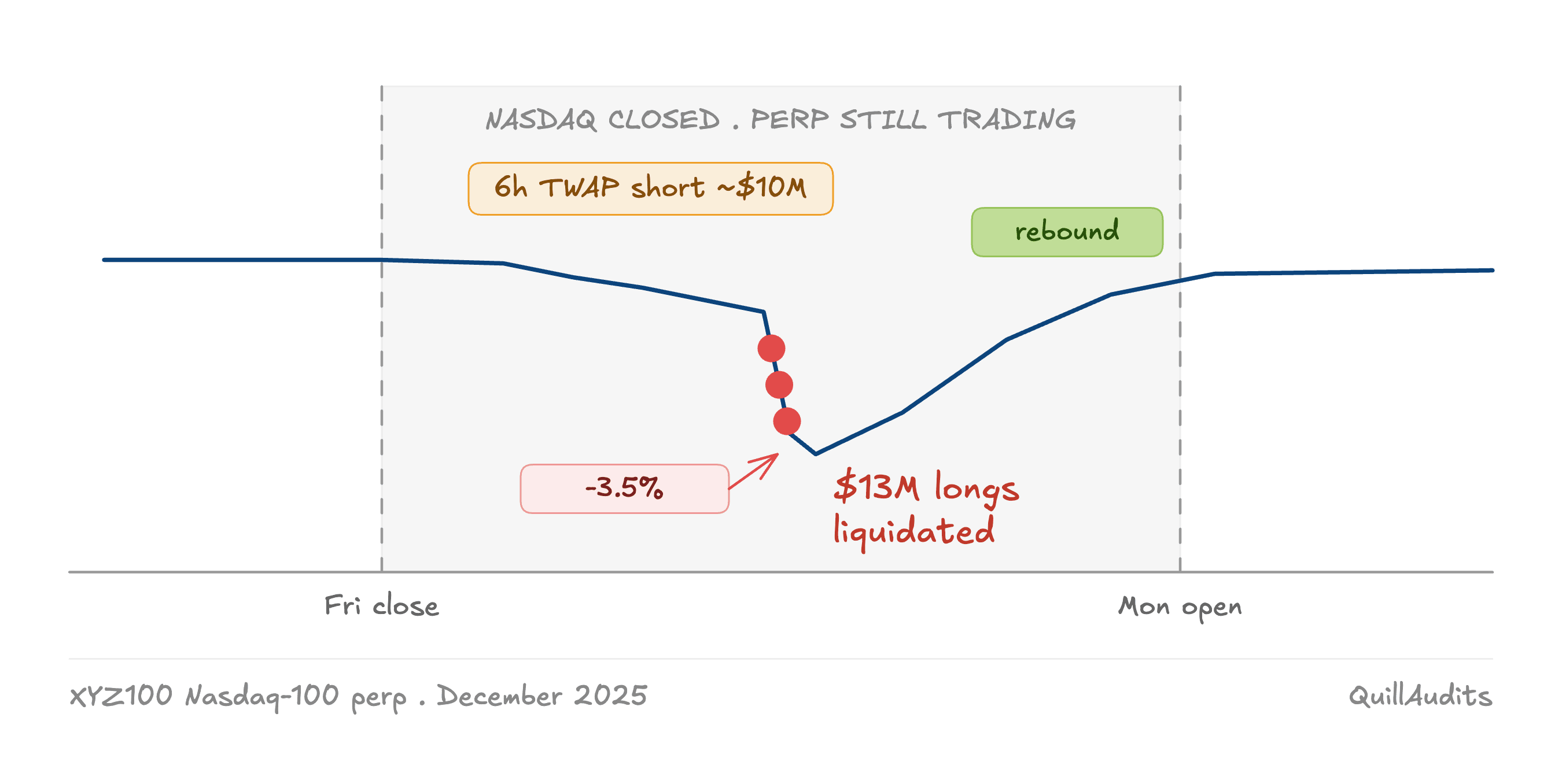
In December 2025, a fresh wallet ran a six-hour TWAP short of roughly $10M on the XYZ100 Nasdaq-100 perp on Hyperliquid.
The Nasdaq was closed. The perp was not. Its price fell more than 3.5% within minutes, and around $13M of long positions were liquidated before prices recovered.
This is the off-hours problem in its clearest form. When the underlying market is shut, many venues price from their own order book. That book is thinner, easier to push and disconnected from any real reference.
Liquidations keep running on the mark price regardless. An attacker with enough size does not need to hack anything. They only need to push a quiet book through a cluster of liquidation levels.
The reverse risk appears on reopen. A real Monday gap can liquidate positions that looked safe all weekend.
Ventuals and the reflexive oracle
Pre-IPO markets on names like SpaceX and OpenAI have a deeper problem. There is no live public price at all.
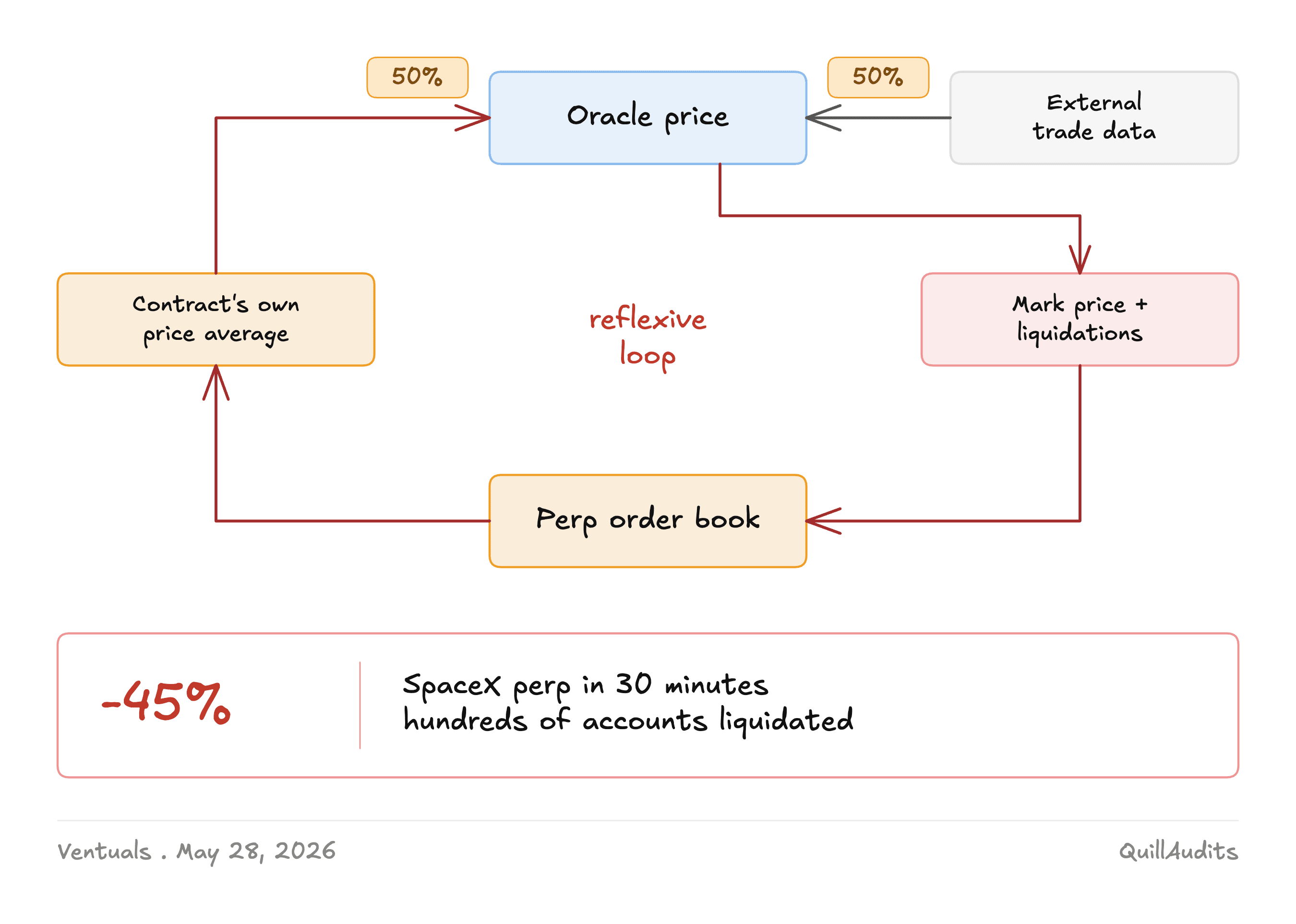
Ventuals, a HIP-3 deployer of pre-IPO perps, built its oracle from two halves. One half came from external historical trade and financing data. The other half came from the moving average of the contract's own trading price.
That design is reflexive. Anyone who moves the order book is partly writing the oracle that marks every position.
On May 28, 2026, incorrect data from an off-chain provider crashed the SpaceX perp 45% in 30 minutes, liquidating hundreds of accounts. Ventuals compensated affected traders and later shut down after nine months of operation.
The failure here was not malicious, but the same path is available to an attacker. If an oracle reads its own market, the market can steer the oracle.
HIP-3 and deployer-controlled pricing
HIP-3 gives builders enormous flexibility. It also hands them full responsibility for the oracle.
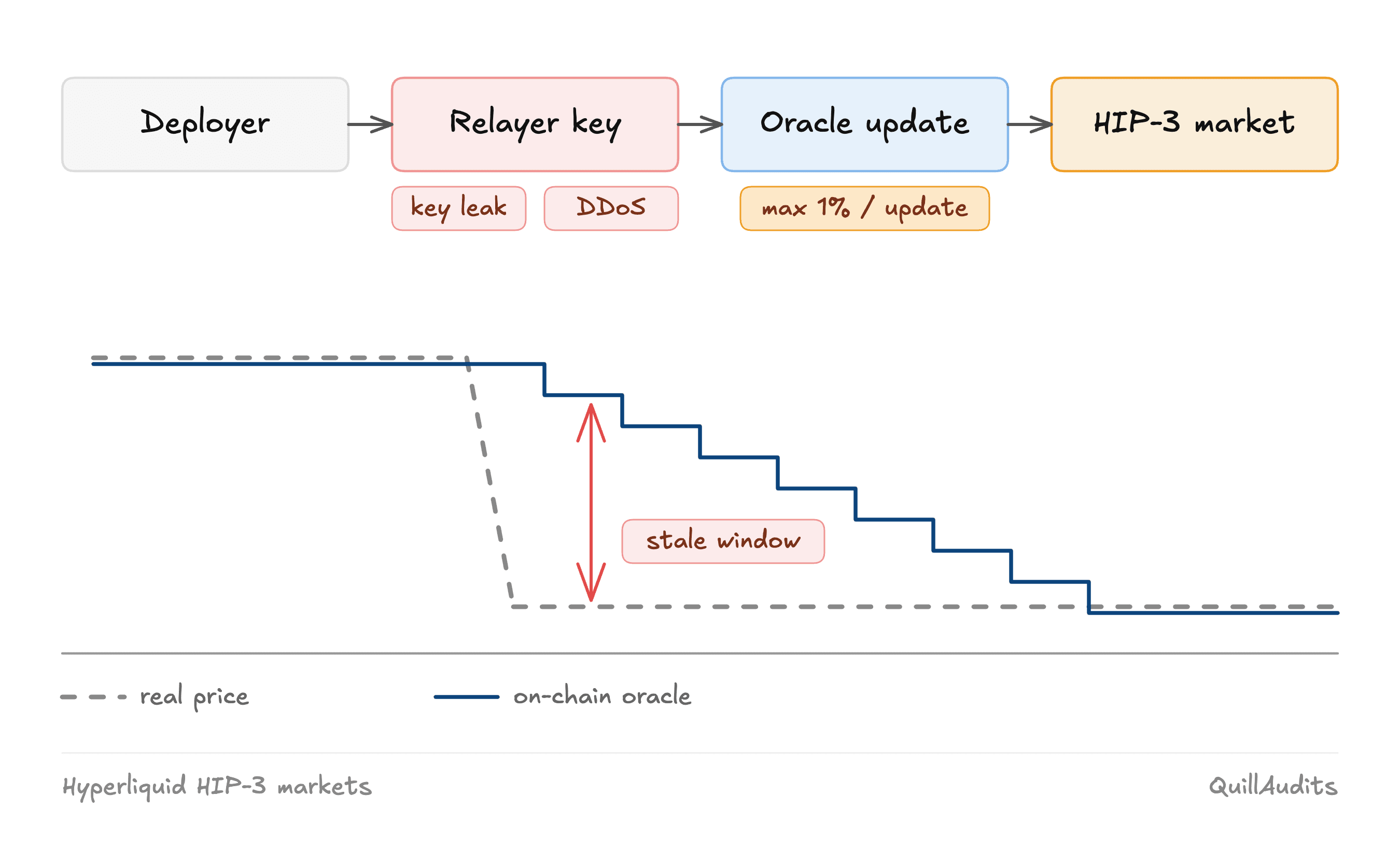
Deployers must supply their own price feeds, typically through a relayer. If a relayer's private key leaks, or the relayer is taken down by DDoS, a market can be left with manipulated or unanchored prices for an extended period.
HIP-3 also caps each oracle update at a 1% move from the previous value. That protects against single bad prints, but it creates a different gap. During a sharp real-world move, the on-chain price catches up in steps. Traders who see the real price first can trade against the stale one.
The quieter gaps auditors miss
Some RWA-specific risks have not yet produced a headline exploit, but they appear repeatedly in design reviews.
Corporate actions. Stock splits, dividends and ticker changes alter the reference price without any change in value. An oracle that does not adjust for a 3-for-1 split would show every long as down 67%.
Market calendars. Holidays, early closes and trading halts differ by exchange and country. A protocol that applies one global calendar will misprice Korean equities, US indices and commodities in different ways.
Funding during closed hours. When the index stops updating, funding can drift or spike. That creates both trader losses and an incentive to game the funding window.
Thin long-tail listings. Newly listed stocks and pre-IPO names often carry high leverage limits with very little depth behind them. Those markets are the cheapest place to start a manipulation.
What to audit in an RWA perp
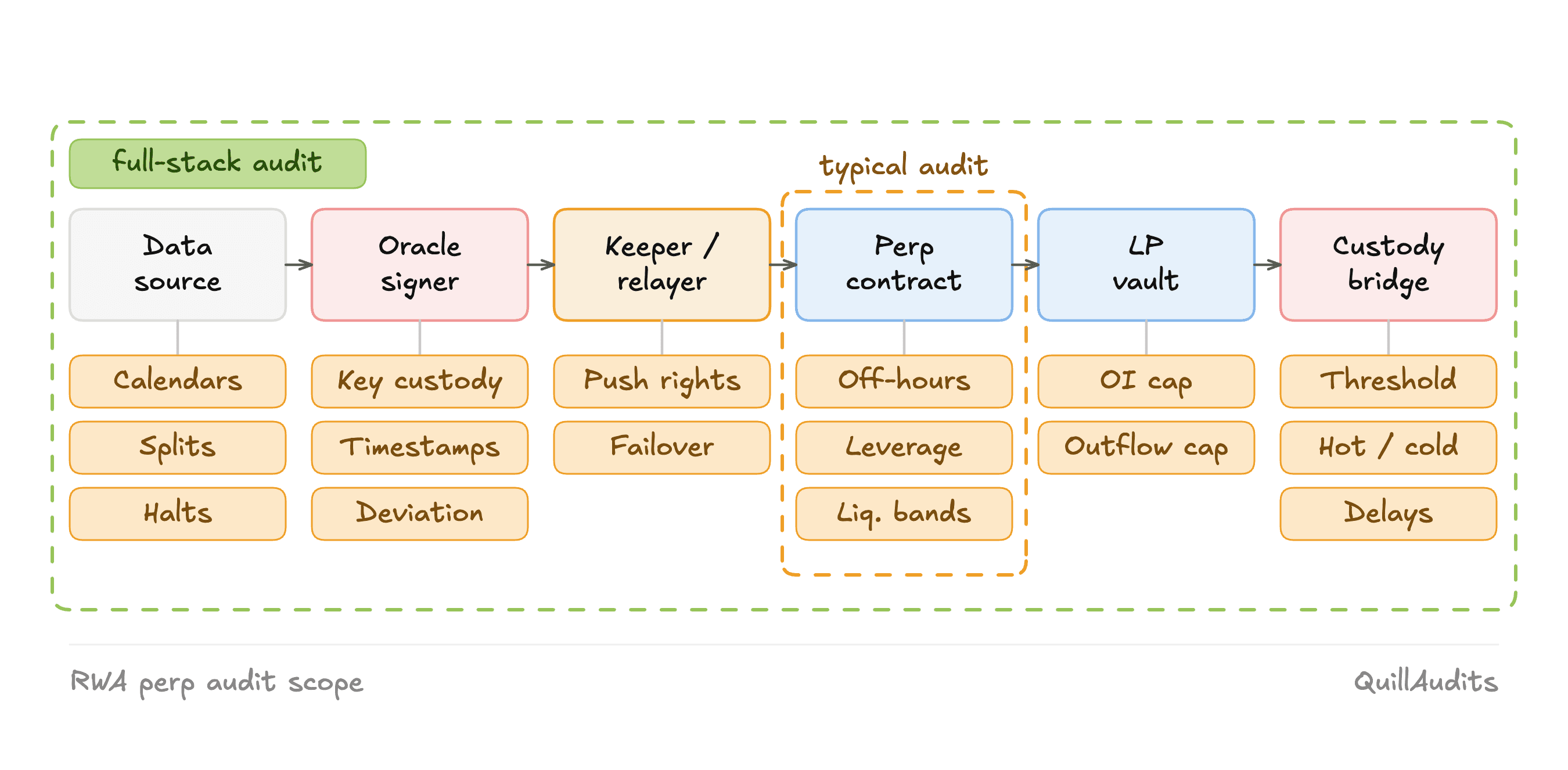
The contracts still need a full review. But an RWA perp audit that stops at Solidity misses the surfaces where 2026's losses actually came from.
Oracle pipeline. Who signs prices, where those keys live, and whether the contract enforces timestamp windows, monotonic timestamps, deviation bounds and cross-feed checks.
Keepers and forwarders. Which addresses can submit prices or trigger settlement, and what happens if one is compromised.
Off-hours logic. How the mark price behaves when the underlying closes, what bands apply, and how liquidations behave around reopen gaps.
Leverage versus reference depth. Whether max leverage on each market is sized to how cheaply its reference price can be moved.
Vault exposure. Whether open interest is capped against vault capital, and whether outflows are rate-limited per block or per epoch.
Custody and bridges. Signer thresholds, hot versus cold key separation, withdrawal delays and emergency pause paths. Teams running Safe wallets can check their setup for free with Multisig Inspector.
Corporate actions and calendars. Whether splits, dividends, halts and regional holidays are handled explicitly rather than assumed away.
How QuillAudits can help
Securing an RWA perp takes more than a contract review. QuillAudits covers the full price and custody stack these incidents went through.
RWA and Tokenization Audit. We review perp engines, margin and liquidation logic, and the oracle integration together, including market-hours handling, corporate actions and off-hours pricing.
DeFi Protocol Audit. We stress-test leverage limits, open interest caps and vault exposure against how cheaply each reference market can be moved.
dApp Pentest. We test the off-chain side, including oracle signers, keepers, relayers, APIs and the servers that hold your keys.
Smart Contract Monitoring. Real-time alerts for abnormal price reports, vault outflows and liquidation spikes, so an attack is caught in minutes, not hours.
Incident Response. If something goes wrong, our team helps you contain the damage, trace funds and coordinate recovery.
Building or launching an RWA perp? Book a free audit consultation with our team.
Conclusion
The largest RWA perp losses of 2026 came through keys, feeds and risk parameters, not broken code. As volume moves into equities and pre-IPO names, the oracle becomes the most valuable target in the system. Securing an RWA perp means auditing the full price pipeline, from data source to vault payout. In this market, whoever controls the price controls the vault.
Contents