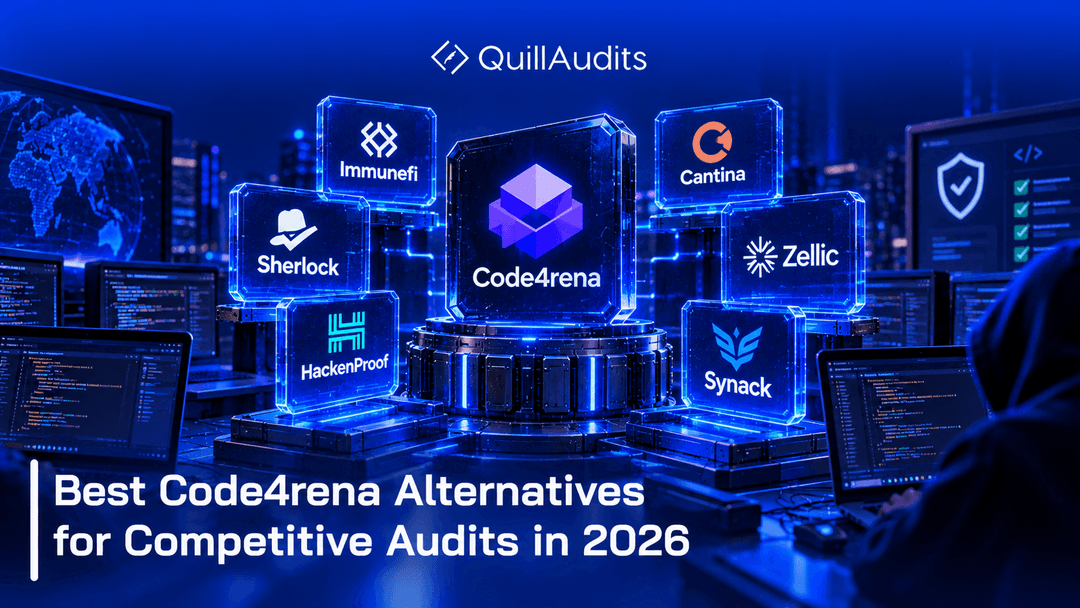
Best Code4rena Alternatives for Competitive Audits in 2026
Code4rena shut down in 2026, leaving pre-launch contests without their default platform. Compare Sherlock, Cantina, Codehawks, and fixed-scope audits as Code4rena alternatives, and see how your launch timeline and budget should decide between a crowdsourced contest and a single-firm smart contract audit, including what each model trades off before you book.

The decision · answer in brief
Code4rena shut down in 2026, leaving pre-launch contests without their default platform. Compare Sherlock, Cantina, Codehawks, and fixed-scope audits as Code4rena alternatives, and see how your launch timeline and budget should decide between a crowdsourced contest and a single-firm smart contract audit, including what each model trades off before you book.
Code4rena shut down in 2026, and if you had a pre-launch contest booked on its calendar, you now have a gap where your security milestone used to be. This post breaks down the real code4rena alternative options, Sherlock, Cantina, Codehawks, or a fixed-scope audit, around the two variables that actually decide this for you: how much launch runway you have left and what your budget can absorb.
What Changed When Code4rena Wound Down
Code4rena was the platform that normalized the public contest model for smart contract security: post a scope, attach a prize pool, let hundreds of independent researchers compete to find bugs before launch. In 2026, that platform stopped taking new business.
The May 13, 2026 Announcement and Closure Process
Code4rena's official account posted the wind-down decision directly on X: "After careful consideration, we've made the decision to wind down @code4rena. This community has meant a great deal to everyone who has been part of building it, and sharing this news is not easy." Coverage of the announcement, dated May 13, 2026, confirms the team's commitment to existing clients: "Every active competition and bounty will be seen through to a full and proper close."
If you had a contest scheduled with Code4rena, that's the operative detail. Obligations already on the books were honored; new bookings were not being taken. For a founder planning a 2026 launch, that means Code4rena is off the table as a forward option regardless of how satisfied past clients were with the model.
Where Code4rena's Contests and Researchers Went (Immunefi)
Code4rena's wind-down didn't erase the contest model, it redistributed it. The independent researchers (wardens, in Code4rena's own terminology) who built reputation and payout history on the platform moved to the contest platforms that stayed standing, and competitive bug-bounty infrastructure elsewhere absorbed a share of that overflow.
Worth separating out: if your Code4rena engagement was a live bug bounty program rather than a pre-launch contest, that's a different category of replacement than the contests covered in this post. Immunefi is the largest standing platform in that category, describing itself on its own site as a "Crypto & Smart Contract Bug Bounty Platform" that can "put 85,000+ security researchers on your code." It runs ongoing bounty programs rather than time-boxed contests, so it's worth evaluating on its own terms if an open-ended bounty, not a pre-launch contest, is what you actually need. The three platforms covered below are the ones that absorbed the contest-specific demand, which is why they're worth evaluating by name rather than treating "run a contest" as a single generic option.
What Is a Crowdsourced Smart Contract Audit Platform?
A crowdsourced smart contract audit platform is a marketplace that opens your code to many independent security researchers at once, usually competing for a shared prize pool, instead of routing it to one fixed audit team. You get breadth of eyes and, often, speed; you give up the single point of accountability a traditional engagement provides.
How the Contest Model Works
The mechanics are consistent across platforms even when the branding differs:
- Scope definition. You and the platform agree on which contracts, and which specific commit, are in scope.
- Prize pool funding. You fund a pool, sometimes with a platform-matched or staked component, that pays out based on the severity and uniqueness of findings. Codehawks, for instance, lists individual contest prize pools ranging from 12,000 to 500,000 USDC.
- Open or gated competition window. Researchers (wardens on Code4rena's old terminology, Watsons on Sherlock) submit findings during a fixed window, typically one to two weeks.
- Judging and deduplication. Submissions are triaged, duplicates merged, and severity assigned, usually by a mix of platform staff and senior researchers.
- Payout and report. Prize money is distributed per the judged severity, and you receive a public or private findings report.
Sherlock runs this as one of three parallel tracks on its platform: open "Audit Contests" that it describes as drawing "hundreds of researchers," alongside expert-led private "Collaborative Audits" and an "Audit Engine" that blends AI models with human researchers. Sherlock's own site also reports more than 11,000 registered security researchers, over $250 billion in TVL secured, more than 2,000 criticals uncovered, and over 1,500 audits and security reviews completed across its history; figures like these change as platforms update their own pages, so treat them as current to this post's publish date rather than fixed.
Why Founders Defaulted to Code4rena Pre-Launch
Before the wind-down, Code4rena was the path of least resistance for a specific reason: it was the largest, best-known venue, so booking a contest there didn't require founders to evaluate alternatives. That default is exactly what broke in May 2026, and it's why this decision now requires an actual framework instead of a single phone call.
Contest Model vs Fixed-Scope Audit: Which Fits Your Launch
The honest answer is that neither model is strictly better; they trade different things for different risks, and your launch timeline and budget determine which trade you can afford. If you're also weighing a bug bounty against either option, QuillAudits' bug bounty vs audit comparison is worth reading alongside this section, since it names Code4rena, Sherlock, and Cantina side by side with bounty programs.
What You Trade Off With a Public Contest
A contest buys you volume: dozens to hundreds of researchers looking at your code in parallel, which genuinely surfaces findings a single team of two or three auditors can miss. In exchange, you give up predictability. Contest timelines depend on researcher participation, a published scope is visible (at least to competitors) during the window, and payout depends on how many high-severity bugs get found, so a "clean" contest with few findings can still look ambiguous to outside observers deciding whether that means your code is solid or the contest was under-attended.
What You Trade Off With a Single-Firm Fixed-Scope Audit
A fixed-scope audit buys you a fixed timeline, a fixed price (within the scope you agree on), and a single accountable team you can ask follow-up questions after delivery. What you give up is the sheer researcher-hour volume a well-funded public contest pool attracts. A $500,000 prize pool on a high-TVL protocol pulls in far more combined researcher attention than one firm's audit team can match in the same window, which is exactly why some protocols run both in sequence rather than choosing one.
Sherlock vs Cantina vs Codehawks: Your Code4rena Alternative Options
These three are the main standing crowdsourced smart contract audit platform options now that Code4rena has wound down. Here's how they differ on model, researcher pool, and positioning. Figures in the table are current as of this post's publish date and can shift, so check each platform's own site before you budget against them.
Sherlock: Contests, Collaborative Audits, and an AI-Assisted Engine
Sherlock is the closest thing to a direct successor to Code4rena's open-contest format, but it doesn't stop there. Its site describes three tracks running in parallel: public Audit Contests that draw "hundreds of researchers," private Collaborative Audits for teams that want expert reviewers without a public scope, and an Audit Engine that pairs AI models with human researchers for faster first-pass coverage.
Worth flagging before you plan around it: Sherlock's own site lists an "Institutional Vaults" coverage product as "Coming Soon," and the site states plainly that "Sherlock's services do not constitute a guarantee against all security incidents or losses." If you've heard Sherlock described as carrying an active insurance backstop, treat that as outdated rather than current.
Cantina: Spearbit's Researcher Network and Hybrid Review
Cantina positions itself around a combination of "Spearbit's top researchers and AI-native review," spanning hybrid audits, expert triage, and live bounty programs, per its own site. The pitch is less "open the gates to anyone" and more "a vetted pool of senior researchers plus tooling," which tends to suit protocols that want contest-style parallelism without fully open public participation.
Codehawks: Cyfrin's Competitive Audits and First Flights
Codehawks, run by Cyfrin, offers Competitive Audits structured like the classic contest model, alongside a First Flights track aimed at newer or less-experienced researchers and protocols still building a track record. Prize pools on individual contests range from 12,000 to 500,000 USDC, which gives you a concrete budget anchor when you're sizing what a Codehawks contest will cost versus a Sherlock or Cantina engagement of comparable scope.
How to Choose Based on Launch Timeline and Budget
The fastest way to cut through three platforms and one fixed-scope option is to ask two questions in order: how many weeks until launch, and what can the budget actually absorb. The answers point you toward a specific choice, not a vague "it depends."
If You Need a Decision in Under 2 Weeks
Walk the timeline yourself before you book anything. A public contest needs scope lock first, which realistically takes two to three days once a team is still finishing feature work. Then the prize pool has to be funded and the listing scheduled with the platform. Only after that does the one-to-two-week competition window open, and findings don't start arriving in volume until partway through it. Add those stages up and you're ten business days or more before you've even reached triage, let alone a report. That rarely fits inside a genuine two-week runway. A fixed-scope audit with a firm that can start immediately is usually the only option that fits a tight timeline, because you're booking one team's calendar instead of coordinating a public event. QuillAudits' 2026 audit process breakdown covers what a fixed-scope engagement timeline actually looks like end to end.
If Budget Is the Constraint, Not Speed
If you have runway but a tight budget, Codehawks' lower-end prize pools (starting around 12,000 USDC) give you a contest-model option without committing to a six-figure pool. Compare that number against fixed-scope pricing before deciding: QuillAudits' 2026 audit cost guide lays out the typical price brackets for a single-firm engagement, which is the number you need alongside the contest prize pool to actually compare apples to apples.
If You Want a Single Team Running the Whole Stack
Some protocols don't want to coordinate a public contest at all; they want one firm accountable for manual review, automated tooling, and contest-caliber researcher input in a single engagement. QuillAudits offers its Smart Contract Audit as a direct, fixed-scope service, and its process folds in a Vigilant Squad, independent researchers the firm describes as drawn from active participants in the competitive audit contest scene, so you get contest-trained reviewers without running a public contest yourself.
The honest limit: a single fixed-scope engagement won't replicate the researcher-hours a $500,000-plus public contest pool attracts on a very high-TVL protocol, and QuillAudits' own pages don't publish a Sherlock-style financial coverage product or a public researcher leaderboard the way Code4rena, Sherlock, and Cantina do. If a public reputation signal matters to your launch marketing as much as the audit itself, that's a real reason to keep a contest platform in the mix.
Whichever route you choose, the two variables don't change: how many weeks you actually have, and what the budget can absorb. Map your launch date against the options above before you book anything, and if a single accountable team running the full review stack fits your situation, QuillAudits' research page carries its published audit reports if you want a reasonable starting point to scope.
Contents