


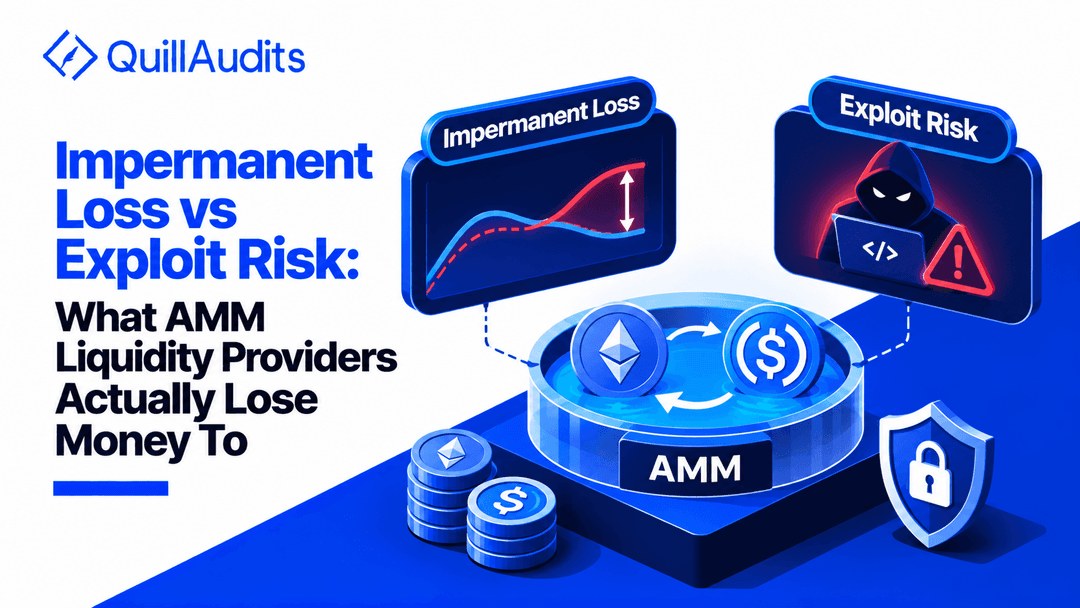
Impermanent Loss vs Exploit Risk: What AMM Liquidity Providers Actually Lose Money To
Understand what an impermanent loss calculator reveals—and what it misses. This guide explains how AMM price movements affect liquidity providers, breaks down the impermanent loss formula, and distinguishes normal market-driven losses from oracle manipulation, rounding errors, and reentrancy exploits. Explore real DeFi attack examples, LP risk disclosures, and practical security checks to assess pool risks before depositing with confidence.

The decision · answer in brief
Understand what an impermanent loss calculator reveals—and what it misses. This guide explains how AMM price movements affect liquidity providers, breaks down the impermanent loss formula, and distinguishes normal market-driven losses from oracle manipulation, rounding errors, and reentrancy exploits. Explore real DeFi attack examples, LP risk disclosures, and practical security checks to assess pool risks before depositing with confidence.
What Does an Impermanent Loss Calculator Miss? A Guide for LPs
Run the numbers with an impermanent loss calculator before you deposit into any automated market maker (AMM) pool, and you'll see a clean, predictable curve: the further two assets in a pool drift apart in price, the more value a liquidity provider (LP) gives up relative to just holding the tokens. That's genuine math, and it's the most visible AMM liquidity pool risk LPs can quantify ahead of time. But a meaningful share of what LPs report as impermanent loss in forum threads and support tickets isn't impermanent loss explained by a formula at all, it's an oracle manipulation exploit, a rounding error, or a reentrancy bug dressed up as a market outcome. Telling the two apart decides whether you wait out the market or whether the protocol needs a security audit.
What Is Impermanent Loss, and What Does an Impermanent Loss Calculator Show You?
Impermanent loss is the difference in value between holding two tokens in a liquidity pool versus holding them separately in your wallet. It happens because constant-product AMMs, the Uniswap v2-style x*y=k design that most DEXs still build on, automatically rebalance a pool's token ratio as prices move, selling the asset that's rising and buying the one that's falling. An LP ends up holding less of the winner and more of the loser compared to simply holding both tokens outright.
The loss is called "impermanent" because it only becomes permanent once you withdraw. If the price ratio between the two assets returns to where it was when you deposited, the loss disappears on its own. Trading fees earned while providing liquidity can offset or fully cover it too, which is why an IL number alone doesn't tell you whether a pool was a bad trade, only how much price divergence cost you before fees.
How Do You Calculate Impermanent Loss? (Formula and Quick-Reference Table)
The standard impermanent loss formula for a two-asset constant-product pool is IL = 2 x sqrt(r) / (1 + r) - 1, where r is the ratio of the new price to the price at deposit. Plug in a price ratio and the formula returns the percentage value lost relative to holding, before counting any fees earned.
| Price ratio (new price / deposit price) | Impermanent loss vs. holding |
|---|---|
| 1.0x (no change) | 0% |
| 1.25x | -0.6% |
| 1.5x | -2.0% |
| 2.0x | -5.7% |
| 3.0x | -13.4% |
| 4.0x | -20.0% |
| 5.0x | -25.5% |
These figures come directly from the formula above, not from any specific pool, so they apply to any constant-product AMM pair, from ETH/USDC to a long-tail token pool. A 2x price move, common for a mid-cap token over a few months, costs an LP about 5.7% relative to just holding. That's the number any impermanent loss calculator will return for that scenario, and it's the full extent of what the math can explain.
Where an Impermanent Loss Calculator Stops Being the Real Risk
An impermanent loss calculator only knows one input: the price ratio between two assets. It can't see what's happening inside the pool's smart contract, how the pool's price is sourced, or whether a withdrawal function updates state in the right order. Those are the things that turn a normal LP position into a total loss.
This matters because LPs and support forums routinely use "IL" as a catch-all for any unexpected drop in pool value. A pool's token balance can fall in ways that have nothing to do with price divergence: a price oracle can be fed from the same thin liquidity an attacker is trading against, a withdrawal function can round in the attacker's favor on every call, or a contract can let someone re-enter a function before balances update. None of that shows up on a calculator, because none of it is a market outcome. It's a code or design failure, and flash loans, the single most common delivery mechanism for these failures, were behind a striking share of 2024's exploits: flash loan attacks made up 83.3% of eligible DeFi exploits that year.
When "IL" Is Actually an Exploit: Oracle-Drained and Code-Broken Pools
An oracle manipulation exploit is the most common way a pool's reported losses get mistaken for IL. On April 14, 2025, an attacker exploited KiloEx by forging a signature in the protocol's TrustedForwarder/MinimalForwarder contract, pushing ETH's reported price from $100 to $10,000 and draining a leveraged position for $7.4M across Base, opBNB, BNB Chain, and Manta. No LP in that pool experienced genuine price divergence; the oracle simply reported a number the rest of the market never agreed to.
Thin liquidity makes the same style of attack cheaper to pull off without forging anything. On August 27, 2026, Moonwell lost $8.7M when an attacker combined a direct-donation exchange-rate inflation attack with oracle manipulation, because MAMO's price oracle was fed by the same thin on-chain liquidity the attacker was trading against. A pool that looks healthy on a dashboard can still be one large trade away from reporting a price nobody else in the market would accept.
Rounding and reentrancy bugs produce the same symptom through a different mechanism: the contract's own accounting is wrong, not the oracle. Bunni V2 lost $8.3M on September 2, 2025 across Ethereum and UniChain when an attacker exploited a rounding-direction flaw in its Liquidity Distribution Function through 44 consecutive tiny withdrawals, draining 85.7% of the pool's active token balance without burning a proportional share of liquidity. CloberDEX lost about 133.7 ETH (roughly $501,279) on December 10, 2024 on Base when a reentrancy bug in the Rebalancer contract's _burn function let an attacker drain pool reserves, because token transfers happened before the contract's own reserve state variables were updated. And Cork Protocol lost $12M on May 28, 2025 when an attacker created a fraudulent market using Uniswap v4 hook mechanics and exploited missing callback-data validation in the protocol's CorkCall function.
In every one of these cases, the LP's balance showed a large, sudden drop that had nothing to do with the price ratio between pool assets. The same report attributes 34.6% of direct contract exploitation cases to a lack of, or faulty, input validation, which is exactly the category Bunni V2 and Cork fall into.
What Founders Should Disclose to LPs vs What an Audit Can't Fix
Founders owe LPs a clear line between the two risk types before anyone deposits. Pool documentation should disclose the oracle design (is price pulled from the pool's own thin liquidity, or from an external, deep-liquidity source?), the withdrawal and rebalancing logic, and whether the contract has gone through third-party review. None of that is covered by an impermanent loss calculator, because IL math assumes the contract behaves exactly as written.
That's also the honest limit of a security audit. A DeFi Protocol Audit, the kind QuillAudits performs, can catch the vulnerability classes behind the Bunni V2, Cork, and CloberDEX losses: missing validation, rounding errors, and reentrancy in withdrawal or settlement functions. On-chain monitoring and incident response can flag a manipulation attempt, like a sudden spike against thin liquidity feeding a spot oracle, before funds fully drain, which is the pattern behind the Moonwell and KiloEx losses.
What an audit can't do is make impermanent loss disappear. IL is a function of relative price movement between two assets, not a code defect, so no amount of review changes the numbers in the table above. An audit also only covers what's explicitly in scope; a contract review that doesn't include tokenomics or oracle-source review won't catch a thin-liquidity price feed, since that's an economic design choice, not a bug. Custody failures sit in a third category again: a treasury or multisig can be drained regardless of what the pool contract does, and wallet and private key compromise is its own loss vector worth disclosing separately from pool-level risk.
Checklist: Is This Pool's Risk Impermanent or Structural?
Run through these before chalking up an unexpected loss to impermanent loss:
- Did the price ratio between the two pool assets actually move by the amount needed to explain the loss? Check it against the table above.
- Did the loss happen gradually, tracking a market move over days or weeks, or did it happen in a single block or a short burst of transactions?
- Is the pool's price oracle pulling from deep, external liquidity, or from the same pool (or a correlated thin pool) that just moved?
- Did the withdrawal activity look unusual: dozens of small calls back to back, like the 44 withdrawals that drained Bunni V2, or a single large call riding a forged signature, like KiloEx?
- Has the protocol published a smart contract audit that covers the exact function involved, including oracle and tokenomics review, not just the token contract itself?
A yes to the first two and a "deep, external" answer on the oracle question points to ordinary impermanent loss: real, explained by the formula, and resolved if prices revert or fees catch up. A yes to the third or fourth point points to a structural failure that a calculator was never going to show, and the right next step is incident response and an audit, not patience.
Final Thoughts
Impermanent loss is the risk LPs can price before they deposit: plug a price ratio into the formula, read the percentage, and decide if expected fee income covers it. Oracle manipulation, rounding errors, and reentrancy bugs are a different category entirely, and five losses from 2024 and 2025 alone, KiloEx, Moonwell, Bunni V2, Cork Protocol, and CloberDEX, show they aren't rare edge cases.
Before listing a pool or depositing into one, treat impermanent loss as a specific, calculable number and treat everything else as a security question. A DeFi Protocol Audit can't touch the math in the table above, but it can close the validation, rounding, and reentrancy gaps that keep showing up disguised as IL in LP complaints.
Contents









