


Smart Contract Audit Timeline: How Long to Budget in 2026
How long does a smart contract audit really take? This 2026 guide covers review times by complexity, from simple tokens to bridges, plus the booking lead time and fix-verification pass most timelines skip. Learn what delays audits mid-engagement and how to plan your launch date around both clocks, so your mainnet date doesn’t depend on guesswork.

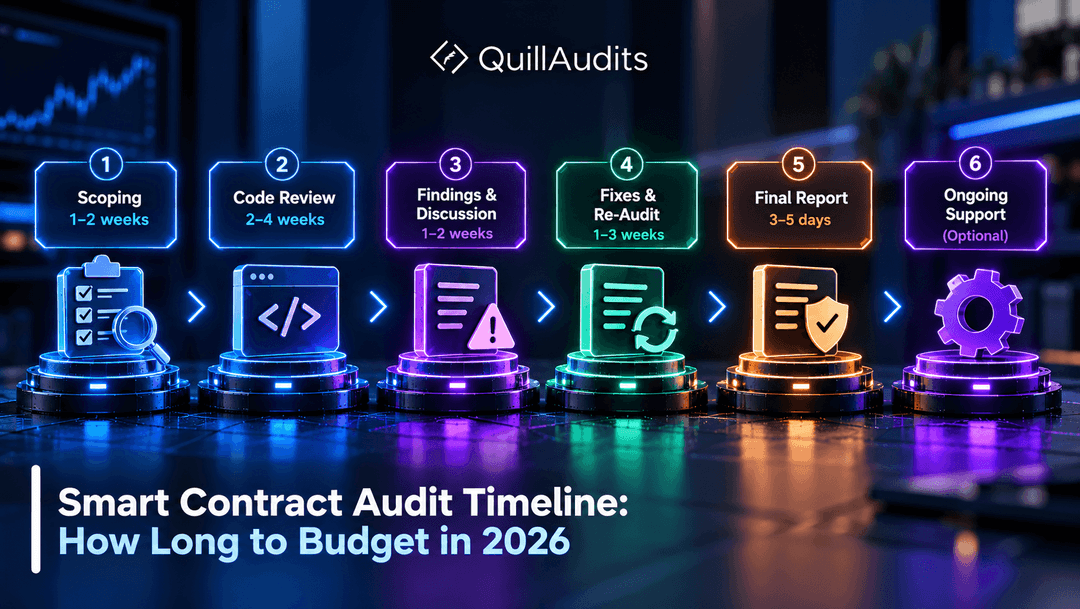
The decision · answer in brief
How long does a smart contract audit really take? This 2026 guide covers review times by complexity, from simple tokens to bridges, plus the booking lead time and fix-verification pass most timelines skip. Learn what delays audits mid-engagement and how to plan your launch date around both clocks, so your mainnet date doesn’t depend on guesswork.
How Long Does an Audit Scheduling Smart Contract Take? 2026 Guide
If you're trying to pin an audit scheduling smart contract timeline to a launch date, you're actually budgeting two separate clocks, not one. The first is the booking queue, the weeks you wait before a reputable firm even opens a slot for you. The second is the engagement itself: manual review, your fix window, and a re-verification pass before the report says "resolved." Most guides only cover the second clock. This one covers both, so you can work backward from a mainnet date instead of guessing.
Audit Scheduling Smart Contract Timeline: The Quick Answer
A smart contract audit typically takes between a few days and several months, depending on codebase size and complexity, but that review window is only part of the real timeline. Simple tokens or NFT contracts often clear review in 2 to 8 days, standard DeFi protocols run 3 to 6 weeks, and complex, multi-chain, or bridge systems can take 2 to 6 months, according to QuillAudits' own cost breakdown. On top of that review window, add the booking lead time before the audit starts and the fix-verification pass after the first report lands. Treat all three as one budget, not one number.
Timeline by Project Complexity
Project complexity is the single biggest driver of how long the manual review phase runs. Codebase size, number of external integrations, and novelty of the logic all push the estimate around, and they push it in the same direction every time: more surface area, more time.
Simple Tokens and NFTs
A standard ERC-20 token, a vanilla ERC-721 collection, or a simple staking contract with no exotic logic is the fastest category to audit. QuillAudits' pricing guide puts these jobs at 2 to 8 days of audit time, and research firm Zealynx Security independently estimates 3 days to 1 week for simple contracts under roughly 500 lines of code, covering everything from scoping to final report delivery.
The catch: a short timeline cuts both ways. QuillAudits' own guide to choosing a smart contract auditor flags a commitment as short as two days as a red flag, since that's rarely enough time for a focused audit to run its full scope, even on simple code. If a firm quotes two days for anything beyond a near-identical fork of an audited template, ask what's actually being skipped.
Standard DeFi Protocols
Lending markets, AMMs, yield vaults, and other contracts in the 1,000 to 3,000 line range sit in the middle tier. QuillAudits prices these at 3 to 6 weeks of audit time, and Zealynx's independent estimate of 1 to 2 weeks for standard DeFi protocols in that line-count band lines up with the lower end of that range, before accounting for firm-specific scope and the back-and-forth that comes with novel tokenomics or custom oracle logic.
This is also the tier where most founders underestimate scope. A lending protocol with a custom interest-rate curve, a liquidation engine, and governance hooks is not "standard" in the audit sense just because the pattern is common. Each custom piece adds its own review surface.
Complex, Multi-Chain, and Bridge Systems
Bridges, cross-chain messaging layers, and multi-contract systems with external dependencies are the long pole. QuillAudits quotes 2 to 6 months for this tier, and Zealynx's figure of 4 to 8 weeks for complex multi-contract or cross-chain systems describes the review phase specifically, within that broader window that also includes scoping, fix rounds, and re-verification.
Bridges carry the added burden of cross-chain state consistency, which means auditors often need custom tooling or formal verification passes that a single-chain contract never requires. QuillAudits' 8-stage audit process walks through where fuzzing, formal verification, and manual review each sit inside that window, which is worth reading if you want to know what's actually consuming the weeks.
| Project type | Audit review time (QuillAudits) | Audit review time (Zealynx) |
|---|---|---|
| Simple tokens and NFTs | 2 to 8 days | 3 days to 1 week (under ~500 lines) |
| Standard DeFi protocols | 3 to 6 weeks | 1 to 2 weeks (1,000 to 3,000 lines) |
| Complex, multi-chain, and bridges | 2 to 6 months | 4 to 8 weeks |
Audit Scheduling Smart Contract Lead Time: Before the Clock Starts
Here's the catch almost every other timeline guide skips: the review clock doesn't start the day you decide you need an audit. It starts whenever the firm you want has an open slot, and that slot is usually weeks away. According to pricing research from smartcontractaudit.com, top-tier independent firms such as Trail of Bits and Spearbit require roughly 6 to 16 weeks of advance booking. Boutique auditors typically need 1 to 6 weeks of notice, and competitive-contest platforms run fixed 1 to 4 week windows instead of a traditional booking queue.
That same research notes that requesting a start date inside four weeks typically means paying a premium for expedited scheduling or accepting whatever lower-tier availability is left. As the guide puts it: "A 48-hour audit of a 3,000-line protocol is a throughput product, not a security assurance." Speed bought by skipping the queue is usually speed bought by skipping scope.
Practically, this means the booking decision has to happen months before launch, not weeks. QuillAudits' auditor-selection guide notes that most focused smart contract audits run one to three weeks once they start, which is useful for sizing the engagement, but it doesn't tell you when to start looking. Start that search as soon as you have a rough code-freeze date, not after.
If you're still comparing firms at this stage, QuillAudits' roundup of leading audit firms is a reasonable starting point for building a shortlist, and QuillAudits itself offers a free initial consultation to scope an engagement before you commit to a paid slot. That consultation can give you a scope-specific estimate instead of a generic range, which matters because QuillAudits' own pages don't publish a fixed turnaround SLA. If your launch date is contractually fixed, get that commitment in writing during the consultation rather than assuming a default.
What Extends an Audit Mid-Engagement
Booking a slot and budgeting the review window is only half the planning problem. The other half is avoiding the mid-engagement delays that push a scheduled 3-week audit into week 6. Three causes show up repeatedly.
Incomplete Documentation
Auditors spend the first days of an engagement reconstructing intended behavior from the code if there's no spec, NatSpec comments, or architecture diagram to work from. Every hour spent reverse-engineering intent is an hour not spent finding bugs, and it pushes the whole timeline right. QuillAudits' audit readiness checklist exists specifically to close this gap before the engagement starts, covering the documentation, diagrams, and context an auditor needs on day one.
Missing or Failing Unit Tests
A codebase that arrives without a working, passing unit test suite forces auditors to spend time establishing basic correctness before they can start reasoning about edge cases and attack paths. Automated tooling and test coverage are meant to catch the mechanical bugs so the manual review can focus on logic flaws, economic exploits, and architecture issues. Arriving with failing tests or thin coverage means the auditor is doing QA work on the clock you're paying for, and that work was never priced into the review-day estimate from the complexity tables above.
Scope Changes and Code Freezes That Slip
The most common schedule-killer isn't a hard technical problem, it's a code freeze that doesn't actually freeze. Adding a feature, swapping an oracle, or restructuring a module mid-audit forces the auditor to re-review already-covered code, and most engagements aren't priced to absorb that rework for free. Lock the scope before the engagement starts, and if you must change it, expect a change order and a revised date, not a quiet absorption into the existing timeline.
Budgeting Time for Fix Verification, Not Just the First Report
The first audit report is a checkpoint, not a finish line. Every finding above informational severity needs a fix, and every fix needs independent verification before the report can mark it resolved. QuillAudits' breakdown of what's inside an audit report is explicit that findings are only marked Resolved after the auditor independently verifies the fix, not simply when the developer says it's done.
That verification pass has its own timeline. Zealynx's research puts the typical window between report delivery and remediation at one to three weeks, depending on how many findings came back and how structurally invasive the fixes are, followed by 3 to 7 days for the same firm to re-review and confirm each fix. A protocol with a handful of medium findings might clear this in under two weeks; one with a critical finding that requires restructuring a core module could need the full three weeks plus a longer re-review.
This is also the phase most launch plans forget to budget at all. If your calendar only accounts for "audit: 3 weeks" and treats the report delivery date as the all-clear, you're missing the fix-and-reverify loop that actually has to close before a reasonable team ships to mainnet with real user funds at stake.
How to Plan Your Launch Date Around Audit Timing
Work backward from launch, not forward from "we're ready now." Halborn's guidance on audit timing is blunt about where in the development cycle the audit should sit: "The most ideal time to commission a smart contract audit is right before the project is scheduled for deployment." Too early and the code will still change under the auditor's feet; too late, after mainnet, and your options for fixing a critical finding are limited to emergency patches or pauses instead of a clean pre-launch fix.
Putting the full budget together, a standard DeFi protocol launch plan looks roughly like this, reading left to right from today:
- Booking lead time: 1 to 16 weeks depending on firm tier, per the booking-lead-time section above.
- Manual review: 1 to 6 weeks depending on complexity tier, per the complexity tables above.
- Remediation: 1 to 3 weeks for the team to fix findings.
- Fix verification: 3 to 7 days for the auditor to confirm fixes and close the report.
Zealynx frames the standard-protocol version of that math directly: "Plan for four to eight weeks between audit start and mainnet for a standard DeFi protocol, eight to sixteen weeks for anything bridge-grade." Add the booking queue on top of that, and a standard protocol's full audit scheduling smart contract budget, from first outreach to a clean final report, realistically runs 2 to 4 months, longer for anything bridge-grade or multi-chain.
One more date to put on the calendar before you forget it: the audit doesn't end your security obligations at launch. QuillAudits' guide on why a one-time audit isn't enough recommends a re-audit after every major upgrade or new module, after significant dependency changes, and at least once annually for live protocols. Build that cadence into your roadmap now, so the next audit isn't another scramble against a booking queue.
Final Thoughts
Treat the audit scheduling smart contract question as a calendar problem first and a review-duration problem second. Book the slot as soon as you have a code-freeze date in sight, arrive with documentation and passing tests ready, and leave room in your launch plan for the fix-verification pass that closes out the report. A smart contract audit readiness check or a free scoping consultation with QuillAudits is a reasonable next step if you want a timeline estimate specific to your codebase rather than a generic range. For more detail on the audit process itself, QuillAudits' research library at quillaudits.com/research has further technical breakdowns worth reading before you lock a date.
Contents









