Token Generation Event Security Checklist for Founders
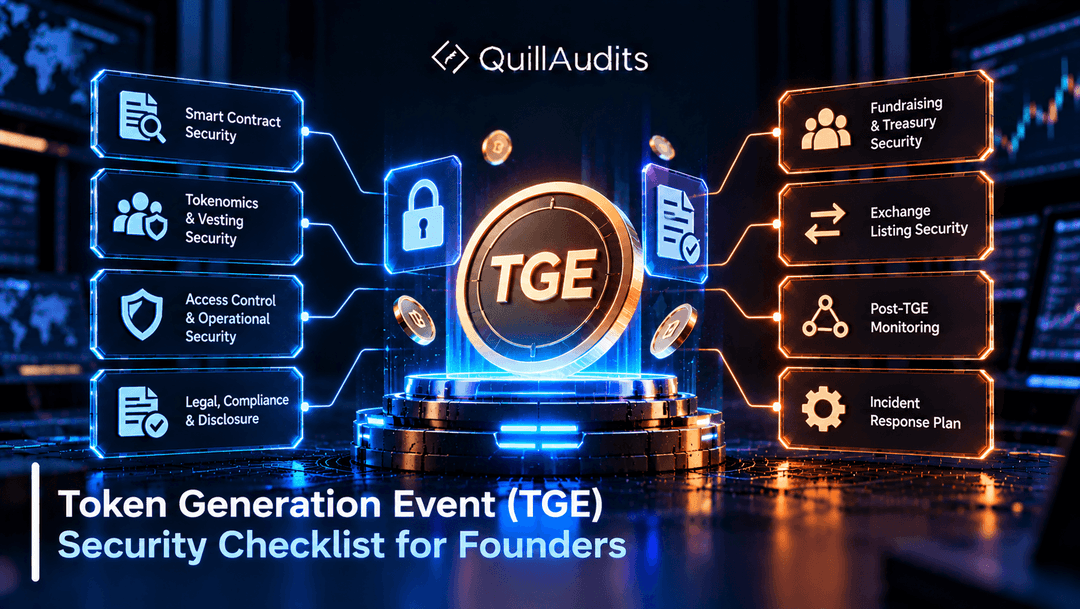
This token generation event checklist covers the security steps most TGE guides skip: commissioning and publishing your audit early, deciding mint and pause authority, separating deployer, admin, and treasury roles, documenting your multisig, rehearsing deployment on testnet, and running a verified launch day, using Truebit’s $26.44M overflow exploit and the Bybit blind-signing failure as lessons.

The decision · answer in brief
This token generation event checklist covers the security steps most TGE guides skip: commissioning and publishing your audit early, deciding mint and pause authority, separating deployer, admin, and treasury roles, documenting your multisig, rehearsing deployment on testnet, and running a verified launch day, using Truebit’s $26.44M overflow exploit and the Bybit blind-signing failure as lessons.
Token Generation Event Checklist: Pre-Launch Security Steps
A token generation event checklist is incomplete if it only covers marketing timing, tokenomics design, and legal sign-off. The week before TGE, someone on your team still has to answer a narrower set of questions: who can call mint() right now, does the pause function survive launch day, and is the treasury multisig actually configured the way your documentation claims? This guide covers the operational, function-level security steps founders and developers need to execute before a token generation event, not the marketing or tokenomics prep that most TGE checklists already cover well.
What Makes TGE Week the Highest-Risk Moment for a New Token
A token generation event concentrates privilege, liquidity, and attention into a single week. Contracts that sat untouched in a testnet repo for months suddenly hold real treasury funds. Deployer wallets that nobody thought to retire still carry owner-level permissions. And the attack surface that mattered least during development, who can still act as admin, matters most the moment a token has a market price.
Truebit Protocol learned this the hard way. On January 8, 2026, an attacker drained roughly $26.44 million, 8,535.36 ETH, from the protocol by exploiting an integer overflow vulnerability in its token-purchase logic, a defect that existed because the price calculation function was compiled with Solidity ^0.6.10, a version that does not include overflow checks, according to KuCoin's incident writeup. The vulnerability was not exotic. It was the kind of defect a standard audit, and newer Solidity versions, are built to catch before a contract ever touches mainnet.
The same concentration of risk shows up on launch pads that skip the operational layer entirely. Solidus Labs examined liquidity pools on Raydium and found that approximately 93%, about 361,000 pools, exhibited soft rug pull characteristics, with a median rug pull value of about $2,832, per Solidus Labs' research. Most of those are small, but the pattern is the point: the gap between "we launched a token" and "we launched a token with no one able to quietly mint more of it or drain the treasury" is exactly the gap this checklist exists to close.
The Token Generation Event Checklist at a Glance
Here is the full pre-TGE technical checklist, ordered from earliest to latest in the launch timeline:
- Commission a smart contract audit four to six weeks out so there is time to remediate findings, and publish the report with all critical and high findings resolved before TGE.
- Decide the mint function's final state: renounced, hard-capped, or gated behind a multisig and timelock. No TGE should launch with an uncapped mint function controlled by a single EOA (externally owned account).
- Decide whether a pause function survives TGE, and if it does, document who can trigger it and under what conditions.
- Separate deployer, admin, and treasury roles across distinct wallets, none of which is a single person's hot wallet.
- Document the treasury multisig: signer identities, signing threshold, hardware wallet usage, and a verification process for every outgoing transaction.
- Run a full testnet rehearsal of the deploy, mint, pause, and any upgrade sequence in the exact order planned for mainnet.
- Write a rollback plan for what the team does if a bug, an oracle issue, or a compromised signer surfaces mid-launch.
- Assign launch-day roles so that each privileged action (deploy, mint, liquidity add, ownership transfer) has a named owner and a second person verifying it before it executes.
Each of these gets its own section below, with the reasoning and the failure modes that make it non-negotiable.
Contract Audit and Public Report Before TGE
A token generation event checklist that treats the audit as "get it done at some point" skips the part that actually matters: timing and transparency. The audit needs to finish early enough that findings get fixed and re-verified, and the report needs to be public so holders are not asked to trust a launch on your word alone.
When to Commission the Audit Relative to Launch Date
Can a TGE happen without an audit? Technically yes. Should it? Truebit's $26.44 million loss is a direct answer to that question: an integer overflow bug in outdated Solidity code drained the protocol, and in its aftermath, security analysts recommended the team conduct new security audits of its smart contracts, according to KuCoin's reporting on the incident. That recommendation reads differently before a hack than after one.
Commission the audit with enough runway to fix what it finds, not just read the report. A pre-TGE checklist published by EchoTrade states plainly that a reputable audit from a recognized firm must be completed, with critical findings resolved, and the final report made publicly available before TGE, not after launch, per EchoTrade's token launch checklist. In practice, that means starting the engagement four to six weeks out: one to two weeks for the review itself, one to two weeks to remediate findings, and time for the auditor to re-verify fixes before the report goes public. If your team is not sure its codebase is even ready for that engagement, a smart contract audit readiness checklist is worth working through first.
What the Published Report Should Include
A report that just says "no critical issues found" is not useful to a holder trying to evaluate your launch. The published audit should state:
- The exact commit hash or contract address audited, so readers know the report matches what actually deployed.
- Every finding by severity, including informational and low-severity items, with its resolution status.
- Confirmation of how mint, pause, and any other owner-privileged functions behave, since an uncapped mint function controlled by a single account is one of the most common rug-pull risk patterns auditors flag in ERC-20 reviews, as outlined in QuillAudits' breakdown of what gets checked in an ERC-20 contract audit.
- Any accepted risk the team chose not to fix, with a stated reason.
A Smart Contract Audit from QuillAudits covers exactly this surface, checking whether mint is capped or owner-controlled and who holds pause, blacklist, or freeze privileges on the contract. It is one option among the firms a team can commission for this step, and the choice of which firm matters less than making sure the engagement happens early and the result gets published.
Mint Authority, Pause Functions, and Role Separation
What is mint authority in a token contract, and should it be revoked before TGE? Mint authority is the permission to create new tokens after deployment. Whoever or whatever holds it can expand supply at will, which is why an unrevoked, unchecked mint function is one of the clearest signals a launch is unsafe.
Renounce, Cap, or Multisig-Gate the Mint Function
What happens if mint authority isn't revoked before TGE? The contract keeps a live door for someone, a founder, a compromised key, or a malicious insider, to inflate supply after the market has already priced the token. That is the exact rug-pull pattern QuillAudits flags as one of the most common findings in ERC-20 audits: an uncapped mint function controlled by a single privileged account, per QuillAudits' ERC-20 audit guide.
Before TGE, pick one of three end states for mint authority, and have your audit confirm it on-chain, not just in your documentation:
- Renounce it entirely. Fixed-supply tokens with no further minting are the simplest to reason about and the easiest for a holder to verify.
- Hard-cap it. If the tokenomics require future minting, for staking rewards or ecosystem incentives, set an immutable maximum supply in the contract so minting can never exceed a known ceiling.
- Gate it behind a multisig and a timelock. If minting needs to stay flexible, make sure no single signer can trigger it alone, and build in a delay so holders see a mint transaction queued before it executes.
What a TGE checklist should never allow through is the default state most contracts ship with during development: an EOA, externally owned account, with unrestricted mint access and no public statement about what happens to that access after launch.
Should a Pause Function Survive Past TGE?
Should a token keep a pause function after launch? It depends on what the pause function protects. A pause that halts transfers during an active exploit can limit damage while a team responds. The same pause, left under a single key's control, is also a centralization risk that undermines the "decentralized launch" claim many projects make.
The middle ground most mature projects land on: keep the pause function, but gate it behind the same multisig and timelock that governs mint, and publish the exact conditions under which the team would use it (an active exploit, a critical bug, a confirmed oracle failure). A pause function nobody can explain the purpose of is a pause function a holder is right to be suspicious of.
Separating Deployer, Admin, and Treasury Roles
A contract's deployer wallet often keeps lingering admin rights long after deployment is done, simply because nobody revoked them. That is a well-documented failure mode: a deployer key that still holds owner-level privileges is a single point of compromise for the entire protocol, as covered in QuillAudits' analysis of deployer wallet attack vectors.
Before TGE, your team should be able to answer, role by role:
| Role | Who holds it | What it controls | Should it be a multisig? |
|---|---|---|---|
| Deployer | Should be retired post-deploy | Initial contract setup | N/A once retired |
| Admin/Owner | Protocol team | Pause, upgrade, parameter changes | Yes |
| Treasury | Protocol team + advisors | Fund custody, disbursement | Yes |
| Mint authority | Contract logic or multisig | Supply issuance | Yes, if not renounced |
If any of these rows still maps to a single individual's hot wallet, that is a finding, not a formality. An Admin Audit is built specifically to review this layer: a standard smart contract audit covers the on-chain code, but as QuillAudits puts it, "the other 70% is the operational layer that goes completely unexamined unless you specifically commission an admin/opsec audit," including multisig architecture, governance thresholds, timelocks, and role-based access.
Treasury Wallet Documentation and Permissions
Should treasury wallets use a multisig before TGE? Yes, without exception. Pre-TGE treasury governance guidance from Toku recommends multi-signature requirements on every treasury transaction specifically so that no single individual retains unilateral control over funds, according to Toku's pre-TGE readiness resource.
Multisig Threshold and Signer Disclosure
A multisig is only as strong as its configuration and the discipline of its signers. QuillAudits puts the test plainly: "could one compromise reach quorum on its own. If yes, the threshold is decorative," as stated in its guide to multisig security habits that actually matter. A 2-of-3 multisig where two signers share a laptop, or where two keys live in the same cloud backup, is not meaningfully safer than a single key.
Document, before TGE, not after an incident:
- The signing threshold (for example, 3-of-5) and the reasoning behind that number relative to signer count.
- Each signer's identity and whether they use a hardware wallet. As QuillAudits notes, "a hardware wallet protects the key. It does not protect the computer that built the transaction in the first place," a reminder that the device signing a transaction is only one part of the attack surface.
- A verification step every signer follows before approving a transaction, independent of the interface that presented it to them.
- How signer rotation works if a team member leaves or a key is suspected compromised.
QuillAudits' Multisig Inspector tool gives founders a way to check a treasury Safe's configuration against this documentation step directly, though it does not replace writing the policy down and training every signer on it.
Lesson From the Bybit Multisig Blind-Signing Failure
The clearest cautionary tale for why signer process matters as much as signer count is the Bybit incident, where attackers manipulated what multisig signers saw on their screens, getting legitimate signers to approve a malicious transaction without realizing what they were authorizing. The QuillAudits writeup on the Bybit hack covers the mechanics in more detail, but the operational takeaway for a pre-TGE team is simple: a signer who approves whatever their signing interface displays, without independently verifying the transaction's actual destination and calldata, is not providing real security no matter how many signatures the multisig requires.
Blind signing is the gap a documented treasury process has to close. If your signers cannot describe, in their own words, what a pending transaction does before they sign it, your multisig threshold is theater.
Testnet Rehearsal and Deployment Runbook
The single most valuable hour a founding team can spend before TGE is a full dry run of the exact deployment sequence planned for mainnet, run on a testnet or a mainnet fork, with every privileged action exercised in order.
Dry-Running Mint, Pause, and Upgrade Paths Before Mainnet
A testnet rehearsal is not a generic "does the contract compile" check. It is a scripted walkthrough of the specific actions your team expects to take during and immediately after TGE:
- Deploy the contract with the final constructor parameters, including initial supply and any vesting addresses.
- Transfer ownership from the deployer wallet to the admin multisig, and confirm the deployer no longer holds privileged access.
- Trigger the mint function exactly as planned, whether that is a one-time initial mint or a capped scheduled mint, and confirm the resulting supply matches the published tokenomics.
- Trigger the pause function and confirm transfers halt as expected, then unpause and confirm normal operation resumes.
- If an upgrade path exists (a proxy pattern or a planned contract migration), exercise it end to end on testnet before it is ever exercised on mainnet.
Static analysis and fuzzing tools are useful here precisely because they catch the edge cases a manual rehearsal will not. Tools like Slither for static analysis, Echidna for property-based fuzzing, and the Foundry testing framework are commonly used for this kind of pre-launch verification, and QuillAudits' guide to smart contract security tools walks through how each fits into a pre-deployment workflow. Run them against the exact bytecode you intend to deploy, not an earlier draft.
Writing the Rollback Plan
A rollback plan is the document nobody wants to write because it assumes something will go wrong. Write it anyway. At minimum, it should answer:
- Who has the authority to trigger pause, and what is the communication chain for deciding to use it.
- What happens to in-flight transactions (pending mints, liquidity adds) if the team pauses mid-launch.
- How the team communicates publicly if a vulnerability is discovered after contracts are live but before full liquidity is deployed.
- Whether any portion of the launch, liquidity provisioning, airdrop distribution, is reversible, and what the irreversible point of no return actually is.
If your tokenomics include vesting schedules or lockups as part of the TGE, those contracts carry their own release-logic risks that sit outside this checklist's scope; QuillAudits' token vesting and lockup contract audit guide covers what a vesting-specific review should check.
Launch-Day Execution Checklist
On the day itself, every privileged action should have a named owner and a second person confirming it before execution, not after. A practical launch-day sequence looks like this:
- Final pre-flight check. Confirm the audited contract address matches what is about to deploy, byte for byte.
- Deploy. One named individual executes the deployment transaction; a second confirms the deployed bytecode and constructor arguments match the audited version.
- Transfer ownership. Move admin rights from the deployer wallet to the pre-configured multisig immediately, and verify the deployer wallet no longer holds privileged functions.
- Execute the initial mint, if applicable, under multisig approval, and cross-check the resulting total supply against the published tokenomics before announcing anything publicly.
- Add liquidity under the same two-person verification model, confirming pool parameters before the transaction is signed.
- Monitor. Have someone watching on-chain activity in real time for the first hours post-launch, specifically for unexpected mint events, large transfers from privileged wallets, or pause function calls nobody authorized.
- Publish confirmation. Share the deployed contract address, the audit report, and the multisig signer list publicly once launch is confirmed stable, so holders can verify everything in this checklist themselves.
A broader pre-launch security review that goes beyond TGE week specifically, covering infrastructure, front-end, and operational security, is covered in QuillAudits' general web3 security checklist, worth working through earlier in the project timeline alongside this one. QuillAudits also maintains a research hub tracking audit findings and security patterns across live protocols, useful background reading while building out your own launch-day runbook.
Final Thoughts
Most token generation event checklists stop at tokenomics design and legal review, and leave the function-level questions, who can mint, who can pause, who holds the treasury keys, undocumented until something goes wrong. The teams that get through TGE week cleanly are the ones who treat mint authority, role separation, and multisig configuration as launch-blocking items, not afterthoughts, and who rehearse the deploy sequence on testnet before touching mainnet. A combination of a Smart Contract Audit and an Admin Audit covers both layers, the code and the operational permissions around it, for a team working through this list before launch.
Contents