


What Is a Sybil Attack? How Fake Identities Drain Airdrops and Capture Governance
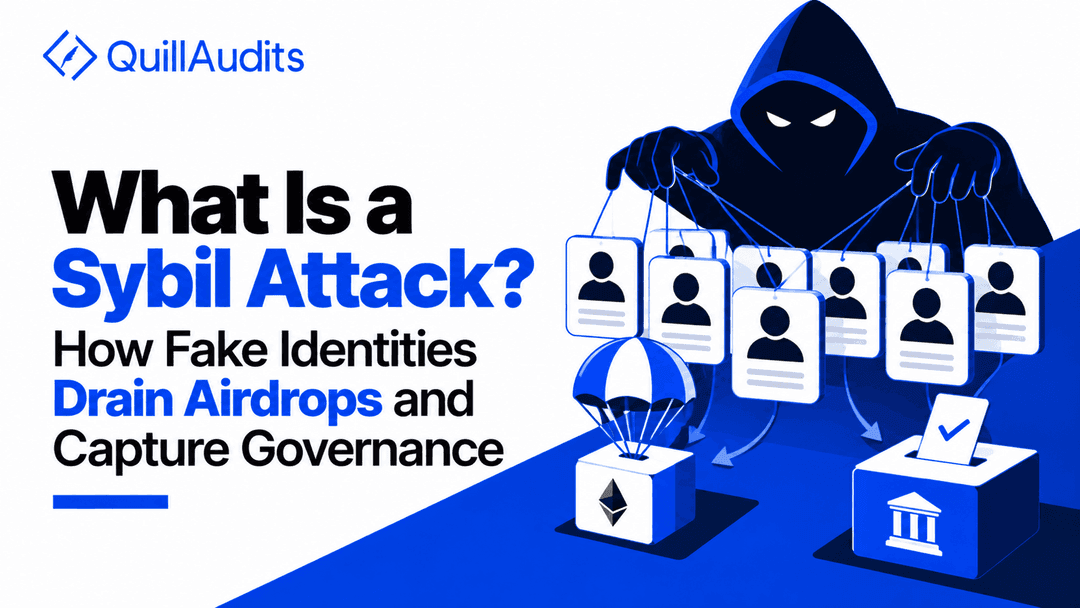
What is a Sybil attack? One actor creates thousands of fake wallets to farm token airdrops or outvote real holders in a DAO. Learn how the ROBO and Arbitrum airdrop farms worked, how governance Sybil attacks differ from BonkDAO-style vote exploits, which resistance techniques hold up, and what to review before your token generation event.

The decision · answer in brief
What is a Sybil attack? One actor creates thousands of fake wallets to farm token airdrops or outvote real holders in a DAO. Learn how the ROBO and Arbitrum airdrop farms worked, how governance Sybil attacks differ from BonkDAO-style vote exploits, which resistance techniques hold up, and what to review before your token generation event.
What Is a Sybil Attack? Airdrop and Governance Risks
A Sybil attack happens when one person or group creates many fake identities, usually wallet addresses, to make a single actor look like hundreds or thousands of independent participants. In crypto, that fake plurality lets an attacker farm a disproportionate share of a token airdrop or outvote genuine holders in a DAO (a Decentralized Autonomous Organization that governs a protocol by member vote). If you're planning a token generation event (TGE), Sybil resistance isn't a feature to bolt on after launch; it's a distribution and governance-design decision you need to pressure-test before a single token moves.
This post separates two risks that get lumped together: Sybil attacks on airdrops, where fake wallets multiply a claim, and Sybil attacks on governance, where fake voters multiply a vote. It also draws a hard line between a governance Sybil attack and a compromised-vote exploit like the ones that hit BonkDAO and Term Labs, which QuillAudits has already covered in detail.
What Is a Sybil Attack?
A Sybil attack is an attempt to gain disproportionate influence over a network or system by creating a large number of fake identities that each appear independent. The name comes from the 1973 book Sybil, a case study of a woman diagnosed with multiple personalities, and Microsoft researcher John Douceur formally applied it to peer-to-peer networks in a 2002 paper on the problem of verifying unique identities in decentralized systems.
In blockchain terms, the "identity" is usually a wallet address. If your protocol counts wallets instead of verified people, an attacker who controls 10,000 addresses, each holding a small amount of capital or activity, can impersonate 10,000 separate users. That matters most in two places you'll need to design around before launch: token airdrops, where allocation is often based on wallet-level activity, and DAO governance, where voting power is sometimes distributed per address rather than strictly by economic stake.
Why Do Sybil Attacks Hit Crypto Harder Than Web2 Platforms?
Web2 platforms fight fake accounts with centralized identity checks: phone verification, device fingerprinting, email history, behavioral scoring, all run by a company that can ban an account at will. Crypto's core design principle, permissionless pseudonymity, removes that lever. Anyone can generate a new wallet address in seconds, for free, with no name, phone number, or email attached, and no central party can unilaterally freeze it. A fake social media account still needs a phone number and has to survive a platform's fraud models; a fake wallet needs nothing but a keypair and, often, a small amount of gas money.
A Sybil attack and a 51% attack both get described as "control" problems, but they target different layers. A 51% attack hits a blockchain's consensus layer directly: an entity accumulates enough hashing power or stake to rewrite transaction history or double-spend. A Sybil attack targets the application layer sitting on top of the chain, your distribution list or voter roll, and doesn't require controlling the network itself. You can run a fully secure chain at the consensus level and still watch a Sybil farm drain your airdrop.
How Do Sybil Attacks Drain Token Airdrops?
The mechanics stay consistent across nearly every farmed airdrop: an attacker scripts a single set of actions (bridge a small amount, swap on a decentralized exchange, or DEX, provide minor liquidity, mint an NFT) and replays it across hundreds or thousands of wallets, each funded from a common source, to qualify every wallet for an allocation it has no legitimate claim to. If your claim criteria can be satisfied by a script instead of a real user, assume someone has already written that script.
Fabric Protocol's ROBO airdrop shows the scale this reaches in practice. One group used 11,204 claim wallets, funded through seven exchanges including HTX, LBank, Bitget, Poloniex, Backpack, Bybit, and Ourbit, to claim 285.6 million ROBO tokens, 87% of all tokens distributed. By the time those tokens were moved to Bitget months later, their value had fallen from roughly $12.0 million at claim time to about $3.7 million, a decline of roughly 70%.
Arbitrum's March 2023 airdrop was hit the same way at smaller scale: one attacker funneled more than 428,000 ARB tokens, worth about $531,000 at the time, through over 1,000 wallets seeded from a single funding address, DL News reported. ParaSwap took the opposite approach after its November 2021 token launch and excluded 98.5% of the active users it identified as Sybil-linked addresses from receiving tokens at all, per the same DL News report, a sign of how dominant farmed wallets can get if you leave them unchecked.
The downstream effect compounds past the claim itself. Per 2025 data aggregated by Coinlaw, 50 to 70% of airdropped tokens typically get sold within the first 30 days of distribution, and Sybil-farmed allocations are disproportionately represented in that early sell pressure since farmers have no incentive beyond converting to cash. As Hop Protocol co-founder Christopher Whinfrey put it, "Sybil farms have taken in hundreds of millions of dollars at this point," a scale that turns airdrop design into a tokenomics and treasury problem for you, not a marginal fraud line item to clean up later. Sybil farming is also distinct from the phishing and fake-claim-site scams covered in QuillAudits' Web3 airdrop scams guide; farming abuses a real airdrop's rules, while those scams trick users into signing away funds through a fake one.
LayerZero took a more direct approach with its own 2024 airdrop: a self-reporting program that let users voluntarily flag their own Sybil-linked wallets within a 14-day window and still keep 15% of their planned allocation, while paying bounty hunters 10% of a flagged wallet's intended allocation for identifying someone else's farm. It's a rare case of a protocol pricing Sybil forgiveness explicitly instead of treating every flagged wallet as a binary ban, and a model worth studying if your own distribution plan will have gray-area wallets you'd rather convert than cut off.
How Is a Governance Sybil Attack Different From a Compromised-Vote Exploit?
A governance Sybil attack works by multiplying fake voters, not by compromising real ones. QuillAudits' own breakdown of DAO governance risk describes the mechanism directly: attackers "create many fake identities, commonly known as Sybils, which they can use to vote in the DAO's decision-making process multiple times," as explained in the site's DAO governance attacks post. If your DAO grants voting weight per address rather than by proportional, time-locked economic stake, splitting one large position into many small wallets can manufacture consensus that never existed among real stakeholders.
That's mechanically different from the governance exploits this blog has analyzed as live incidents. The BonkDAO treasury drain, a loss of $21.2 million, and the Term Labs governance takeover were both executed by acquiring real capital or voting power through separate wallets to meet a quorum threshold, not by multiplying fake identities, as detailed in QuillAudits' BonkDAO governance takeover writeup. In a Sybil attack, the votes are fake. In a compromised-vote exploit like BonkDAO's, the votes are often real, but the attacker found a way to accumulate enough genuine power to force a proposal through quorum. Confuse the two and you'll build the wrong defense: identity-based Sybil resistance does nothing against an attacker who legitimately acquires tokens for a single vote, and quorum or timelock fixes do little against an attacker who simply controls more wallets than you expected.
Which Sybil Resistance Techniques Actually Hold Up?
No single Sybil resistance technique is airtight; each trades off against decentralization, cost, or privacy, which is why most serious protocols combine several. Here's how the main approaches stack up:
| Technique | How it works | Main trade-off |
|---|---|---|
| Proof of personhood | Verifies each participant is a unique human, often via biometric or social-graph methods | Centralization and privacy concerns around the verifying party |
| Economic cost (stake or fee thresholds) | Requires meaningful capital per identity, making mass wallet creation expensive | Favors wealthy actors; determined farmers still split large capital across wallets |
| Behavioral and on-chain graph analysis | Clusters wallets by funding source, transaction timing, and interaction patterns, as Bitquery did to unmask the ROBO farm | Produces false positives and runs after the fact, not before a claim |
| KYC-based identity checks | Ties a wallet to a verified real-world identity through a centralized provider running Know Your Customer, or KYC, checks | Reintroduces custodial trust and compliance overhead, the opposite of what many users want from crypto; see QuillAudits' KYC in crypto explainer for the trade-offs |
| Quadratic or reputation-weighted voting | Makes each additional identity's voting power cost more than the last, reducing the payoff of splitting a stake | Requires reliable identity or reputation data to work as intended |
Proof of personhood, verifying unique humans rather than unique wallets, draws the most research attention because it targets the root cause rather than the symptom. But none of these approaches works alone, so don't lean on just one. The ROBO and Arbitrum cases above both happened on protocols with at least some basic Sybil heuristics already in place; the farms simply found the gaps.
What Should a Pre-TGE Sybil-Resistance Review Check?
Run this checklist before your token generation event or governance launch, not after a farm has already claimed its share.
- Allocation criteria: does your qualification depend on wallet-level actions that cost little to replicate, like a single swap or bridge transaction, rather than sustained, capital-weighted activity?
- Funding-source clustering: can your team run on-chain analysis, similar to the clustering Bitquery used to unmask the ROBO farm, against your own claim list before the window closes? Running that kind of check on your wallet list a day before the deadline, rather than months after tokens have already been sold off, is what would have caught the ROBO pattern while it still mattered.
- Voting weight model: does your governance weight votes by address count or by proportional, time-locked economic stake? Address-based weighting is the direct enabler of a governance Sybil attack.
- Quorum and timelock design, separate from Sybil checks: does your DAO have quorum thresholds and execution timelocks that would slow a BonkDAO-style capital-acquisition attack, independent of whatever Sybil defenses you have for voter identity? QuillAudits' playbook on governance attacks and how DAOs can protect protocol control covers this side in depth.
- Forgiveness and bounty mechanics: does your design include a self-reporting or bounty path, along the lines of LayerZero's 14-day window, so marginal Sybil wallets have an incentive to self-identify?
- Post-claim dump exposure: given that 50 to 70% of airdropped tokens are typically sold within 30 days per the data cited above, have you modeled what a concentrated Sybil claim does to your token price if even a fraction of it dumps at once?
Final Thoughts
Sybil attacks aren't a one-time exploit to patch after the fact; they're a predictable response to any distribution or voting mechanism that counts wallets instead of unique, capital-weighted participants. The ROBO, Arbitrum, and ParaSwap cases above all happened to protocols that had already shipped and were reacting under pressure. If you model Sybil behavior into your airdrop criteria and governance weighting before the token generation event, you won't spend the following quarter clawing back allocations from wallets that should never have qualified.
Contents









