


Private Credit Pool Manager Risk: What to Check Before Launch
Credit defaults make the headlines in onchain private credit, but the pool manager contracts are where one bug reaches every lender. A teardown of seven failure points, with findings from Maple and Centrifuge reviews and a checklist to run before a credit pool goes live.

Onchain private credit has lost money in two ways. Borrowers have defaulted, as they did on Maple in 2022 and on Centrifuge pools in 2023. And pool contracts have been drained, as YieldCore's vault was in April 2026. The first kind of loss gets the headlines. The second is the one a team can remove before launch.
Neither Maple nor Centrifuge has a publicly known contract exploit. Their security reviews show how close the pool management layer can come: a withdrawal module that a delegate could swap to drain a pool, and a function that let any user set themselves as a pool's manager. Both were caught before they could be used. This post covers where that layer breaks and what to check before a credit pool goes live.
Key Takeaways
- The pool management layer decides what the pool is worth, who exits first, where capital goes and which modules are trusted. A bug there reaches every lender at once.
- In Maple's April 2023 audit, all three high severity findings sat in pool management and loan setup code.
- A pool's share price is an accounting output. Accrued interest, impairments and price updates all feed it, and each can be gamed or go stale.
- The withdrawal queue is where a credit loss becomes unfair. Whoever exits before an impairment leaves the loss to everyone else.
- Manager roles carry near total control of a pool in both designs. The key behind the role matters as much as the code.
- Platforms with many pools on many chains add a bug class single pools do not have: state shared between pools and messages accepted from the wrong sender.
- YieldCore lost about $398,700 in April 2026 because its withdraw function skipped one allowance check.
What Is a Pool Management Contract?
In a private credit pool, lenders deposit a stablecoin into a vault and receive shares. The vault itself holds very little logic. Maple's documentation describes its Pool as an ERC-4626 vault whose logic is delegated to a PoolManager, which holds most administrative functions and routes calls to the loan, strategy and withdrawal contracts. Centrifuge splits the same job between a Hub and Spokes: the Hub handles pool management, accounting and share pricing, and a Spoke on each chain holds the vaults and balances.
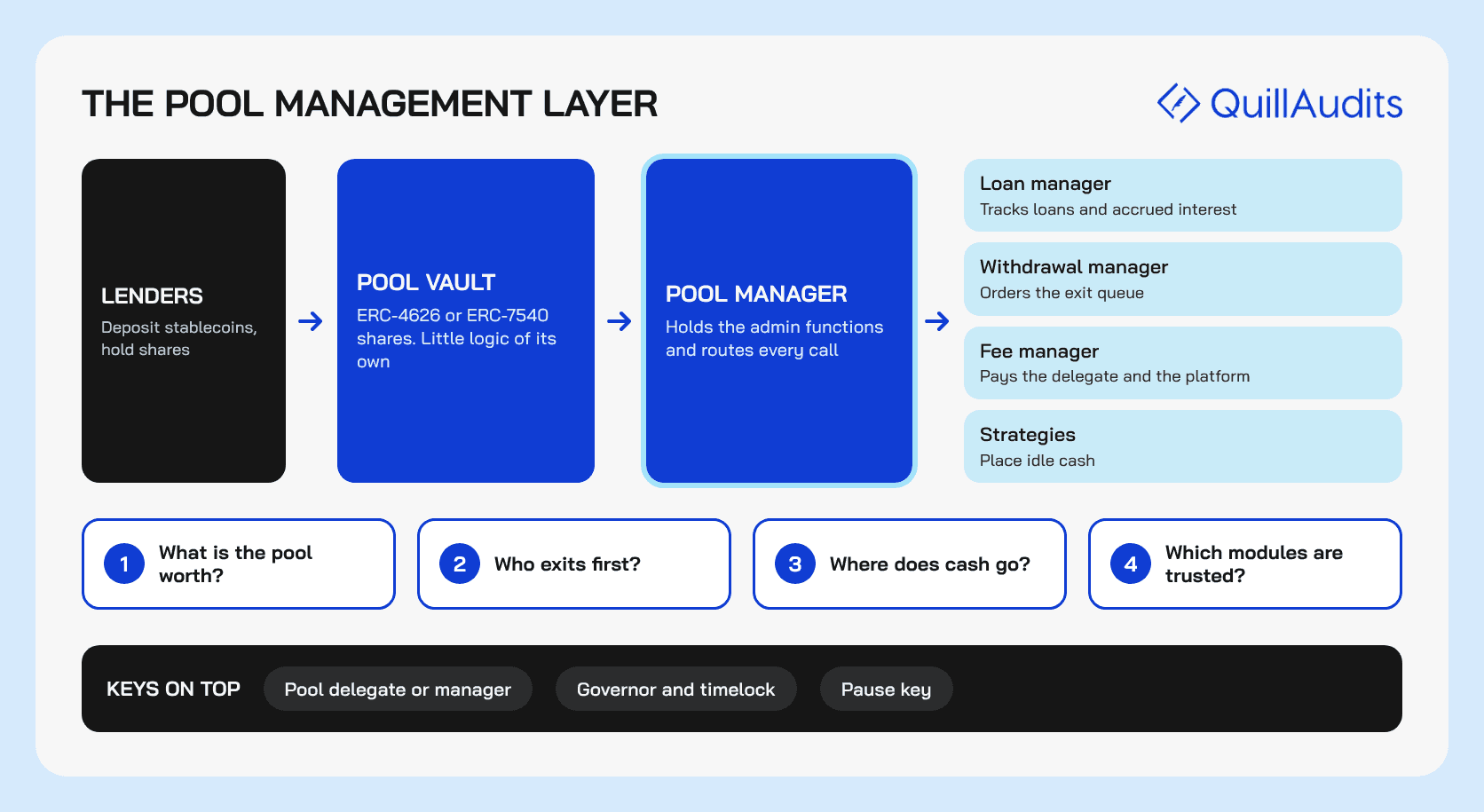
Whatever the names, this layer answers four questions for the vault:
- What is the pool worth right now?
- Who may deposit, and who gets paid out first?
- Where does idle capital go?
- Which modules and managers are trusted?
The sums behind those questions are large. Maple's syrupUSDC pool held about $1.38 billion in total assets when Yearn's curation team reviewed it in May 2026. Across the sector, rwa.xyz figures cited by Rock'n'Block put tokenized credit that can move between wallets at about $8.2 billion on 16 October 2026.
Is Smart Contract Risk the Primary Danger?
By dollars lost so far, no. The large losses in this sector were credit losses. Maple's lenders took about $36 million of defaults from one borrower pool in late 2022 after FTX collapsed. Two Centrifuge pools had about $5.8 million of loans overdue in early 2023, which we covered in our trade receivables teardown.
Contract risk is different in kind. A default costs a pool part of one loan. A pool manager bug can cost every lender everything in the pool, in one transaction, with no workout process afterwards. The record shows the bugs are there to be found, including at the two largest protocols:
| Protocol | Where the bug sat | What it allowed | Outcome |
|---|---|---|---|
| Maple V2, 2023 | PoolManager, setWithdrawalManager() | A delegate could point the pool at a malicious withdrawal manager and redeem one share for the whole pool | Found in audit, fixed |
| Maple V2, 2023 | Loan initializer, origination fee | A delegate could set a fee equal to the pool balance and collect it at loan creation | Found in audit, fixed |
| Maple V2, 2023 | Loan initializer, fee manager | A loan could be created with an unlisted fee manager, so the pool funded an attacker's contract | Found in audit, fixed |
| Centrifuge | sendSetPoolAdaptersManager | Missing access control let any user set themselves as a pool's manager | Found in review, fixed |
| Centrifuge | Pending deposit and redeem balances | State shared across pools produced incorrect deposits and redemptions | Found in review, fixed |
| YieldCore, April 2026 | withdraw() and redeem() | A missing allowance check let anyone burn another lender's shares | About $398.7K taken |
| CrediX, August 2025 | Access control manager | An account holding admin, bridge and pool roles minted unbacked tokens | About $4.5M taken |
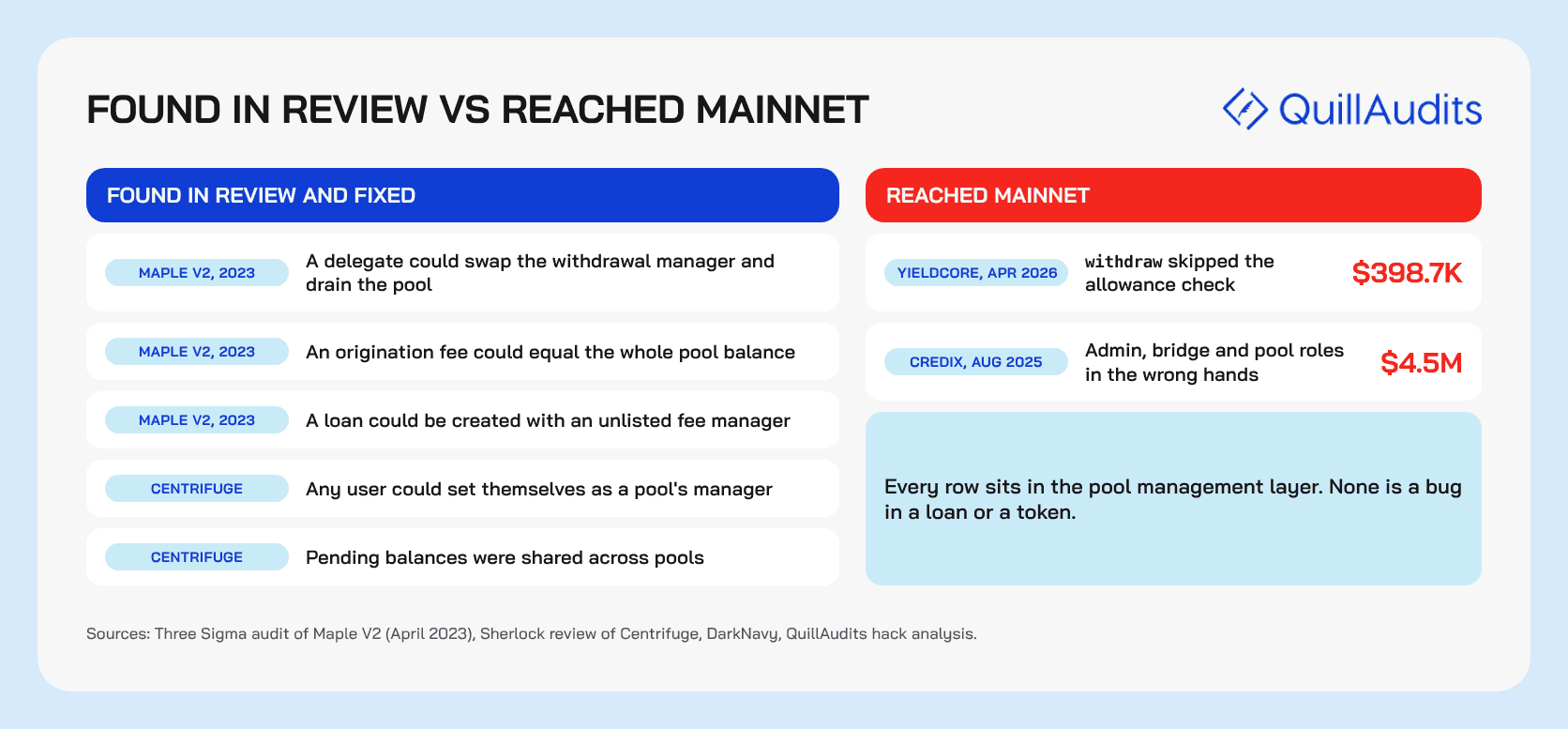
The Maple findings come from Three Sigma's April 2023 audit, the Centrifuge findings from Sherlock's review. The first five rows were found and fixed before anyone could use them. The last two reached mainnet. Every row sits in the pool management layer, and none is a bug in a loan or a token. That is the case for auditing this layer first, even while credit risk remains the larger number.
The same layer fails in seven places.
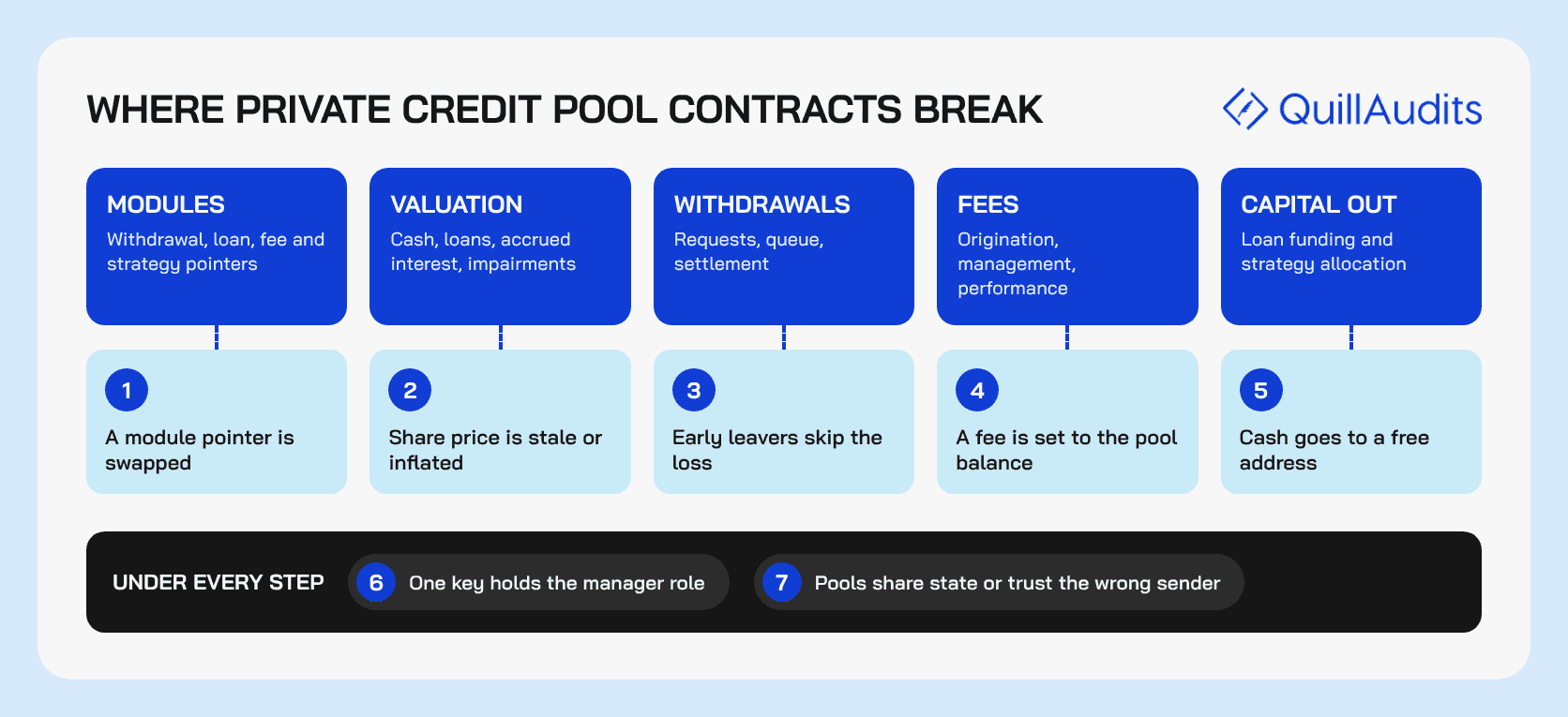
1. Who Can Swap a Module?
A modular pool trusts addresses: a withdrawal manager, a loan manager, a fee manager, a strategy, a valuation contract. Whoever can change one of those pointers can change what the pool does with lender money.
That was the Maple finding. setWithdrawalManager() was callable by the pool delegate with no allow list, and the fix moved it behind the governor and a timelock. Maple today keeps factories on an allow list in MapleGlobals and gates upgrades with time locks. Yearn measured a 24 hour minimum delay on the governor timelock and a 7 day default in MapleGlobals.
Centrifuge answers the same problem with an immutable core and pool specific extensions for valuation, transfer rules and manager permissions. The core cannot be swapped. The manager still chooses the valuation contract for each holding, so that choice is in scope.
What to check:
- Every address the pool calls is either immutable or changed only through an allow list and a timelock.
- New loans, strategies and fee managers are validated as instances of an approved factory.
- No single role can both change a module and move funds through it.
- Module changes emit events, and someone is alerted when one fires.
2. What Does the Pool Think It Is Worth?
Share price is total assets divided by shares. In a credit pool, total assets is cash plus loans outstanding plus accrued interest, minus impairments. Only the first of those is a token balance. The rest are numbers a contract or a manager writes.
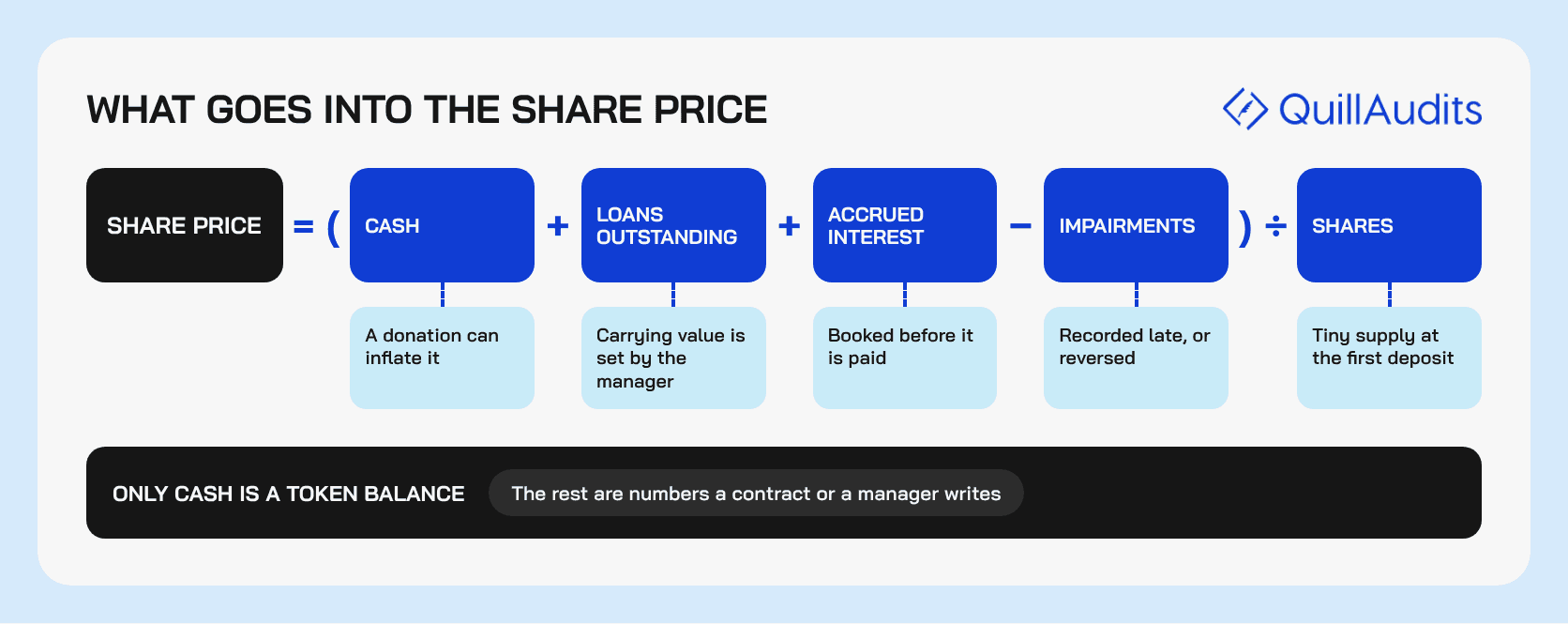
Where this goes wrong:
- Interest accrues in the books faster or slower than it will be paid, so depositors and redeemers trade at the wrong price.
- An impairment is recorded late. On Maple the pool delegate decides when to impair a loan, and Yearn notes that lenders who withdraw during an impairment take a permanent loss.
- A price update is stale. Centrifuge's ShareClassManager stores each share price with a timestamp and rejects future ones. Whatever consumes the price still has to reject old ones.
- Share price is inflated by a donation while supply is small. Edel Finance lost $403K this way in July 2026, and we explain the mechanics in our post on ERC-4626 vault inflation attacks.
- A stablecoin is hardcoded at $1. Yearn flags this in Maple's internal collateral liquidations as a depeg risk.
What to check:
- An invariant holds at all times: total lender claims never exceed cash plus performing loans at carrying value.
- Deposits and redemptions use a price no older than a defined maximum age, and revert otherwise.
- The first deposit cannot inflate the share price. Use virtual shares, a minimum deposit or a seeded pool.
- Impairment and its reversal are tested with deposits and redemptions landing before, during and after.
- Rounding always favours the pool.
3. Who Gets Out First?
A credit pool cannot pay everyone at once because the money is lent out, so every design has a queue. Maple uses a first in, first out withdrawal queue. Yearn reports that requests are typically processed within minutes to two days, and can take up to 30 days when liquidity is low. Centrifuge vaults use ERC-7540, a standard it co-authored with Maple, so deposits and redemptions can be requested now and settled later.
The queue was tested in April 2026. Dune data cited by Rock'n'Block shows more than $800 million leaving Maple's pools within 72 hours after a bridge exploit elsewhere in DeFi. Yearn's snapshot the following month found the queue empty.
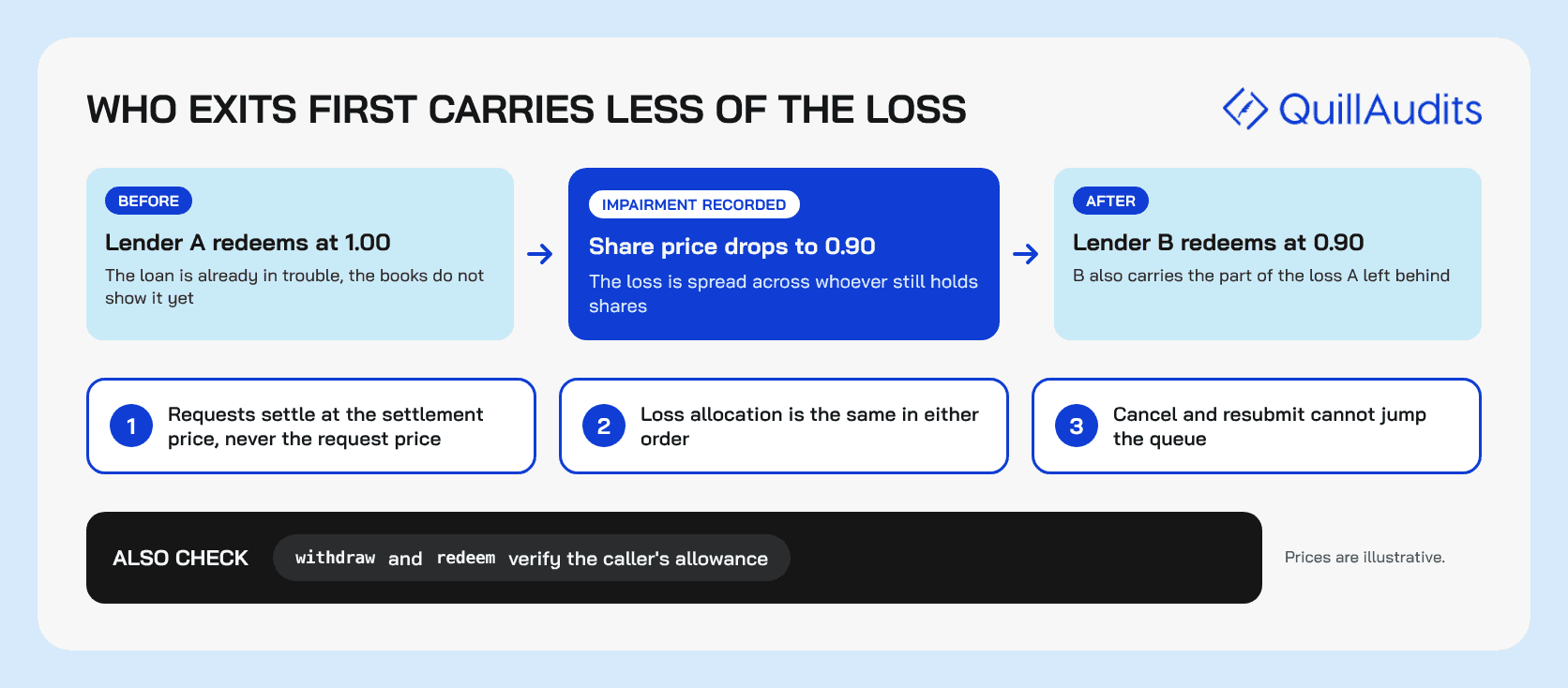
The code risks in a queue:
- A request is fulfilled at a price set before bad news. Early leavers are paid in full and the loss lands on those behind them.
- Requests can be cancelled and resubmitted to jump position.
- A third party can redeem someone else's shares. This was YieldCore on 28 April 2026. Its
withdrawandredeemoverrides dropped the ERC-4626 allowance check, and an attacker burned the shares of seven lenders and sent about $392,764 of principal to itself. - A manager can process requests out of order.
What to check:
withdraw,redeemand every request function check that the caller is the owner or holds an allowance or operator approval.- Loss allocation gives the same result whether an impairment lands before or after a pending redemption.
- Queue position cannot be improved by cancel and resubmit.
- The queue has been simulated under a run, with every lender requesting at once and loans maturing over months.
- Pause stops deposits and new loans without trapping claims that are already fulfilled.
4. How Much Can the Manager Take in Fees?
A fee is a transfer of pool assets to the manager, authorised by the manager's own configuration. Maple's second high severity finding was exactly this. The pool delegate could set an origination fee of almost 100% of a loan, create a loan the size of the pool and collect the pool as a fee. The fix was a protocol level cap in MapleGlobals.
What to check:
- Every fee has a hard cap in code that the manager cannot raise.
- Fee changes are timelocked and cannot apply to loans already funded.
- Performance fees are charged on interest received, never on accrued interest that may be impaired later.
- The role that sets a fee rate cannot also change the fee recipient.
5. Where Can Capital Be Sent?
Funding a loan is a transfer out of the pool to an address the manager chooses. Allocating idle cash to a strategy is the same thing. Maple routes idle capital to Aave V3, Sky and managed wallets through strategy contracts. Centrifuge offers manager contracts that limit a strategist to a set of operations approved in advance and committed as a Merkle root.
What to check:
- Loan and strategy destinations come from an allow list, never from a free address argument.
- A strategist's allowed calls are enumerated, and the list is reviewed like code.
- Caps for each strategy and each borrower are enforced in the contract.
- Assets held in a managed wallet or an offchain account are reported through a path that cannot overstate them.
6. Who Is the Manager, Really?
Centrifuge's docs say pool managers have 'full rights over all pool actions'. On Maple, Yearn's review found that the pool delegate for syrupUSDC is a single externally owned account with discretion over loans and impairments. Neither is a flaw in itself. It means the pool is as safe as that key.
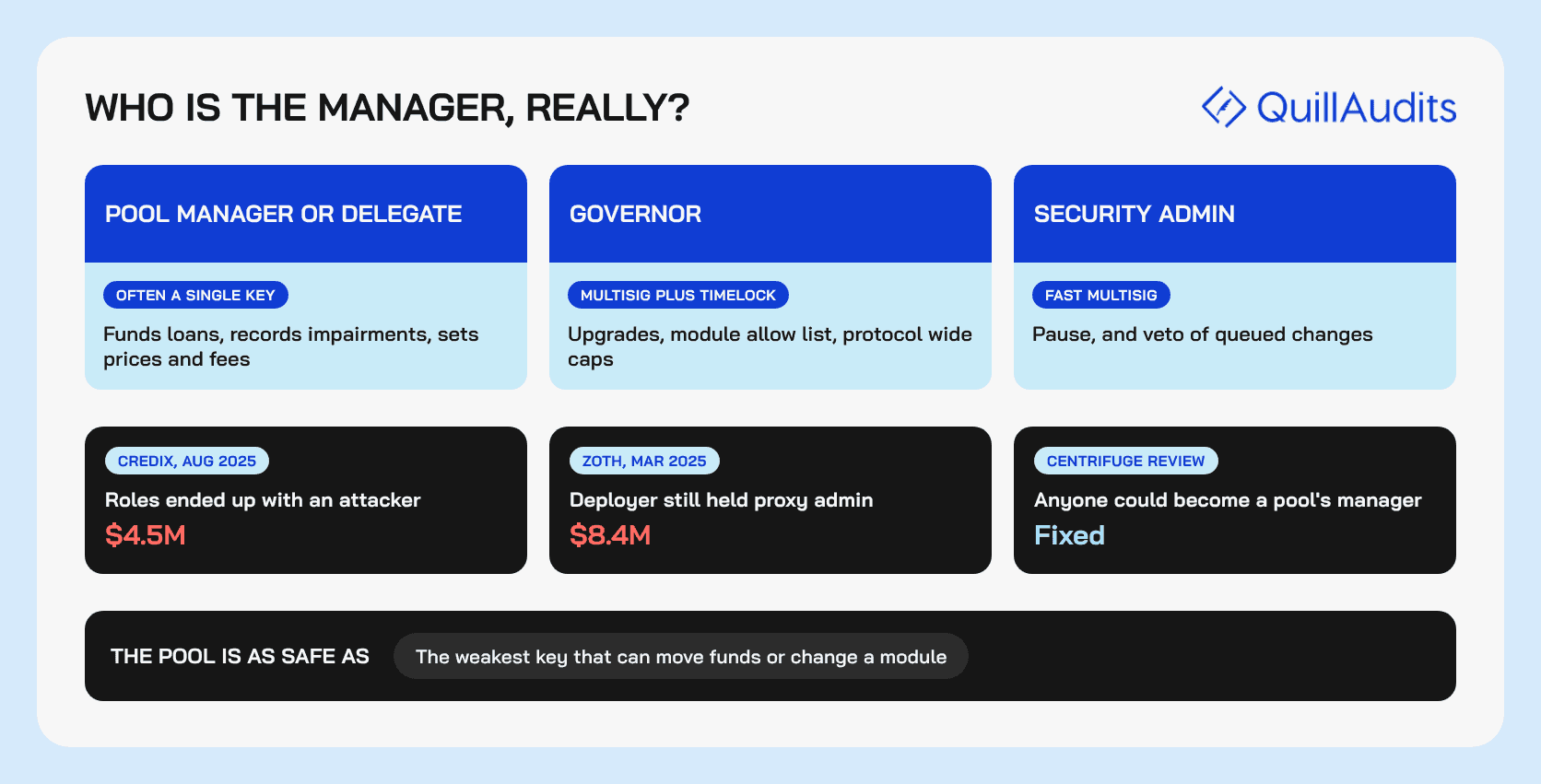
Two incidents and one near miss show what the key is worth. CrediX lost about $4.5 million in August 2025 after an account was granted admin, bridge and pool roles through its access control manager, a case our analysis traced to an exit scam pattern. Zoth lost about $8.4 million in March 2025 when a deployer key that still held proxy admin rights was used to upgrade a vault. And in Centrifuge's review, the high severity finding was the function that let any user become a pool's manager.
What to check:
- A matrix of every privileged function against every role, with the wallet type behind each.
- Manager and delegate roles sit on multisigs. Emergency pause is a separate, faster key.
- Role grants are timelocked and monitored. A new admin appearing is an alert.
- The deployer holds nothing after launch.
- Signer devices and the signing process get their own review. Our admin audit checklist covers that part.
7. Does Each Pool Keep Its Own Books?
A platform that hosts many pools on many chains shares code, and sometimes storage, between them. Sherlock's review of Centrifuge found pending balances shared across pools, which produced incorrect deposits and redemptions until every mapping and epoch was keyed by pool ID. Centrifuge's current release runs on nine chains, with one hub chain as the source of truth for each pool and adapters from LayerZero, Wormhole, Chainlink and Axelar carrying the messages.
What to check:
- Every mapping that holds balances, requests or epochs is keyed by pool and share class.
- A message handler accepts calls only from the gateway, and the gateway only from configured adapters.
- A message cannot be replayed on another chain or for another pool.
- Share supply across all chains adds up to the hub's record.
- One pool's manager cannot reach another pool's functions.
What Should Be Checked Before Going Live?
Put the seven sections together and add monitoring, and you get the list to run before the first deposit.
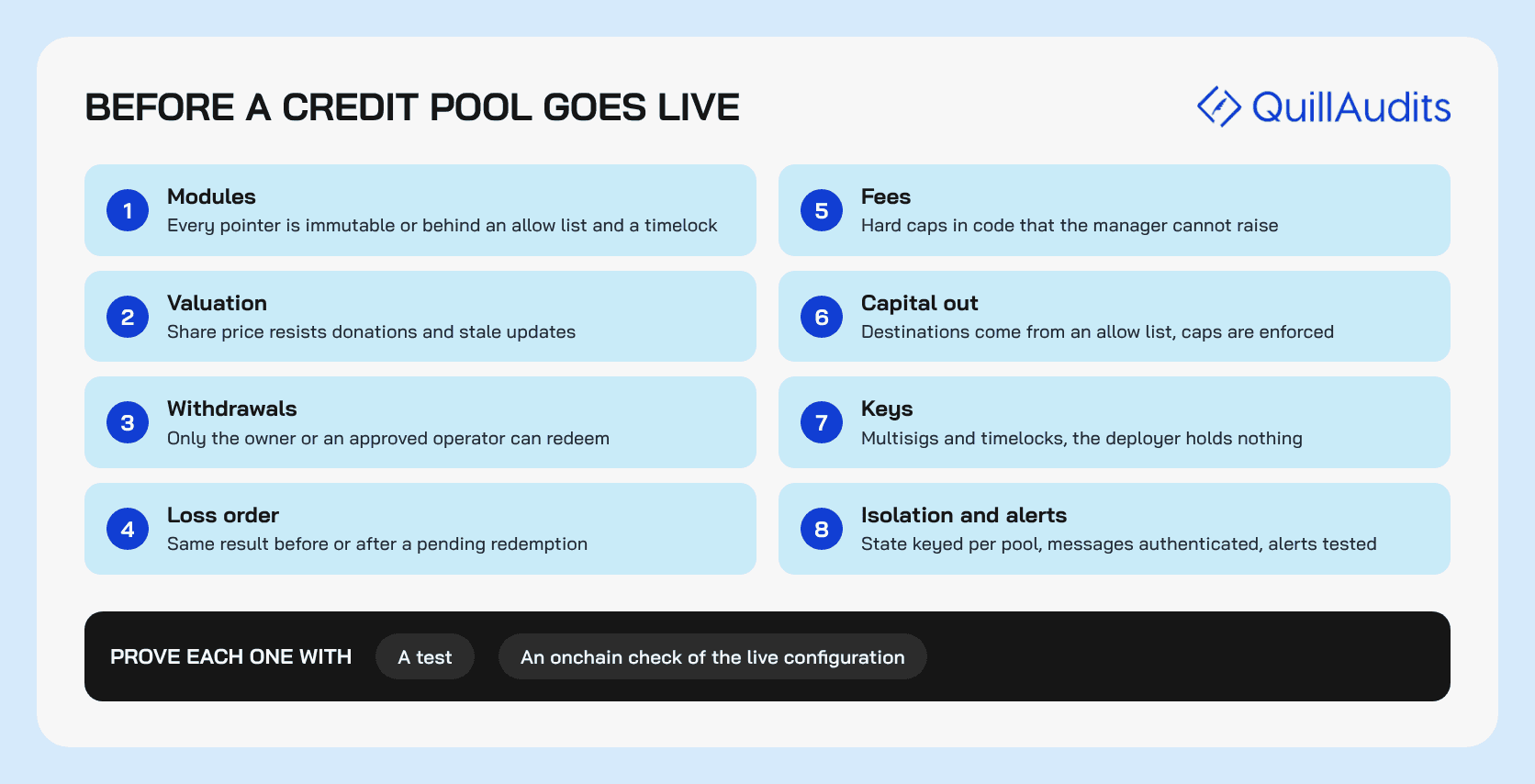
| # | Area | Must be true at launch | How to prove it |
|---|---|---|---|
| 1 | Modules | Every pointer is immutable or behind an allow list and a timelock | Role matrix, fork test of each setter |
| 2 | Valuation | Share price cannot be moved by a donation or a stale update | Invariant tests, first deposit test |
| 3 | Withdrawals | Only the owner or an approved operator can redeem | Fuzzing every exit function with a third party caller |
| 4 | Loss order | Loss allocation does not depend on who requested first | Impairment tests around pending requests, run simulation |
| 5 | Fees | Hard caps in code | Unit tests at the cap and one unit above it |
| 6 | Capital out | Destinations on an allow list, caps enforced | Review of the strategist policy and each strategy |
| 7 | Keys | Multisigs and timelocks, the deployer holds nothing | Onchain check of every role holder on the live deployment |
| 8 | Isolation and alerts | State keyed per pool, messages authenticated, alerts firing | Tests with two pools and two chains, dry run of each alert |
A Solidity review covers the first six rows. The last two need the live configuration, the keys and the monitoring, so the scope has to include them.
QuillAudits has worked with 1,500+ Web3 projects, including 20+ RWA teams. If you are designing a credit product, Tokenization 101 will help with standards and vault design, and our founder's guide to tokenizing private credit covers custody and compliance. When you want the pool contracts, the keys and the monitoring reviewed together before launch, talk to us.
Frequently Asked Questions
What is a pool manager contract?
It is the contract, or set of contracts, that runs a lending pool on behalf of the vault. It holds the administrative functions, computes what the pool is worth, routes capital to loans and strategies, and decides how withdrawals are queued and paid.
Have Maple or Centrifuge been hacked?
No contract exploit is on public record for either. Their losses came from borrower defaults in 2022 and 2023. Their published security reviews did find high severity issues in pool management code, which were fixed before they could be used.
What is the biggest smart contract risk in a private credit pool?
The pool management layer. A bug in a single loan affects that loan. A bug in the code that sets the share price, orders withdrawals or lets a manager swap a module affects every lender in the pool at once.
Why do credit pools use ERC-7540?
Loans cannot be recalled instantly, so deposits and redemptions have to be requested first and settled later. ERC-7540 standardises that request and settle flow on top of ERC-4626, which lets other protocols integrate a pool without custom code.
What should be audited before a private credit pool launches?
The pool, manager, loan, withdrawal, fee and strategy contracts, with invariant and fuzz testing on valuation and exits. Then the live configuration: who holds each role, which modules are set, what the timelocks are, and whether alerts fire for role grants, module changes and stale prices.
Contents









