


What Breaks in Tokenized Trade Receivables: 7 Security Risks
A security teardown of tokenized trade receivables and invoice financing. Seven places these platforms fail, from double financing and the fiat leg to default logic, interest math, role sprawl, upgrade keys and transfer compliance, with what to test in each before launch.

The decision · answer in brief
Tokenized trade receivables break in seven places: the same invoice financed twice, bank and chain balances drifting apart, default and redemption logic, interest math, too many privileged roles, a single upgrade key, and transfers that skip compliance. Most of these sit outside the token contract, so a review has to cover the offchain services and the keys as well as the Solidity.
Most losses in tokenized trade receivables start at a point where the contract has to trust something it cannot see: whether the invoice exists, whether the buyer's payment reached the bank, whether the person marking a loan as defaulted is allowed to. The Solidity around those points is usually fine. The assumptions underneath it are what give way.
This is a teardown of the seven places to look first when a trade finance or invoice financing platform moves onchain, with what goes wrong in each and what to test before launch.
Key Takeaways
- The same invoice can be financed twice unless its identity is anchored to something outside the originator's own database.
- The fiat leg is an oracle. If the bank balance and the vault's accounting can drift apart, redemptions pay out money that is not there.
- Default, write off, recall and redemption form a state machine. The serious bugs sit in the transitions.
- Interest math fails quietly. A day count mismatch on a $10 million pool at 12% for 90 days is $4,109.59.
- Operator roles multiply, and each one that can move funds or change a loan's status is a key someone can lose.
- An upgrade key held by one wallet makes every other control optional.
- Transfer restrictions have to hold on every path that changes a balance, including forced transfers and wallet recovery.
What Is a Tokenized Trade Receivable?
A trade receivable is an invoice a buyer has agreed to pay, usually in 30 to 120 days. Tokenizing it means recording that claim onchain so investors can fund the supplier today and collect when the buyer pays.
A typical build has four parts. An access layer onboards and whitelists participants. An origination module registers each receivable and its terms. A vault holds investor money. A loan or note contract tracks repayment, default and redemption for each funded deal.
The demand is real. The Asian Development Bank puts the global trade finance gap at $2.5 trillion in 2025, about 10% of world trade. On the supply side, rwa.xyz tracked $8.64 billion of tokenized credit distributed onchain and $42.84 billion represented onchain as of 13 November 2026.
The loss record is worth reading before the growth charts. In February 2023, about $5.8 million of loans were overdue across two Centrifuge pools that included invoice and trade receivables financing. Later that year the default of a freight invoice pool put $1.84 million of MakerDAO's DAI at risk, and Maker halted lending to a trade credit pool after $2.1 million of loans went unpaid. No contract was exploited in any of these cases, because the contracts did exactly what they were built to do and recorded what they were told.
Where Do Tokenized Receivables Break?
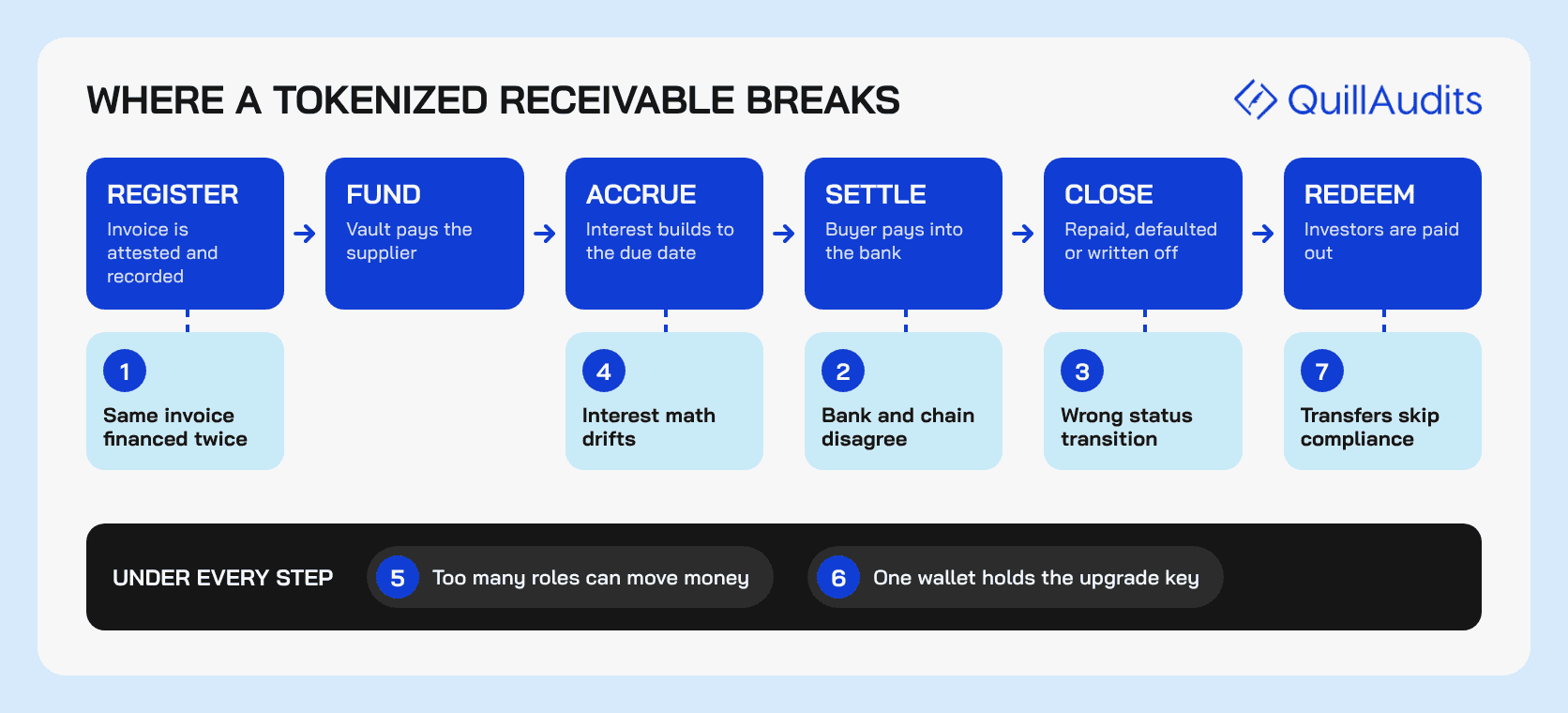
| # | What breaks | Where it lives | First thing to test |
|---|---|---|---|
| 1 | Invoice financed twice | Origination, registry, attestation | Can two receivables point to one invoice? |
| 2 | Bank and chain disagree | Fiat vault, settlement updates | Can redemptions exceed confirmed cash? |
| 3 | Wrong status transition | Loan and note accounts | Every transition, from every state, by every role |
| 4 | Interest drift | Accrual and prepayment math | Day count, rounding direction, dust |
| 5 | Role sprawl | Access manager | Who can move funds or change status alone |
| 6 | Upgrade key compromise | Proxy or beacon admin | Multisig, timelock, alerting |
| 7 | Transfer skips compliance | Token and compliance module | Forced transfer, recovery, mint and burn |
1. Can the Same Invoice Be Financed Twice?
Double financing is the oldest fraud in receivables finance, and putting the receivable onchain does not remove it by default. After First Brands Group filed for bankruptcy in September 2025, its restructuring officer alleged that at least $2.3 billion of receivables finance liabilities rested in significant part on forged invoices, and court filings describe the same invoices being sold to more than one factor. Trade press later reported that lenders typically never saw the underlying invoices.
The onchain version of this starts when the receivable's identity comes from the originator. If the registry keys a receivable by an ID the caller supplies, the originator can register the same invoice under two IDs, or finance it once onchain and once at a bank that never looks at the chain, and a ledger only prevents the duplicates it can see.
The same shape of bug shows up in other asset classes. In one of our published findings, a tokenized gold vault returned a custody certificate to the customer instead of retiring it, so the certificate could be deposited again to mint claims against gold that had already left. Swap the certificate for an invoice and you have double financing.
What to check:
- The dedup key is derived from the invoice's content and an external registry, never chosen by the caller. India's e-invoicing system is a useful model: the government portal issues a 64 character hash from the supplier's tax ID, financial year, document type and document number, and a second registration of the same document is rejected.
- The attestation that an invoice is real is signed by someone other than the borrower. The signature covers amount, debtor, due date, pool and chain ID, so it cannot be replayed elsewhere.
- Amount, debtor and due date are immutable after funding. Any edit path is a way to inflate collateral.
- The buyer has confirmed the invoice. Without that, the pool is funding a claim the seller made about itself.
2. What Happens When the Bank and the Chain Disagree?
Trade receivables settle in fiat. The buyer pays into a bank account, and someone then tells the contract that the money arrived. That message is an oracle update whatever the function is called, and it deserves the same scrutiny as a price feed.
The failure is drift: the vault believes it holds more than the bank does. It comes from repayments recorded before funds clear, a payment recorded twice after a retry, reversals and chargebacks that have no onchain equivalent, and currency conversion when the invoice is in one currency and the pool in another.
What to check:
- Recording a fiat receipt requires a unique bank reference, and the same reference cannot be used twice.
- Redemptions are capped by confirmed cash, never by accounting value.
- A reversal path exists for bounced payments and cannot be used to reduce honest balances.
- One operator key cannot both record a deposit and withdraw against it.
- Bank statements are reconciled against onchain balances on a schedule, and a mismatch pauses redemptions.
3. Who Decides a Loan Has Defaulted?
A receivable moves through states: registered, funded, partly repaid, repaid, overdue, defaulted, written off, recalled, redeemed. Every function that changes one is a transition, and the bugs sit in the transitions nobody drew on the whiteboard.
The patterns repeat across credit protocols:
- A repayment is accepted after write off, with no rule for who receives it.
- A recall returns investor funds but leaves the loan marked active, so interest keeps accruing on nothing.
- Redemption pays early leavers at full value just before a write off lands on everyone else.
- A prepayment closes the loan with a few units of principal outstanding, which blocks the final redemption for good.
Defaults are when this code finally runs. Goldfinch saw three borrower defaults between 2023 and 2024, including a $10.15 million pool where the borrower was expected to repay about $4.25 million. Those were credit losses. Splitting them fairly between investors was the contract's job, and that only works if the state machine was right before the first missed payment.
What to check:
- Write out the full state table and test every transition from every state, including the ones that should revert.
- Loss allocation gives the same result whether a write off lands before or after a pending redemption.
- Redemption uses a request and settle flow in the style of ERC-7540, so nobody exits at a stale value ahead of bad news.
- An invariant holds at all times: total holder claims never exceed cash plus performing receivables at carrying value.
4. How Much Interest Is Actually Owed?
Trade finance runs on day count conventions, and they disagree. A $10 million pool at 12% for 90 days earns $300,000 under ACT/360 and $295,890.41 under ACT/365. If the term sheet says one and the contract implements the other, the gap is $4,109.59 on that pool alone, repeated on every pool after it.
The smaller errors are harder to spot. Integer division in Solidity truncates, so dividing before multiplying loses precision on small invoices. Receivables are bought at a discount, and yield on face value is a different number from yield on purchase price. Due dates are calendar dates in someone's time zone while the contract only knows block timestamps.
What to check:
- One documented convention, implemented once, in a library with its own tests.
- Multiply before dividing, round in the pool's favor, and fuzz with small invoice amounts where truncation dominates.
- Partial repayments apply in a fixed order: fees, then interest, then principal.
- Splitting one repayment into several smaller ones never lowers the total interest collected.
5. How Many Roles Can Move Money?
Permissioned credit platforms collect roles: admin, originator, servicer, verifier, compliance officer, treasury, pauser, upgrader. Each was added for a good reason. Together they are the attack surface, because a regulated platform is operated by keys, and keys get phished. Our admin audit checklist covers the general case.
The failures specific to this kind of platform:
- A role that can grant itself other roles.
- A servicer who can change the address repayments are sent to.
- Roles granted to single wallets during testing and never revoked.
- On a platform that hosts several originators, one tenant's admin reaching another tenant's pools.
- Signed approvals with no nonce or expiry, which lets an old approval be reused.
What to check:
- Build a matrix of every privileged function against every role. For each cell, ask whether that role alone can move funds or change a loan's status.
- Different parties attest the invoice, approve funding and release money.
- Roles sit on multisigs, with a written process for rotating a signer who leaves.
- Every signed approval carries a nonce, an expiry and the chain ID.
6. Who Holds the Upgrade Key?
Almost every RWA platform is upgradeable, because regulation and product terms change. That makes the upgrade key the most valuable object in the system. In March 2025 the RWA protocol Zoth lost about $8.4 million after an attacker compromised a deployer wallet that still held admin rights over a vault proxy and upgraded it to a malicious implementation. The vault logic itself had no bug to exploit.
Beacon patterns raise the stakes. One beacon upgrade changes the logic of every loan and vault instance at once.
What to check:
- Proxy and beacon admins are multisigs behind a timelock. The deployer holds nothing after launch.
- Storage layout is checked on every upgrade, and initializers cannot be called twice.
- Admin actions emit events that are monitored, with an alert a person sees within minutes.
- An operational security review covers signer devices, key storage and the signing process. A correct contract is still one phished signer away from a malicious upgrade.
7. Can a Token Reach a Wallet That Failed KYC?
Receivable tokens are treated as securities in most jurisdictions, so transfers are limited to verified holders. Standards such as ERC-3643 do this by checking an identity registry and a compliance contract on each transfer. The standard transfer path is well tested. Restrictions leak through the side doors:
- Forced transfers and wallet recovery, built for court orders and lost keys, that skip the eligibility check on the receiving wallet.
- Mint and burn paths used for subscriptions and redemptions that skip compliance.
- A vault share or wrapper token that moves freely while the underlying token is restricted.
- An eligibility signature that still works after the investor has been offboarded.
- A compliance module address that an admin can swap for an empty one.
What to check:
- Every function that changes a balance runs the same eligibility check on the receiver.
- Revoking an investor takes effect on the very next transfer.
- Freezing applies to pending redemption claims as well as balances.
What Should an Audit of Tokenized Receivables Cover?
A Solidity review covers part of this list. The rest sits in the services that feed the chain and the people who hold the keys, so the scope has to follow the money end to end:
- Contracts, with invariant and fuzz testing on the state machine and the interest math.
- The attestation and settlement services that tell the contracts what happened offchain.
- Roles, multisig configuration and signer operational security.
- The upgrade process, including timelocks and storage layout checks.
- Monitoring for admin actions and for drift between bank and chain.
QuillAudits has worked with 1,500+ Web3 projects, including 20+ RWA teams. If you are building trade finance or private credit onchain, Tokenization 101 will help you choose standards and vault design, and What Breaks in RWA Tokenization maps how tokenized assets have failed so far. When you want the contracts, the keys and the fiat leg reviewed together, talk to us.
Frequently Asked Questions
What is a tokenized trade receivable?
It is an invoice a buyer has agreed to pay, recorded onchain as a token or a pool position so that investors can fund the supplier before the due date and be repaid when the buyer settles.
Can blockchain prevent double financing of invoices?
Only for duplicates the chain can see. It stops the same invoice being registered twice in one registry if the invoice ID is derived from the invoice itself. It does nothing about a seller who also pledges that invoice to a bank offchain, which is why external registries and buyer confirmation still matter.
Is tokenized trade finance safe for investors?
It carries two kinds of risk. Credit risk is the buyer not paying, and no contract removes it. Technical risk covers the seven areas above: invoice authenticity, the fiat leg, default logic, interest math, roles, upgrade keys and transfer restrictions. Technical risk can be tested before launch.
Which token standards are used for tokenized receivables?
Permissioned tokens commonly use ERC-3643, which ties transfers to an onchain identity registry. Pools often use ERC-4626 vaults, with ERC-7540 added when deposits and redemptions settle asynchronously.
What does a security audit of a trade finance platform include?
A full review covers the smart contracts, the offchain services that attest invoices and report bank settlements, role and key management, the upgrade process and monitoring. Reviewing only the Solidity leaves the fiat leg and the keys untested.
Contents









