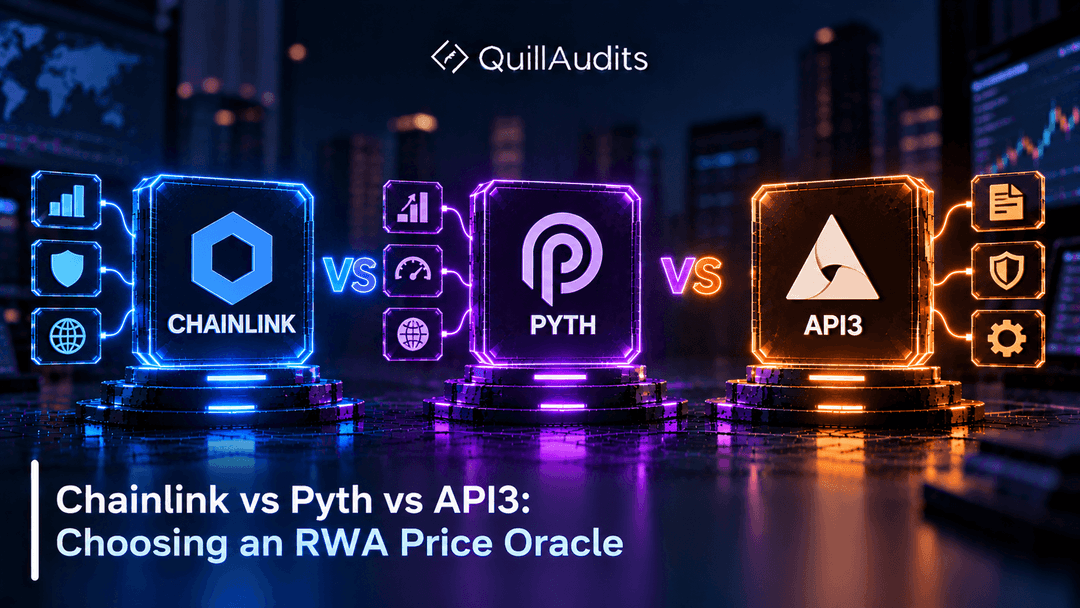
Chainlink vs Pyth vs API3: Choosing an RWA Price Oracle
What does your RWA price feed do when the market behind it closes? This price feed oracle comparison for 2026 pits Chainlink, Pyth, and API3 on push vs pull delivery, first-party sourcing, weekend staleness, and RWA tooling like NAVLink and OEV, plus a pre-integration checklist drawn from the Ostium and Loopscale exploits.

The decision · answer in brief
What does your RWA price feed do when the market behind it closes? This price feed oracle comparison for 2026 pits Chainlink, Pyth, and API3 on push vs pull delivery, first-party sourcing, weekend staleness, and RWA tooling like NAVLink and OEV, plus a pre-integration checklist drawn from the Ostium and Loopscale exploits.
Price Feed Oracle Comparison 2026: Chainlink vs Pyth vs API3
A price feed oracle comparison 2026 for RWA builders comes down to one question that most vendor pages avoid answering directly: what does the feed do when the market behind it is closed? This post compares Chainlink, Pyth, and API3 on push versus pull delivery, first-party versus node-operator data sourcing, weekend and after-hours staleness, and the RWA-specific tooling (NAV, Proof of Reserve, OEV) each one ships, so you can wire the right oracle into a vault or lending market instead of discovering the gap during an incident. If you need the oracle basics first, QuillAudits' blockchain oracle explainer covers what an oracle is and how decentralized oracle networks (DONs) work before you get into vendor selection.
Tokenized equities, treasuries, and commodities trade on-chain around the clock, but the markets that set their reference price don't. That mismatch is not a theoretical edge case. It's the exact failure mode behind QuillAudits' own forensic coverage of a Coinbase tokenized-equity feed freezing over a weekend, and it's the lens this comparison uses throughout.
Why RWA Price Feeds Are Harder Than Crypto Price Feeds
A crypto price feed only has to track a market that never closes. An RWA price feed has to track a market that closes on a schedule, a token that keeps trading after it closes, and a set of corporate actions (dividends, splits, delistings) that a pure crypto feed never has to model.
Chainlink's own documentation recommends using its equity, forex, and precious-metals feeds only during their specified market hours, for example 09:30 to 16:00 ET for US equities, Monday through Friday, and it warns that prices observed outside those windows may be subject to volatility and should be treated with caution, according to Chainlink's data feed selection guide. That is a vendor telling integrators, in writing, that the feed's reliability is time-of-day dependent. Chainlink also assigns each feed a market-pricing risk rating of low, medium, high, or very high based on the underlying asset's liquidity, source concentration, and recent market events such as hacks or delistings, per the same documentation.
The practical consequence: a vault that prices collateral with an RWA feed inherits the underlying market's trading calendar whether its smart contract code acknowledges that calendar or not. Get this wrong and you get a tokenized stock that keeps moving on a DEX while the oracle reports Friday's closing print, two days stale.
Price Feed Oracle Comparison 2026: Chainlink vs Pyth vs API3 at a Glance
The three oracles solve the same problem (get an external price on-chain) with different delivery models, different data-sourcing philosophies, and different answers to what happens when the reference market shuts for the weekend.
| Chainlink | Pyth | API3 | |
|---|---|---|---|
| Primary delivery model | Push (Data Feeds), with pull added via Data Streams | Pull-first, sub-second off-chain updates | Push, via first-party dAPIs |
| Data sourcing | Node operators aggregating from multiple data sources | 138+ first-party publishers (market makers, exchanges, trading firms) submitting directly | First-party only, via each provider's own Airnode |
| Update trigger | Deviation threshold and/or heartbeat interval | On-demand pull when a consumer needs a fresh price | Deviation threshold and/or heartbeat interval |
| Confidence signal | Aggregated median price | Price plus a confidence interval that widens under volatility or low liquidity | Aggregated median price |
| RWA-specific tooling | SmartData (NAVLink, Proof of Reserve) | 2,022+ equity feeds, 299+ FX feeds, 189+ commodity feeds | OEV Network revenue share |
| Scale (self-reported) | Used by Aave, Compound, Morpho for liquidations | 3,600+ live price feeds, 720+ data consumers, 114 blockchains | 190+ dAPIs across major EVM chains |
Sources for the figures in this table are cited in the sections below, each tied to the vendor's own documentation or network stats page.
Push vs Pull Oracle Models for Tokenized Assets
A push oracle writes a price to the blockchain on its own schedule, triggered by a deviation threshold or a heartbeat timer, so the price sits in a contract ready to read at zero extra cost to the consumer. A pull oracle does the opposite: it keeps prices off-chain until a consuming application explicitly requests (pulls) a signed, fresh update and pays the gas to post it. Push feeds are cheaper to consume and simpler to integrate; pull feeds are fresher at the moment of use but require the integrator to actively request an update before relying on the price, according to Chainlink's own push-vs-pull explainer.
That distinction is the single biggest factor in how an oracle behaves when the underlying market closes, because a push feed left alone past its heartbeat just sits there holding Friday's print, while a pull feed only goes stale if nobody bothers to request a fresh one.
Chainlink: Data Feeds (push) and Data Streams (pull)
Chainlink Data Feeds update on-chain when either of two triggers fires: the off-chain price has moved past a deviation threshold (Chainlink's own explainer uses a 0.5% move as its illustrative example) since the last on-chain update, or a heartbeat interval has elapsed (the same explainer uses 10 minutes as its example) since the last update, according to Chainlink's push-vs-pull explainer. The exact threshold and interval are set per feed, but the mechanism is the same everywhere: a feed that hasn't crossed its deviation threshold or hit its heartbeat simply doesn't write a new price, whether the underlying market is open or closed. Aave, Compound, and Morpho all use Data Feeds for liquidation pricing, which is exactly the use case where a stale weekend price becomes a protocol-level risk rather than a display glitch.
Chainlink Data Streams flips the model: a decentralized oracle network (DON) generates signed price reports off-chain at sub-second speed, and the application pulls and verifies the report on demand rather than waiting for a scheduled on-chain write. GMX and Kamino use Data Streams for derivatives and perps pricing, where sub-second freshness matters more than the gas savings of a push feed, according to Chainlink's Data Streams mainnet announcement.
Pyth: Pull-First, Sub-Second Off-Chain Updates
Pyth is built pull-first from the ground up. First-party publishers submit prices directly to Pythnet, the network aggregates them per slot into a price and a confidence interval, and the consuming application pulls a signed update exactly when it needs one, according to Pyth's price feeds documentation, which describes Pyth Price Feeds as delivering "real-time financial market data sources from 120+ first-party providers". There is no heartbeat to miss, because there is no scheduled push to begin with. If nobody pulls an update, the stored last-pulled price simply ages, and reading it comes with an explicit publish timestamp an integrator can check.
API3: Push-Based dAPIs via First-Party Airnode
API3's dAPIs (decentralized APIs) are managed, aggregated price feeds that still use the push model, updating on-chain based on a deviation threshold or heartbeat much like Chainlink Data Feeds. API3's Market lists 190 plus dAPIs across major EVM chains covering crypto, stablecoins, and liquid staking and restaking tokens, according to API3's own "What is API3?" post. The difference from Chainlink isn't the delivery model, it's who is pushing: API3 routes every update through a first-party Airnode rather than a third-party node-operator network, which the next section covers in detail.
First-Party vs Third-Party Data Sourcing
Push versus pull describes when a price lands on-chain. First-party versus third-party describes who is allowed to be the source of that price in the first place, and it's the second axis you need before picking an oracle for an RWA vault.
Chainlink's Node-Operator Aggregation Model
Chainlink's model runs through independent node operators that each pull prices from multiple off-chain data sources (exchanges, data aggregators) and report them into a DON, which then aggregates across nodes into a single on-chain price. The node operators are a layer of infrastructure between the raw data source and the chain, which is what lets Chainlink support feeds for assets that have no natural "first party" to ask directly, like a broad commodity index.
Pyth's 138+ First-Party Publisher Model and Confidence Intervals
Pyth skips the node-operator layer entirely. Market makers, exchanges, and trading firms, including Jane Street, Cumberland DRW, Jump Trading, CBOE, Binance, and OKX, submit their own prices directly to Pythnet as first-party publishers, according to Pyth's publishers page, which names these and other institutions among "+138 leading institutions powering a new era of financial infrastructure." Pyth's live network currently reports 138 plus data publishers, 3,600 plus live price feeds, 720 plus data consumers, and 114 supported blockchains, with more than $5 trillion in cumulative transaction volume through its feeds, according to Pyth's network stats page.
The other structural difference is the confidence interval. Rather than publishing a single point price, Pyth's aggregation produces a price plus a confidence band, and Pyth's own best-practices documentation notes that "during periods of high volatility, large price moves widen confidence intervals and can cause significant slippage relative to your executable quote," according to Pyth's price feeds best-practices guide. That gives an integrator a built-in signal of reduced reliability instead of a number that looks equally trustworthy at 2pm on a Tuesday and 2am on a Sunday. A vault that checks the confidence interval, not just the price, can widen collateral haircuts automatically when the market the price depends on is thin or closed.
API3's First-Party-Only Airnode Model
API3 goes further than Pyth on the sourcing axis: every dAPI is fed exclusively by first-party Airnodes, meaning the data provider runs its own oracle node rather than relying on a third-party node operator to relay its API, according to API3's own explainer. There is no node-operator marketplace at all in API3's design; the provider that owns the data is the only entity allowed to push it on-chain. That removes one layer of trust (you don't have to trust a node operator's relay of someone else's API) but it also means API3's feed coverage depends entirely on which data providers choose to run an Airnode, which is why its roughly 190 dAPIs skew toward crypto, stablecoins, and liquid staking tokens rather than the deep equity and FX coverage Pyth and Chainlink offer.
Weekend and Off-Hours Price Gaps
This is the section every RWA vault integrator should read before writing a single line of Solidity, because it's where vendor choice turns into solvency risk.
How Each Oracle Handles Market-Closed Hours
A push-based equity or FX feed, Chainlink's included, typically freezes at the underlying market's close, commonly 4pm ET on Friday for US equities, and does not resume updating until the market reopens Monday, even though the on-chain token backed by that price keeps trading all weekend, according to reporting on on-chain stock mispricing risk from CoinDesk. An industry estimate cited in the same reporting puts roughly 90% of current RWA oracle integrations on this older push model, versus a newer always-fresh pull model that can, in principle, keep sourcing a reference price around the clock from venues that do trade on weekends.
Pull-based delivery changes the mechanics but doesn't automatically solve the problem. Pyth's pull model means the price only goes stale if nobody requests an update, but if the underlying first-party publishers (the exchanges and market makers actually trading that asset) are themselves closed for the weekend, there's simply no fresh institutional price to pull, confidence interval or not. The model determines whether staleness is silent or visible, not whether the underlying market reopens early.
Why This Matters for Vaults and Lending Protocols
If you're building a vault, lending market, or liquidation engine on top of a tokenized RWA, a frozen weekend price feed creates specific, predictable failure modes:
- Phantom liquidations: if the on-chain token price moves against a position over the weekend but the oracle still reports Friday's close, undercollateralized positions can go unliquidated until Monday, by which point the loss has already compounded.
- Arbitrage against the protocol: a trader who can see the token's real weekend price (on a DEX, for instance) but borrows against the oracle's frozen price can extract value the protocol has no way to detect until the feed updates.
- False solvency signals: a Proof-of-Reserve or NAV check that reads a frozen price can report a vault as fully collateralized when its actual, live-market collateral value has already dropped.
- Delayed bad-debt recognition: protocols that rely on the oracle to flag undercollateralization inherit a multi-day lag between the real loss and the on-chain record of it, which is the opposite of the real-time accounting RWA tokenization is supposed to deliver.
Every one of these stems from the same root cause: a reference price that is quietly stale, not visibly wrong. That is why checking the feed's updatedAt timestamp, not just its price, has to be part of your integration from day one.
RWA-Specific Tooling: NAV, Proof of Reserve, and OEV
Beyond delivering a price, each oracle has built RWA-specific tooling that goes further than "what is the current price." This is where the three vendors diverge the most.
Chainlink SmartData (NAVLink, Proof of Reserve)
Chainlink's SmartData suite includes NAVLink (branded SmartNAV), which makes a tokenized fund's Net Asset Value available on-chain on an institutional reporting schedule rather than as a continuous market price, and Proof of Reserve, which gives "cryptographic proof of the current collateralization of digital assets," according to Chainlink's SmartData product page. Aave is listed among the protocols using SmartData, which is the kind of institutional-schedule NAV update a lending market needs for RWA collateral that doesn't trade continuously. For teams propagating NAV or Proof-of-Reserve data across multiple chains, QuillAudits' cross-chain RWA architecture breakdown covers how Chainlink's NAV feeds and CCIP (Cross-Chain Interoperability Protocol) interact in a multi-chain deployment.
Pyth's Equity, FX, and Commodity Feed Coverage
Pyth's RWA-relevant strength is breadth of coverage, not a separate product line. For an RWA issuer whose underlying asset is a specific equity or FX pair rather than a generic basket, that breadth of first-party-sourced coverage can matter more than a dedicated NAV product.
API3's OEV Network and Revenue-Sharing Model
API3's distinct RWA-adjacent tool is its OEV (Oracle Extractable Value) Network. OEV is the value created by events that depend on a precise oracle update, the clearest example being a liquidation that only becomes possible the instant a price feed crosses a threshold. According to API3's OEV rewards documentation, "80% of the resulting revenue is paid to the dApp in the form of OEV Rewards." For a lending protocol, that's a mechanism to recapture some of the value that would otherwise go entirely to a searcher bot the instant a liquidation becomes profitable.
What to Check Before Wiring an Oracle Into a Vault
Picking a vendor is the first decision, not the last one. Two forensic cases from QuillAudits' own hack-analysis stream show why the integration details matter as much as the brand name on the feed.
The $23.75 million Ostium exploit came down to a single authorized price-signer key. The on-chain verifier checked that the signature was valid, but had no independent reference price to cross-check the signed report against, so a compromised signer could move the price the entire trading and settlement pipeline relied on. As the QuillAudits hack-analysis team put it, "a single authorized signer's output was sufficient to move the price the entire trading and settlement pipeline relied on, with no secondary check against an independent reference price," according to QuillAudits' breakdown of the Ostium signer compromise. That risk is vendor-agnostic: it's a property of how many independent signers or sources a given deployment actually requires, not which oracle network is named in the integration docs.
The $5.8 million Loopscale hack is the other side of the same coin. The external price oracle wasn't compromised at all; the loss came from a flawed internal pricing mechanism Loopscale had built for its PT (principal token) positions, sitting on top of a legitimate feed, according to QuillAudits' analysis of the Loopscale price-manipulation attack. Any custom pricing logic you layer on top of an oracle feed, whether it's a dividend multiplier, a derived PT price, or a NAV adjustment, is its own attack surface and needs its own review, separate from auditing the underlying oracle.
Before wiring any of the three oracles into a production vault, check:
- Source count: does the feed rely on a single signer or a genuinely independent quorum, and what happens if one signer goes offline or is compromised?
- Staleness detection: does your contract check the feed's
updatedAttimestamp against a maximum acceptable age, not just read the latest stored price? - Market-hours behavior: for any equity, FX, or commodity feed, does your integration account for the underlying market's trading calendar, or does it assume 24/7 freshness it was never designed to provide?
- Custom logic on top of the feed: if you apply a multiplier, derived price, or NAV adjustment after reading the oracle, has that logic been reviewed with the same scrutiny as the oracle integration itself?
- Confidence or risk signals: if the oracle exposes a confidence interval (Pyth) or a market-pricing risk rating (Chainlink), does your contract or off-chain monitoring actually read and act on it?
QuillAudits' RWA security risks and practices guide covers multi-source aggregation, deviation thresholds, and staleness monitoring in more depth, and the top 10 RWA attack vectors post covers centralized NAV oracle compromise as a specific, named attack vector. For a broader CXO-level checklist once the oracle decision is made, see QuillAudits' RWA tokenization security guide for CXOs. QuillAudits' research hub carries the broader hack-analysis and audit-checklist archive this comparison draws on.
Price Feed Oracle Comparison 2026: Which Oracle Fits Your Vault
Strip away the marketing copy and the decision mostly comes down to three questions: how fresh does the price need to be, who do you trust to source it, and does your asset trade on a schedule a push feed can quietly miss.
- Pick Chainlink if you're building on established DeFi infrastructure (Aave, Compound, Morpho-style liquidations) or need SmartData's NAVLink and Proof of Reserve for an institutional-schedule NAV product, and you can tolerate a feed that pauses outside market hours.
- Pick Pyth if your protocol needs sub-second, on-demand freshness, you want a confidence interval as a built-in risk signal, or your RWA exposure sits in one of its 2,022 equity, 299 FX, 189 commodity, or 44 metals feeds.
- Pick API3 if first-party-only sourcing (no node-operator relay layer) is a hard requirement for your risk model, and you want a share of OEV flowing back to your protocol instead of entirely to searcher bots.
- In every case, don't stop at the vendor name: check source count, staleness detection, market-hours behavior, and any custom pricing logic you've layered on top, as the checklist above spells out.
None of these picks are permanent. A vault can combine a push feed for routine pricing with a pull feed as a staleness cross-check, and the right combination depends on the specific asset, chain, and liquidation design more than on which vendor's logo is on the integration guide.
Contents