


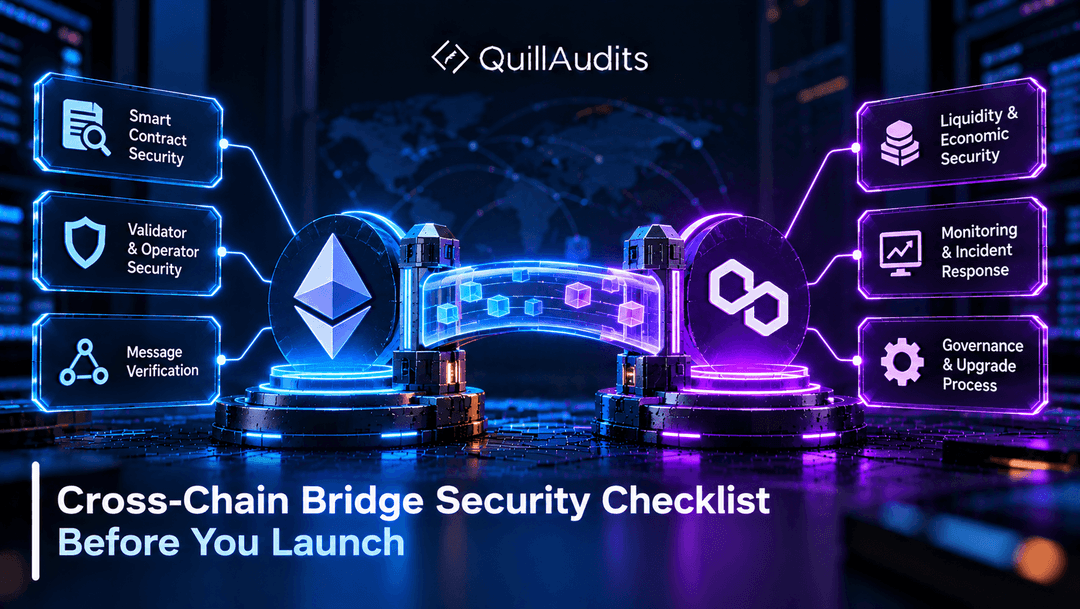
Cross-Chain Bridge Security Checklist Before You Launch
Use this bridge smart contract security checklist to scope your pre-launch audit. Learn how to map trust boundaries, validate messages and replay protection, lock down token registries and admin keys, and set circuit breakers that actually trigger, drawing on the KelpDAO, Gravity Bridge, and BSC Token Hub exploits and what a bridge-specific audit covers that a generic one misses.

The decision · answer in brief
Use this bridge smart contract security checklist to scope your pre-launch audit. Learn how to map trust boundaries, validate messages and replay protection, lock down token registries and admin keys, and set circuit breakers that actually trigger, drawing on the KelpDAO, Gravity Bridge, and BSC Token Hub exploits and what a bridge-specific audit covers that a generic one misses.
Bridge Smart Contract Security Checklist Before You Launch
Use this bridge smart contract security checklist to scope your pre-launch audit: trust boundaries, message validation, replay protection, and circuit breakers. If you're about to ship a cross-chain bridge and you're handing a generic smart contract audit scope to your auditor, you're already missing half the attack surface that actually gets bridges drained.
Cross-chain bridges lost $340.7 million across 14 exploits in 2026 through mid-year, according to a CoinGabbar analysis of 2026 bridge attacks. That's not a one-off bad year. A 2022 Token Terminal report cited by Cointelegraph found that roughly half of all DeFi exploits happened on cross-chain bridges, with more than $2.5 billion stolen through bridge hacks over a two-year period. Bridges keep failing in the same handful of ways, and most of those ways never show up on a standard ERC-20 or DeFi protocol audit checklist.
This post is a founder-facing scope document: what to map before you even request a quote, what your audit needs to cover, and what to hand your auditor so nothing falls into the gap between "the token contract was audited" and "the bridge got drained anyway."
Why a Bridge Smart Contract Security Checklist Looks Different From a Generic One
A standard smart contract audit checks for reentrancy, unchecked external calls, timestamp dependence, uninitialized storage, front-running, and gas limit issues inside a single contract or a tightly coupled protocol. A bridge audit has to check all of that too, but it also has to validate a much bigger claim: that a message asserting "X tokens were locked on chain A" is actually true before chain B agrees to mint or release anything.
That claim depends on off-chain infrastructure the token contract itself doesn't contain: validator sets, relayer networks, light clients, or decentralized verifier networks (DVNs). A bridge contract can pass every unit test and still get emptied if the thing deciding whether a message is genuine can be fooled, bribed, or knocked offline. smartcontractaudit.com's cross-chain bridge security guide frames this directly: a bridge-focused audit has to cover the trust model, message verification, rate limits, and emergency mechanisms as a full-stack system spanning contracts, signer operations, and governance, not just the token logic sitting on top.
The April 2026 KelpDAO exploit is the clearest recent proof of that gap. KelpDAO's LayerZero-powered bridge lost $292 million on April 18, 2026, and the root cause wasn't a bug in the ERC-20 mint function. It was a trust-boundary decision: the protocol relied on a single DVN verifier instead of the multi-DVN redundancy it had been advised to use, and attackers poisoned that sole verifier's RPC infrastructure to get a forged message validated. Read the full breakdown in QuillAudits' KelpDAO hack analysis. A token-logic audit would never have caught that, because the vulnerable component wasn't a line of Solidity. It was an architecture decision about who gets to vouch for cross-chain truth.
If you want foundational context on how bridges actually move value between chains, trusted, trustless, or hybrid, QuillAudits' blockchain bridges explainer is a useful primer before you work through the rest of this checklist. And if you haven't already run your codebase through general audit readiness, start with QuillAudits' smart contract audit readiness checklist; this post picks up where that one leaves off.
Mapping Every Trust Boundary Before Scoping an Audit
Before you write a request for an audit quote, draw a diagram of every point where your system has to trust an external input instead of verifying it cryptographically on-chain. Every one of those points is a trust boundary, and every trust boundary is a place an attacker can forge a message, impersonate an authority, or poison a data source. Your audit scope should name each one explicitly.
Validators, Relayers, and Light Clients - Who Can Forge a Message
Most bridges use one of three verification models: a federated validator set that signs off on messages, a relayer network that passes messages through an off-chain layer, or a light client that verifies source-chain state directly on the destination chain. Each model has a different single point of failure, and your checklist needs to ask the same question of all of them: what's the minimum number of compromised or colluding parties needed to forge a valid message?
For DVN-based systems like LayerZero, that number should never be one. Certora's security research team put it plainly in its breakdown of the KelpDAO incident: "A single DVN, no matter how reputable, should never sit alone in front of real money," and more broadly, "If your decentralized bridge security ultimately bottlenecks through a single operator's infrastructure, it is only as secure as that operator's worst-hardened node," according to Certora's analysis of bridge single points of failure. Your audit scope should require the auditor to document the exact quorum needed to forge a message under every configuration your bridge actually ships with, not just the one in your whitepaper.
Admin Keys and Multisig Control Over Bridge Contracts
Bridges concentrate enormous value behind upgrade keys, parameter-setting functions, and pause controls. Map every role that can upgrade the bridge contract, change a validator set, add a token to the registry, or move funds in an emergency. Then map who holds the keys to each role, what multisig threshold is required, and whether any timelock sits between a proposal and execution.
This is a distinct discipline from code review, and it's worth scoping separately. QuillAudits' admin audit checklist covers multisig thresholds, timelock configuration, and pause-key custody in the depth a bridge launch actually needs. Don't assume your code auditor is checking who holds your Gnosis Safe keys unless you've explicitly put it in scope.
Token Registries and Mint/Burn Authority
Every bridge that mints wrapped tokens on a destination chain needs a registry mapping source-chain assets to destination-chain contracts. If that registry can be written to permissionlessly, or if the function that registers a new token doesn't validate the custody contract address embedded in the token's metadata, an attacker can register a fake asset that looks legitimate to the minting logic.
That's exactly what happened to Gravity Bridge, which lost $5.4 million when an attacker exploited a permissionless deployERC20() function to embed real custody contract addresses inside fabricated token denomination strings, poisoning the token registry itself. QuillAudits' Gravity Bridge analysis walks through the full denom-mapping mechanics. Your checklist item here is simple to state and easy to skip: who can add an entry to the token registry, and what validation runs before that entry is trusted by the mint function?
Message Origin Validation and Replay Protection
A bridge message is only as trustworthy as the checks run against it before any state changes. At minimum, destination-chain logic needs to verify the source chain ID, a strictly increasing or otherwise unique nonce, and the full payload hash before minting or releasing a single token. Skipping or weakening any one of those checks is how a legitimate-looking message gets accepted twice, or gets accepted from the wrong chain entirely.
If you want the conceptual background on how messaging protocols like LayerZero and Chainlink CCIP distribute trust before you apply the checks below, QuillAudits' cross-chain messaging security explainer covers that layer in depth. This section focuses narrower: the specific checks a bridge-specific audit scope should name, not the messaging architecture underneath them.
Verifying Source Chain ID, Nonce, and Payload Before Minting
Chain ID verification stops a message that's valid on one chain from being replayed on another chain running the same contract bytecode, a real risk when bridges deploy near-identical contracts across many EVM chains. Nonce verification stops a legitimate, already-processed message from being resubmitted to mint twice. Payload hash verification stops a message from being partially modified in transit, for example changing the recipient address while keeping the signature valid for the rest of the payload. Your audit scope should require explicit test cases for each of these three checks in isolation, not just a general "replay protection exists" sign-off.
Proof Verification Edge Cases Testing and Fuzzing Should Catch
Proof verification bugs are rarely visible in a code read-through; they tend to show up only when you throw malformed, boundary, or adversarial inputs at the verifier. BSC Token Hub's bridge hack is the case study worth putting in front of your auditor: a flaw in how the bridge's verification logic computed the root hash of its IAVL (Merkleized AVL) proof tree let an attacker construct a forged proof that validated as legitimate. See QuillAudits' BSC Token Hub bridge hack analysis for the mechanics.
This is why fuzzing matters more for bridges than for most contract types; proof verification has a huge, adversarial input space that manual review alone won't exhaustively cover. QuillAudits' own bridge audit process, described on its Bridge Smart Contract Audit service page, pairs senior-led manual review with an independent "Vigilant Squad" validation pass and fuzzing through Echidna, Medusa, Foundry, and Chimera, aimed at exactly this category of edge case alongside reentrancy, unchecked external calls, timestamp dependence, uninitialized storage, front-running, and gas limit issues. That page scopes to code-level vulnerabilities; it doesn't itself cover admin-key custody or post-launch monitoring, which is why those sit as separate checklist items above and below rather than folded into one audit engagement.
Circuit Breakers and Rate Limits That Actually Trigger
A circuit breaker that exists in your contract but has never been tested under a realistic attack scenario isn't a safety mechanism, it's a false sense of security. The goal of a circuit breaker on a cross-chain bridge is to cap the damage of a single compromised message or validator, not to prevent every possible attack. It should do two things on a schedule measured in blocks, not hours: throttle or halt outbound value above a defined threshold, and give a small, pre-authorized set of signers the ability to pause the bridge without a governance vote.
Setting Per-Asset and Per-Route Caps
A single global cap on bridge outflow is better than nothing, but it still lets an attacker drain your largest, most liquid asset down to the cap before anyone reacts. Per-asset and per-route rate limits, a maximum outflow for each token on each source-destination pair within a given time window, contain damage to a smaller blast radius and buy your team time to react. ChainScore Labs' guide to cross-chain circuit breakers recommends pairing per-lane and per-asset rate limits specifically so that one failure can't drain the whole bridge in a single transaction sequence.
Who Can Pause the Bridge, and How Fast
Pause authority is a trade-off between speed and decentralization, and bridges need to lean toward speed. The same ChainScore Labs guide recommends pause functionality require minimal signers, for example a 1-of-N guardian multisig, so the bridge can actually be paused in the minutes that matter during a live exploit rather than the hours a full governance process would take. Your checklist should require your team to document, in writing, exactly which addresses hold pause authority, what the quorum is, and whether that authority has ever been tested against a live incident drill rather than just a testnet deployment.
Once the bridge is live, the circuit breaker is only useful if something is actually watching for the conditions that should trigger it. That's a monitoring function, not an audit deliverable; see QuillAudits' on-chain security monitoring overview for what continuous monitoring should cover once your bridge is processing real value.
What a Bridge-Specific Audit Covers That a Standard Audit Doesn't
| Area | Standard smart contract audit | Bridge-specific audit |
|---|---|---|
| Code-level bugs | Reentrancy, unchecked calls, overflow, access control | Same, plus bridge-specific patterns in lock/mint/burn logic |
| Trust model | Usually out of scope, assumes a single deployer | Explicit mapping of validators, relayers, DVNs, or light clients and the quorum needed to forge a message |
| Message handling | Not applicable | Chain ID, nonce, and payload validation; replay protection across every supported route |
| Proof verification | Not applicable | Fuzzing and adversarial testing of Merkle or signature proof logic |
| Registry integrity | Not applicable | Validation of who can add assets or mappings to a token registry |
| Admin and key custody | Sometimes covered superficially | Often scoped as a separate admin audit covering multisig thresholds and timelocks |
| Emergency response | Rarely covered | Circuit breaker design, per-asset rate limits, and pause-authority speed |
| Post-launch | Out of scope | Monitoring scope handed off to a dedicated service, not folded into the audit itself |
The pattern across every major 2026 bridge incident holds here too: Kelp DAO's single-DVN failure, Gravity Bridge's registry poisoning, and BSC Token Hub's proof-verification bug all passed as working software in production before they were exploited. None of them were caught by checking the ERC-20 transfer function for reentrancy, because none of them were ERC-20 bugs.
The Pre-Launch Bridge Smart Contract Security Checklist
Hand this list to your audit provider when requesting a quote, and expect each item to show up as a named section in the final report, not a passing mention.
- Trust boundary diagram. Every validator, relayer, light client, or DVN in the system, with the minimum quorum needed to forge a message under each supported configuration.
- Admin key and multisig inventory. Every role that can upgrade the bridge, change a validator set, or touch the token registry, mapped to the specific keys, multisig threshold, and timelock controlling it.
- Token registry validation. Explicit review of who can add or modify entries, and what checks run on the embedded custody address before an asset is trusted by the mint function.
- Message origin checks. Source chain ID, nonce uniqueness, and full payload hash verification tested as separate, isolated cases.
- Replay protection across routes. Confirmation that a message valid on one chain or route cannot be resubmitted on another.
- Proof verification fuzzing. Adversarial and malformed input testing against Merkle or signature proof logic, not just the happy path.
- Per-asset and per-route rate limits. Defined, tested outflow caps for each token on each source-destination pair.
- Pause authority and speed. Documented signer set, quorum, and a tested response time for halting the bridge during a live incident.
- Post-launch monitoring handoff. A named plan, and ideally a named provider, for watching the conditions that should trip your circuit breaker once the bridge is live.
- Incident response plan. A written runbook for who gets paged, what gets paused, and how users are communicated with if a breach is detected after launch.
Final Thoughts
Not all blockchains are created equal, and neither are the bridges connecting them; a checklist built for a single-chain DeFi protocol will miss the exact failure modes that have cost the industry hundreds of millions of dollars this year alone. Map your trust boundaries first, scope message validation and replay protection explicitly, and test your circuit breakers before you need them, not after.
A comprehensive Bridge Smart Contract Audit can help verify the code-level pieces of this checklist against known attack patterns before launch. For more insights on securing Web3 projects, visit QuillAudits' research.
Contents









