


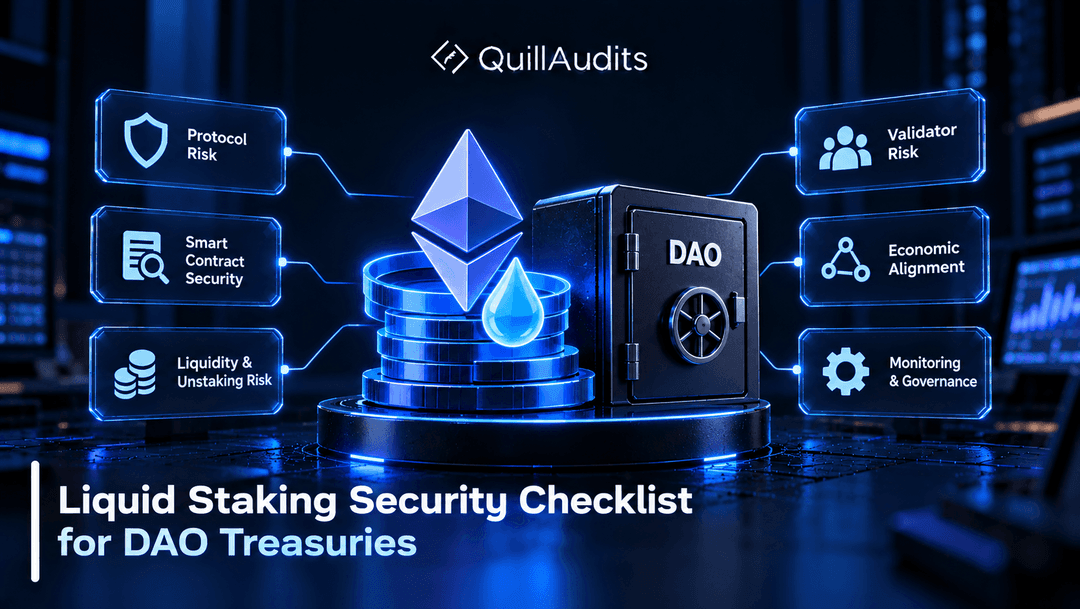
Liquid Staking Security Checklist for DAO Treasuries
Before your DAO parks treasury funds in a liquid staking token, run this liquid staking risk assessment. It covers validator concentration, slashing, withdrawal queues, peg stability, audit and admin-key exposure, and regulatory posture, using the 2025 mass-slashing event, the stETH depeg, and the Cork exploit, plus an 11-point checklist and Solana-specific differences.

The decision · answer in brief
Before your DAO parks treasury funds in a liquid staking token, run this liquid staking risk assessment. It covers validator concentration, slashing, withdrawal queues, peg stability, audit and admin-key exposure, and regulatory posture, using the 2025 mass-slashing event, the stETH depeg, and the Cork exploit, plus an 11-point checklist and Solana-specific differences.
Liquid Staking Risk Assessment Checklist for DAO Treasuries
DAO treasurers moving idle ETH or SOL into a liquid staking token face a decision that looks simple and isn't: pick a protocol, deposit, collect a receipt token, and keep earning staking yield while staying able to trade or deploy that token elsewhere. Run this liquid staking risk assessment before you allocate DAO treasury funds: validator decentralization, withdrawal queue mechanics, peg stability, smart contract and oracle dependencies, and the audits and admin keys sitting behind the protocol all deserve a documented answer before the first deposit, not after a sell-off tests all four at once.
If you're still mapping out what liquid staking is and how liquid staking tokens (LSTs) work mechanically, QuillAudits' liquid staking explainer covers that ground. This piece assumes you already know the mechanics and starts where a treasury committee's actual decision begins: which protocol, how much, and what could go wrong with the money while it's parked there.
What a Liquid Staking Risk Assessment Actually Covers
Most risk write-ups on liquid staking repeat the same taxonomy that's been circulating since 2022: smart contract risk, slashing risk, depeg risk, regulatory risk. That list isn't wrong, but it's static, and a DAO treasurer deciding where to park funds this quarter needs more than category names. A real liquid staking risk assessment ties each category to a dated, verifiable incident, so you're not just told "slashing can happen" but shown what it looked like the last time it did, at what scale, and what that implies for a protocol you're evaluating today.
That's the structure below: four risk domains, each paired with a 2025-era event you can check against yourself, followed by a checklist built from the questions those events actually raised.
Validator Set Decentralization and Slashing Exposure
Why Operator Concentration Is a Financial Risk, Not Just a Technical One
A liquid staking protocol doesn't run validators itself in most designs; it delegates deposited ETH or SOL to a set of node operators who run the actual validator infrastructure. If that operator set is small, or if many operators lean on the same underlying infrastructure (the same cloud region, the same validator client, the same staking-as-a-service middleware), a single infrastructure fault doesn't stay contained to one operator. It propagates across every validator using that dependency at once.
For a DAO treasury, that's not an abstract technical concern. Slashing penalties and correlated downtime penalties reduce the ETH or SOL backing your LST directly. The exchange rate between the receipt token and the underlying asset moves against you whether you ever notice the operator's name or not. Checking operator count and infrastructure diversity is therefore a financial due-diligence step, not an engineering one you can defer to someone else.
The September 2025 Mass-Slashing Event as a Case Study
In September 2025, Ethereum saw a rare mass-slashing event tied to node operators using SSV Network's distributed validator technology. SSV founder Alon Muroch was quick to draw a line between the protocol and the operators running on it: in reporting from CoinDesk, Muroch said "the protocol itself was not compromised," pointing instead to operator-side infrastructure issues at third-party staking providers running SSV.
The same reporting puts the event in perspective: fewer than 500 of Ethereum's more than 1.2 million active validators have ever been slashed since the Beacon Chain launched in 2020. Slashing is genuinely rare in aggregate. But rarity across the whole network tells you nothing about concentration risk inside a single protocol's operator set, which is exactly what the September 2025 event exposed. If several operators behind one liquid staking protocol share the same infrastructure stack, one misconfiguration can turn a network-wide rarity into a protocol-specific cluster event. Before allocating, ask the protocol directly: how many distinct operators hold delegated stake, and do any of them share infrastructure dependencies that a single fault could hit simultaneously?
Withdrawal Queue and Peg Stability Risk
Exit Queue Mechanics and Why Wait Times Spike
Ethereum limits how many validators can exit per epoch through a protocol-level churn limit, and that limit scales with the total number of active validators rather than with current demand. When a large volume of validators tries to exit at once, whether from a single large staker unwinding or a market-wide flight to liquidity, the queue backs up and wait times for anyone further back stretch out. A liquid staking protocol's own redemption queue sits on top of this network-level constraint, so the protocol's queue can only move as fast as the underlying chain allows validators to exit.
The practical question for a treasurer isn't "does an exit queue exist" (it always does), but "what happens to my ability to redeem at par if queue times spike while I need liquidity." Does the protocol maintain a deep secondary-market trading pair for its LST, so you can sell on a DEX instead of waiting in the native queue? Is there a buffer of liquid reserves the protocol can tap for instant redemptions before falling back to the queue? Get a straight answer to both before you assume redemption is a formality.
The stETH Depeg: Liquidity Event vs. Solvency Event
The clearest illustration of why queue mechanics matter happened to stETH in June 2022, and it's worth revisiting because the distinction it reveals still applies to every LST today. As Celsius and Three Arrows Capital unwound large stETH positions following the Terra collapse, stETH traded as low as roughly 0.92 to 0.93 ETH on secondary markets, a 7 to 8 percent discount to its underlying backing, according to reporting from CoinDesk.
That discount was a liquidity event, not a solvency event. The underlying ETH backing stETH hadn't disappeared; stETH simply couldn't be redeemed 1:1 on demand at the time, since Ethereum's native staking withdrawals didn't exist yet, so forced sellers had to accept whatever price the secondary market offered. A DAO treasury holding stETH through that window and needing to exit immediately would have realized a 7 to 8 percent loss on paper, even though the protocol's backing remained intact. The lesson for a risk assessment: ask whether a protocol's LST can be redeemed natively today, what the current queue depth looks like, and how deep secondary-market liquidity is for the pair you'd actually need to sell into during stress. A token with no live native redemption path is more exposed to this kind of liquidity-driven discount than one with fast, working withdrawals.
Smart Contract and Oracle Dependencies to Check
Audit History and Upgrade/Admin-Key Exposure
Treat a liquid staking protocol's smart contracts the same way you'd treat any other treasury-facing integration: check who audited it, when, and against what version of the code currently deployed. A stale audit against a contract that's since been upgraded tells you very little about the code holding your funds right now. QuillAudits' research hub publishes standard-specific audit checklists and hack-analysis breakdowns that are a useful reference point for what a thorough review of this kind of contract should actually check.
Reward accounting deserves specific scrutiny, since even a working audit process can miss a narrow miscalculation. QuillAudits' writeup on a staking APY miscalculation documents a contract that paid out a full annual yield on every lock period instead of scaling rewards to the actual time elapsed, draining a reward pool roughly sixfold faster than intended. Confirm that the protocol's reward math has been independently tested against edge cases like partial periods and early withdrawals, not just checked for the common path.
Also confirm who can change the contracts after deployment. Is the protocol upgradeable through a proxy, and if so, is the upgrade key held by a single signer, a multisig, or a DAO vote with a timelock? A multisig with a meaningful signer threshold and independent, out-of-band verification habits among its signers is a materially different risk profile than a two-of-three key held by the founding team; QuillAudits' piece on multisig security habits lays out what the stronger version of that setup looks like, and it applies equally to the protocol's own admin multisig and to the wallet your DAO uses to hold the resulting LST.
What the Cork Protocol Exploit Reveals About Peg Stability Modules
Several liquid staking tokens rely on auxiliary protocols to maintain price stability or enable leveraged positions against the LST, and those auxiliary contracts carry their own attack surface, separate from the LST issuer itself. The May 2025 exploit of Cork Protocol is a direct example. According to QuillAudits' hack analysis, an attacker drained roughly $12 million from a wstETH:weETH market by abusing Cork's permissionless market creation and unvalidated callback data inside the protocol's peg stability module logic, converting around 3,760 wstETH into approximately 4,530 ETH in the process.
The takeaway for a treasury risk assessment isn't about Cork specifically; it's that an LST's own audit history doesn't cover the peg stability modules, lending markets, or leverage wrappers built around it by other teams. If your DAO plans to hold an LST passively, that distinction matters less. If you plan to deploy it into a peg stability module, a lending market, or a leveraged vault to boost yield, you're now underwriting a second, separate smart contract's security, and it needs its own line item in the assessment.
Regulatory and Counterparty Considerations
The SEC's Division of Corporation Finance issued a staff statement addressing certain liquid staking activities, stating its view that these activities and the staking receipt tokens involved do not, by themselves, constitute the offer and sale of securities under the federal securities laws. SEC Chairman Paul Atkins framed the move as part of a broader push for regulatory clarity: "Under my leadership, the SEC is committed to providing clear guidance on the application of the federal securities laws to emerging technologies and financial activities," according to the SEC's press release.
Treat that statement for what it is, though. As legal analysis from Fenwick points out, it's a staff view only, not a rule, an exemption, or binding legal authority, and facts and circumstances specific to a given protocol still control the actual analysis. A DAO treasury with U.S.-connected members or counterparties shouldn't read the statement as blanket clearance; it's a data point to bring to counsel, not a substitute for one. On the counterparty side, also map out who else sits between your DAO and the underlying staked asset: the node operators, any custodian involved in key management, and any bridge or wrapper contract if the LST you're evaluating isn't native to the chain where you'll hold it. Each of those is a party whose failure or exit could affect your position independent of the LST's own contract security.
A Liquid Staking Risk Assessment Checklist Before Allocating Treasury Funds
Work through this list before the first deposit, and revisit it on a standing schedule (quarterly is reasonable for a treasury-sized position) rather than only at onboarding.
- Validator and operator set: How many distinct operators hold delegated stake, and is any single operator, client implementation, or infrastructure provider concentrated enough to create correlated slashing risk?
- Slashing track record: Has this protocol or its operators ever been slashed, and if so, was the cause operator-side infrastructure or a protocol-level fault?
- Native redemption status: Can the LST be redeemed 1:1 through the protocol today, or only traded on secondary markets?
- Exit queue depth: What is the current queue length for native withdrawals, and how has it behaved during past periods of elevated exit demand?
- Secondary-market liquidity: How deep is the on-chain trading pair for this LST, and what discount would a treasury-sized sell order realistically incur during a stress event?
- Audit currency: Is there a public audit report, and does it cover the exact contract version currently deployed, including any upgrades since the audit date?
- Reward accounting: Has the yield/reward calculation logic been specifically tested for edge cases like partial periods and early exits, not just the standard path?
- Admin key and upgrade control: Who can upgrade or pause the contracts, under what multisig threshold or timelock, and are those signers independently verifiable?
- Dependent protocols: If the DAO plans to deploy the LST into a peg stability module, lending market, or leverage vault, has that separate contract been audited on its own merits?
- Regulatory posture: Does the protocol's structure and your DAO's jurisdictional footprint align with current guidance, confirmed with counsel rather than assumed from a press release?
- Counterparty map: Who are the custodians, bridge operators, or wrapper contracts sitting between the DAO and the underlying staked asset, and what happens to the position if any one of them fails?
Solana and Alt-L1 Liquid Staking: What Changes
The checklist above travels to Solana and other alternative L1s, but a few of the underlying mechanics differ enough to change how you weight each item. Solana's validator penalty model is structured differently from Ethereum's: Solana doesn't impose the same kind of balance-reducing slashing for routine liveness faults that Ethereum does, which shifts more of the risk weighting in a Solana LST toward validator performance and commission-rate selection than toward slashing exposure itself. Unstaking on Solana also runs on an epoch-based cooldown, typically resolving within a few days rather than the multi-week queues that can build up on Ethereum during high-exit periods, which changes how much weight you put on secondary-market liquidity as a workaround.
Alt-L1 and app-chain liquid staking adds a further wrinkle worth checking directly rather than assuming: how the protocol selects and rebalances validators, and how its unstaking queue is designed. QuillAudits' coverage of Kinetiq's liquid staking design on Hyperliquid is a useful worked example, since it documents a protocol-managed validator allocation process with performance-based rebalancing and a two-step withdrawal flow that queues redemptions behind a security delay before processing. Those are exactly the kind of design decisions the checklist above asks you to find for any protocol, on any chain, before funds move.
Final Thoughts
None of the incidents above sank a liquid staking protocol outright. The September 2025 slashing event was traced to operator infrastructure, not a protocol compromise. The 2022 stETH discount closed once native withdrawals went live. Cork Protocol's exploit hit a peg stability module built around an LST, not the LST issuer itself. Each one was survivable, and each one was also, in hindsight, checkable in advance by someone asking the right question before the deposit rather than after. Run the checklist above against the specific protocol your DAO is considering, get the answers in writing, and set a date to run it again.
The audit-currency line on that checklist is the one item a DAO shouldn't take on faith. A report is only as good as the contract version it covers, so confirm it against what's actually deployed before funds move; QuillAudits' audit and hack-analysis research is a reference point for what that kind of version-by-version review should look like.
Contents









