Plasma Chain Security: What to Audit Before You Build
Explore Plasma network security risks and understand the security tradeoffs behind its zero-fee USDT transfers, Bitcoin-anchored checkpoints, and PlasmaBFT consensus mechanism. Discover potential paymaster vulnerabilities, validator concentration risks, bridge trust assumptions, and reward-slashing limitations. Learn what developers should audit before deploying smart contracts on Plasma to strengthen blockchain security and protect their protocols.

The decision · answer in brief
Explore Plasma network security risks and understand the security tradeoffs behind its zero-fee USDT transfers, Bitcoin-anchored checkpoints, and PlasmaBFT consensus mechanism. Discover potential paymaster vulnerabilities, validator concentration risks, bridge trust assumptions, and reward-slashing limitations. Learn what developers should audit before deploying smart contracts on Plasma to strengthen blockchain security and protect their protocols.
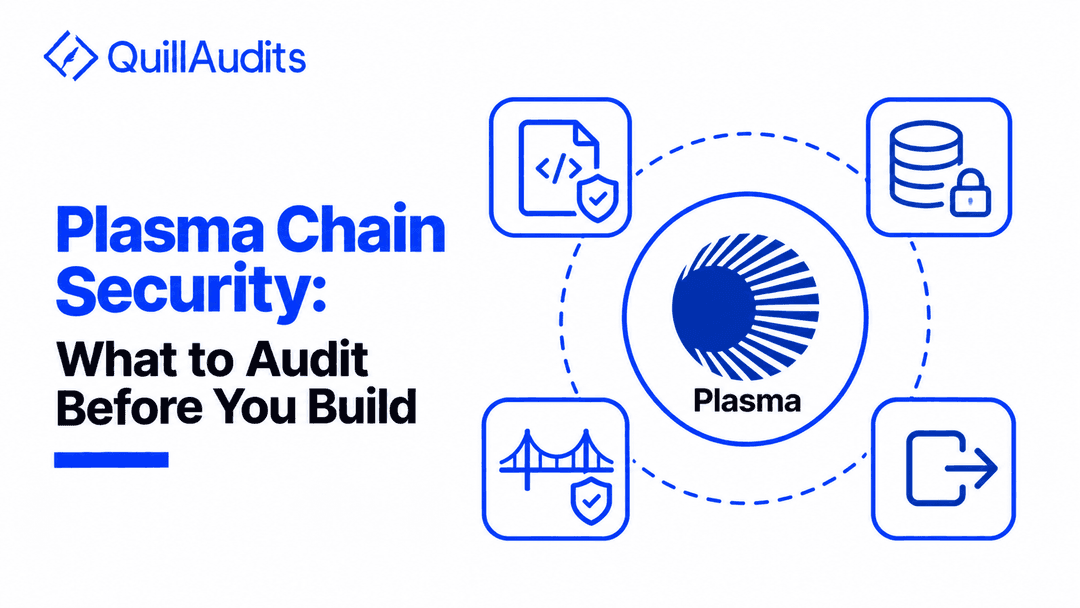
Plasma Network Security Risks: Audit Before You Build
Plasma network security risks don't look like generic EVM-chain risks, because Plasma isn't a generic EVM chain. It's a Layer 1 built around moving one asset, USDT, for free, settled by a small validator set, and checkpointed to Bitcoin. Each of those design choices creates a narrow trust assumption that a standard audit checklist won't catch. This post walks through what Plasma actually guarantees, what it doesn't, and what to check before you deploy a contract on top of it.
Overview: A Stablecoin L1 and Its Plasma Network Security Risks
Plasma is an EVM-compatible Layer 1 designed around a single use case: moving USDT at zero cost to the sender. A protocol-level paymaster sponsors gas for USDT transfers, so users can send stablecoins without holding XPL, the chain's native token. The chain also supports a gas model where other transactions can be paid for in stablecoins instead of XPL, which lowers the onboarding barrier further.
The project is backed by Tether and Bitfinex, with Founders Fund among its investors, and its token sale raised roughly $373 million against an original $50 million target, about seven times oversubscribed. More than 100 DeFi integrations, including Aave, Ethena, Fluid, and Euler, were live on the chain at launch. That liquidity depth is the point: Plasma exists because stablecoin transfer volume is large enough, and fee-sensitive enough, to justify a chain built specifically around it rather than treating stablecoins as just another ERC-20 on a general-purpose network.
One disambiguation worth making before going further: Plasma One is a separate, consumer-facing neobank app from the Tether ecosystem for everyday stablecoin spending and saving. It is not the Plasma Layer 1 blockchain covered in this post. Builders evaluating infrastructure risk should make sure they're reading about the chain, not the app, when they research the project.
For a builder, the overview matters because it reframes the threat model. On a general-purpose chain, you audit your contract against generic risks: reentrancy, access control, oracle manipulation. On Plasma, you still audit for all of that, but you also have to audit the assumptions baked into the chain itself, because the chain's core features (the paymaster, the consensus mechanism, the Bitcoin anchoring) are not neutral infrastructure. They're economic and security trade-offs that your contract inherits whether you've reviewed them or not.
Zero-Fee Transfer Logic and Paymaster Risks
Zero-fee USDT transfers work because a protocol-level paymaster covers gas on the sender's behalf, which means the cost of every free transfer lands somewhere, not nowhere. That's the part most coverage of Plasma skips. A subsidized resource is, by definition, an economic attack surface: something will try to extract value from it.
Here's the catch for anyone building a dApp on top of that subsidy. A paymaster that sponsors gas for USDT transfers has to decide, at the contract level, which calls qualify for sponsorship and which don't. If that eligibility logic is too permissive, it opens a griefing vector: an attacker spins up throwaway wallets and fires high-volume, low-value USDT transfers purely to drain the sponsored gas pool, with no intention of using the chain for anything else. If the logic is too strict, legitimate integrations get rejected or silently fall back to paid transactions, breaking the "zero-fee" assumption your own contract might be relying on for UX.
This matters for your own contract, not just the paymaster, in three concrete ways:
- Don't assume every call from a user wallet is fee-sponsored. If your contract design (or your front end) hardcodes an assumption that USDT moves for free in every path, a throttled or paused paymaster turns that into a silent failure mode. Build and test the paid-gas fallback path, not just the happy path.
- Treat the paymaster's spam resistance as part of your own threat model. If your protocol accepts unauthenticated or low-cost calls that route through the paymaster, a spam campaign against Plasma's subsidy can indirectly degrade your contract's availability, even though your code never changed.
- Check how your token-handling logic behaves under both fee regimes. A contract that moves USDT and also touches other ERC-20 tokens should be audited the same way any token contract is, covering supply controls, approval mechanics, and transfer-path edge cases. QuillAudits' breakdown of what gets checked in an ERC-20 token contract audit is a useful baseline, and it applies just as much when USDT is the asset your protocol is built around.
None of this means the paymaster model is broken. It means the subsidy is a design decision with a failure mode, and a pre-launch audit should ask explicitly what happens to your contract's assumptions if that subsidy gets throttled, paused, or gamed.
Bitcoin-Anchored Finality: What It Does and Doesn't Guarantee
Plasma periodically commits its state roots to Bitcoin, anchoring finality checkpoints to Bitcoin's proof-of-work chain. This is a real security property: once a checkpoint is written into a Bitcoin block, rewriting Plasma's history back past that point would require rewriting Bitcoin itself, which is a vastly higher bar than attacking Plasma's own validator set.
It is not, however, the same thing as Plasma being a Bitcoin sidechain, and it does not mean Bitcoin's security backstops the day-to-day operation of the chain. Bitcoin anchoring secures checkpoint history, the record of where the chain has already been. It does nothing to the chain's live consensus process, which is run entirely by PlasmaBFT and Plasma's own validator set in between checkpoints. If PlasmaBFT produces a conflicting block, stalls, or is compromised by a malicious supermajority before a checkpoint lands, the Bitcoin anchor can't undo that; it can only make a finalized checkpoint hard to reverse after the fact.
The chain's Bitcoin bridge compounds this distinction. Rather than relying on a single custodial bridge operator, Plasma's BTC bridge is run by the validator network itself, with each validator operating its own Bitcoin node. That design avoids a single custodian as a point of failure, but it also means BTC bridge security is bound to the same validator set that runs consensus, not to an independent security layer. For a builder, the practical question isn't "is this chain secured by Bitcoin?" in the abstract. It's: which specific guarantee are you relying on, checkpoint immutability or live liveness and safety, and does your contract's risk tolerance match which one Bitcoin anchoring actually provides? The same question of trusting a bridge's message source and verification path comes up in most cross-chain integrations; QuillAudits' piece on cross-chain messaging security covers the authentication issues that recur whenever a protocol has to trust a bridge's reported state.
PlasmaBFT and Validator Concentration: Consensus-Level Plasma Network Security Risks
PlasmaBFT is a pipelined, Rust-based implementation of Fast HotStuff, a Byzantine fault-tolerant consensus protocol. Byzantine fault tolerance means the protocol is designed to stay safe even if some validators act maliciously or fail outright, up to a defined threshold. Plasma's own documentation states that "block finality is achieved in seconds with minimal communication overhead," which is the performance side of the trade-off builders should also weigh against the trust side.
The threshold matters more than the speed claim. PlasmaBFT requires a validator count n of at least 3f+1, with a quorum size q of 2f+1, which means the protocol tolerates up to one-third of validators (f out of 3f+1) acting maliciously or going offline without breaking consensus safety. That one-third threshold is a standard BFT bound, not unique to Plasma, but what is unique is how small and concentrated the validator set has been at launch. Plasma's validator set started as a small, curated group under a phased rollout plan, with permissionless validation and full decentralization scheduled for later phases. A one-third fault tolerance threshold means something very different when the validator set is a handful of known, curated operators than when it's thousands of permissionless, globally distributed nodes. The math is identical; the real-world cost of colluding to hit that threshold is not.
Here's the part that doesn't show up in a generic consensus writeup: Plasma deliberately chose reward slashing over capital slashing for validator misbehavior. Misbehaving validators lose block rewards, not staked capital, a design choice distinct from most proof-of-stake chains. Capital slashing is the mechanism most PoS security models rely on to make attacking the network expensive in absolute terms, because an attacker risks losing real staked value. Reward slashing instead makes misbehavior unprofitable going forward, without clawing back what a validator already has at risk. For a small, curated validator set, that's a meaningfully lighter deterrent than capital-at-risk slashing, and it's a trust assumption builders should weigh independently of the BFT math.
None of this means PlasmaBFT is insecure. Fast HotStuff is a well-studied family of protocols, and the one-third fault tolerance bound is the same bound used by comparable BFT chains. The point for a builder is narrower: your contract's security doesn't just depend on the consensus algorithm's theoretical guarantees, it depends on who is actually running the validators today, how concentrated that set is, and what it costs them, in practice, to misbehave.
What to Audit Before Launching on Plasma
Before deploying a contract on Plasma, run through this checklist. It's shaped around the three trust assumptions above, not generic EVM audit scope, because the generic scope is table stakes you should already be doing.
- Paymaster dependency mapping. Identify every code path in your contract or front end that assumes a zero-fee USDT transfer, and confirm each one has a tested fallback for paid gas.
- Spam and griefing exposure. Model what happens to your protocol's availability if the Plasma paymaster is throttled, paused, or hit by a spam campaign designed to drain the subsidy.
- Checkpoint-versus-liveness distinction. Document which Bitcoin-anchoring guarantee your protocol actually relies on, checkpoint immutability or live consensus safety, and don't treat the Bitcoin anchor as covering both.
- Bridge trust boundary. If your contract touches Plasma's BTC bridge, confirm you understand that bridge security is bound to the validator set, not to an independent custodian or a separate security layer.
- Validator concentration check. Look up the current size and operator composition of Plasma's validator set before launch, not at audit time months later, since the phased decentralization rollout means this figure changes.
- Slashing-model fit. Weigh whether reward-only slashing provides enough economic deterrence for the value your contract is expected to secure, especially for high-value or long-duration positions.
- Standard token and access-control review. Run the same ERC-20, supply-control, and access-permission checks you'd run on any chain, since Plasma's EVM compatibility means familiar vulnerability classes still apply in full.
- General audit readiness. Confirm your code, tests, and documentation meet baseline audit-readiness standards before submission; QuillAudits' smart contract audit readiness checklist is a reasonable starting point regardless of which chain you're deploying to.
This list isn't exhaustive, and it isn't a substitute for a full audit. It's meant to make sure Plasma's specific design choices are on the table before a reviewer starts, instead of being discovered partway through.
Final Thoughts
Plasma's security model rewards close reading, not pattern matching against other EVM chains. The zero-fee paymaster, the Bitcoin-anchored checkpoints, and the reward-slashing validator economics are three separate, narrow trust assumptions, and each one needs to be evaluated on its own terms rather than assumed to work the way an equivalent mechanism works elsewhere.
For teams evaluating who should run that review, it's worth being specific about scope. QuillAudits offers Blockchain and Layer 1 chain audits in addition to application-level smart contract audits, which fits a reader trying to evaluate a whole new chain's design rather than just a single contract, and its EVM-focused audit experience applies directly to Plasma given the chain's full EVM compatibility. QuillAudits has also published chain-specific security breakdowns in this same format for networks like Hyperliquid and Robinhood Chain, which is a useful signal of hands-on familiarity with evaluating a new L1's trust assumptions rather than treating every chain as Ethereum-equivalent. That said, Plasma isn't among the chains named on QuillAudits' own services page, so there's no stated track record auditing Plasma specifically or its Bitcoin bridge design; a team whose primary concern is Bitcoin-protocol-level bridge security may want to pair a general smart contract auditor with a firm that lists Bitcoin-protocol auditing as an explicit specialty.
If you're still deciding who should review a Plasma deployment, QuillAudits' guide to choosing a smart contract auditor and its research page are reasonable places to compare methodology and scope before you commit.
Contents