Yield-Bearing Stablecoin Security: What Auditors Check
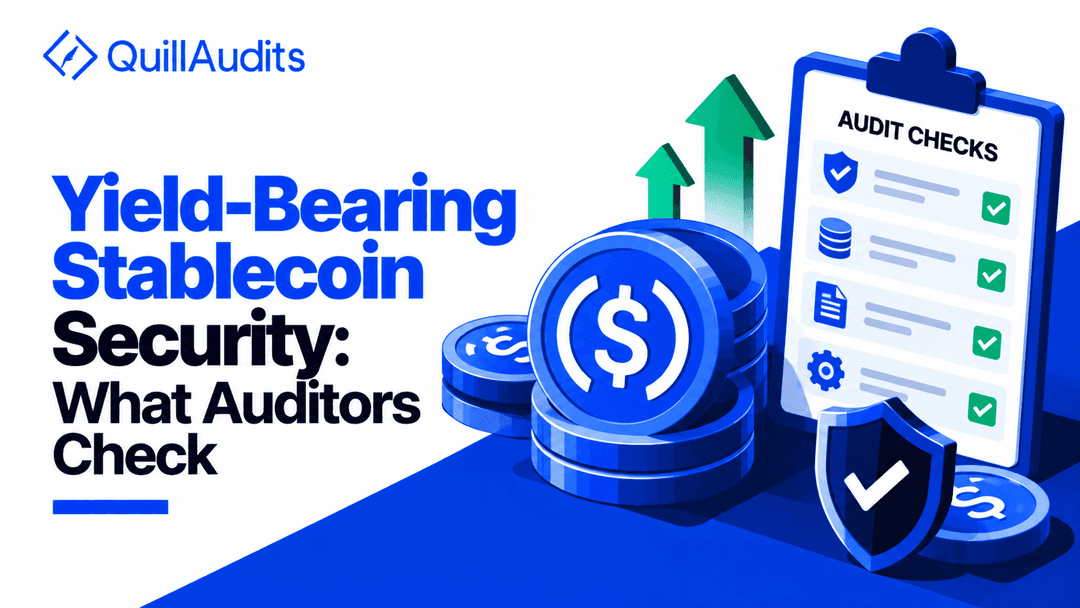
Stablecoin yield protocol security goes beyond peg code. This guide shows what auditors check across the full stack of yield-bearing stablecoins like sUSDe and USD0++: ERC-4626 vault accounting, oracle feeds, off-exchange custody counterparties, redemption circuit breakers, and governance controls, using the 2025 USD0++ depeg to show what breaks when one layer fails

The decision · answer in brief
Stablecoin yield protocol security goes beyond peg code. This guide shows what auditors check across the full stack of yield-bearing stablecoins like sUSDe and USD0++: ERC-4626 vault accounting, oracle feeds, off-exchange custody counterparties, redemption circuit breakers, and governance controls, using the 2025 USD0++ depeg to show what breaks when one layer fails
Stablecoin Yield Protocol Security: What Auditors Check
Stablecoin yield protocol security is not just peg-code review. A yield-bearing stablecoin like sUSDe or USD0++ stacks a delta-neutral trading strategy, an off-exchange custody arrangement, and an ERC-4626 vault wrapper on top of the usual minting and redemption logic, and each layer has its own failure mode. This post walks through that stack as an audit scope checklist, using sUSDe's custodian architecture and USD0++'s 2025 depeg as the concrete cases that show what happens when one layer breaks.
What Makes Stablecoin Yield Protocol Security Different From USDC or DAI?
USDC's main risk is custodial: does Circle hold the dollars it claims to hold. DAI's main risk is collateral: is the vault over-collateralized against a price crash. If you're scoping stablecoin yield protocol security instead, you inherit both of those questions and add a third: does the yield-generating strategy itself survive stress.
Ethena's sUSDe, for example, earns yield from a delta-neutral strategy, pairing staked ETH collateral with short perpetual futures positions on centralized exchanges. That strategy introduces exposure neither USDC nor DAI carries: funding-rate risk, exchange counterparty risk, and custody risk on the collateral sitting between the protocol and the exchanges. Usual Protocol's USD0++, by contrast, earns yield from tokenized real-world assets (RWAs), which swaps exchange counterparty risk for a different kind of redemption-mechanics risk, as its 2025 depeg showed.
As an auditor or a founder commissioning one, you can't let the review stop at the minting contract. The actual question you need answered is whether the contract code, the custody arrangement, and the yield source all remain solvent and reconcilable under the same stress scenario at the same time.
Where Do Off-Exchange Settlement and Custody Introduce Counterparty Risk?
If you're scoping a delta-neutral stablecoin, treat the off-exchange settlement (OES) layer as a distinct risk surface, separate from the smart contracts, because it's where most of the collateral actually sits.
sUSDe's custody runs through institutional OES providers Copper and Ceffu, with Anchorage Digital Bank added as an additional custodian in early 2026. These custodians publish monthly signed attestations and weekly proof-of-reserves reports to back the arrangement. The OES model is designed to limit blast radius: it keeps the bulk of hedge collateral off the exchange's own balance sheet, so if a trading venue fails, the loss is contained to the working-margin layer that's actually on the exchange rather than wiping out the full hedge.
That containment is real, but it doesn't remove the counterparty layer, it relocates it. sUSDe still carries counterparty exposure to the centralized perpetual exchanges it trades on, Binance, Bybit, OKX, and Deribit, and separately to the OES custodians holding the collateral itself. When you write the scope, enumerate each custodian and exchange by name, check the cadence and signing method of their attestations, and flag concentration if too much collateral sits with a single counterparty.
This is also where the limits of a code audit show up clearly: no amount of Solidity review verifies that Copper or Anchorage actually holds what it attests to. That verification depends on the custodian's own attestation process and proof-of-reserves reporting, which sits outside what a smart contract audit can check. Treat custodian attestations as a separate, ongoing diligence item, not something a one-time audit closes out.
What Broke When USD0++ Depegged, and What It Means for Auditors
Usual Protocol's USD0++ depegged on January 9, 2025, falling as low as $0.89 after the team cut the token's redemption floor from $0.995 down to $0.87. The team also introduced a penalty-based "1:1 Early Unstaking" option for holders who wanted immediate par redemption instead of waiting out the lower floor.
This wasn't a smart contract bug in the sense of a reentrancy exploit or a broken access control. It was a governance decision, made public with little warning, that changed the economic terms holders thought they had locked in. In response, Usual Labs activated a "Revenue Switch" that routes RWA and protocol revenue, estimated at roughly $5 million a month, back to token holders to rebuild confidence in the peg.
If you're auditing a protocol like this, treat redemption-floor parameters, penalty schedules, and the governance path that can change them as in scope just as much as the transfer function. Ask who can change the redemption floor, what time delay or multisig threshold applies, and what disclosure obligation exists before that change takes effect. Synthetic dollar designs carry a related pattern: privileged roles sit outside an integrator's operational control by default, whether a freeze key, a mint authority, or in this case a redemption-parameter setter, and your scope should document exactly who holds that control and under what constraints.
What Should an Audit Scope Cover Beyond the Minting Contract?
If you're commissioning or running a stablecoin yield protocol security review, scope it to cover at least these six items:
- ERC-4626 vault accounting. If the yield-bearing token wraps a base asset in an ERC-4626 vault, check for the inflation/donation attack, where an attacker manipulates the share-price ratio in an empty or low-liquidity vault through a direct asset donation, making subsequent deposits unsafe.
- Oracle and funding-rate feeds. Verify redundancy and staleness checks on any price or funding-rate oracle the strategy depends on, since a single stale feed can misprice the hedge.
- Custodian and exchange counterparty mapping. List every OES custodian and trading venue by name, and check the cadence of their attestations, per the custody section above.
- Redemption-queue circuit breakers. Confirm the contract or off-chain process has a mechanism to pause or throttle redemptions under stress, rather than relying only on a governance vote made under pressure, as USD0++'s depeg showed.
- Governance and parameter-change controls. Document who can alter redemption floors, penalty schedules, or fee parameters, and what time-lock or multisig threshold gates that change, applying the same threshold-integrity and out-of-band confirmation checks you'd run on any protocol multisig.
- Privileged roles. Catalog freeze, mint, and upgrade authority the same way you'd catalog a bug, since these sit outside a holder's control regardless of audit result.
If you're new to the audit process itself, read through the phases a typical smart contract review runs through before you scope protocol-specific checks like these.
QuillAudits' own DeFi Protocol Audit service applies a multi-layer approach to this kind of scope: threat modeling built around the protocol's specific yield source, fuzzing and formal verification against the vault math, manual review, deployment verification, and on-chain monitoring after launch, rather than one static code pass. Its published ERC-4626 checklist is explicit that the checklist is "a floor, not a ceiling," and that a real engagement still needs manual review, property tests and fuzzing against the actual math, and a threat model built around the specific yield source and token. Keep that in mind: a checklist alone can confirm the vault math is sound without ever touching whether the custodian behind it is solvent, which is a separate diligence track entirely.
A code audit also stops at the contract boundary for another reason: repeating the same type of review three times doesn't add three layers of coverage. QuillAudits puts it plainly: "Three audits are not three layers of security. It's one layer repeated three times." For a yield-bearing stablecoin, your scope needs manual review, automated testing, and runtime monitoring together, since each catches a different class of failure, code logic, economic edge case, live operational anomaly, that the others miss. After launch, you'll also want continuous checks for funding-rate flips and redemption-queue anomalies, since a one-time audit can't catch those on its own.
What Are the Biggest Stablecoin Yield Protocol Security Risks Right Now?
Three risks sit above the rest if you're building or integrating a yield-bearing stablecoin today.
First, custodian and exchange concentration. If too much collateral sits with one OES provider or one perpetual exchange, a single counterparty failure can freeze or impair the hedge, even under an OES model designed to contain exchange-level losses.
Second, governance-controlled redemption terms. USD0++ showed that a redemption floor set by a team, not an immutable contract parameter, can change with limited notice and move the market price well below par. Treat that control the same way you'd treat a privileged smart contract role in your scope.
Third, privileged key exposure at scale. On-chain data shows over 11,000 stablecoin freeze events across major networks, totaling roughly $5.85 billion frozen, with more than $1.4 billion of that later permanently destroyed. That figure covers stablecoins broadly, not yield-bearing tokens specifically, but it shows how common privileged-role intervention already is in this asset class, and why cataloging freeze, mint, and upgrade authority belongs in every stablecoin audit scope, yield-bearing or not.
Which stablecoins are yield-bearing matters here too: sUSDe (delta-neutral funding-rate strategy), USD0++ (RWA-backed), and most ERC-4626-wrapped vault tokens fall into this category, each with a different yield source and therefore a different threat model. There's no single "most secure stablecoin" among them; security depends on which of these layers, custody, governance, or vault accounting, you've actually reviewed and had attested to, not just which one has the highest audit count.
Final Thoughts
Not all stablecoins are created equal, and that's especially true once yield enters the picture. A fiat-backed stablecoin's risk stack ends at custody; a yield-bearing one adds a strategy, a custodian network, and often a vault wrapper on top, and each of those needs its own line item in your audit scope rather than an assumption that the minting contract review covers it. sUSDe's OES architecture and USD0++'s depeg are two different proof points for the same conclusion: the code can be clean and the protocol can still fail at the custody or governance layer.
If you're building or integrating a yield-bearing stablecoin, a DeFi Protocol Audit that treats custody mapping, oracle redundancy, vault accounting, and governance controls as separate scope items, backed by a published checklist like QuillAudits' ERC-4626 review, is a reasonable starting point. It won't verify a custodian's solvency on its own, but it will tell you whether your contract layer is ready for the scrutiny that custody and governance deserve.
Contents