What It Takes to Secure Tokenized Assets in Dubai
Dubai tokenized a 1,971kg silver bar under VARA. Learn UAE ARVA rules, where RWA protocols break, and how to secure mint, vault feeds, and admin keys.

On 7 September 2026, the world's largest silver bar became the first commodity tokenized asset under the DMCC and VARA framework.
Tokinvest issued fractional interests token on 1,971kg bar as an Asset-Referenced Virtual Asset (ARVA) on BNB Chain, and eligible retail investors can buy these tokens. SAM Metals made this bar as a tribute to 1971, the year UAE was founded. It was presented at the Dubai Precious Metals Conference in November 2025. The bar is registered and verified on DMCC Tradeflow, and Brink's handles its storage and logistics.
So every mint on that contract is now a claim on one bar in one vault. As we can see that Dubai has became the hub for tokenization, with perfect regulation and authorities in place, but now question is what it really takes to build a secure tokenization protocol, where things can go wrong and what are the fixes. We will cover all these points in this blog.
Who regulates what in Dubai and the UAE
UAE runs several regions side by side and choosing the right one is the first security aspect, because a token filed with the wrong regulator leaves holders without the protections they expect.
| Authority | Where it applies | What it means for tokenization |
|---|---|---|
| VARA | Dubai mainland and free zones, including DMCC, but not DIFC | ARVAs such as tokenized commodities and property |
| DFSA | DIFC | Investment tokens, crypto tokens and the tokenisation sandbox |
| CMA, formerly SCA | UAE-wide, outside the financial free zones | Security and commodity-contract tokens, including bonds, sukuk and fund units |
| CBUAE | UAE-wide | Dirham payment tokens, plus the wider perimeter under Federal Decree-Law No. 6 of 2025 |
| FSRA of ADGM | Abu Dhabi Global Market | A separate regime for virtual assets and tokenized securities |
| DLD | Dubai real estate | The title deed registry behind property tokens |
What VARA expects from an ARVA issuer
Issuing an ARVA is a Category 1 activity under VARA's Virtual Asset Issuance Rulebook and the issuer needs a licence + separate approval for each token, and paid-up capital of at least 1.5M AED, or 2% of average reserve value over 24 months, whichever is higher. It also needs two full-time, VARA approved individuals who are UAE either residents or passport holders, and a compliance officer.
VARA tells issuers to rank their material risks in the whitepaper rather than on boilerplate. VARA can suspend issuance, and can also revoke approval if the whitepaper or marketing is misleading.
Here legal part and security meets, every privileged function, whether it mints, pauses, freezes, forces transfers or upgrades, is a promise about who controls holders assets. If a power role exists on-chain but missing from the whitepaper, then you have a disclosure problem and a hidden trust assumption, which can revoke your approvals.
VARA rulebook enforces after licensing also. In 2026 it fined KuCoin and MEXC for unlicensed activity, and a licensed firm CoinMENA finde for AML control failures. Getting a VARA licence is hard. Keeping it even harder.
VARA's testing rules and security standards
VARA's Technology and Information Rulebook covers testing and audit, and it binds every VARA-licensed firm, ARVA issuers included. A qualified, independent third party must run vulnerability assessments and penetration tests at least once a year and before any new system, application or product goes live and results shared with VARA on request.
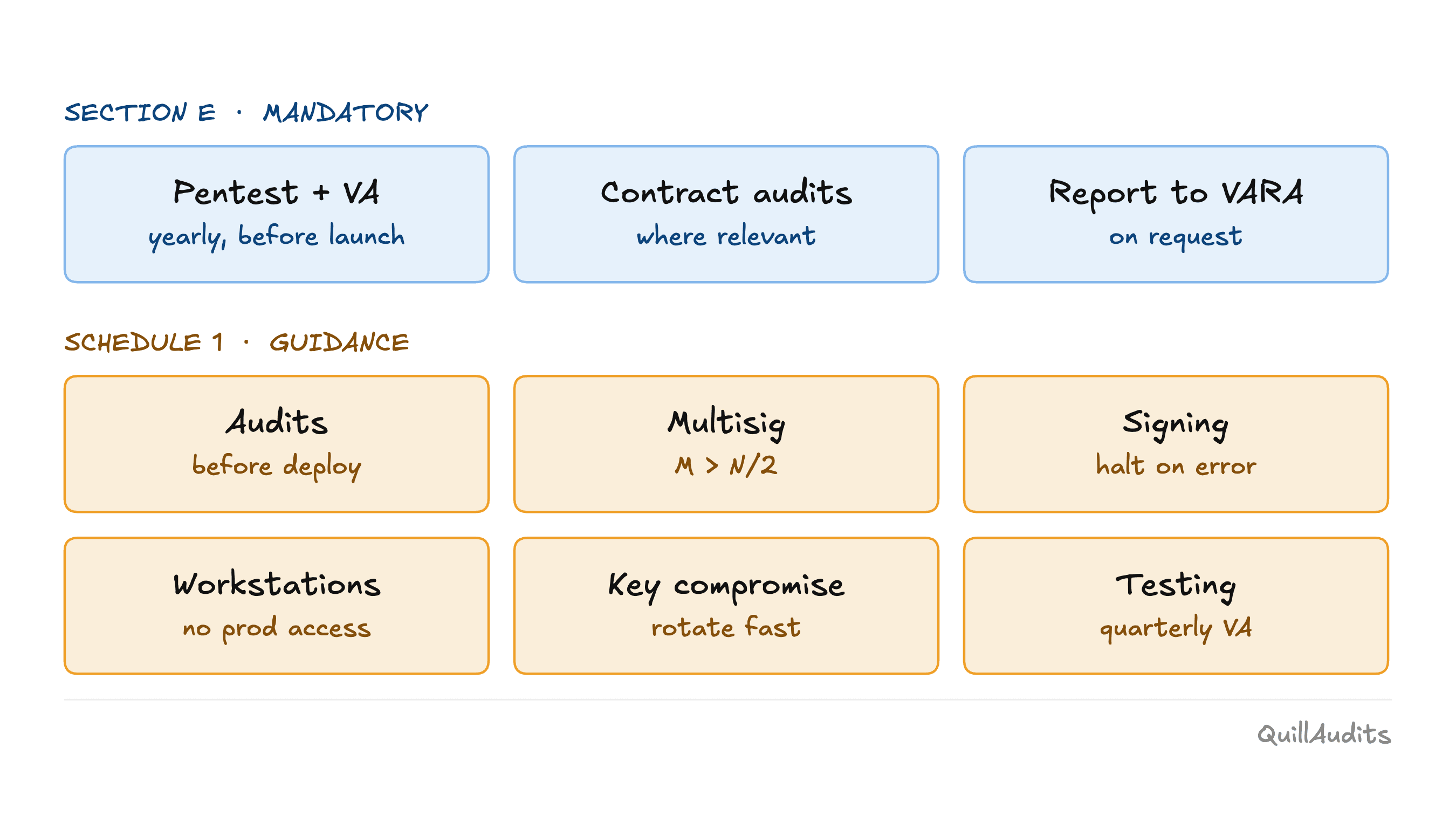
Schedule 1 of the same rulebook is guidance rather than hard rules, but it sets out the security standards VARA expects firms to meet. Several of them read like a post-mortem of 2025's biggest hacks:
- Contracts. Independent audits before deployment, formal verification where applicable, and regular re-assessment of deployed contracts.
- Multisig. For high-value operations, the number of required signers (M) must be greater than half the total signers (N). Signers should sit in different locations and use different authorisation methods.
- Signing. Signing must halt immediately when an error is reported.
- Workstations. Developer machines get endpoint monitoring and no direct production access.
- Key compromise. A tested response plan with rapid key rotation.
- Security Testing. Annual third-party penetration tests, quarterly vulnerability assessments and yearly independent resilience testing that includes source code review and scenario-based tests.
Reserve-backed or direct-ownership changes your threat model
VARA guidance separates two kinds of ARVA. In both cases, holders must be able to redeem at par in AED or a disclosed equivalent, within a reasonable time and free of charge.
Stable-value (reserve-backed). The token needs full backing held by a licensed custodian, segregated from the issuer's own money. The core risk is on-chain supply drifting above what the vault holds.
Direct-ownership. The token is the asset, so no reserve is needed, but the underlying interest must transfer at the same moment the token does. The core risk is legal title and the token ledger falling out of sync. Dubai's property tokens work this way, with each transfer synced in real time to the DLD land registry.
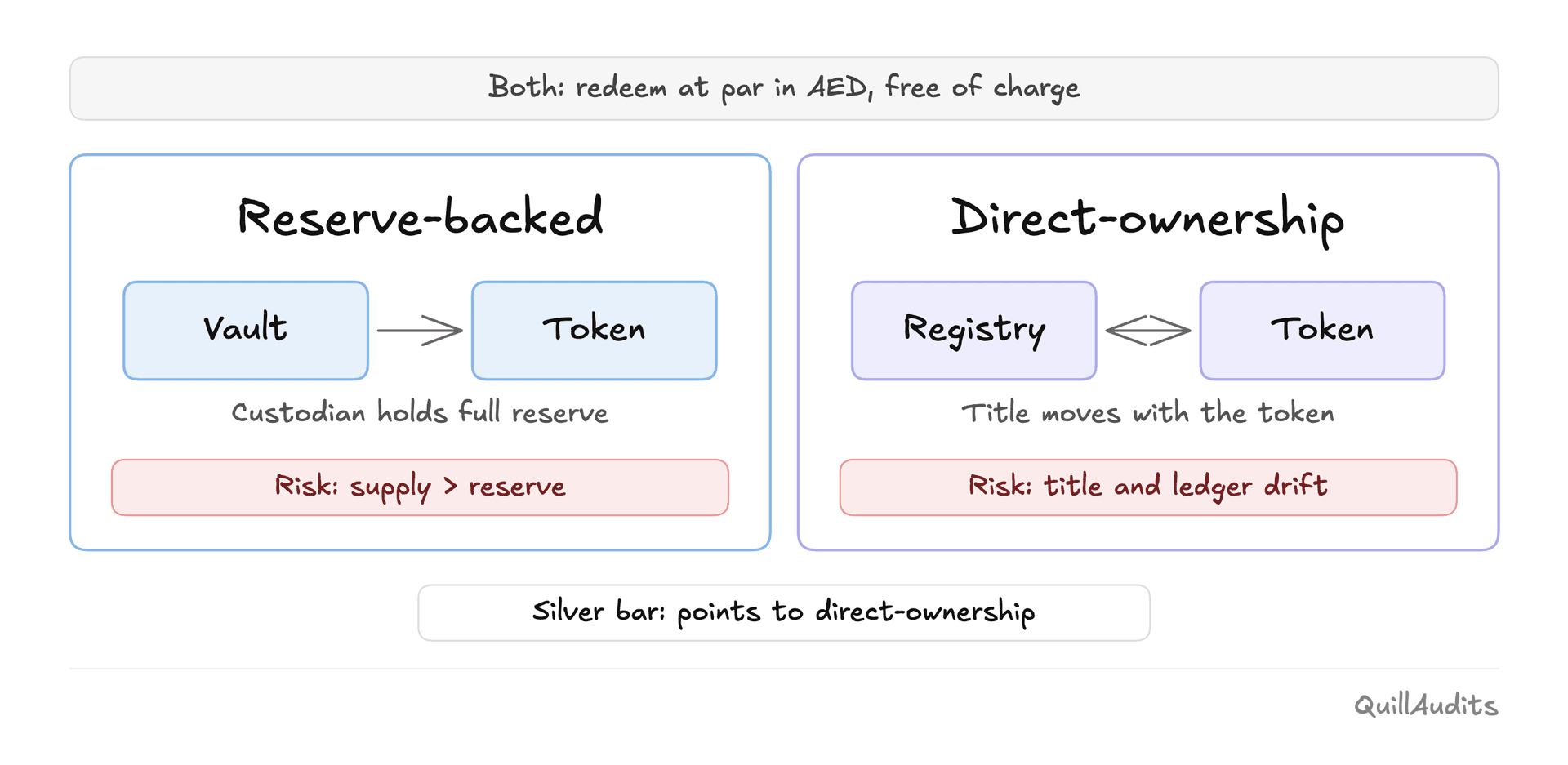
The launch material of this silver bar tokenization protocol says investors can own a fractional interest in the bar, which points toward direct ownership, but it never names the model. If it is direct-ownership, the Tradeflow record and the BNB Chain ledger can never disagree, even for one block. That matters more than any proof-of-reserve dashboard. For a reserve-backed design, our stablecoin security blueprint walks through collateral architecture and settlement.
Where Dubai tokenization projects break
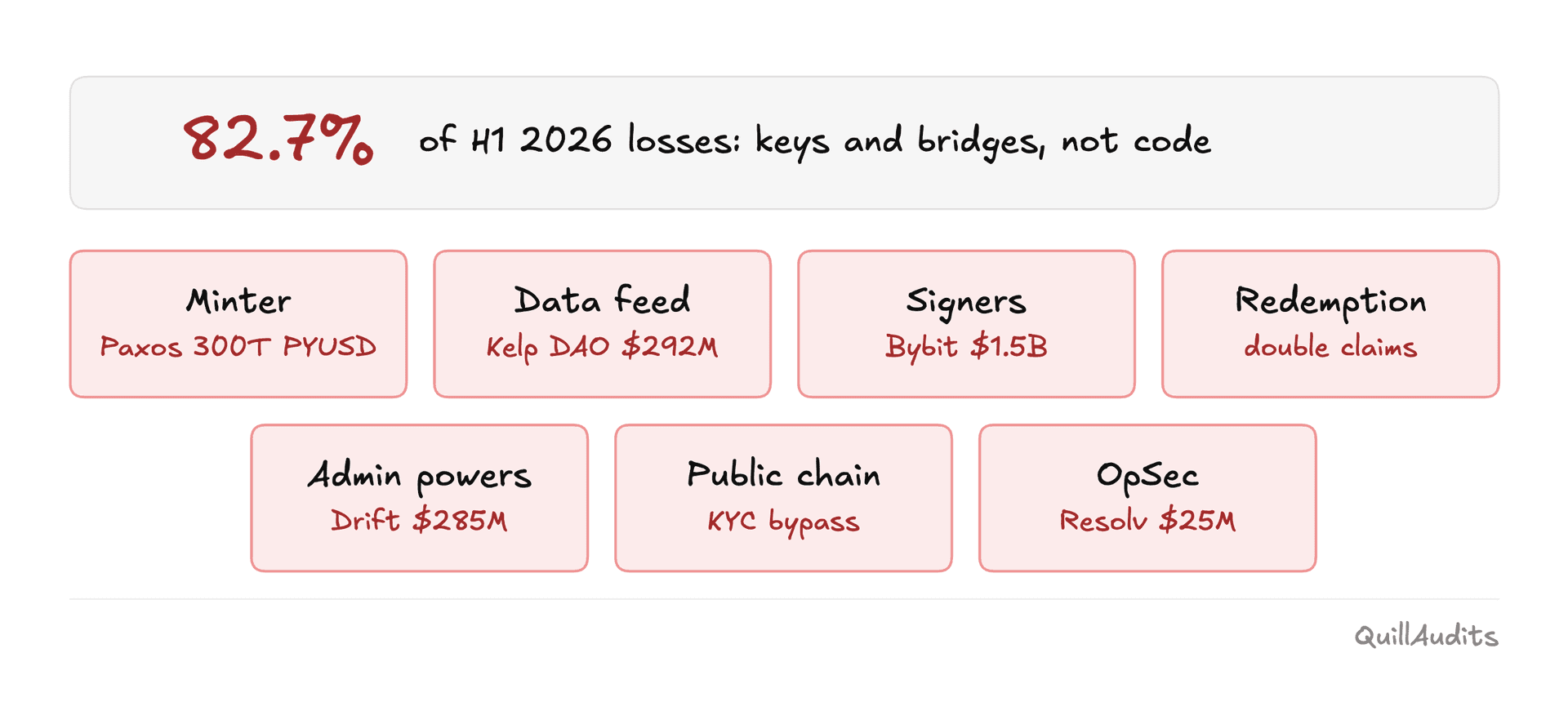
In our H1 2026 data, $935.3M was lost across 87 DeFi hacks, and 82.7% of it came from key compromise and bridge exploits rather than contract bugs. Tokenized assets inherit every one of those risks, and they add a physical asset and an off-chain registry on top.
The minter
In October 2025, Paxos minted 300 trillion PYUSD by mistake from a hot wallet. It burned the excess within 30 minutes, while Aave froze PYUSD markets. Paxos is a regulated issuer, and the contract still let that mint through. Broken mint logic has drained real protocols too, as our breakdowns of Resolv Labs and Solv Protocol show.
For a one-of-one bar, supply is fixed the day the asset is fractionalized, so an extra mint should be impossible. Hard-cap total supply at the number of fractions and close minting after issuance. If minting must continue, gate it on a signed attestation from the registry or custodian, and put the role behind a multisig and a timelock.
The feed between the vault and the chain
Every RWA token depends on off-chain truth, such as a Tradeflow record, a custodian statement or a DLD(Dubai Land Department) registry entry. Whatever carries that truth on-chain is an attack surface.
In April 2026, Kelp DAO lost roughly $292M after compromised infrastructure fed false data into a bridge. For an RWA issuer, the equivalent is a spoofed attestation, a replayed registry message or an unauthenticated API response that triggers a mint.
Defend it with:
- Signed attestations.
- More than one independent source.
- Circuit breakers that pause minting when sources disagree.
- Monitoring that pages a human.
We cover the server side of this in who's watching your servers.
Custody and the signers
Physical custody protects the metal Off-chain, and key custody protects the token On-Chain. In February 2025, Dubai-based Bybit lost about $1.5B, North Korea's Lazarus Group compromised a Safe{Wallet} developer machine, altered a routine cold-to-hot transfer and masked it in the signing interface. The signers approved it, and there was no contract bug.
That is exactly what VARA's multisig, workstation and signing-halt standards now target. Our write-up of the North Korean playbook shows how these attacks start.
Redemption
Redemption is where the promise gets tested with real money:
- Non-atomic flows. A burn and payout that are not atomic let a holder claim twice, or lose tokens without getting paid.
- Queue attacks. A redemption queue can be griefed with dust requests or blocked by a denial of service.
- Rounding. Rounding on fractional units leaks value over thousands of redemptions.
- Compliance lists. Allowlist and sanctions logic can trap honest holders.
Periodic reserve audits leave long blind spots, so reconcile supply against custodian records continuously and stress-test redemption under load before launch.
Admin powers and upgrades
Compliant tokens need pause, freeze and forced transfer to handle court orders and sanctions, and each one is also an attack path. Separate the roles, timelock upgrades and watch every privileged call in real time.
Compromised admin controls sat behind Drift Protocol's roughly $285M loss in April 2026. Our admin audit checklist covers what a code audit misses here.
Transfers on a public chain
The silver bar token lives on BNB Chain, a public network, and regulated secondary trading is scheduled to follow issuance. Transfer rules therefore need enforcing in code, not just in platform terms. Gate transfers through an on-chain identity registry, in the style of ERC-3643, so tokens cannot move to wallets that failed KYC.
Protect the registry's admin keys as carefully as the minter's, and do not bridge the token to other chains unless the bridge has been audited too.
OpSec and people
The largest losses of 2026 started with people, not code. Drift's attackers spent six months socially engineering the team before two signers unknowingly pre-approved malicious transactions. Resolv's minting key sat in a single cloud account. A smart contract audit never looks at these places.
But an OpSec audit does. It maps every privileged key, tests whether signers check raw calldata or just trust the wallet screen, and reviews signer devices, cloud access and social engineering exposure. It also measures how fast an attacker with admin access could drain the system, which is the question VARA's key compromise standard asks you to answer in advance.
Investors are targets too. VARA and the DLD have already warned about entities falsely claiming to take part in the real estate tokenization pilot, so publish your official channels and monitor lookalike domains.
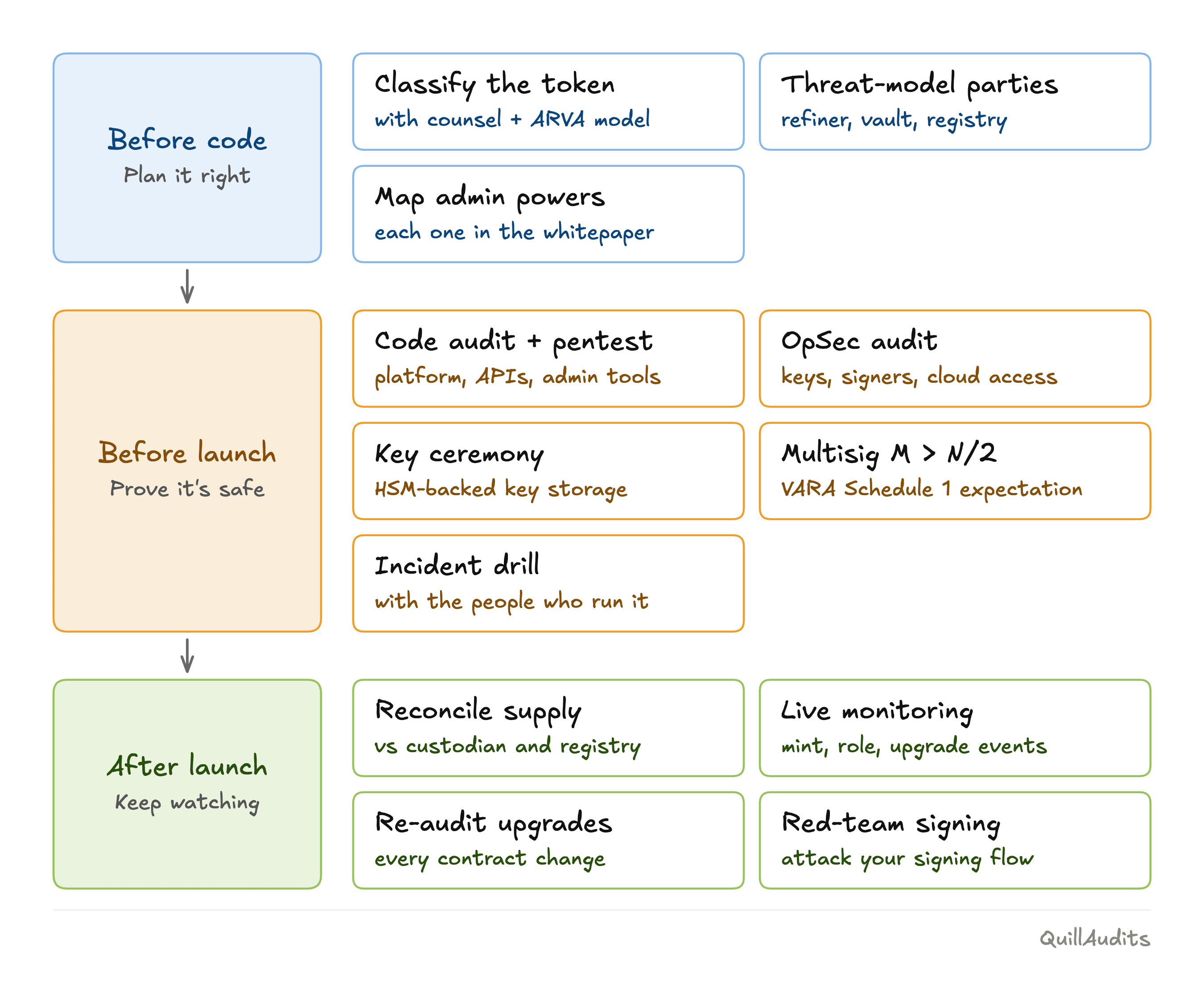
What a secure build looks like, stage by stage
How QuillAudits can help
QuillAudits operates from Downtown Dubai and has completed more than 1,500 audits. Its services map onto every pillar in this piece.
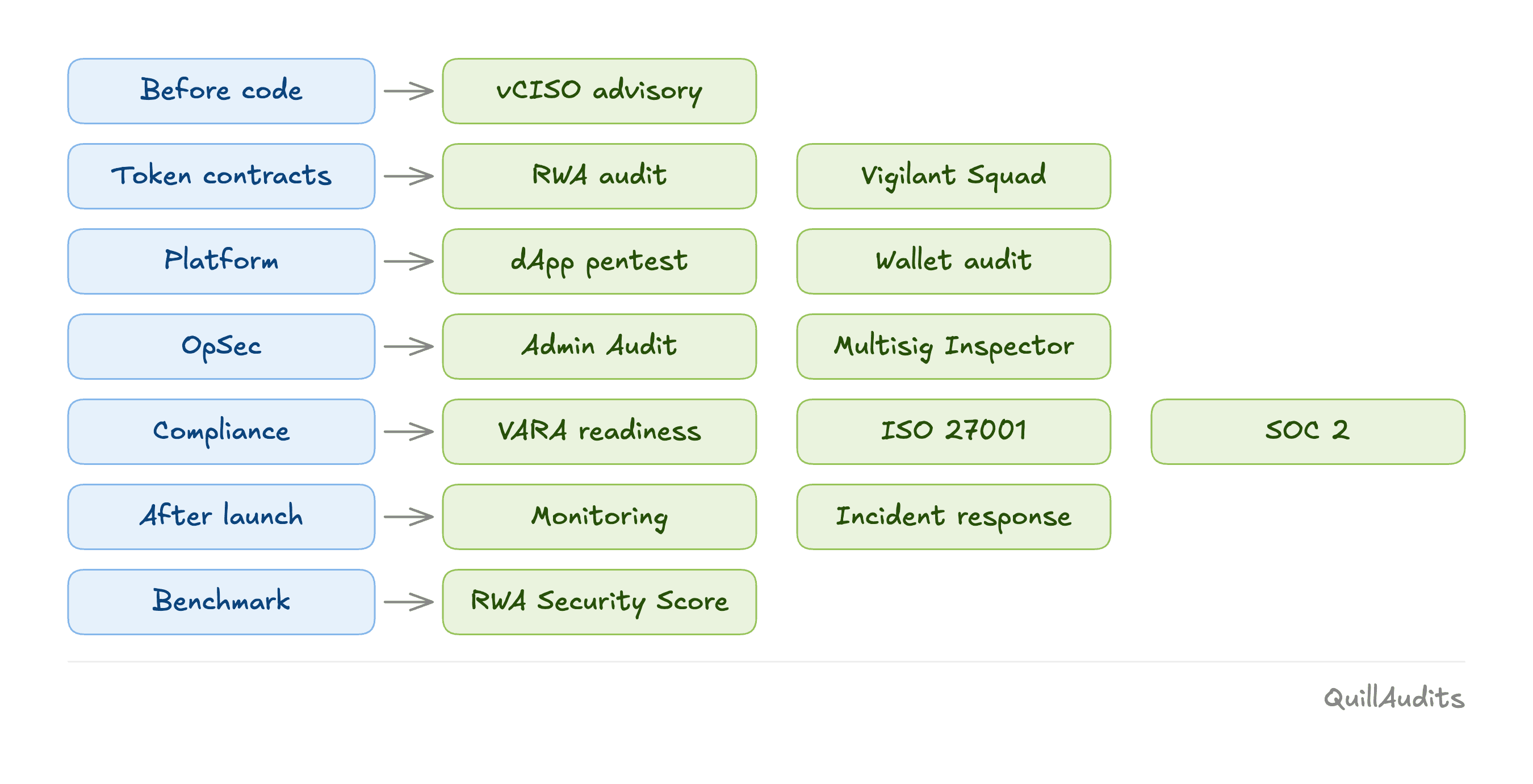
- vCISO advisory brings security engineers into architecture decisions, such as the ARVA model, mint design and key custody, before anything is built.
- RWA and tokenization audits cover mint, burn, redemption, oracle and registry feeds, compliance modules and upgrade paths. For high-value launches, the Vigilant Squad puts 10 to 12 independent researchers on one audit.
- dApp penetration testing covers the issuance platform, APIs and admin tooling, and wallet security audits cover custody and wallet apps, both scoped to Section E's testing rules.
- Our Admin Audit reviews what a code audit skips: privileged keys, multisig thresholds, signer devices, cloud access, social engineering resistance, timelocks and incident readiness. The free Multisig Inspector checks a Safe setup in minutes.
- VARA Compliance Readiness maps your controls to the Technology and Information Rulebook, and ISO/IEC 27001 and SOC 2 readiness help with institutional partners.
- Smart contract monitoring alerts on signer anomalies, timelock changes and unusual admin calls, and incident response is on hand if something breaks.
- The RWA Security Score rates your protocol across eight risk categories, operational security included.
Conclusion
Dubai has built a detailed tokenization rulebook, and the silver bar shows that the pieces work together. But a licence sets the floor, not the ceiling. The vault, the registry, the keys and the code each need their own defence, because every mint must remain a true claim on something real. Wanted to learn more about VARA regulation, checkout our detailed blog here.
Contents