Developer Foundation
First RWA: Stablecoins
Why stablecoins became the first RWA, how they bridge fiat and crypto, enable settlement, maintain peg stability & power global on-chain finance.
Stablecoins are the quiet backbone of the RWA ecosystem, the programmable, price-stable tokens that transform off-chain fiat reserves into on-chain atomic settlement. They underpin everything from DeFi liquidity pools to tokenized Treasury markets. As of December 2025, the stablecoin market cap exceeds 310 billion dollars, with daily volumes surpassing 150 billion across ecosystems like Ethereum L2s, Solana, and Tron. This growth, up 25% year over year, has been fueled by the surge in tokenized assets and regulatory clarity from frameworks such as MiCA.
Behind the familiar one dollar peg sits a diverse set of architectural models: custodial reserve systems powering large issuers like USDT with more than 184 billion dollars in circulation, overcollateralized vaults that secure DAI’s 4.5 billion dollar supply, and yield-bearing RWA backed wrappers like USDY, holding 1.6 billion in Treasuries at roughly 4.3% YTM.
For developers, stablecoins are far more than ERC 20 tokens—they are the foundational layer of RWA composability. Launching a lending market? USDC collateral avoids the volatility of ETH. Tokenizing invoices or credit lines? Settling in PYUSD gives instant fiat accessibility. But their stability remains delicate: maintained through economic incentives, redemption mechanisms, verified attestations, and oracle feeds, yet vulnerable to liquidity shortages, redemption halts, and smart contract oversights.
This section provides a blueprint for understanding and engineering stablecoins within the broader RWA stack. We break down issuance and redemption flows, hardened Solidity patterns, real-world vulnerabilities, and the 2025 era mitigations needed to prevent failure modes. We also highlight modern redeemability risks, such as how illiquid reserves can trigger rapid bank run dynamics during market stress.
Why Stablecoins Matter?
Traditional finance still runs on legacy rails, three to five-day wire transfers contributing to more than 1.5 trillion dollars in annual remittance fees, 1.7 billion people excluded from basic banking, and “business hours” that ignore a globally connected world. Crypto offers the opposite, instant settlement and open access, but assets like BTC remain too volatile for day-to-day commerce, with 2025 showing 18% intra-week price swings that can turn a fifty-dollar purchase into a speculative gamble.
Stablecoins blend the strengths of both systems, the predictability of the US dollar and the efficiency of blockchain infrastructure. They reduce cross-border transfer costs to well under ten cents and enable settlement that is global, atomic, and available twenty-four seven.
In DeFi, stablecoins function as the two-hundred-billion-dollar liquidity backbone, they represent roughly 17% of Aave and Compound collateral and power 18% of Uniswap V3 trading pairs. In the RWA ecosystem, they serve as the universal settlement layer, tokenize a Treasury bill, earn yield in a vault, and redeem it back to USD without significant slippage. Corporates such as MicroStrategy manage multi-billion-dollar USDC treasuries to optimize yield, while merchants like the ten million-plus Shopify storefronts leverage stablecoins for fraud resistant payments.
For developers, stablecoins are the unit of account you build around. Price APIs in DAI instead of volatile assets like SOL, insulate fee calculations from price swings, and maintain predictable denominators in lending, swaps, and RWA flows.
2025 Snapshot
- Fiat-backed stablecoins dominate with eighty eight percent market share, led by USDT and USDC totaling around two hundred sixty billion dollars.
- RWA hybrid stablecoins have grown to eight billion dollars in TVL, boosted by products like BlackRock’s BUIDL, holding two point five billion in tokenized funds.
- Depegs have fallen forty percent year over year thanks to real-time proof of reserve oracles, though liquidity crunches still occur, as seen in November’s two point five per cent USDT slippage during a brief market panic.

Types of Stablecoins: Architectures, Trade-Offs and Implementation Blueprints
Stablecoins fall into two major architectural families: off chain fiat-backed models and on-chain collateralized engines. Each approach balances decentralization, compliance, yield, and peg stability differently. Fiat-backed designs focus on redeemability and regulatory alignment, while crypto-backed designs prioritize permissionless robustness and liquidation mechanics. RWA-backed hybrids sit between these extremes, using tokenized T-bills or bond portfolios for yield and peg integrity.
Below is a matrix summarizing backing logic, contract surfaces, oracle dependencies, integration benefits, common pitfalls, and 2025 upgrades across leading stablecoin types.
Stablecoin Architecture Matrix
| Type | Backing & Peg Logic | 2025 Market Cap & Examples | Dev Pros (Integrations) | Dev Cons (Risks/Pitfalls) | Core Contracts & Hooks | 2025 Upgrades |
|---|---|---|---|---|---|---|
| Fiat-Backed | Backed 1:1 by off-chain USD, T-Bills, or money-market funds. Peg maintained via institutional mint/redeem flows and arbitrage. Proof-of-reserves attest to backing. | USDT (184B), USDC (77.1B), PYUSD (3.84B) | Easy integrations: Paxos/Circle SDKs, EIP-2612 for gasless approvals. | Opaque redemption pipelines, institutional access only, run risks during redemption halts. | Standard ERC-20 + Ownable, multisig mint/burn roles. | MiCA-aligned EU issuance, sub-1-hour redemption windows. |
| RWA-Backed | Collateralized by tokenized Treasuries or bond ETFs. Yield distributed via ERC-4626 share-price mechanics. Peg anchored by NAV oracles with >110% collateralization. | USDY (Ondo, 1.6B, 4.3% YTM), BENJI | Plug-and-play yield vaults, Chainlink PoR for collateral visibility. | Duration mismatches, thin liquidity on non-EVM chains, oracle sync risk. | ERC-20 + ERC-4626, oracle-backed _previewRedeem() logic. | Multichain yield via Wormhole attestations. |
| Crypto-Collateralized | Overcollateralized (150%+) ETH/BTC deposits. Peg maintained through stability fees, auctions, and oracle-triggered liquidations. | DAI (5B), LUSD (36M) | Highly composable with Aave/Compound, flash-loan minting workflows. | Liquidation cascades in crashes, oracle delays can break peg. | Maker-style vaults (DSAuth), Flipper/Clipper auction modules. | Maker Endgame adds RWA sub-vaults for stability. |
| Hybrid | Mix of RWA and crypto collateral (70–90%), supplemented with algorithmic controllers and AMOs to stabilize peg. | FRAX, USDe (Ethena, 7.1B) | Extremely flexible peg design, veToken economic tuning. | More complex peg dynamics, stress-test depegs, tricky rebase logic. | ERC-20 + governance modules, oracle-adjusted collateral ratios. | AI-enhanced AMOs for real-time peg defense. |
| Algorithmic | Elastic supply based on seigniorage and demand signals, minimal collateral. Now mostly hybrid variants post-UST. | Legacy algo forks (~150M), experimental sDAI | Lightweight issuance, no KYC barriers. | High spiral risk, historical failures (2022’s 50B collapse). | Rebase ERC-20, dual-token incentive structures. | Mandatory circuit breakers and multi-oracle guards. |
Fiat-Backed (USDC / PYUSD) : Typically composed of roughly 75% short-duration U.S. Treasury bills yielding around 4.6 per cent, and 25% cash or cash-equivalent assets. Peg stability depends on redeemability, stress events can expose liquidity gaps. During the 2022 SVB incident, for example, USDC briefly depegged by 1.2% due to inaccessible cash reserves.
Circle provides a GraphQL API for real time reserve and mint/redeem activity, enabling off-chain monitoring or on-chain oracle relays. In Solidity, developers usually implement compliant wrappers that enforce allowlists, minting permissions, or jurisdictional checks before interacting with custodial stablecoins.
1// NOTE: Sample code - not for production use.
2// SPDX-License-Identifier: MIT
3pragma solidity ^0.8.24;
4import "@openzeppelin/contracts/token/ERC20/ERC20Permit.sol";
5import "@openzeppelin/contracts/access/AccessControlEnumerable.sol";
6import "@chainlink/contracts/src/v0.8/interfaces/AggregatorV3Interface.sol";
7
8contract CompliantUSDC is ERC20Permit, AccessControlEnumerable {
9    bytes32 public constant MINTER_ROLE = keccak256("MINTER_ROLE");
10    bytes32 public constant PAUSER_ROLE = keccak256("PAUSER_ROLE");
11    AggregatorV3Interface public reserveOracle;  // Chainlink PoR for attestations
12
13    bool public paused;
14    mapping(address => bool) public blacklisted;  // AML compliance
15
16    constructor(address _oracle) ERC20("USD Coin", "USDC") ERC20Permit("USD Coin") {
17        _grantRole(DEFAULT_ADMIN_ROLE, msg.sender);
18        reserveOracle = AggregatorV3Interface(_oracle);
19    }
20
21    function mint(address to, uint256 amount) external onlyRole(MINTER_ROLE) {
22        _requireValidRedemption(amount);  // Check reserves
23        _mint(to, amount * 10**6);  // 6 decimals
24    }
25
26    function _requireValidRedemption(uint256 amount) internal view {
27        (, int256 reserves,,,) = reserveOracle.latestRoundData();
28        require(uint256(reserves) >= totalSupply() + amount, "Insufficient reserves");
29    }
30
31    function transfer(address to, uint256 amount) public override returns (bool) {
32        require(!paused, "Paused"); require(!blacklisted[msg.sender] && !blacklisted[to], "Blacklisted");
33        return super.transfer(to, amount);
34    }
35
36    function pause() external onlyRole(PAUSER_ROLE) { paused = true; }
37    function blacklist(address account) external onlyRole(DEFAULT_ADMIN_ROLE) { blacklisted[account] = true; }
38}
39
RWA-Backed (USDY) : Ondo’s USDY is backed by short-duration U.S. Treasury bills held with BNY Mellon, with a weighted-average maturity of approximately 28 days. The token auto-rebases daily through share-price appreciation driven by the underlying T-bill yield.
Liquidity stress can emerge when secondary markets thin out. For example, USDY experienced up to 3% slippage on Solana DEXs during periods of heavy outflows, despite full collateralization. This illustrates the difference between solvency (sound) and liquidity (execution risk).
USDY is exposed as a yield-bearing ERC-4626 vault, allowing developers to inherit standardized deposit, withdraw, and preview functions. Typical integration involves wrapping the vault for protocol-specific accounting or restricting transfers through compliance modules.
1// NOTE: Sample code - not for production use.
2// Yield-bearing RWA stable (ERC-4626)
3import "@openzeppelin/contracts/token/ERC20/extensions/ERC4626.sol";
4import "@chainlink/contracts/src/v0.8/interfaces/AggregatorV3Interface.sol";
5
6contract USDYVault is ERC4626 {
7    AggregatorV3Interface public navOracle;  // T-bill NAV feed
8    uint256 public constant OVERCOLLATERAL = 110;  // 110%
9
10    constructor(IERC20 _asset, address _oracle) ERC4626(_asset) {
11        navOracle = AggregatorV3Interface(_oracle);
12    }
13
14    function totalAssets() public view override returns (uint256) {
15        (, int256 nav,,,) = navOracle.latestRoundData();
16        uint256 rawAssets = super.totalAssets();
17        return (rawAssets * OVERCOLLATERAL) / 100;  // Overcollateral check
18    }
19
20    function _convertToShares(uint256 assets) internal view override returns (uint256) {
21        uint256 supply = totalSupply();
22        return supply == 0 ? assets : (assets * supply) / totalAssets();
23    }
24
25    // Redemption: Burn + pro-rata RWA claim
26    function redeem(uint256 shares, address owner, address receiver) public override returns (uint256) {
27        uint256 assets = previewRedeem(shares);
28        _burn(owner, shares);
29        IERC20(asset()).transfer(receiver, assets);
30        return assets;
31    }
32}
33- Crypto-Collateralized (DAI) Mechanics: Maker vaults allow users to lock volatile assets (for example, 200 ETH) and mint against them (such as drawing 130 DAI). Overcollateralization and stability fees maintain the peg. Maker’s Endgame architecture introduces specialized SubDAOs that manage RWA collateral, including tokenized gold and short-term debt instruments.
Hybrids (FRAX) Mechanics: FRAX maintains a dynamic collateral ratio (CR), often around 8% RWA and crypto collateral. When the peg weakens, the protocol burns FXS to absorb supply and buy back FRAX. A Governor module adjusts the CR based on market conditions. A simplified pattern looks like:
1function adjustCR(uint256 newCR) external onlyGovernor {
2    collateralRatio = newCR;
3}
4
This enables responsive peg defence without manual intervention.
- Algorithmic Example: Ethena’s USDe uses a delta-hedged ETH position (spot + perpetuals) to synthetically maintain dollar exposure. The design is gas-efficient and capital-light but relies heavily on arbitrage, perpetual funding markets, and centralized CEX liquidity, making it sensitive to exchange downtime or sudden funding spikes.
Issuance and Redemption
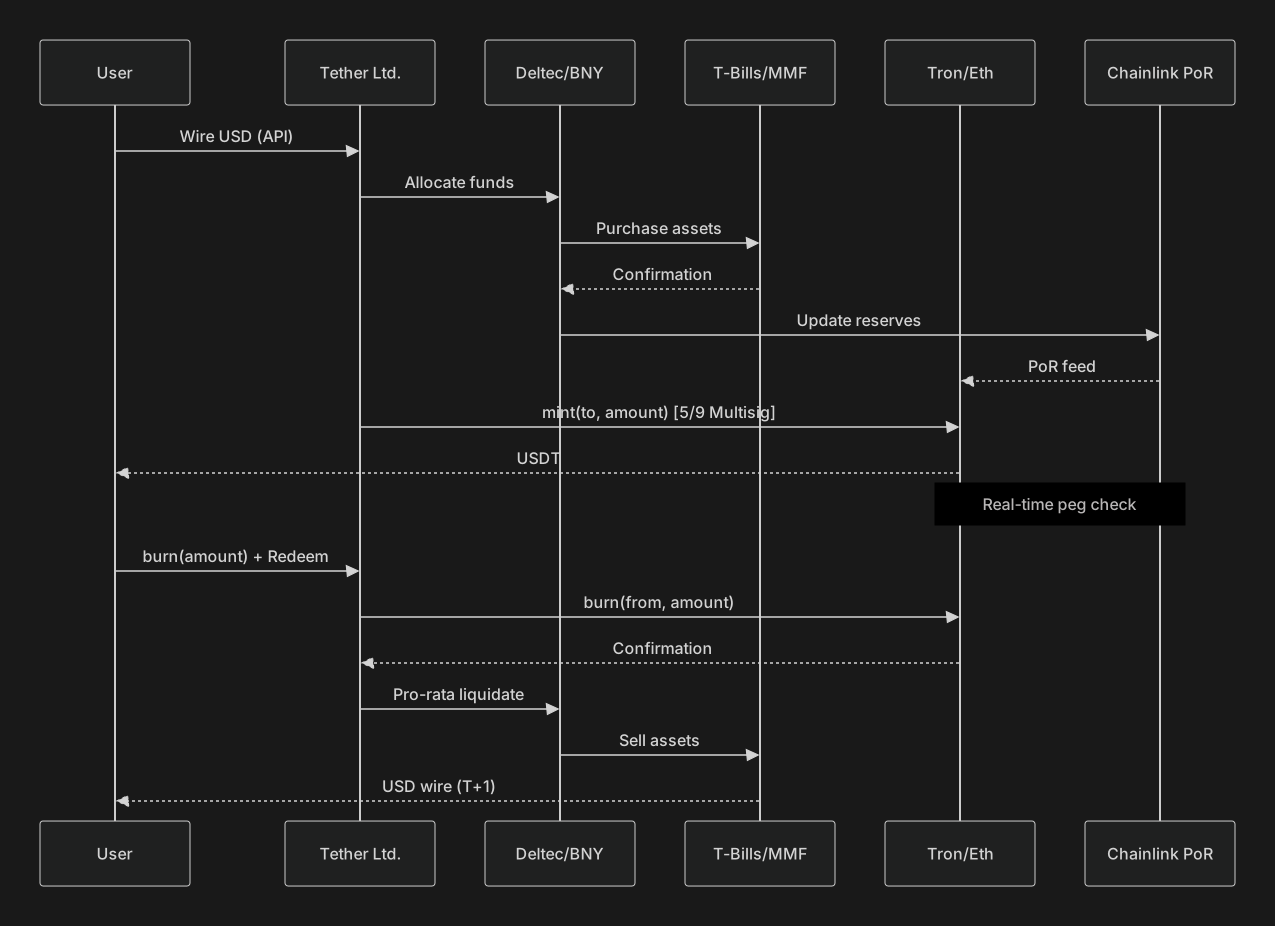
Stablecoin lifecycles operate as tightly coupled off-chain and on-chain processes. Issuance follows the path: fiat wire - reserve allocation - token mint. Redemption inverts the sequence: token burn - reserve liquidation - T+0 or T+1 wire back to the customer.
For fiat-backed stablecoins, roughly 98% of issuance and redemption volume is institutional. Peg stability becomes fragile when redemption queues exceed 24 hours, during the 2023 banking stress, USDC experienced a 48 hour backlog that contributed to a 0.8% depeg.
Enhanced Issuance Flow (USDT Example)
- The customer wires funds after completing KYC with Bitfinex or Tether Ltd.
- The custodian (such as Deltec) allocates reserves, for example, 60% into U.S. Treasury bills and 40% into money-market funds.
- BDO or another auditor provides an attestation, after which a multisig executes the on-chain
mint()transaction. - Yield generated by reserve assets is reinvested through automated off-chain portfolio management hooks.
PayPal USD (PYUSD): A Comprehensive Analysis of PayPal’s Stablecoin Ambitions
PayPal USD (PYUSD) marks a transformative moment in the journey toward mainstream stablecoin adoption. Launched in August 2023, PYUSD is the first major stablecoin initiative spearheaded by a global payments giant, signaling the convergence of traditional finance and digital assets.
Institutional-Grade Compliance and Trust
PYUSD is issued by Paxos Trust Company and operates under the regulatory supervision of the New York State Department of Financial Services. This structure ensures that the stablecoin meets stringent compliance and security standards. Unlike many crypto-native tokens, PYUSD benefits from institutional-grade oversight, aligning its governance with the expectations of regulators, traditional institutions, and risk-conscious users.
Robust Backing and Transparency
The stability of PYUSD comes from its full backing by US dollar deposits, short-term US Treasuries, and similar liquid cash equivalents. All reserves are managed by Paxos Trust Company, an experienced and regulated custodian. Monthly attestation reports are published to verify the integrity of reserves and reinforce transparency. This structure mirrors the practices used by established regulated stablecoins such as USDP and BUSD, ensuring every PYUSD token is backed one-to-one by safe, liquid assets.
Integration with the PayPal Ecosystem
One of PYUSD’s defining advantages is its seamless integration with PayPal’s global platform home to over 400 million active users. By embedding PYUSD directly within PayPal wallets, millions of users can now buy, sell, hold, and transfer digital dollars using familiar PayPal interfaces. This puts stablecoins within reach of mainstream consumers, bypassing the complexities of standalone crypto wallets and private key management. In effect, PYUSD serves as a bridge between traditional fintech and the emerging Web3 ecosystem.
Ethereum Foundation and DeFi Compatibility
Technically, PYUSD is deployed as an ERC-20 token on the Ethereum blockchain. This strategic choice leverages Ethereum’s mature infrastructure, enabling compatibility with a wide range of decentralized finance (DeFi) protocols and liquidity pools. As an ERC-20 token, PYUSD benefits from fast settlement, high security, and access to a vibrant developer and application ecosystem while preserving the transparency and auditability native to public blockchains.
Enhanced Compliance and Control Features
Beyond standard token features, PYUSD’s smart contract includes provisions for regulatory compliance. The contract can pause transactions, freeze specific addresses, and implement transaction monitoring, a necessity for compliance with anti-money laundering (AML) and financial regulations. While these features offer enhanced security and consumer protection, they also introduce centralization elements that differ from purely decentralized stablecoins.
Market Positioning: Retail and Institutional Appeal
PYUSD is uniquely positioned for adoption by both retail and institutional users.
- Retail users benefit from PayPal’s intuitive UI and established trust, making it easier than ever to access stable digital money.
- Institutions gain confidence from the coin’s regulatory clarity and the quality of its reserve backing, supporting use cases in treasury management, business payments, and cross-border settlements.
Challenges and Considerations
Despite its strengths, PYUSD faces several important challenges:
- Competition from entrenched stablecoins such as USDC and USDT, which already enjoy wide adoption across exchanges and DeFi.
- Centralization Concerns, especially regarding the ability to freeze assets, potentially conflicting with the ethos of decentralization.
- PayPal Ecosystem Reliance, as primary distribution and utility, may initially be limited to PayPal’s platform, restricting broader adoption until further integrations occur.
PayPal USD (PYUSD) represents a landmark step in bridging the worlds of traditional finance and digital assets. Its strong regulatory foundation, transparent backing, and integration into a massive payments ecosystem make it a stablecoin to watch—capable of onboarding mainstream and institutional users alike. As the digital asset landscape evolves, the success and adoption of PYUSD may serve as a bellwether for the future of regulated, compliant stablecoins in global finance.
Key Factors to Consider When Creating a Stablecoin
Building a reliable stablecoin takes more than just good code. You need to balance technical choices, economic design, compliance, and community trust. Here are the core areas to get right:
- Peg mechanism: Start by choosing how your stablecoin will stay “stable.” Options include:
- Fiat-backed: Each token is backed by real-world cash or equivalents. Simple and familiar, but more centralized.
- Crypto-collateralized: Backed by other crypto assets, usually overcollateralized to handle volatility. More decentralized, but more complex.
- Algorithmic: Uses market incentives and smart contracts to maintain the peg without full collateral. Flexible, but riskier and harder to prove resilient.
- Collateral management (for backed models): If you’re using reserves, how you manage them is crucial.
- Pick safe, liquid assets and diversify them.
- Use trustworthy custodians, with clear controls and segregation.
- For fiat-backed coins, publish regular, independent attestations so users can verify reserves.
- For crypto-backed systems, design robust liquidation processes, conservative collateral ratios, and clear rules for extreme volatility.
- Regulation and compliance: You can’t ignore the legal side.
- Requirements vary by country—licensing, reserve rules, disclosures, audits, and operational standards.
- Build KYC/AML processes into onboarding and redemption.
- Set up proper reporting, monitoring, and record-keeping from day one.
- Technical architecture: The platform and code shape the user experience and safety.
- Choose a blockchain (or multiple) based on speed, fees, security, and ecosystem support.
- Write secure, well-audited smart contracts with upgrade paths and emergency controls.
- Plan for scale: think about gas efficiency, L2s, or multichain deployments as you grow.
- Ensure strong key management, permissions, and incident response procedures.
- Governance: Decide how decisions get made over time.
- Centralized governance can move fast but reduces decentralization.
- Decentralized governance increases community control but can be slower and more complex.
- Define how you’ll adjust parameters (e.g., fees, collateral ratios), handle emergencies, and evolve the protocol.
- Adoption and ecosystem: A stablecoin is only useful if people can actually use it.
- Partner with exchanges, wallets, payment processors, and DeFi protocols to build liquidity and utility.
- Provide great developer docs, SDKs, and support to make integrations easy.
- Communicate clearly with users and market participants to build trust.
- Risk management: Prepare for the bad days, not just the good ones.
- Mitigate smart contract and oracle risks with audits, redundancy, and monitoring.
- Use safeguards like circuit breakers, rate limits, and pause mechanisms.
- Run stress tests and simulate extreme scenarios to validate your design.
- Have a clear playbook for incidents and recovery.
Security Considerations
Peg Maintenance Vulnerabilities
Stablecoins must maintain their peg to the target asset (usually USD) through various mechanisms. When these mechanisms assume perfect pegs of reference assets (like DAI) or lack circuit breakers during extreme market conditions, the stablecoin becomes vulnerable to cascading failures and depeg events.
1*// @audit - No check for DAI depeg*
2function redeem(uint ussdAmount) external {
3    uint daiAmount = ussdAmount * 1e12; *// Assumes 1 USSD = 1 DAI always*
4    IERC20(dai).transfer(msg.sender, daiAmount);
5}
6
7
Lack of Slippage Protection
Slippage protection is crucial in DeFi swaps, especially for stablecoins that frequently rebalance or allow users to swap collateral. Without minimum output parameters, trades can execute at extremely unfavorable rates during market volatility or due to sandwich attacks. This is particularly dangerous for large automated rebalancing operations.
1*// @audit - No minimum output parameter*
2function swapToDai(uint tokenAmount) external {
3    IERC20(token).transfer(router, tokenAmount);
4    router.swapExactTokensForTokens(tokenAmount, 0, path, address(this));
5}
6
7
Rebalancing Logic Flaws
Stablecoins often rebalance their collateral portfolios to maintain the peg. When this rebalancing logic contains arithmetic errors, particularly division before multiplication, significant precision loss occurs. This creates opportunities for MEV bots and arbitrageurs to exploit the miscalculations, especially during high-frequency rebalancing operations.
1function sellCollateral(uint collateralAmount, uint minOutput) internal {
2    uint usdValue = (collateralAmount * price) / 1e18; *// Early division*
3    uint daiAmount = (usdValue * 1e18) / daiPrice; *// Precision loss*
4}
5
6
Cross-Protocol Stablecoin Arbitrage Vulnerabilities
When multiple stablecoin protocols operate in the same ecosystem, price discrepancies create arbitrage opportunities that can drain individual protocols. This is especially dangerous when protocols assume perfect $1.00 pegs for other stablecoins or don't validate cross-protocol pricing. Arbitrageurs exploit temporary depegs, oracle delays, or liquidity imbalances between protocols to extract value systematically.
USDT Boolean Return Issue
One of the most notorious and widespread security issues in the stablecoin space is the USDT boolean return problem. The original Tether (USDT) smart contract on Ethereum implements the ERC-20 transfer function incorrectly by not returning a boolean value to indicate success or failure.
Oracle Manipulation Risk
Oracle manipulation is one of the most critical vulnerabilities in DeFi stablecoins. When protocols rely on a single price feed or use spot prices without proper validation, attackers can artificially inflate or deflate asset prices to exploit the system. This happens through flash loans, large trades, or by targeting the oracle mechanism itself.
1*// @audit*
2function getPrice() external view returns (uint256) {
3    (,int price,,,) = chainlink.latestRoundData();
4    return uint256(price); *// No staleness check or deviation threshold*
5}
6
7
Fee-on-Transfer Token Vulnerabilities
Some ERC-20 tokens (like SafeMoon, reflection tokens, or certain deflationary tokens) charge fees on every transfer, meaning the recipient receives less than the specified amount. When stablecoin protocols don't account for these fees, they create under-collateralized positions by minting stablecoins based on the intended transfer amount rather than the actual received amount.