Standards
ERC7208 On-Chain Data Containers
A guide to ERC7208 data containers built for structured on-chain storage, seamless retrieval and modular contract workflows.
ERC7208 defines a standardized way to separate on-chain data storage from the business logic that uses it. This modular structure is especially valuable for real-world asset systems, where ownership proofs, valuations, compliance documents, or legal metadata must remain intact even if token logic changes. The standard introduces four components: Data Objects (DO) for raw, persistent storage; Data Points (DP) as unique identifiers that reference specific data entries; Data Managers (DM) for executing business, compliance, or transfer logic; and Data Indexes (DI) for permissioned access and retrieval. By splitting these layers, ERC7208 makes it possible to upgrade logic, swap compliance modules, or migrate to new token formats without needing to move or rewrite underlying asset data.
The standard addresses a long-standing issue in token design: most protocols tightly couple data and logic, meaning upgrades, migrations, or regulatory changes require full contract replacements or risky bridging. For RWAs, where documents and valuation feeds must persist across jurisdictions and product cycles, ERC7208 enables “horizontal data mobility,” keeping data neutral, durable, and portable across chains and token types. Drafted in 2024 and finalized in 2025, it does not require a specific base token standard, but supports ERC165 for interface detection. It is already powering early implementations across platforms like Centrifuge and RealT, allowing data to remain untouched during protocol upgrades, audits, or regulatory refactoring. In full-stack RWA deployments, it often works alongside ERC3643 for identity-bound data layers or ERC7518 for partitioned rights and ownership structures.
Use of ERC7208 in RWA Contexts
ERC7208 lets RWA data live independently from the token logic that references it. An issuer can tokenize an asset once, store its legal records and valuation data in durable data containers, and then swap or upgrade the logic layer over time without rebuilding or migrating the asset. This matters for real-world assets because regulations, compliance flows, and token standards evolve quickly, while the core asset data must remain consistent and legally reliable.
Key Applications in RWA Development
Immutable Asset Data and Metadata Core documents such as deed hashes, NAV feeds, inspection certificates, or proof-of-ownership records are stored in Data Objects, referenced through Data Points. This makes the data chain-agnostic and persistent. Even if a protocol shifts from ERC20 to ERC4626 or restructures liquidity, the underlying RWA identifiers remain intact.
Compliance and Logic Upgrades Without Data Touch Data Managers enforce rules (KYC, jurisdictional access, accreditation), while Data Indexes define who can read or update data. When regulations change, developers can replace the logic modules without ever altering the stored data. This prevents repeated token issuance cycles and lowers structural risk in tightly regulated RWA environments.
Cross-Standard and Cross-Chain Interoperability A single storage layer can serve multiple token interfaces at once: ERC20 for liquidity markets, ERC721 for fractional deeds, or ERC1155 for mixed pools. Encoding chain information in Data Points allows smooth migrations across L1s, L2 rollups, or appchains without risking data loss or ownership disputes.
Gated and Auditable Data Access Data Indexes allow fine-grained read and write permissions. Auditors, custodians, valuation partners, or legal entities can access only what is relevant to them, while on-chain events provide full audit trails for appraisals, payouts, or redemption triggers.
Developer Advantages in RWA Builds
Upgrade Logic Without Redeployment Because the data layer remains stable, teams avoid full contract redeployments during compliance or architecture changes, cutting upgrade cost and risk significantly.
Neutrality Across Standards Data stays persistent whether the asset is expressed as ERC20 liquidity units, ERC721 ownership rights, or ERC1155 tranches. ERC165 detection simplifies integration across vaults, DEXs, and dashboards.
Modular Security Model Access controls sit at the data layer, not the logic layer. This enables multisig ownership, custody hierarchies, and institutional permissions without fragmentation.
Scale-Friendly Design Lightweight identifiers and batch operations make ERC7208 practical for large-scale pools like receivables, invoice financing, and asset-backed lending platforms that need efficient, high-volume data processes.
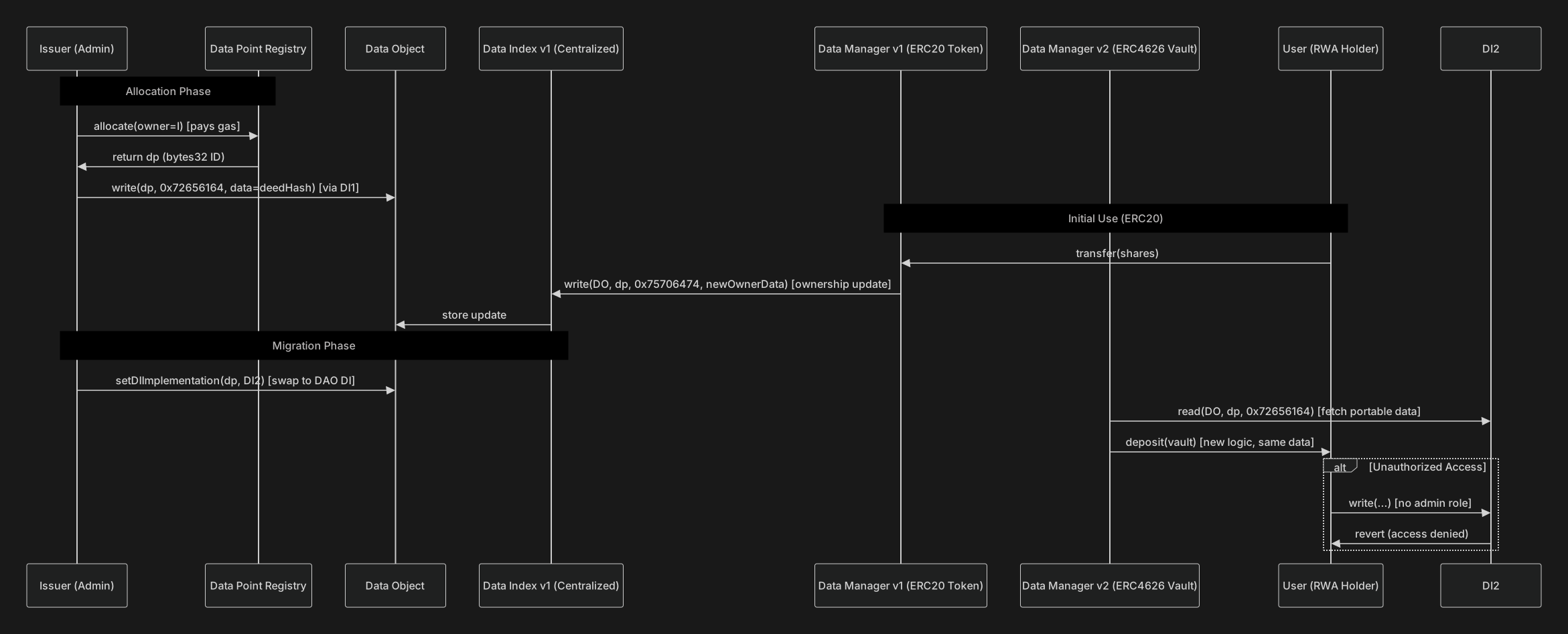
The following sequence diagram illustrates tokenizing an RWA (e.g., real estate share), storing data in a DO, and migrating logic via DI swap, highlighting portability for developers.
Core Specification
ERC7208 requires contracts to expose interfaces for Data Objects, Data Point registries, and Data Index layers. Data Managers sit above them as the logic controllers that read and write through those layers. All operations use bytes4 selectors for consistency, while Data Points are stored as structured bytes32 identifiers to remain portable across chains and token standards. The access path always follows the same order: Data Manager - Data Index - Data Object. View functions revert if the referenced Data Point is invalid, and write operations must be approved by the Data Index before they can reach storage.
Key definitions:
- Data Point (DP) A globally unique
bytes32identifier encoding prefix (e.g.,0x4450for DP), version, local ID, chain ID, and optional registry address. Its format makes the data it represents portable across rollups, L1s, and appchains. - Data Object (DO) The lower-level storage contract that holds raw bytes keyed by Data Points. It never handles business logic and remains stable across system upgrades.
- Data Index (DI) The access-control layer that validates who can read or write to a given Data Point. It mediates every interaction between Data Managers and Data Objects.
- Data Manager (DM) The business logic layer, such as a token or module, that performs operations through the Data Index rather than storing data internally. It can be upgraded or replaced without impacting stored records.
- Data Point Registry (DPR) The authority that issues Data Points and governs ownership rights for them. It defines who can create, revoke, or migrate identifiers.
- Operation Selector A
bytes4function identifier, likekeccak256("read(bytes32)")[:4], used to standardize read, write, and update calls across implementations.
The standard supports ERC165 detection, though the final interface IDs are still pending in the EIP draft and may differ by implementation layer.
The standard defines three core interfaces. Below are the full ABI-compliant codes from the EIP.
IDataPointRegistry
1interface IDataPointRegistry {
2    event DataPointAllocated(bytes32 indexed dp, address indexed owner);
3    event DataPointOwnershipTransferred(bytes32 indexed dp, address indexed from, address indexed to);
4    event AdminRoleGranted(bytes32 indexed dp, address indexed account);
5    event AdminRoleRevoked(bytes32 indexed dp, address indexed account);
6
7    function isAdmin(bytes32 dp, address account) external view returns (bool);
8    function allocate(address owner) external payable returns (bytes32 dp);
9    function transferOwnership(bytes32 dp, address newOwner) external;
10    function grantAdminRole(bytes32 dp, address account) external returns (bool);
11    function revokeAdminRole(bytes32 dp, address account) external returns (bool);
12}
IDataObject
1interface IDataObject {
2    event DIImplementationSet(bytes32 indexed dp, address indexed oldImpl, address indexed newImpl);
3
4    function read(bytes32 dp, bytes4 operation, bytes calldata data) external view returns (bytes memory);
5    function write(bytes32 dp, bytes4 operation, bytes calldata data) external returns (bytes memory);
6    function setDIImplementation(bytes32 dp, address newImpl) external;
7}
IDataIndex
1interface IDataIndex {
2    event DataManagerAllowed(bytes32 indexed dp, address indexed dm, bool allowed);
3
4    function isApprovedDataManager(bytes32 dp, address dm) external view returns (bool);
5    function allowDataManager(bytes32 dp, address dm, bool approved) external;
6    function read(address dobj, bytes32 dp, bytes4 operation, bytes calldata data) external view returns (bytes memory);
7    function write(address dobj, bytes32 dp, bytes4 operation, bytes calldata data) external returns (bytes memory);
8}
Detailed Function Breakdown
allocate(address owner) external payable returns (bytes32 dp) Creates a new Data Point for the specified owner and emits a DataPointAllocated event. The payable component helps prevent spam creation. In RWA systems, issuers typically allocate a unique DP per asset such as a building, loan, property record, or note.
transferOwnership(bytes32 dp, address newOwner) external Moves control of a Data Point to a new owner and emits an event recording the transfer. This is frequently used for custodian transitions or compliance-driven handoffs in RWA lifecycles.
grantAdminRole(bytes32 dp, address account) and revokeAdminRole(bytes32 dp, address account) Adds or removes admin rights for a Data Point. In RWAs, this usually means assigning compliance reviewers, valuation oracles, or licensed transfer agents.
isAdmin(bytes32 dp, address account) external view returns (bool) Checks whether an address is approved to act as an admin for the Data Point. Front ends use this to verify whether an operation such as updating appraisals or compliance metadata can proceed.
read(bytes32 dp, bytes4 operation, bytes calldata data) external view returns (bytes memory) Retrieves stored asset information based on the operation selector. It reverts if the Data Point is not valid. RWAs use this for clean valuation lookups, ownership verification, insurance records, or lien attestations.
write(bytes32 dp, bytes4 operation, bytes calldata data) external returns (bytes memory) Writes data into the storage layer. This is only allowed when the Data Index confirms permission. In practice, RWA protocols use this to update legal ownership logs, NAV records, servicing states, or compliance stamps.
setDIImplementation(bytes32 dp, address newImpl) external Updates which Data Index is used to handle permissions and emits DIImplementationSet. This allows systems to upgrade compliance and access control without touching stored asset data.
isApprovedDataManager(bytes32 dp, address dm) external view returns (bool) Checks whether a Data Manager such as a token contract or vault module is approved to interact with the Data Point. RWA issuers use this to ensure only verified modules can modify asset records.
allowDataManager(bytes32 dp, address dm, bool approved) external Grants or removes permission for a Data Manager and emits DataManagerAllowed. For RWAs, this covers scenarios like onboarding a new vault strategy or secondary registry.
read(address dobj, bytes32 dp, bytes4 operation, bytes calldata data) and write(address dobj, bytes32 dp, bytes4 operation, bytes calldata data) These functions route read and write requests through the Data Index to the Data Object. They enforce access controls and keep a secure separation between asset storage and business logic in RWA architectures.
Reference Implementation
The EIP provides an Solidity reference at ERC7208.sol. It includes a basic DO with mapping storage, DPR with role management (via AccessControl), and DI proxy with whitelisting. Demonstrates shared DO across ERC20/ERC721 DMs, includes tests for allocation, reads/writes, and DI swaps.
1import "@openzeppelin/contracts/access/AccessControl.sol";
2import "./IDataPointRegistry.sol";
3
4contract SimpleDPR is AccessControl, IDataPointRegistry {
5    uint256 private _nextId;
6    mapping(bytes32 => address) public dpOwner;
7    mapping(bytes32 => mapping(address => bool)) public admins;
8
9    constructor() {
10        _grantRole(DEFAULT_ADMIN_ROLE, msg.sender);
11    }
12
13    function allocate(address owner) external payable override returns (bytes32 dp) {
14        require(msg.value >= 0.001 ether, "Insufficient fee");
15        dp = bytes32(_nextId++);  // Simplified; add encoding
16        dpOwner[dp] = owner;
17        emit DataPointAllocated(dp, owner);
18        return dp;
19    }
20}
This basic setup assigns the deploying address as the registry admin and issues new Data Points using a simple incremental ID. In production RWA builds, _nextId is normally replaced with structured encoding containing prefixes, version bytes, and chain identifiers to ensure global uniqueness and portability.
Key Functions
write (executed by a DO through a DI)
1function write(bytes32 dp, bytes4 operation, bytes calldata data) external override returns (bytes memory) {
2    require(msg.sender == _diImpl[dp], "Invalid DI");  // Proxy check
3    // Store: _data[dp][operation] = data; (mapping impl)
4    emit DataWritten(dp, operation, data);  // Optional
5    return abi.encode("success");
6}
This write flow ensures that only the active Data Index for a given Data Point can modify its stored contents. The Data Object itself stays simple and storage-focused, while the Data Index enforces access control and policy rules. In real-world asset contexts, sensitive entries such as valuation reports, deed scans, insurance attestations, or KYC-linked metadata are commonly encrypted or ZK-attested before being written on-chain.
Security Considerations
ERC7208’s separation of storage, access control, and logic is powerful, but it also creates multiple points of failure. If a Data Index or Data Point Registry is compromised, an attacker can write over critical asset records, corrupt valuations, or freeze migrations. Because RWA systems depend on immutable, legally tied data, integrity failures at any layer can have real-world consequences. Independent audits have already highlighted proxy risks and configuration vulnerabilities, especially during upgrades and migration flows.
Access Control Weaknesses
If admin roles in the Data Point Registry or Data Index are loosely set, unauthorized Data Managers can modify ownership proofs or compliance records. Mitigation includes multisig enforcement for admin grants, strict validation when replacing DI modules, and identity-bound admin roles through standards like ERC3643.
Data Point Encoding Collisions
Improperly formatted Data Points can overlap when bridging or redeploying, causing cross-chain overwrites or invalid references. Mitigation includes enforcing structured encoding in the registry, embedding chain and version information, and fuzz testing DP space to detect collision vectors early.
Proxy and Upgrade Manipulation
Because setDIImplementation can swap out the logic enforcing permissions, a malicious upgrade could trap data, block reads, or rewrite fields. Mitigation includes timelocks for implementation changes, transparent event logging, and governance-controlled approvals for migrations.
Unrestricted Operation Selectors
If bytes4 operation selectors are not validated, callers may trigger writes or reads that bypass intended routing rules. Mitigation includes whitelisting approved selectors in the DI layer and reverting on unknown or unregistered operations, especially for data linked to regulated assets.
Gas or Fee-Based Denial Risks
If allocation fees, storage writes, or DP creation become too costly or unbounded, critical RWA flows can stall, especially during high-volume redemption or reporting cycles. Mitigation includes setting hard fee ceilings, defining maximum payload sizes, and introducing refunds or batching logic to reduce transaction-level shocks.